British Butterfly Identification Chart
Butterflies have long symbolized beauty, change, and the magic of the British countryside. Whether fluttering through wildflower meadows or resting on lavender in home gardens, they add color and life to every season.
This British butterfly identification chart helps you recognize and appreciate the many native and migratory species across the UK.
Perfect for nature enthusiasts, this guide combines names, photos, and key identification tips, much like a butterfly identification by picture free reference, only better organized for beginners and experts alike.
I still remember my first summer morning butterfly walk in the Lake District, the dew was just drying off the grass when a bright blue flash caught my eye. It was a Common Blue, delicate and shimmering, resting quietly on a clover leaf.
That single moment sparked a fascination that led me to create my own British butterfly identification chart pdf years later, filled with field notes and photos from all over the UK.
There’s a quiet joy in learning to tell each one apart, from the gentle flutter of a Meadow Brown to the bold contrast of a Red Admiral.
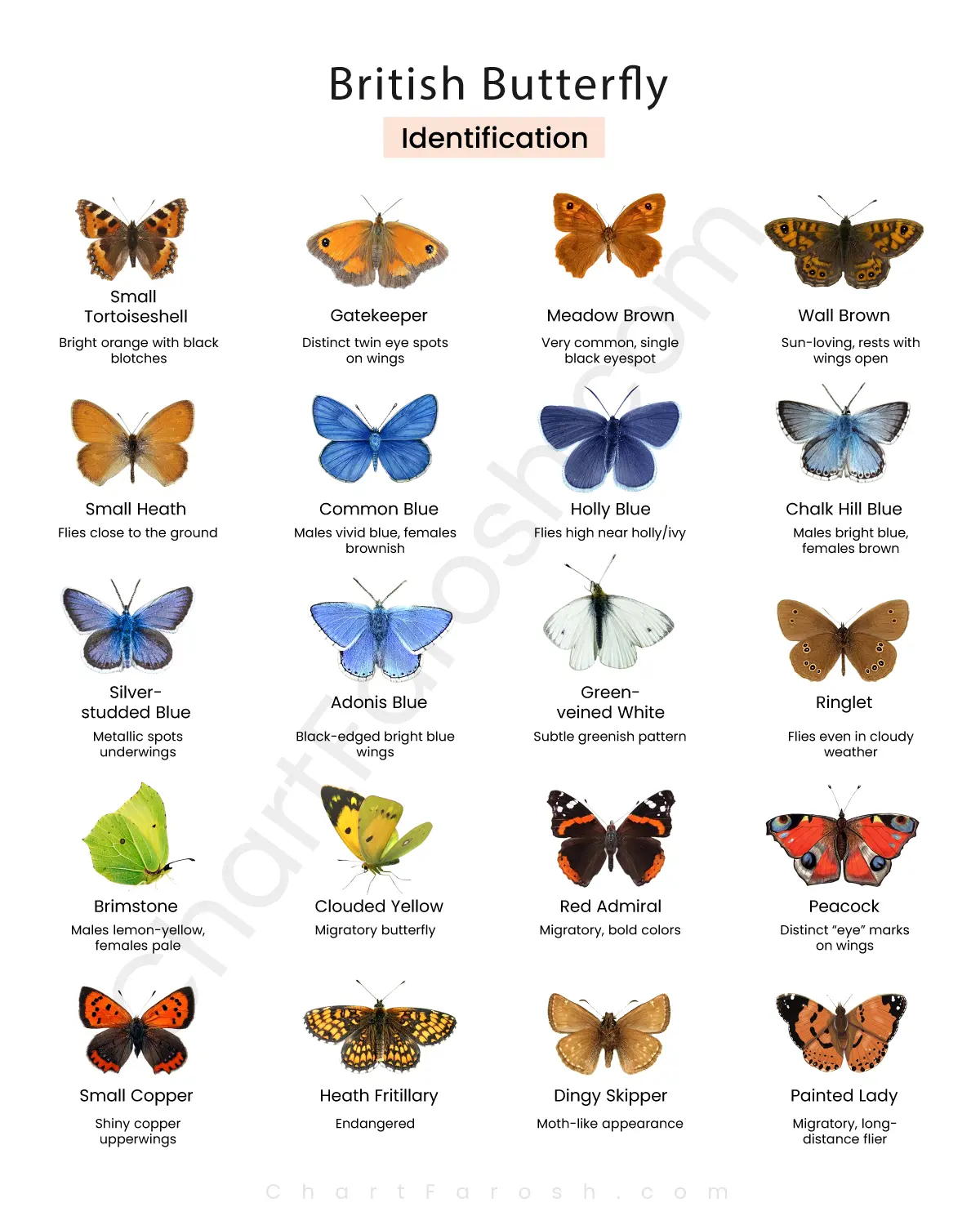
Table of Contents
British Butterfly Identification – Names and Pictures
Below is a quick look at some of the most commonly seen butterflies in Britain, with visual clues to help you tell them apart. These species vary in color, size, and habitat preference, but all are native or regularly seen across the UK.
| Butterfly Name | Wing Color | Common Habitat | Flight Period | Notable Features |
| Small Tortoiseshell | Orange, Black, Yellow | Gardens, hedgerows | March–October | Distinctive orange wings with dark spots |
| Red Admiral | Red, Black, White | Woodlands, gardens | April–October | Bold red bands on black wings |
| Peacock | Red, Brown, Purple | Parks, meadows | March–September | Eye-spots on wings resemble peacock feathers |
| Common Blue | Blue, Brown (female) | Grasslands | May–September | Bright blue males, subtle females |
| Large White | White, Black tips | Fields, gardens | April–September | Often called the “cabbage white” |
How to Identify Butterflies in the UK
Identifying butterflies in the UK can be both easy and deeply rewarding once you learn what to look for. Start by noting wing color and shape, which are often the quickest visual identifiers.
Many British butterflies display consistent patterns, such as eye-spots (Peacock, Comma) or borders (Marbled White).
Next, pay attention to flight behavior. Some species, like the Brimstone, glide gracefully, while others, like the Small Copper, have quick, darting movements.
Habitat also provides strong clues: Chalkhill Blues prefer open downlands, while Speckled Woods favor shaded woodland paths.
Seasonal timing helps, too. Early spring often brings the first sightings of Brimstone and Orange-tip, while late summer showcases Painted Ladies migrating from Europe.
A British butterfly identification chart pdf can be a valuable tool here, it allows you to cross-reference colors, wing shapes, and habitats quickly when out in the field.
The more you observe, the easier it becomes to distinguish even subtle variations, like the difference between a Gatekeeper and a Meadow Brown. Over time, you’ll find yourself spotting these delicate creatures almost instinctively.
Orange and Brown Butterflies in Britain
Britain is home to several beautiful orange and brown butterflies. These species are often seen in meadows, woodlands, and gardens during the warmer months. Their earthy tones help them blend into dried grass and tree bark, making them masters of camouflage.
| Common Name | Color | Wingspan (cm) | Habitat | Key Features |
| Small Tortoiseshell | Orange & black with blue edges | 4.5–6.2 | Gardens, meadows | Bright orange with black blotches |
| Gatekeeper | Orange-brown with eye spots | 4–5 | Hedgerows, meadows | Distinct twin eye spots on wings |
| Meadow Brown | Brown with orange patch | 4–5 | Grasslands | Very common, single black eyespot |
| Wall Brown | Orange-brown with dark markings | 4.5–5 | Cliffs, walls | Sun-loving, rests with wings open |
| Comma | Orange with black spots, scalloped edges | 4.5–5 | Woodland edges | Ragged wing shape |
| Small Heath | Light brown-orange | 3–4 | Grasslands | Flies close to the ground |
Blue Butterflies Found in the UK
Blue butterflies are among the most captivating species in Britain. They prefer open grasslands and sunny meadows, where they glide close to the ground. Male blues often have brighter hues, while females appear more muted.
| Common Name | Color | Wingspan (cm) | Habitat | Key Features |
| Common Blue | Bright blue | 3–4 | Meadows, grasslands | Males vivid blue, females brownish |
| Holly Blue | Pale silvery blue | 3–4 | Gardens, parks | Flies high near holly/ivy |
| Chalk Hill Blue | Sky blue | 4–5 | Chalk grasslands | Males bright blue, females brown |
| Adonis Blue | Deep turquoise | 4–5 | Limestone hills | Black-edged bright blue wings |
| Silver-studded Blue | Blue with silver spots | 3–4 | Heathlands | Metallic spots underwings |
| Large Blue | Dusky blue | 4–5 | Grasslands | Rare, reintroduced species |
White and Yellow Butterflies to Spot in Gardens
White and yellow butterflies are some of the first species to appear in spring, signaling warmer days ahead. They’re commonly seen around cabbages, daisies, and hedgerows.
These butterflies include several familiar names like the Large White, Small White, and Brimstone.
| Common Name | Color | Wingspan (cm) | Habitat | Key Features |
| Small White | White with black tips | 4–5 | Gardens, fields | “Cabbage white” – very common |
| Large White | White with dark tips | 5–6.5 | Farmlands, gardens | Larger than Small White |
| Green-veined White | White with green veins | 4–5 | Meadows, hedgerows | Subtle greenish pattern |
| Brimstone | Yellow-green | 6–7 | Woodland edges | Males lemon-yellow, females pale |
| Clouded Yellow | Bright yellow-orange | 5–6 | Fields, coasts | Migratory butterfly |
Red and Black Butterflies in the UK
Red and black butterflies, such as the Red Admiral and Peacock, are bold, beautiful, and instantly recognizable. Their strong color contrast and striking wing patterns make them favorites for photographers and garden watchers alike.
| Common Name | Color | Wingspan (cm) | Habitat | Key Features |
| Red Admiral | Red bands on black wings | 6–7 | Gardens, woodlands | Migratory, bold colors |
| Peacock | Red-brown with eye spots | 6–7 | Gardens, parks | Distinct “eye” marks on wings |
| Painted Lady | Orange and black pattern | 5–7 | Meadows, coasts | Migratory, long-distance flier |
| Small Copper | Copper-orange | 3–4 | Heaths, grasslands | Shiny copper upperwings |
| Dark Green Fritillary | Orange-brown | 6–7 | Grasslands | Green-tinted underwings |
Black Butterfly Identification Chart
While completely black butterflies are rare in the UK, several dark-winged species have near-black tones with blue or red highlights. The Ringlet and the Scotch Argus are good examples, thriving in shaded woodlands and cooler regions.
| Common Name | Color & Markings | Wingspan (cm) | Habitat | Key Features |
| Black Hairstreak | Dark brown-black with orange border | 3–4 | Woodland edges | Rare, orange crescent marks |
| Dingy Skipper | Grey-brown, smoky black tint | 3–3.5 | Grasslands, chalk hills | Moth-like appearance |
| Small Blue | Dark bluish-black (males), brownish (females) | 2–3 | Chalk grasslands | UK’s smallest butterfly |
| Ringlet | Blackish-brown with small eyespots | 4–5 | Meadows, shady areas | Flies even in cloudy weather |
| Scotch Argus | Dark brown-black with orange-ringed eyespots | 4–5 | Northern moorlands | Prefers cooler regions |
| Grayling | Grey-black mottled wings | 5–6 | Coastal dunes, heathlands | Excellent camouflage on rocks |
🇬🇧 British Butterfly Identification Chart UK
Britain’s climate supports over 60 butterfly species, ranging from common garden visitors to rare regional types like the Large Blue. Regional butterfly charts often help enthusiasts spot which species are most active in their specific counties.
| Common Name | Color | Wingspan (cm) | Habitat | Season Seen |
| Red Admiral | Black with red bands | 6–7 | Gardens, woodlands | May–October |
| Peacock | Red-brown with eye spots | 6–7 | Gardens, meadows | March–September |
| Small Tortoiseshell | Orange and black | 5–6 | Gardens, hedgerows | March–October |
| Large White | White with black tips | 5–6.5 | Gardens, farmland | April–September |
| Small White | White with light tips | 4–5 | Fields, gardens | April–October |
| Meadow Brown | Brown with orange patch | 4–5 | Grasslands | May–September |
| Gatekeeper | Orange-brown with eyespots | 4–5 | Hedgerows, meadows | June–August |
| Common Blue | Bright blue | 3–4 | Grasslands | May–September |
| Brimstone | Yellow-green | 6–7 | Woodland edges | March–October |
| Painted Lady | Orange and black | 5–7 | Gardens, coasts | May–September |
Small British Butterflies Identification
Small British butterflies are often the most active and hardest to spot due to their quick, darting flight and ability to camouflage among wildflowers and grasses.
These tiny species, such as the Small Blue, Small Copper, and Common Blue, play a big role in Britain’s natural ecosystems despite their size. Their wings are often less than 3 cm across, but their patterns and colors are striking up close.
Learning to recognize these species can be a rewarding challenge for any butterfly enthusiast or wildlife photographer.
| Common Name | Size | Color | Habitat | Distinguishing Features |
| Small Blue | Tiny (2–3 cm) | Greyish-blue | Chalk grasslands | Smallest UK butterfly |
| Small Heath | 3–4 cm | Brown-orange | Grasslands | Flies low, eyespot on wing |
| Small Copper | 3–4 cm | Bright copper-orange | Heaths, meadows | Shiny upper wings |
| Brown Argus | 3–4 cm | Brown with orange border | Grasslands | Underside has two white spots |
| Common Blue | 3–4 cm | Bright blue (male), brown (female) | Fields, gardens | Widespread and active flyer |
| Small Skipper | 3–4 cm | Golden orange-brown | Meadows | Fast, darting flight pattern |
Common British Butterflies Identification
From the cheerful Meadow Brown to the striking Red Admiral, common British butterflies are familiar sights in gardens, parks, and countryside walks.
These species are well-adapted to various environments and can often be found basking in the sun on wildflowers or hedgerows. Recognizing these butterflies by color, size, and season helps beginners start their journey into identification and conservation.
| Common Name | Color | Wingspan (cm) | Habitat | Season Seen |
| Red Admiral | Black with red bands | 6–7 | Gardens, woodlands | May–October |
| Peacock | Red-brown with eye spots | 6–7 | Gardens, meadows | March–September |
| Small Tortoiseshell | Orange and black | 5–6 | Gardens, hedgerows | March–October |
| Large White | White with black tips | 5–6.5 | Gardens, farmland | April–September |
| Small White | White with light tips | 4–5 | Fields, gardens | April–October |
| Meadow Brown | Brown with orange patch | 4–5 | Grasslands | May–September |
| Gatekeeper | Orange-brown with eyespots | 4–5 | Hedgerows, meadows | June–August |
| Common Blue | Bright blue | 3–4 | Grasslands | May–September |
| Brimstone | Yellow-green | 6–7 | Woodland edges | March–October |
| Painted Lady | Orange and black | 5–7 | Gardens, coasts | May–September |
Rare and Endangered British Butterflies
Sadly, several British butterfly species have become rare or endangered due to habitat loss, pollution, and climate change.
The Large Blue, once extinct in Britain but now successfully reintroduced, is one of the most famous examples. Other threatened species, like the Heath Fritillary and the Duke of Burgundy, require very specific conditions to survive.
Conservation projects across the UK continue to protect these delicate insects and their unique habitats.
| Common Name | Color | Wingspan (cm) | Habitat | Conservation Status |
| Heath Fritillary | Orange-brown | 4–5 | Woodland clearings | Endangered |
| Large Blue | Dusky blue | 4–5 | Grasslands | Critically endangered, reintroduced |
| Duke of Burgundy | Orange-brown | 3–4 | Scrub, grasslands | Vulnerable |
| Pearl-bordered Fritillary | Orange with black spots | 4–5 | Woodland edges | Near threatened |
| Wood White | Pale white | 4–5 | Woodland rides | Rare, limited range |
| Lulworth Skipper | Brown-gold | 3–4 | Coastal grasslands | Rare, found in Dorset |
Butterfly Identification Features and Wing Patterns
Butterflies can be identified using several visual features, but their wing patterns and colors are the most important. Each species has a distinct combination of spots, lines, and color gradients that make it unique. For instance:
Eye spots are circular markings that deter predators.
Bands and borders help distinguish species such as the Red Admiral or Speckled Wood.
Underwing patterns are often more muted, allowing butterflies to blend into their surroundings.
Butterfly Habitats and Flight Seasons in the UK
Each butterfly species in Britain prefers a specific type of habitat, which is a key clue in identification.
- Grassland and meadows
- Woodlands and shaded areas
- Gardens and hedgerows
- Wetlands and marshes
The flight season, when butterflies are most active, varies by species and region. Many appear between May and September, with some like the Brimstone emerging as early as March.
Tips for Watching and Photographing Butterflies
Observing and photographing butterflies is one of the most peaceful and rewarding outdoor hobbies. To make the most of your butterfly-watching experience, consider these expert tips:
- Go out during warm, sunny mornings.
- Move slowly and avoid sudden motions.
- Wear neutral-colored clothing.
- Use a macro lens or phone zoom.
- Photograph from multiple angles.
- Record date, time, and location.
- Bring a field guide or a printed chart.
FAQs
What time of year can I see the most butterflies in the UK?
The best months are from May to September, when temperatures are warm and wildflowers are abundant.
Which butterfly species are native to Britain?
There are over 60 native species, including the Small Tortoiseshell, Peacock, and Common Blue.
How can I tell if a butterfly is rare or common?
Use a British butterfly identification chart or an app, rare species often have specific regional ranges or unique markings.
What do butterflies eat?
Adult butterflies feed on nectar from flowers, while caterpillars (larvae) eat host plants like nettles, cabbage, or grasses.
Where is the best place to see butterflies in Britain?
Nature reserves, wildflower meadows, and National Trust gardens are great spots to observe multiple species.