British Butterflies Chart
When I was a child, I used to spend entire summer afternoons in my grandmother’s garden, chasing the colorful wings that fluttered among her lavender bushes.
I remember sitting still for what felt like hours, hoping one of those butterflies would land on my hand. Decades later, that same fascination has turned into a quiet hobby, spotting and identifying different butterfly species across the UK.
Every season brings something new: a bright blue shimmer in the hedgerows, a rusty orange glide across a meadow, or a soft white flit among wildflowers. This British butterflies chart is a perfect companion for anyone who’s ever paused to admire those fleeting moments.
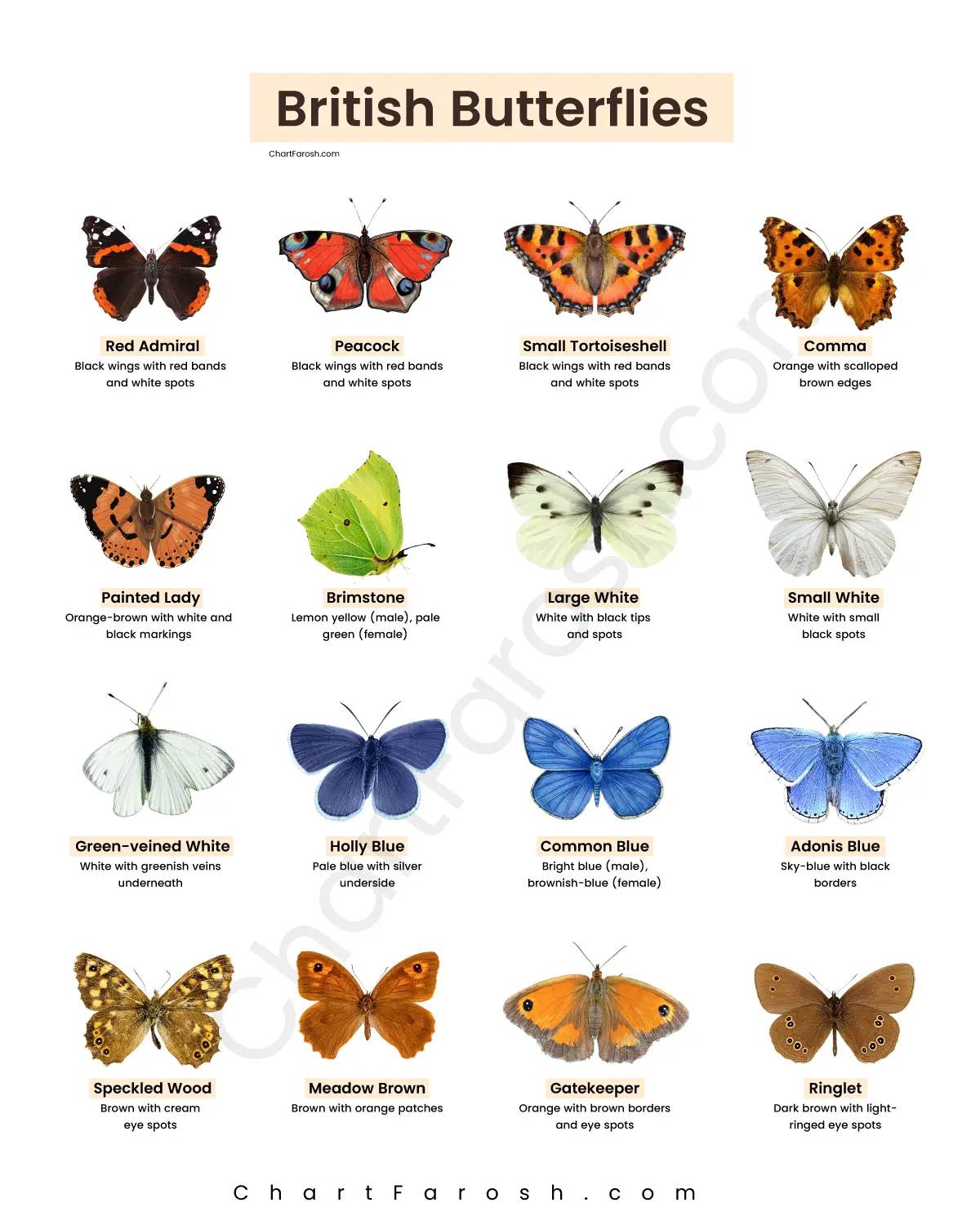
Table of Contents
British Butterflies Chart with Pictures
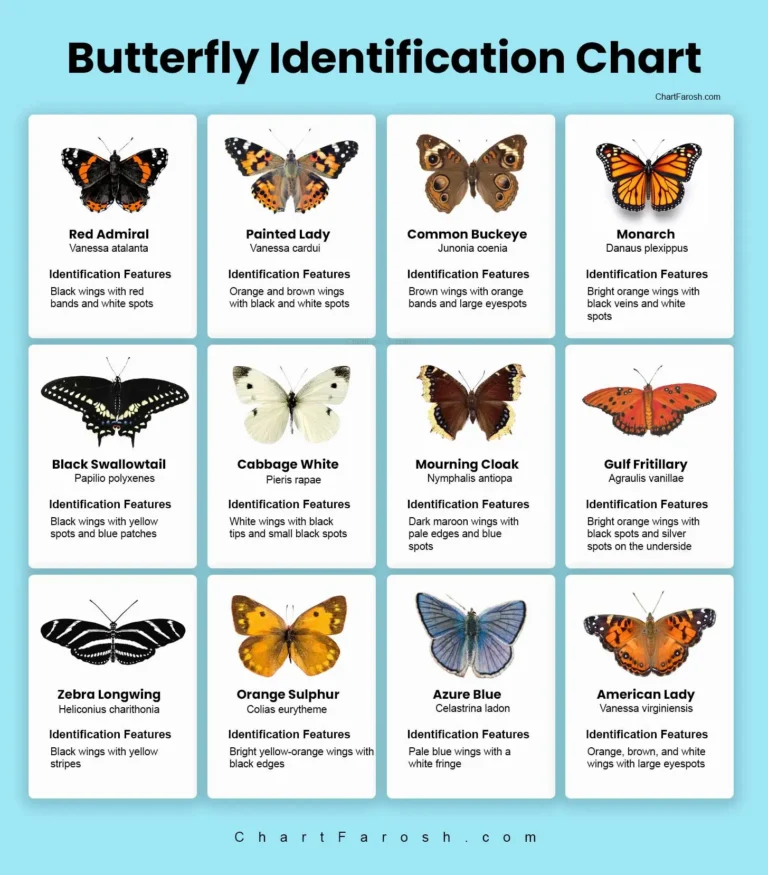
A British butterflies list with pictures gives you a visual overview of the most common and rare species in the UK. Each butterfly is shown alongside its name, size, and preferred habitat, making it easier to identify them during your walks.
From vibrant blues and soft yellows to deep reds and patterned browns, these charts capture the diversity of British butterflies across seasons and regions.
Adding such charts to your birdwatching or garden journals can also help you track migration periods and population changes over the years, a great way to connect with local wildlife while contributing to conservation awareness.
| Common Name | Scientific Name | Color / Pattern | Wingspan | Habitat | Flight Period |
| Red Admiral | Vanessa atalanta | Black wings with red bands and white spots | 6–7 cm / 2.4–2.8 in | Gardens, woodlands | March – October |
| Peacock | Aglais io | Reddish-brown with large eye spots | 6–7 cm / 2.4–2.8 in | Gardens, parks, hedgerows | March – September |
| Small Tortoiseshell | Aglais urticae | Orange with black and yellow patches | 4.5–6.2 cm / 1.8–2.4 in | Gardens, meadows | March – October |
| Comma | Polygonia c-album | Orange with scalloped brown edges | 4.5–6.4 cm / 1.8–2.5 in | Woodland edges, gardens | March – September |
| Painted Lady | Vanessa cardui | Orange-brown with white and black markings | 5–9 cm / 2–3.5 in | Open fields, gardens | May – October |
| Brimstone | Gonepteryx rhamni | Lemon yellow (male), pale green (female) | 6–7 cm / 2.4–2.8 in | Woodlands, gardens | February – October |
| Large White | Pieris brassicae | White with black tips and spots | 5–6.5 cm / 2–2.6 in | Gardens, fields | April – September |
| Small White | Pieris rapae | White with small black spots | 4–5.5 cm / 1.6–2.2 in | Gardens, hedgerows | March – October |
| Green-veined White | Pieris napi | White with greenish veins underneath | 4–5 cm / 1.6–2 in | Damp meadows, hedgerows | April – September |
| Holly Blue | Celastrina argiolus | Pale blue with silver underside | 2.5–3.5 cm / 1–1.4 in | Gardens, parks | April – September |
| Common Blue | Polyommatus icarus | Bright blue (male), brownish-blue (female) | 2.8–3.6 cm / 1.1–1.4 in | Grasslands, meadows | May – September |
| Adonis Blue | Lysandra bellargus | Sky-blue with black borders | 3–4 cm / 1.2–1.6 in | Chalk grasslands | May – September |
| Speckled Wood | Pararge aegeria | Brown with cream eye spots | 4–4.8 cm / 1.6–1.9 in | Woodlands, shady areas | March – October |
| Meadow Brown | Maniola jurtina | Brown with orange patches | 5–5.5 cm / 2–2.2 in | Meadows, grasslands | May – October |
| Gatekeeper | Pyronia tithonus | Orange with brown borders and eye spots | 4–5 cm / 1.6–2 in | Hedgerows, meadows | July – September |
| Ringlet | Aphantopus hyperantus | Dark brown with light-ringed eye spots | 4–5 cm / 1.6–2 in | Woodland edges, meadows | June – August |
| Marbled White | Melanargia galathea | Black and white checker pattern | 5–6 cm / 2–2.4 in | Grasslands, meadows | June – August |
| Small Copper | Lycaena phlaeas | Bright orange with black spots | 2.5–3.5 cm / 1–1.4 in | Grasslands, wastelands | April – October |
| Orange-tip | Anthocharis cardamines | White with orange tips (male) | 4–5 cm / 1.6–2 in | Meadows, hedgerows | April – July |
| Clouded Yellow | Colias croceus | Golden yellow with black borders | 5–6 cm / 2–2.4 in | Fields, coastal areas | May – October |
Types of Butterflies in the UK
When it comes to variety, the UK hosts around 59 native species of butterflies, each with its own unique appearance, flight pattern, and habitat.
Interestingly, some of the easiest to spot share spaces with dragonfly species near ponds and meadows, two types of insects that often thrive in similar warm, open environments.
| Butterfly Name | Color | Wingspan | Habitat | Best Months | Distinct Feature |
| Peacock | Red, brown, eyespots | 63–75 mm | Gardens, fields | Mar–Sep | Eye-like wing spots |
| Small Tortoiseshell | Orange, black | 45–62 mm | Gardens, hedgerows | Apr–Sep | Bright orange with dark borders |
| Comma | Orange, brown | 45–55 mm | Woodland edges | Mar–Oct | Ragged wing edges |
| Meadow Brown | Brown, orange patches | 50–55 mm | Meadows, grasslands | Jun–Sep | Dark wings with orange eyespots |
| Painted Lady | Orange, black, white | 50–60 mm | Open countryside | May–Oct | Migratory butterfly |
| Red Admiral | Red, black | 60–72 mm | Gardens, woods | Apr–Oct | Bold red bands across wings |
Orange and Brown Butterflies in the UK
The warm-toned orange and brown butterflies are some of the most common species in the British Isles. They blend beautifully into the countryside’s autumn palette, often found basking in sunlight or drifting over tall grasses.
| Species | Color Shade | Wingspan | Habitat | Flight Season | Distinctive Markings |
| Gatekeeper | Orange, brown | 35–40 mm | Hedges, meadows | Jul–Sep | Two white eye spots |
| Wall Brown | Brown, orange | 42–53 mm | Rocky coastal areas | May–Oct | Mottled brown with orange centers |
| Small Heath | Light brown, beige | 33–38 mm | Dry grasslands | May–Sep | Subtle orange wash on wings |
| Brown Argus | Brown with blue tint | 29–35 mm | Chalk downs | May–Sep | Orange spots along edge |
| Small Copper | Copper orange | 26–36 mm | Fields, gardens | Apr–Oct | Metallic orange with black dots |
Blue Butterflies of Britain
The blue butterflies of Britain are a true delight for nature enthusiasts. Their shimmering wings catch the sunlight in a way that makes them look almost metallic.
From the Chalkhill Blue to the Common Blue, these butterflies are mostly seen in open fields, chalk grasslands, and meadows where their food plants, clovers, trefoils, and vetches, grow in abundance.
These delicate creatures are indicators of healthy ecosystems. If you spot one fluttering nearby, it often means the environment is thriving.
However, many blue species are sensitive to habitat changes, so sightings in urban gardens are rarer compared to rural fields. Taking note of these in your uk butterflies chart helps track shifts in populations and contributes to local conservation efforts.
White and Yellow Butterflies to Spot in Gardens
The most familiar garden visitors in the UK are the white and yellow butterflies, easily recognized for their bright, fluttery presence.
These include the Large White, Small White, and Brimstone butterflies, which are often seen feeding on cabbages, nasturtiums, and primroses.
Despite their simplicity, these butterflies play an essential role in pollination and plant health. If you have flowering herbs or vegetables in your garden, chances are you’ve already hosted one of these friendly fliers.
Red and Black Butterflies Seen in the UK
Red and black butterflies, like the Red Admiral or the Peacock, are strikingly beautiful and easy to spot. Their vivid markings make them one of the most recognizable butterfly groups in the country.
These butterflies are strong fliers and can even survive in cooler months by seeking sheltered overwintering spots.
They’re particularly attracted to nectar-rich flowers such as buddleia, thistles, and nettles. If you want to attract them to your garden, planting these species will help. Watching one of these butterflies spread its wings in the sunlight is an experience that never loses its charm – no matter how many times you’ve seen it.
Rare and Endangered British Butterflies
Britain’s butterflies are an important part of the country’s natural heritage, yet several species have become rare or endangered due to habitat loss, changing climates, and pesticide use.
| Butterfly Name | Coloration | Habitat | Rarity Status | Main Threat | Regions Found |
| Large Blue | Silver-blue with black spots | Limestone grasslands | Critically Endangered | Habitat loss | Somerset, Gloucestershire |
| Heath Fritillary | Orange-brown patterned | Heathlands, coppices | Endangered | Deforestation | Kent, Devon |
| Duke of Burgundy | Orange and brown | Chalk downlands | Vulnerable | Climate change | Midlands, North Yorkshire |
| High Brown Fritillary | Orange with black patterns | Woodland clearings | Endangered | Habitat degradation | Wales, NW England |
| Pearl-bordered Fritillary | Orange-brown with white spots | Moorlands | Near Threatened | Overgrazing | Scotland, Cornwall |
Common British Butterflies Chart
While some species are rare, many butterflies remain familiar sights across Britain’s countryside, gardens, and city parks.
These common British butterflies are the ones most nature lovers will encounter, particularly from spring through late summer. Their abundance makes them excellent starter species for beginners learning to identify butterflies by color and wing shape.
| Butterfly Name | Dominant Color | Wingspan | Habitat | Best Season | Distinctive Feature |
| Small White | White with grey tips | 40–50 mm | Gardens, meadows | Apr–Oct | “Cabbage white” species |
| Peacock | Red-brown with eye spots | 63–75 mm | Fields, woodlands | Mar–Sep | Bright eyespots on wings |
| Meadow Brown | Brown and orange | 50–55 mm | Grasslands | Jun–Sep | Subtle eyespots |
| Small Tortoiseshell | Orange and black | 45–62 mm | Gardens | Apr–Sep | Deep orange tones |
| Red Admiral | Black with red bands | 60–72 mm | Urban areas | Apr–Oct | Migratory butterfly |
Small British Butterflies
Small British butterflies are often overlooked due to their size, yet many of them are among the most colorful and delicate species in the UK.
Found in grassy fields, moorlands, and coastal paths, these little insects reveal fascinating wing textures and iridescent hues when observed closely. Identifying them can be challenging, but their subtle differences are rewarding for enthusiasts.
| Butterfly Name | Size (Wingspan) | Main Color | Habitat | Flight Period | Notable Feature |
| Small Blue | 18–27 mm | Dusky blue | Chalk downs | May–Jul | UK’s smallest butterfly |
| Common Blue | 29–36 mm | Bright blue | Meadows | May–Sep | Widespread and vibrant |
| Small Copper | 26–36 mm | Orange and brown | Heathlands | Apr–Oct | Metallic orange color |
| Brown Argus | 29–35 mm | Brown with orange spots | Grasslands | May–Sep | Similar to female Common Blue |
| Small Heath | 33–38 mm | Light brown | Grasslands | May–Sep | Flies close to the ground |
Butterfly Identification Features and Wing Patterns
Identifying butterflies relies on observing key physical features such as wing patterns, coloration, and flight behavior.
The wings are often the most telling aspect, each species has a unique combination of veins, scales, and color patches. For instance, the Peacock’s vivid eyespots serve as a predator deterrent, while the Comma’s jagged edges help it camouflage among leaves.
Butterflies also display sexual dimorphism, meaning males and females of the same species can look different. Males may be brighter to attract mates, while females tend to have subtler tones for camouflage during egg-laying.
Observing how the butterfly moves can also offer clues, some species glide gracefully, while others dart quickly from flower to flower.
Butterfly Habitats Across the United Kingdom
The UK’s diverse landscapes, from chalk downs to Scottish moors, host an incredible range of butterfly habitats. Each species prefers specific conditions, usually determined by the availability of its larval food plants and shelter options.
Conservation of these habitats is crucial, as even small changes in vegetation or temperature can impact butterfly populations.
| Habitat Type | Common Species | Region | Vegetation Type | Key Season | Conservation Status |
| Woodland Clearings | Speckled Wood, Comma | England, Wales | Deciduous trees, shrubs | Apr–Oct | Stable |
| Chalk Grasslands | Common Blue, Small Blue | South England | Wildflowers, low grass | May–Sep | Declining |
| Heathlands | Small Copper, Green Hairstreak | South, East England | Heather, gorse | May–Sep | Threatened |
| Coastal Cliffs | Wall Brown, Grayling | Coastal regions | Salt-tolerant plants | Jun–Sep | Declining |
| Meadows and Gardens | Peacock, Tortoiseshell | Nationwide | Wildflowers, nettles | Apr–Oct | Common |
Seasonal Butterfly Activity and When to Spot Them
Butterfly activity in the UK changes dramatically with the seasons. Spring marks the first emergence, as species like the Brimstone and Small Tortoiseshell awaken from hibernation.
Summer brings the greatest variety, with blues, whites, and browns fluttering across fields and gardens. In autumn, you’ll often see migratory species such as the Red Admiral feeding before their long journeys.
- Spring: Early species emerge from hibernation.
- Summer: Peak activity with widespread diversity.
- Autumn: Late migrants feeding before winter.
- Winter: Mostly inactive
FAQs
Do butterflies hibernate in the UK?
Yes, several species such as the Small Tortoiseshell and Peacock butterflies hibernate during winter in sheltered spots like sheds or tree hollows.
What is the rarest butterfly in Britain?
The Large Blue butterfly is considered Britain’s rarest species, having once gone extinct in the UK before being successfully reintroduced through conservation programs.
How can I attract more butterflies to my garden?
Plant nectar-rich flowers like buddleia, lavender, and marjoram, and avoid pesticides. Providing shelter and host plants helps breeding too.
When is the best time to spot butterflies in the UK?
Between May and August, when temperatures are warmest and most species are active.
Are butterflies affected by climate change?
Yes, changing temperatures and altered rainfall patterns are shifting the ranges and flight periods of several species across the UK.