Macaw Lifespan Chart
A few years ago I met a blue-and-yellow macaw named Tango at a friend’s house. Tango was 38. My friend’s father had bought him as a young bird, and three generations of the family had grown up around that parrot.
That stopped me. I once had a dog who lived 13 years and a cat who reached 17. A pet bird outliving its first owner felt like something else entirely.
So I started reading about macaw lifespan. The numbers surprised me. A well-kept macaw can pass 50 years. Some reach 70 or 80. The giant hyacinth macaw is the headline case and can outlive the person who raised it.
Wild macaws have it harder. Most live around 30 to 35 years in the forest. Predators and disease take a toll, and lean food years cut their time short.
Below is a clear macaw lifespan chart for 14 species. Average years, maximum years, and size from mini to giant. You will also find wild versus captive numbers, the life stages a macaw moves through, and the things that keep these birds alive longer.
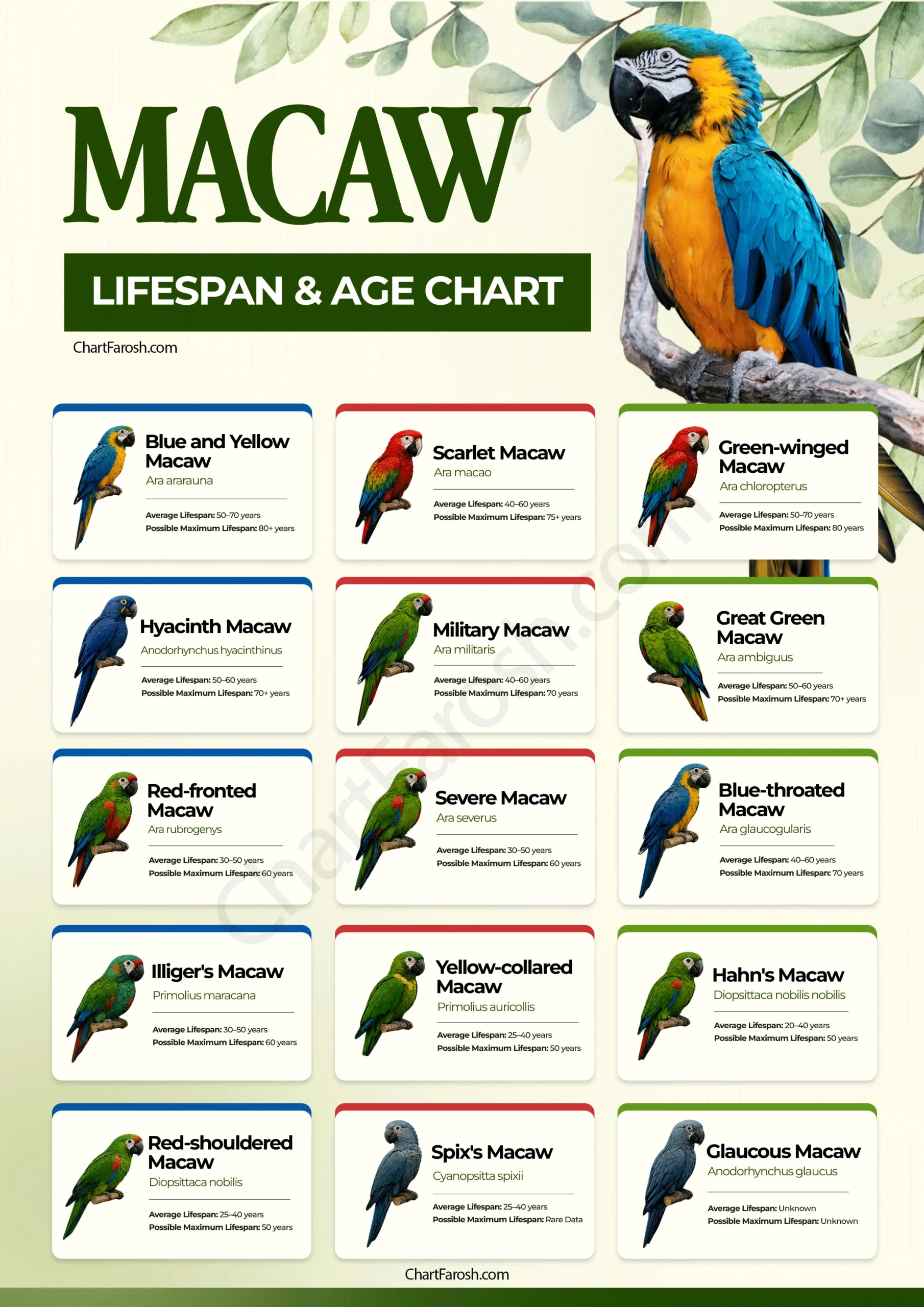
Table of Contents
Macaw Lifespan Chart (All Species)
Here is the full macaw lifespan chart. The average and maximum columns reflect birds in good care, usually in captivity. Scientific names are in italics. Wild numbers run lower, which the next section breaks down.
| Macaw Species | Scientific Name | Average Lifespan | Maximum Lifespan | Size Category |
| Blue-and-yellow Macaw | Ara ararauna | 50–70 years | 80+ years | Large |
| Scarlet Macaw | Ara macao | 40–60 years | 75+ years | Large |
| Green-winged Macaw | Ara chloropterus | 50–70 years | 80 years | Large |
| Hyacinth Macaw | Anodorhynchus hyacinthinus | 50–60 years | 70+ years | Giant |
| Military Macaw | Ara militaris | 40–60 years | 70 years | Large |
| Great Green Macaw | Ara ambiguus | 50–60 years | 70+ years | Large |
| Blue-throated Macaw | Ara glaucogularis | 40–60 years | 70 years | Large |
| Red-fronted Macaw | Ara rubrogenys | 30–50 years | 60 years | Medium |
| Severe Macaw | Ara severus | 30–50 years | 60 years | Medium |
| Blue-winged (Illiger’s) Macaw | Primolius maracana | 30–50 years | 60 years | Mini |
| Yellow-collared Macaw | Primolius auricollis | 25–40 years | 50 years | Mini |
| Red-shouldered (Hahn’s) Macaw | Diopsittaca nobilis | 25–40 years | 50 years | Mini |
| Spix’s Macaw | Cyanopsitta spixii | est. 25–40 years | Limited data | Small/Medium |
| Glaucous Macaw | Anodorhynchus glaucus | Unknown | Unknown | Large |
A pattern jumps out. Bigger macaws live longer. The giant hyacinth and the large Ara species clear 50 years with ease. Mini macaws like the red-shouldered top out closer to 50. Size and lifespan track together across the family.
Wild vs Captivity: Where Macaws Live Longer
Macaws almost always live longer in captivity than in the wild. A safe cage means no hawks, no snakes, and no hungry season. Vet care and a steady diet do the rest.
The gap is large. A blue-and-yellow macaw averages about 30 to 35 years in the forest. The same bird can reach 50 to 60 years in a good home.
| Macaw Species | Average in the Wild | Average in Captivity |
| Blue-and-yellow Macaw | 30–35 years | 50–60 years |
| Scarlet Macaw | about 40 years | up to 75 years |
| Hyacinth Macaw | about 50 years | 60+ years |
| Green-winged Macaw | 30–50 years | 50–60 years |
| Military Macaw | not well recorded | 55–70 years |
| Red-shouldered (Hahn’s) Macaw | about 30 years | up to 50 years |
So the long lives you read about belong to pet and zoo birds. Wild macaws rarely get there. Both numbers are real. They just describe two different lives.
Large and Giant Macaw Lifespans
The large macaws are the long-lived ones. The hyacinth macaw stands alone in the giant class. It can live 50 to 60 years on average and pass 70 with strong care. It is the largest flying parrot in the world.
The blue-and-yellow and green-winged macaws follow close behind. Both average 50 to 70 years and have records near 80. The scarlet macaw averages 40 to 60 years, with some birds reaching 75.
The blue-throated and great green macaws sit in the same range, roughly 40 to 60 years. Both are among the most threatened macaws in the wild. You can check their current status on the IUCN Red List.
Mini and Medium Macaw Lifespans
Smaller macaws live shorter lives, though still long for a pet bird. The red-shouldered macaw, sold in the pet trade as the Hahn’s macaw, is the smallest of all. It runs about 25 to 40 years, with some reaching 50.
The yellow-collared and blue-winged macaws sit in the same band. Medium birds like the red-fronted and severe macaws push higher, around 30 to 50 years, with a ceiling near 60.
These mini macaws are popular first parrots. They take up less space than a hyacinth. Even so, a 40-year commitment is a long one. For more on parrot types and care, see our in the Animals Chart collection.
Spix’s and Glaucous Macaw: The Rarest Birds
Two macaws on the chart barely exist in the wild. The Spix’s macaw, the little blue parrot from the film Rio, was declared Extinct in the Wild in 2019. A breeding program released the first birds back into Brazil in 2022. Lifespan data is thin, with estimates around 25 to 40 years.
The glaucous macaw is in worse shape. It is Critically Endangered and likely extinct, with no confirmed wild bird in over a century. Its lifespan was never well recorded, so the chart lists it as unknown.
Macaw Age and Life Stages
A macaw’s age tells you a lot about how to care for it. The bird moves through clear stages, from a bare chick to a slow senior. Here is how a macaw’s age breaks down.
| Life Stage | Age | What Happens |
| Chick | 0–3 months | Hatches blind and bare. Fully dependent on parents or a hand-feeder. |
| Fledgling | 3–6 months | Feathers grow in. The bird learns to fly and starts to feed itself. |
| Juvenile | 6 months–2 years | Weaned and independent. Not yet able to breed. |
| Young adult | 2–4 years | Reaches sexual maturity. Larger species can take 3 to 6 years. Pairs begin to form. |
| Adult | 4–30 years | The long prime stretch. The bird breeds and bonds with a mate. Life settles into a steady routine. |
| Senior | 30+ years | Slows down. Needs softer food and warmth, plus more frequent vet checks. |
Large macaws stay in their prime for decades. A 25-year-old hyacinth is middle aged, not old. Plan care around the stage, not just the calendar.
What Affects a Macaw’s Lifespan
Genetics set the ceiling. Care decides whether a macaw reaches it. Five factors do most of the work.
| Factor | Why It Matters |
| Diet | Feed mostly pellets, with fresh vegetables and some fruit. Keep seeds and nuts to about 10 percent. An all-seed diet shortens a macaw’s life. |
| Cage and flight space | A cramped bird gets stressed and unfit. Big cages and daily out-of-cage time matter for a long life. |
| Vet care | An avian vet catches problems early. Yearly checkups add years. |
| Mental stimulation | Macaws are smart and social. Boredom leads to feather plucking and stress, which cut life short. |
| Household toxins | Fumes from overheated nonstick pans can kill a bird fast. Avoid them, along with smoke and scented sprays. |
Get these right and a macaw can share most of your adult life. The World Parrot Trust has detailed diet and housing guides worth reading.
FAQs
How long do macaws live as pets?
Most pet macaws live 40 to 60 years with good care. Large species like the hyacinth and blue-and-yellow can pass 70. Buying a macaw is a lifelong commitment.
What is the longest-living macaw?
The hyacinth macaw and the large Ara species live longest. Records for blue-and-yellow and green-winged macaws reach about 80 years in captivity.
Do macaws live longer in the wild or in captivity?
In captivity. A safe home with vet care and a steady diet roughly doubles the wild lifespan for many species.
At what age is a macaw considered old?
Most macaws are seniors past 30. Because large species live so long, a 25-year-old bird is still middle aged.
Which macaw has the shortest lifespan?
The small macaws, such as the red-shouldered (Hahn’s) and yellow-collared, have the shortest lives. They average 25 to 40 years, which is still long for a pet.
Why do macaws live so long?
Large parrots have slow metabolisms, few natural predators as adults, and strong disease resistance. These traits add up to long lives, especially in safe captive settings.
How can I help my macaw live longer?
Feed a pellet-based diet, give plenty of flight space, book yearly avian vet visits, and keep the bird mentally busy. For more reference charts, browse the Animals Chart collection .