Cat Teeth Chart: Cat’s Dental Health From Kittenhood to Adulthood
I didn’t really think much about cat teeth until one day my cat stopped crunching her kibble and started pawing at her mouth like something was wrong.
A vet visit later, I realized how easy it is to overlook dental health in cats until it becomes a problem.
Cats are masters at hiding discomfort, and their teeth play a bigger role in their overall health than most owners realize.
I am going to tell you everything you need to know using a clear cat teeth chart, from how many teeth cats have to what each tooth actually does, how kittens’ teeth differ from adults, and what can go wrong if dental care is ignored.
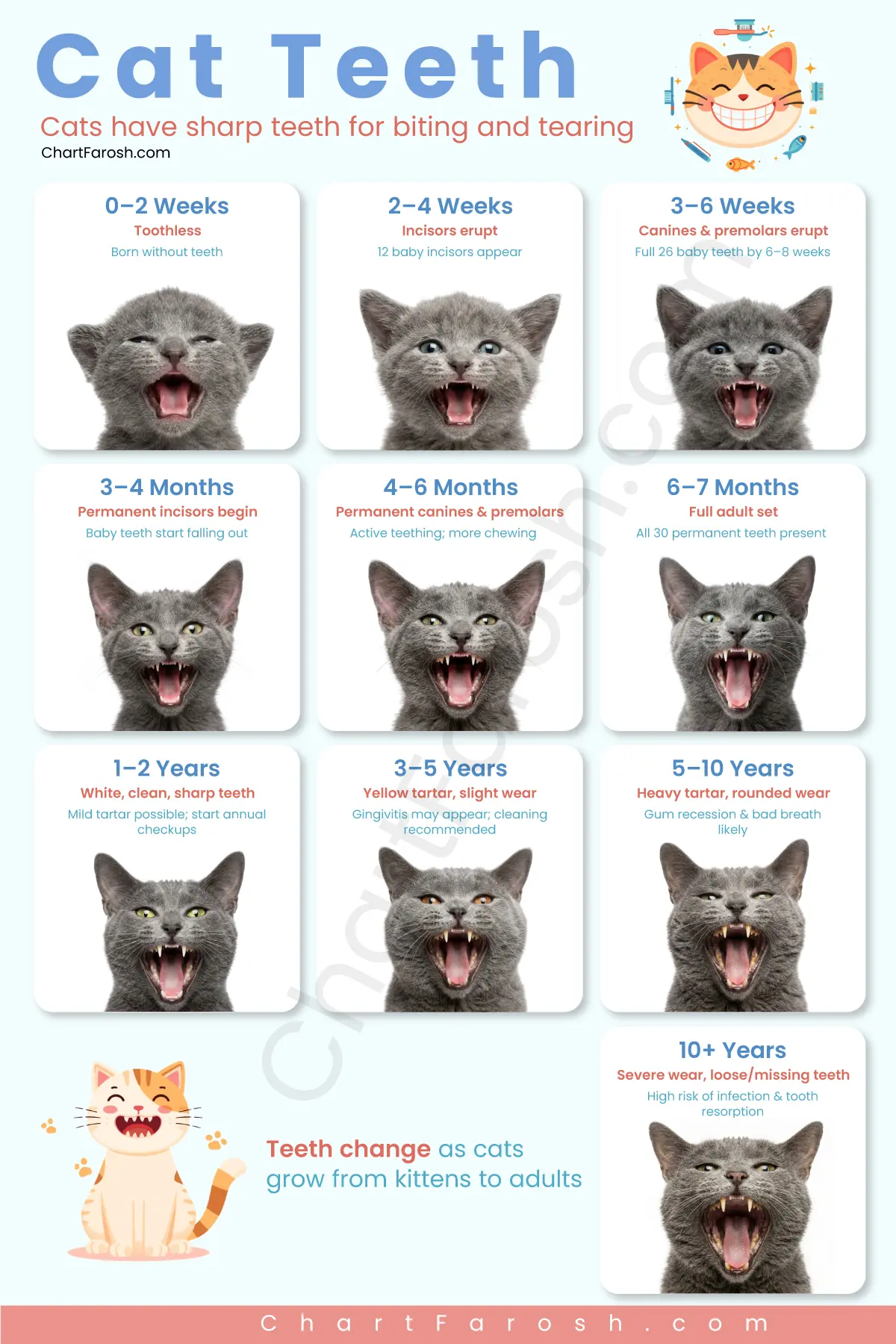
Table of Contents
How Many Teeth Do Cats Have?
Cats have two sets of teeth in their lifetime: baby teeth (also called deciduous teeth) and adult teet
Kittens start with a smaller number of temporary teeth, which are gradually replaced as they grow.
An adult cat typically has 30 teeth, while kittens have 26 baby teeth. Each tooth type has a specific role, and losing even one can affect eating, grooming, and behavior.
You can add your chart here to visually show the tooth count breakdown.
| Age Stage | Dental Features | Key Developmental Milestones & Care Notes |
| 0 – 2 Weeks | Toothless | Kittens are born without visible teeth. |
| 2 – 4 Weeks | Incisors Erupt | 12 tiny deciduous (baby) incisors (6 upper, 6 lower) appear first. |
| 3 – 6 Weeks | Canines & Premolars Erupt | Baby canines and premolars come in. Full set of 26 baby teeth is usually in place by 6-8 weeks. |
| 3 – 4 Months | Permanent Incisors Begin | Baby teeth start to fall out. Permanent incisors begin to erupt. |
| 4 – 6 Months | Permanent Canines & Premolars | Adult canines, premolars, and molars erupt. Teething is active; kittens may chew more. |
| 6 – 7 Months | Full Adult Set | All 30 permanent teeth should be present: 12 incisors, 4 canines, 10 premolars, 4 molars. |
| 1 – 2 Years (Young Adult) | Teeth are white, clean, sharp. May show mild tartar on back teeth. | No gum recession. Teeth should be pristine with regular care. Start annual dental checkups. |
| 3 – 5 Years (Adult) | Visible yellow tartar buildup, especially on molars. Slight wear on incisors. | Some gingivitis (red gum line) may appear. Professional cleaning may be recommended. |
| 5 – 10 Years (Mature Adult) | Significant tartar, potential staining. Noticeable wear on chewing surfaces. Teeth may look more rounded. | Moderate periodontal disease is common. Gum recession and bad breath are likely without care. |
| 10+ Years (Senior) | Heavy tartar, severe wear, or missing teeth. Teeth may be loose. Roots may be exposed. | High risk of tooth resorption, infections, and advanced periodontal disease. Regular vet dental exams are critical. |
Cat Teeth Types and Functions
Each type of cat tooth is designed for a specific purpose, mainly related to hunting and tearing food rather than chewing.
| Tooth Type | Location | Number (Adult) | Shape | Primary Function | Eruption Age | Common Issues |
| Incisors | Front of mouth | 12 | Small, flat | Grooming, nibbling | 3–4 months | Plaque buildup |
| Canines | Corners | 4 | Long, pointed | Gripping prey | 4–5 months | Fractures |
| Premolars | Behind canines | 10 | Sharp-edged | Shearing food | 4–6 months | Tartar |
| Molars | Back | 4 | Flattened | Crushing meat | 5–6 months | Gum disease |
| Baby Incisors | Front (kittens) | 12 | Tiny | Early feeding | 2–3 weeks | Retention |
| Baby Canines | Corners (kittens) | 4 | Needle-like | Teething | 3–4 weeks | Misalignment |
| Baby Premolars | Rear (kittens) | 10 | Sharp | Learning to eat | 4–6 weeks | Crowding |
Kitten vs Adult Cat Teeth
Kittens’ teeth are temporary and much sharper than adult teeth, which is why kitten bites hurt more than expected.
| Feature | Kitten Teeth | Adult Teeth | Purpose | Timeline | Size | Durability | Care Needs |
| Total Teeth | 26 | 30 | Development | 0–6 months | Small | Fragile | Gentle |
| Incisors | Present | Replaced | Grooming | 2–4 months | Tiny | Weak | Monitor |
| Canines | Needle-sharp | Thick | Hunting | 4–6 months | Thin | Moderate | Watch chewing |
| Premolars | Present | Larger | Food tearing | 4–6 months | Small | Weak | Teething toys |
| Molars | Absent | Present | Grinding | 5–6 months | None | — | Adult care |
| Root Strength | Shallow | Deep | Stability | Gradual | Weak | Strong | Dental exams |
| Tooth Loss | Normal | Abnormal | Growth | 3–6 months | — | — | Vet if retained |
Cat Dental Formula Explained
A dental formula is a shorthand way vets describe the number and type of teeth cats have.
| Tooth Type | Upper Jaw | Lower Jaw | Kitten Count | Adult Count | Function | Symbol | Notes |
| Incisors | 3 | 3 | 6 | 12 | Grooming | I | Front teeth |
| Canines | 1 | 1 | 2 | 4 | Gripping | C | Long teeth |
| Premolars | 3 | 2 | 6 | 10 | Shearing | PM | Sharp edges |
| Molars | 1 | 1 | 0 | 4 | Crushing | M | Back teeth |
| Total | — | — | 26 | 30 | — | — | Adult formula |
| Formula | — | — | — | I3/3 C1/1 PM3/2 M1/1 | — | — | Standard |
| Variation | — | — | — | Rare | — | — | Breed related |
Cat Canine Teeth Purpose
Canine teeth are often the most noticeable and important teeth in a cat’s mouth.
| Aspect | Details | Upper Canines | Lower Canines | Growth Time | Strength | Risk Factors | Care Tips |
| Function | Gripping prey | Yes | Yes | 4–5 months | Very strong | Trauma | Avoid hard toys |
| Shape | Pointed | Long | Slightly shorter | — | Dense | Fracture | Vet checks |
| Root Length | Deep | Deep | Deep | — | Stable | Gum disease | Brushing |
| Visibility | High | High | Medium | — | — | Exposure | Regular checks |
| Sensitivity | Moderate | Moderate | Moderate | — | — | Infection | Dental exams |
| Replacement | Baby → Adult | Yes | Yes | 3–6 months | — | Retained teeth | Early removal |
| Role in Behavior | Defense | Major | Major | — | — | Stress biting | Training |
Cat Molars and Premolars
These teeth do most of the “work” when cats eat.
| Tooth | Location | Count | Shape | Function | Eruption Age | Common Problems | Care |
| Upper Premolars | Upper jaw | 6 | Sharp | Shearing | 4–6 months | Tartar | Brushing |
| Lower Premolars | Lower jaw | 4 | Sharp | Cutting | 4–6 months | Gingivitis | Dental chews |
| Upper Molars | Back | 2 | Flat | Crushing | 5–6 months | Plaque | Vet cleaning |
| Lower Molars | Back | 2 | Flat | Grinding | 5–6 months | Resorption | Monitoring |
| Bite Force | — | — | — | Meat processing | — | — | Proper diet |
| Wear Pattern | — | — | — | Natural | — | Excess wear | Avoid bones |
| Loss Impact | — | — | — | Eating difficulty | — | Weight loss | Early care |
Cat Teething Timeline
Teething can be uncomfortable and confusing for both cats and owners.
| Age | Teeth Stage | Teeth Present | Symptoms | Behavior Changes | Care Tips | Vet Needed | Notes |
| 2–3 weeks | Baby incisors | Few | Mild fuss | Nursing | Soft food | No | Normal |
| 3–4 weeks | Canines erupt | More | Chewing | Biting | Toys | No | Sharp |
| 5–6 weeks | Premolars | Most baby teeth | Drooling | Irritable | Wet food | No | Teething peak |
| 3–4 months | Tooth loss | Gaps | Bleeding | Pawing mouth | Monitor | Sometimes | Normal |
| 4–6 months | Adult teeth | Increasing | Sore gums | Reduced appetite | Gentle care | If pain | Transition |
| 6 months | Full adult set | 30 teeth | Settled | Normal | Start brushing | No | Complete |
| Delayed | Retained teeth | Extra | Pain | Aggression | Vet removal | Yes | Common issue |
Common Cat Dental Problems
Dental disease is one of the most common health issues in cats, especially as they age.
Plaque buildup can quickly harden into tartar, leading to gingivitis and painful infections.
Tooth resorption, where the tooth slowly breaks down, is especially common in cats and often goes unnoticed without dental X-rays.
Bad breath, drooling, pawing at the mouth, and changes in eating habits are all red flags.
Regular brushing, dental-friendly food, and routine vet cleanings can prevent most serious problems.
Cat Gum Health Stages
Healthy gums are just as important as healthy teeth, but they’re often overlooked. A cat’s gums can reveal early signs of dental disease long before serious pain or tooth loss occurs.
Understanding the different stages of gum health makes it easier to catch problems early and take action before they worsen.
| Stage | Appearance | Symptoms | Pain Level | Tooth Impact | Treatment | Prevention | Severity |
| Healthy | Pink | None | None | Stable | None | Brushing | Low |
| Mild Gingivitis | Red | Bad breath | Mild | Minor | Cleaning | Dental diet | Low |
| Moderate | Swollen | Bleeding | Moderate | Loose teeth | Vet care | Exams | Medium |
| Severe | Dark red | Pain | High | Tooth loss | Surgery | Early care | High |
| Infection | Pus | Lethargy | Severe | Bone damage | Antibiotics | Hygiene | Critical |
| Chronic | Receding | Weight loss | High | Resorption | Ongoing care | Monitoring | High |
| Advanced | Necrosis | Refusal to eat | Extreme | Loss | Extraction | Prevention | Emergency |
Signs Your Cat Has Tooth Pain
Cats rarely cry or show obvious pain, which makes dental issues easy to miss.
Tooth pain often shows up through subtle behavior changes like avoiding food, acting irritable, or pawing at the mouth.
Knowing what to watch for can help you step in before discomfort turns into a serious health issue.
| Sign | Description | Frequency | Severity | Tooth Involved | Action Needed | Urgency |
| Drooling | Excess saliva | Common | Moderate | Any | Vet visit | Medium |
| Bad breath | Foul smell | Very common | Mild | Molars | Dental exam | Medium |
| Pawing mouth | Scratching | Occasional | Moderate | Canines | Check | Medium |
| Food refusal | Avoids eating | Less common | High | Multiple | Immediate vet | High |
| Aggression | Behavioral change | Rare | High | Pain-related | Vet | High |
| Weight loss | Gradual | Rare | Severe | All | Vet | High |
| Bleeding gums | Visible blood | Occasional | Severe | Gums | Vet | High |
Cat Dental Care Tools
Maintaining your cat’s dental health doesn’t require complicated equipment, but using the right tools consistently makes a big difference. From toothbrushes to dental diets, each tool plays a role in reducing plaque buildup and keeping teeth and gums healthy over time.
| Tool | Purpose | Frequency | Ease of Use | Effectiveness | Age Suitable | Notes |
| Toothbrush | Plaque removal | Daily | Moderate | High | Adult | Gold standard |
| Dental wipes | Quick cleaning | Daily | Easy | Medium | All | Good starter |
| Dental treats | Reduce tartar | Weekly | Easy | Low | Adult | Supplement only |
| Dental food | Abrasion | Daily | Easy | Medium | Adult | Not replacement |
| Water additives | Bacteria control | Daily | Very easy | Low | All | Supportive |
| Toys | Chewing | Weekly | Easy | Low | Kitten | Avoid hard toys |
| Vet cleaning | Deep clean | Yearly | Professional | Very high | Adult | Essential |
Also read: Domestic Cat Species
FAQs
How many teeth should an adult cat have?
An adult cat should have 30 teeth.
Is bad breath normal in cats?
No, persistent bad breath usually signals dental disease.
Do cats need their teeth brushed?
Yes, brushing is the most effective way to prevent dental issues.
When do kittens lose their baby teeth?
Most kittens lose baby teeth between 3 and 6 months.
Can dental disease affect overall health?
Yes, it can impact the heart, kidneys, and immune system.