Types of Penguins
I’ll never forget the first time I really watched penguins up close. It was at a small wildlife sanctuary, and I was immediately captivated by the way they waddled, slid across the ice, and dove into the water with surprising speed.
Each penguin seemed to have its own personality, some curious, some shy, and some completely fearless. That experience sparked a curiosity in me to learn everything I could about these fascinating birds.
I even ended up creating my own mental list of penguin breeds, types of penguin species, and a printable list of penguins to help remember them all.
Learning about the 18 different species of penguins has been a journey filled with surprises, from the rarest penguin in the world to the most common and popular breeds.
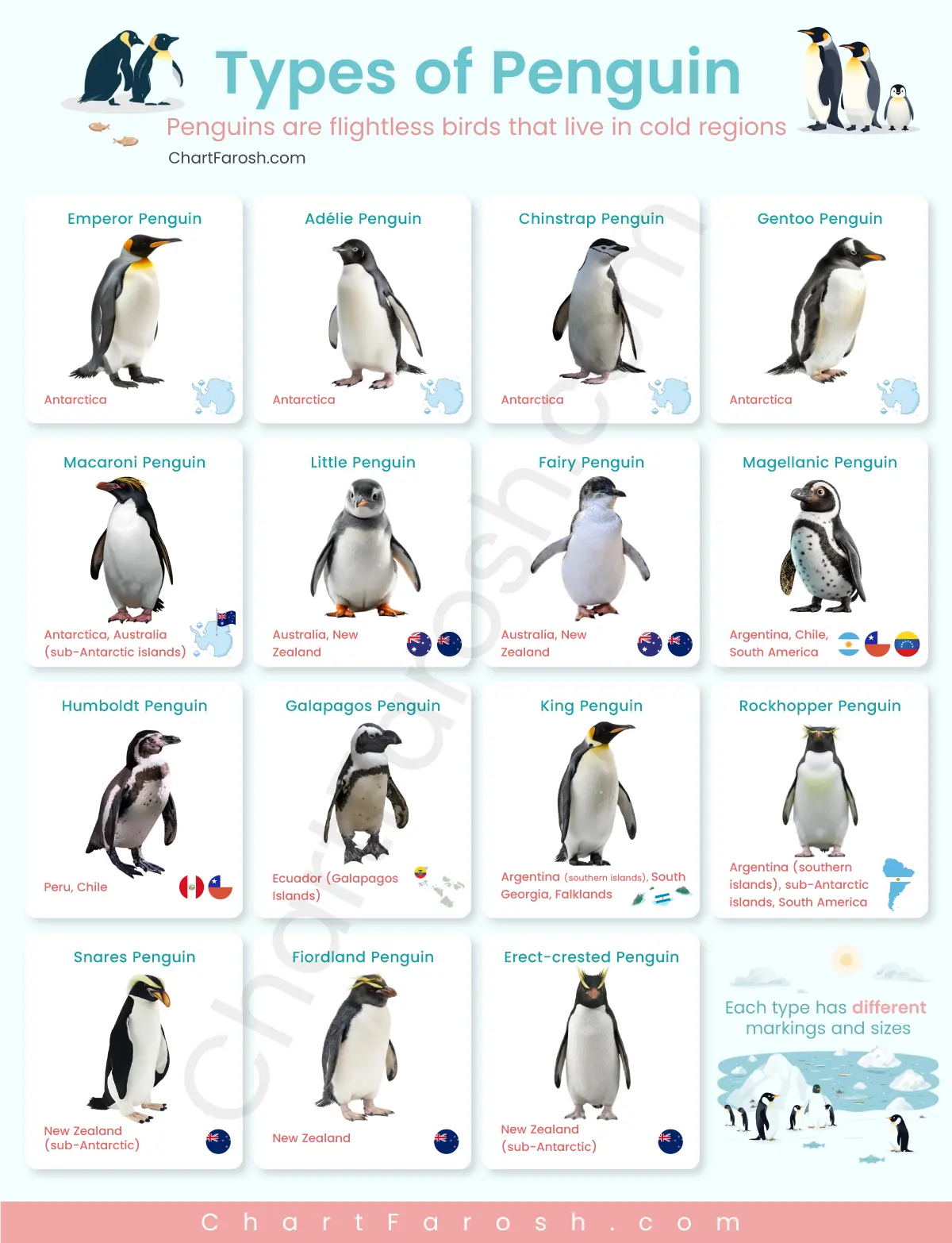
Table of Contents
Types of Penguins
The types of penguins are incredibly varied, each with unique markings, sizes, and behaviors that make them stand out.
From the tiny little penguins that stand barely a foot tall to the towering emperor penguins of Antarctica, every species has adapted perfectly to its environment.
Learning about the different types of penguins with pictures helped me visualize their differences, while reading about their habitats and social behaviors made me appreciate their resilience even more.
Penguin Species Chart
| Penguin Name | Feature | Habitat | Country/Region |
| Emperor Penguin | Largest penguin species; breeds during Antarctic winter | Ice sheets, cold Antarctic waters | Antarctica |
| Adélie Penguin | Medium-sized; feeds on krill; nests on ice-free rock | Coastal Antarctica, ice edges | Antarctica |
| Chinstrap Penguin | Black line under chin; aggressive feeders | Rocky islands & Antarctic coast | Antarctica |
| Gentoo Penguin | Fast swimmers; orange beak; nests on ice-free areas | Antarctic islands & sub-Antarctic islands | Antarctica |
| Macaroni Penguin | Yellow crest feathers; highly social | Sub-Antarctic islands, rocky shores | Antarctica, Australia (sub-Antarctic islands) |
| Little Penguin | Smallest penguin; nocturnal on land | Coastal shores, burrows | Australia, New Zealand |
| Fairy Penguin | Another name for Little Penguin | Coastal burrows | Australia, New Zealand |
| Magellanic Penguin | Medium-sized; migratory; nests in burrows | Coastal Patagonia & Chile | Argentina, Chile, South America |
| Humboldt Penguin | Medium-sized; prefers rocky coasts & islands | Coastal deserts & islands | Peru, Chile |
| Galapagos Penguin | Only tropical penguin; small; adapted to warm climate | Volcanic islands, cliffs | Ecuador (Galapagos Islands) |
| King Penguin | Second largest; long-lived; breeds in large colonies | Sub-Antarctic islands, cold waters | Argentina (southern islands), South Georgia, Falklands |
| Rockhopper Penguin | Small crested penguin; spiky yellow crest | Rocky, remote islands | Argentina (southern islands), sub-Antarctic islands, South America |
| Snares Penguin | Small, crested penguin; endangered | Sub-Antarctic Snares Islands | New Zealand (sub-Antarctic) |
| Fiordland Penguin | Medium-sized; crested; shy and nocturnal | Fiords and coastal forests | New Zealand |
| Erect-crested Penguin | Small; prominent yellow crest; rare | Sub-Antarctic islands | New Zealand (sub-Antarctic) |
Rarest Penguin in the World
Some penguins are not just fascinating but also extremely rare. I remember reading about a species that barely exists outside a few specific islands, making sightings incredibly special.
Rare penguins often face unique threats like habitat loss, climate change, and human interference, which makes understanding and protecting them essential.
Among these, each species has distinctive markings, sizes, and behaviors that make them unique and distinguishable from their more common relatives.
Documenting them and learning about their habitats can feel like discovering hidden gems of the animal world.
| Penguin Species | Habitat | Average Population | Distinctive Features |
| Yellow-eyed Penguin | New Zealand | 4,000 | Pale yellow eyes, long beak |
| Galapagos Penguin | Galapagos Islands | 1,200 | Only tropical penguin, small size |
| Fiordland Penguin | New Zealand | 6,000 | Dark face, yellow eyebrow stripe |
| Snares Penguin | Snares Islands | 10,000 | Unique black head markings, shy nature |
Common & Popular Penguin Breeds
Not all penguins are rare. Many are widely known and beloved due to their appearances in movies, zoos, and nature documentaries.
Watching these popular breeds interact with each other or swim effortlessly in water can be mesmerizing.
Some of these penguins have adapted to both cold and temperate climates, which allows them to thrive in more diverse habitats compared to their rarer counterparts.
Learning the differences between these common breeds gives a clearer picture of the penguin world and makes it easier to identify them in the wild or in captivity.
| Penguin Species | Habitat | Average Population | Distinctive Features |
| Emperor Penguin | Antarctica | 595,000 | Largest penguin, black & white with yellow chest |
| King Penguin | Subantarctic Islands | 2.2 million | Bright orange patches, second largest species |
| Adélie Penguin | Antarctica | 2.5 million | Black head, white ring around eyes |
| Chinstrap Penguin | Antarctica & Subantarctic | 8 million | Thin black band under chin |
Flying and Running Penguin
The terms flying and running penguins might sound contradictory since penguins do not fly like typical birds.
However, in penguin behavior studies, flying refers to their swift, graceful swimming through water, almost like they are flying underwater. “Running” captures their land movement, often characterized by waddling or sliding on their bellies.
These adaptations make penguins remarkable athletes in both their aquatic and terrestrial worlds.
Different types of penguins excel at one or the other depending on their species and environment.
Understanding this distinction helps explain their unique survival strategies and hunting methods.
| Movement Type | Species | Speed | Adaptation Notes |
| Flying (Underwater) | Gentoo Penguin | 36 km/h | Streamlined body, strong flippers |
| Flying (Underwater) | Macaroni Penguin | 30 km/h | Excellent diving capabilities |
| Running (Land) | Rockhopper Penguin | 2 km/h | Small hops over rocks |
| Running (Land) | Humboldt Penguin | 1.5 km/h | Waddling suited to nesting areas |
Types of Penguins in Antarctica
Antarctica is the ultimate penguin hotspot, home to some of the most iconic species. I remember being amazed reading about colonies that can number in the hundreds of thousands, all surviving in some of the harshest conditions on Earth.
Penguins in Antarctica have adapted to freezing temperatures, fierce winds, and ice-covered landscapes.
Types of penguin species in this region range from the massive emperor penguins to the smaller Adélie and chinstrap penguins.
Observing their social structures, mating rituals, and hunting techniques offers incredible insight into how life thrives in extreme environments.
Penguins in Antarctica
| Name | Feature |
| Emperor Penguin | Largest penguin species; breeds during Antarctic winter |
| Adélie Penguin | Medium-sized; breeds along Antarctic coast; feeds on krill |
| Chinstrap Penguin | Distinctive black “chinstrap”; found on islands around Antarctica |
| Gentoo Penguin | Fast swimmers; large orange beaks; nests on ice-free areas |
| Macaroni Penguin | Yellow crest feathers; breeds in sub-Antarctic islands |
Types of Penguins in Australia
Australia may not be the first place people think of when it comes to penguins, but it hosts a few unique species. The little penguins, for instance, are the smallest of all penguin species and are commonly found along southern coasts.
Watching them return from the ocean to their burrows at dusk is a special experience that attracts wildlife enthusiasts from all over.
Penguins in Australia are highly adapted to temperate climates and coastal living, differing significantly from the icy Antarctic species in both size and behavior.
Penguins in Australia
| Name | Feature |
| Little Penguin | Smallest penguin species; breeds on southern coast & Tasmania |
| Fairy Penguin | Another name for Little Penguin; nocturnal on land |
| Macaroni Penguin | Occasionally seen on sub-Antarctic islands south of Australia |
Types of Penguins in South America
South America is home to several remarkable penguin species that have adapted to diverse climates ranging from tropical islands to cold southern coasts.
I was particularly intrigued by their resilience, as they survive both in warmer waters and chilly conditions depending on the location.
Species like the Humboldt and Magellanic penguins demonstrate how these birds can thrive in environments with strong ocean currents and abundant fish.
Documenting the types of penguins in South America shows a fascinating mix of adaptability and survival skills.
Penguins in South America
| Name | Feature |
| Magellanic Penguin | Medium-sized; breeds in Chile & Argentina; migrates along coasts |
| Humboldt Penguin | Found along Peru & Chile; prefers rocky coasts & islands |
| Galapagos Penguin | Only tropical penguin; found on Galapagos Islands |
| King Penguin | Rare visitors on southern coasts; mostly sub-Antarctic islands |
| Rockhopper Penguin | Small crested penguin; breeds on southern islands |
Types of Penguins in Argentina
Argentina provides one of the best locations for observing penguins in South America, particularly in Patagonia and along the southern coast.
Visiting the breeding colonies there reveals a variety of penguin behaviors, from nurturing chicks to fishing trips in the nearby ocean.
Different species of penguins in Argentina have evolved to handle the local climate, predators, and food availability. The sight of these birds in their natural habitat is a remarkable reminder of the diversity within the penguin family.
Penguins in Argentina
| Name | Feature |
| Magellanic Penguin | Most common in Argentina; nests in burrows along coastal Patagonia |
| King Penguin | Found in small colonies in southern regions; mainly sub-Antarctic islands |
| Rockhopper Penguin | Small crested species; limited colonies on southern islands |
FAQs
What is the smallest type of penguin?
The Little Penguin, also known as the Fairy Penguin, is the smallest penguin species, standing around 33 cm tall and weighing approximately 1 kg.
What is the largest penguin species?
The Emperor Penguin holds the title for the largest penguin species, reaching heights of up to 122 cm and weighing between 22 to 45 kg.
Where do penguins live naturally?
Penguins are native to the Southern Hemisphere, primarily in Antarctica, South America, Africa, Australia, and New Zealand, including various subantarctic islands.
Do penguins live only in cold climates?
No, while many penguins inhabit cold regions like Antarctica, some species, such as the Galapagos Penguin, thrive in tropical or temperate climates.
Are penguins endangered or protected species?
Some penguin species are classified as vulnerable or endangered due to climate change, overfishing, and habitat destruction, while others are relatively stable but still benefit from conservation efforts.
What do different types of penguins eat?
Penguins primarily eat fish, krill, and squid. Specific diets vary by species and availability of prey in their natural habitat.
How long do penguins live in the wild?
Penguins can live anywhere from 6 to 20 years in the wild, depending on the species and environmental conditions.