Types of Cicadas
I grew up thinking cicadas were just a sound. That thick wall of buzzing that means it is too hot to move. I never looked closely at the insect making it.
Then one May a few years back, I visited family in Ohio during a periodical cicada emergence. Billions of them. Black bodies, red eyes, clinging to every tree trunk and fence post. The noise was not background anymore. It was a roar you could feel in your chest.
I picked one up. It sat on my finger, harmless, blinking those red eyes. My cousin told me it had spent seventeen years underground for this one loud month above the soil.
That hooked me. There are more than three thousand cicada species in the world. Some show up every summer. Some wait thirteen or seventeen years. One is the loudest insect alive. One is the size of your hand. One barely makes a sound at all.
Below are the cicadas worth knowing, what each looks like, where it lives, and the one trait that sets it apart.
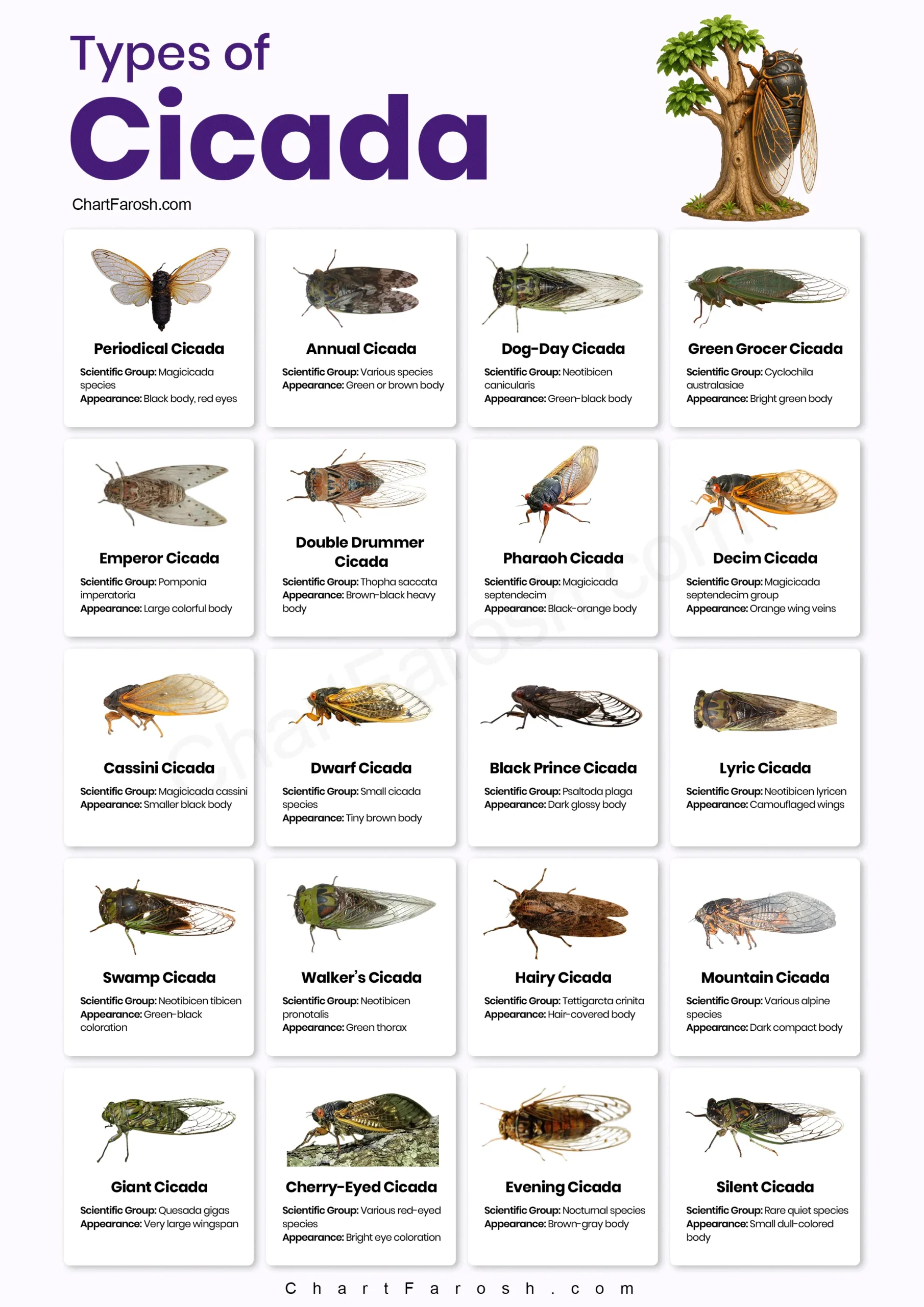
Table of Contents
Cicada identification chart
There are more than three thousand cicada species worldwide. The twenty below are the ones people ask about most, from the periodical cicadas of North America to the ear-splitting giants of Australia.
The chart sorts each by name, scientific group, look, home range, and the single feature that makes it stand out.
| Type | Scientific Name / Group | Appearance | Habitat | Distinct Feature |
| Periodical Cicada | Magicicada spp. | Black body, red eyes | Eastern North America | Emerges every 13 or 17 years |
| Annual Cicada | Various species | Green or brown body | Worldwide forests | Some adults appear yearly |
| Dog-Day Cicada | Neotibicen canicularis | Green-black body | Trees and suburbs | Loud late-summer buzzing |
| Green Grocer Cicada | Cyclochila australasiae | Bright green body | Australia | Among the loudest insects |
| Empress Cicada | Megapomponia imperatoria | Large brown body, huge wingspan | Southeast Asia | Largest cicada in the world |
| Double Drummer | Thopha saccata | Brown-black heavy body | Australia | Reputedly the loudest insect |
| Pharaoh Cicada | Magicicada septendecim | Black body, orange stripes | Eastern North America | 17-year life cycle |
| Thirteen-Year Cicada | Magicicada tredecim | Black body, orange underside | Southern, central US | 13-year life cycle |
| Cassini Cicada | Magicicada cassini | Smaller black body | Eastern U.S. | Synchronized chorus swarms |
| Dwarf Cicada | Cicadetta spp. (grass cicadas) | Tiny brown body | Grasslands, meadows | Among the smallest cicadas |
| Black Prince Cicada | Psaltoda plaga | Dark glossy body | Australia | Deep buzzing call |
| Lyric Cicada | Neotibicen lyricen | Camouflaged wings | Forests | Musical, rhythmic song |
| Swamp Cicada | Neotibicen tibicen | Green-black coloration | Wetlands | Common near water |
| Walker’s Cicada | Megatibicen pronotalis | Green to olive body | Central U.S. plains | One of the loudest US cicadas |
| Hairy Cicada | Tettigarcta crinita | Hair-covered body | Alpine SE Australia | Primitive lineage, very quiet |
| Mountain Cicada | Cicadetta montana, Okanagana spp. | Dark compact body | Mountain forests | Adapted to cooler climates |
| Giant Cicada | Quesada gigas | Very large, wide wingspan | Tropical America to Texas | One of the world’s biggest |
| Redeye Cicada | Psaltoda moerens | Black body, bright red eyes | Southeast Australia | Striking red eyes |
| Evening Cicada | Tanna japonensis (higurashi) | Brown-gray body | Japan, East Asia | Calls at dawn and dusk |
| Silent Cicada | Various quiet species | Small dull-colored body | Dense forests | Very soft or no airborne call |
A few patterns jump out. Most cicadas are annual, which means some adults appear every summer. A small group in North America is periodical, spending thirteen or seventeen years underground before a mass emergence.
Australia holds the loudest species on Earth. Southeast Asia holds the largest. To match a cicada to a photo, the bug identification chart lines them up beside clear images.
Periodical cicadas vs annual cicadas
The biggest split in the cicada world is timing.
Annual cicadas, sometimes called dog-day cicadas, appear every summer. Their life cycles last two to five years, but the broods overlap, so adults turn up each year in the hottest weeks. Most cicadas on Earth are annual. They are usually green or brown and sing through the afternoon heat.
Periodical cicadas are the famous oddity. They live only in eastern North America, in the genus Magicicada, and they spend thirteen or seventeen years underground feeding on tree roots.
Then a whole brood erupts at once, sometimes more than a million bugs per acre, mates in a few loud weeks, and dies. The black-bodied, red-eyed Pharaoh cicada (Magicicada septendecim) runs on the seventeen-year clock.
Its southern cousin, the thirteen-year cicada (Magicicada tredecim), runs on the shorter one. Scientists track these broods by number, and you can follow upcoming emergences through specialist resources like Cicada Mania.
| Feature | Periodical Cicada | Annual Cicada |
| Life cycle | 13 or 17 years underground | 2 to 5 years, broods overlap |
| When adults appear | One synchronized mass emergence | Every summer |
| Where | Eastern North America only | Worldwide |
| Genus | Magicicada | Many genera |
| Color | Black body, red eyes | Green or brown |
| Numbers | Up to over a million per acre | Scattered |
Cicadas of North America
North America has dozens of annual cicadas beyond the periodical ones. They are strong but clumsy fliers, so a flying insect identification guide can help separate them from other large summer bugs.
The dog-day cicada (Neotibicen canicularis) is the green-black bug behind the steady summer drone in yards and woods. It is named for the dog days of late summer.
The lyric cicada (Neotibicen lyricen) has camouflaged wings and a song with a musical, rolling rhythm.
The swamp cicada (Neotibicen tibicen), also called the morning cicada, is green and black and sticks close to wet ground and water.
Walker’s cicada (Megatibicen pronotalis) is one of the largest and loudest annual cicadas in the country. It lives across the Great Plains and the Mississippi basin, and its alarm call is genuinely painful up close.
The cassini cicada (Magicicada cassini) is a periodical species that swarms and choruses in tight synchrony, with the males starting and stopping together.
The giant cicada (Quesada gigas) ranges from Argentina up into Texas, one of the widest ranges of any cicada and one of the biggest bodies in the Americas.
Cicadas of Australia and Asia
Australia is cicada country, with some of the loudest insects ever measured.
The green grocer (Cyclochila australasiae) is a big bright green cicada and one of the loudest insects in the world, reaching levels that can damage human hearing at close range.
The double drummer (Thopha saccata) is louder still. It is reputedly the loudest insect on Earth, named for the dark sound pockets on each side of the male’s body that amplify its call. The Australian coverage of these choruses calls them deafening, and that is not an exaggeration.
The black prince (Psaltoda plaga) is a dark, glossy cicada with a deep buzzing call. The redeye (Psaltoda moerens) is another black Australian cicada, named for its bright red eyes.
The hairy cicada (Tettigarcta crinita) is the odd one out. It belongs to an ancient family, the Tettigarctidae, whose fossils reach back to the age of the dinosaurs. It lives in the cool highlands of southeastern Australia, is covered in fine hairs, and barely sings. Instead of a loud airborne call it sends faint vibrations through the bark it sits on.
Asia has giants of its own. The empress cicada (Megapomponia imperatoria) of Southeast Asia is the largest cicada in the world, with a wingspan that can reach eight inches. The evening cicada (Tanna japonensis), known in Japan as higurashi, is famous for singing at dawn and dusk rather than in the midday heat.
Record-breaking cicadas
A few cicadas hold titles worth knowing. The largest and the loudest both come close to the limits of what an insect this size can manage.
| Record | Cicada | Detail |
| Largest | Empress cicada (Megapomponia imperatoria) | Wingspan up to 8 inches (20 cm) |
| Loudest | Double drummer (Thopha saccata) | Reputedly the loudest insect on Earth |
| Longest life cycle | Periodical cicada (Magicicada septendecim) | 17 years underground |
| Smallest | Dwarf grass cicadas (Cicadetta spp.) | Easy to miss in the grass |
| Oldest lineage | Hairy cicada (Tettigarcta crinita) | Family dates to the dinosaur era |
How and why cicadas sing
The cicada chorus is one of the loudest sounds in nature, and it comes from a clever bit of anatomy.
Only male cicadas sing. They have a pair of ribbed organs called tymbals on the sides of the abdomen. The male buckles and releases them fast, and a mostly hollow abdomen amplifies the clicks into a continuous buzz. Each species has its own song, which keeps females from answering the wrong males.
Female cicadas are silent. They answer with a flick of the wings, not a call. So in every species, half the population makes no sound at all.
A few cicadas break the pattern. The evening cicada sings at dusk instead of midday. The primitive hairy cicada barely makes an airborne sound, sending faint vibrations through bark instead.
These quiet cicadas are a reminder that the famous roar is only one strategy among many. Cicadas are harmless to people and gardens, and they feed countless birds and other animals, which is why they count among the most useful beneficial insects of summer. For the record on body size, Britannica has a good overview of the family.
FAQs
How many types of cicadas are there?
More than three thousand cicada species are known worldwide, and scientists still describe new ones. They fall into two broad groups: annual cicadas that appear every summer, and the periodical cicadas of North America that emerge every thirteen or seventeen years.
What is the difference between annual and periodical cicadas?
Annual cicadas appear every summer and have life cycles of a few years. Periodical cicadas live only in eastern North America, spend thirteen or seventeen years underground, then emerge all at once in huge numbers for a few weeks.
What is the loudest cicada?
Australia’s double drummer (Thopha saccata) is reputedly the loudest insect on Earth. The green grocer is close behind. A chorus of either can reach levels that hurt human ears up close.
What is the largest cicada in the world?
The empress cicada (Megapomponia imperatoria) of Southeast Asia is the largest, with a wingspan that can reach about eight inches. The giant cicada of the Americas and the double drummer of Australia are also among the biggest.
Are cicadas harmful or dangerous?
No. Cicadas do not bite or sting and carry no venom. They do no real damage to healthy plants. The worst they do is startle you with their size and noise.
Why are cicadas so loud?
Only the males sing, using ribbed organs called tymbals that vibrate fast against a hollow abdomen. When thousands sing together, the sound carries a long way. For help telling insects apart, see the bug identification chart, and browse the wider Animals Chart collection for more guides.