Types of Dolphins Names List with Pictures
For a long time, dolphins felt familiar but blurry to me. I knew they were intelligent, social, and somehow always smiling, yet when someone asked how many kinds of dolphins existed, I realized I couldn’t give a straight answer.
Everything seemed to collapse into one mental image: a sleek gray body leaping beside a boat. That gap stuck with me.
I wanted to understand why dolphins show up in oceans, rivers, and coastlines, and why some are thriving while others are quietly disappearing.
Looking deeper made it clear that dolphins aren’t just one type of animal. They’re a wide-ranging group shaped by water depth, geography, and human contact in very different ways.
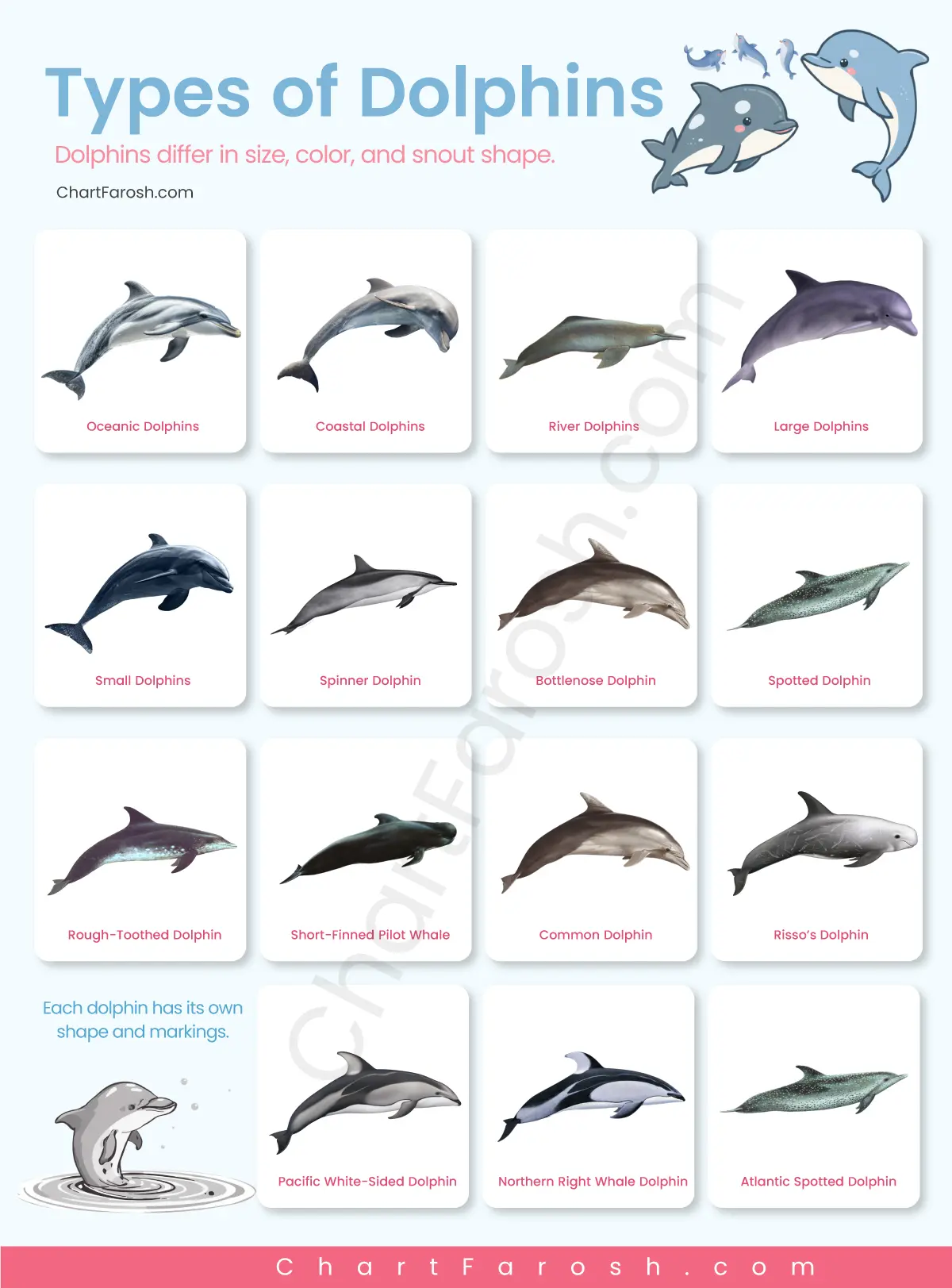
Table of Contents
Types of Dolphins
Dolphins belong to a diverse group of marine mammals that vary far more than most people realize.
Some species live almost their entire lives offshore in deep ocean waters, while others stay close to coastlines or even navigate murky rivers.
These differences affect everything from body shape and coloration to behavior and communication style.
Grouping dolphins by type helps make sense of their adaptability and explains why conservation challenges aren’t the same for all of them.
Understanding the broad categories also makes resources like Types of Dolphins and their names, a list of Dolphins breeds, or a visual Types of Dolphins chart much easier to follow without confusion.
| Dolphin Type | Examples | Key Feature | Habitat |
| Oceanic Dolphins | Bottlenose, Spinner | Fast swimmers, social | Open oceans |
| Coastal Dolphins | Common Dolphin | Seen near shores | Coastal waters |
| River Dolphins | Amazon River Dolphin | Long snout | Freshwater rivers |
| Large Dolphins | Orca (Killer Whale) | Apex predator | Global oceans |
| Small Dolphins | Hector’s Dolphin | Rounded fins | Coastal regions |
Types of Dolphins and How Scientists Group Them
Scientists classify dolphins based on anatomy, genetics, habitat, and behavior rather than appearance alone.
Most dolphins belong to the oceanic dolphin family, but river dolphins form a separate group with unique adaptations. Beak shape, tooth structure, and echolocation patterns all play a role in classification.
This scientific grouping helps researchers track population health and evolutionary relationships. It also explains why dolphins that look similar may not be closely related at all.
These classifications are essential when organizing types of Dolphins species into research databases or building a printable list of Dolphins for education.
| Group | Example Species | Habitat |
| Oceanic Dolphins | Bottlenose Dolphin | Open oceans |
| River Dolphins | Amazon River Dolphin | Freshwater rivers |
| Coastal Dolphins | Indo-Pacific Dolphin | Shorelines |
| Offshore Dolphins | Spinner Dolphin | Deep waters |
Difference Between Dolphins and Porpoises
Dolphins and porpoises are often mixed up, but they differ in noticeable ways once you know what to look for.
Dolphins usually have longer beaks, curved dorsal fins, and conical teeth, while porpoises tend to have blunt faces, triangular fins, and spade-shaped teeth.
Behaviorally, dolphins are generally more social and acrobatic, while porpoises are quieter and more elusive.
Understanding these differences clears up common misunderstandings and helps people correctly identify animals when using types of Dolphins with pictures instead of relying on assumptions.
| Feature | Dolphins | Porpoises |
| Beak | Long and pointed | Short and blunt |
| Teeth | Cone-shaped | Spade-shaped |
| Behavior | Social | Shy |
| Dorsal Fin | Curved | Triangular |
Ocean Dolphins You’re Most Likely to See
Ocean dolphins are the ones most people recognize, especially those living near popular coastlines or shipping routes.
Species like bottlenose and spinner dolphins are frequently spotted from boats and shores due to their playful behavior and curiosity toward humans.
Their adaptability allows them to thrive in a wide range of ocean conditions. These dolphins often shape public perception and appear most often in types of dolphins with pictures, documentaries, and marine parks, making them the default dolphin for many people.
| Species | Region | Notable Trait |
| Bottlenose Dolphin | Worldwide | Highly intelligent |
| Spinner Dolphin | Tropical oceans | Aerial spins |
| Common Dolphin | Open oceans | Speed |
| Dusky Dolphin | Southern oceans | Group acrobatics |
River Dolphins and Why They’re Disappearing
River dolphins are among the most endangered cetaceans on Earth. Living in murky freshwater systems, they rely heavily on echolocation rather than sight.
Unfortunately, pollution, dam construction, fishing nets, and boat traffic have devastated their habitats.
Their slow reproduction rates make recovery extremely difficult once populations decline.
River dolphins highlight how fragile freshwater ecosystems are and why conservation often lags behind awareness.
Many are missing entirely from a typical list of Dolphins breeds, despite their ecological importance.
| Species | River System | Status |
| Amazon River Dolphin | Amazon | Endangered |
| Ganges River Dolphin | Ganges | Endangered |
| Yangtze River Dolphin | Yangtze | Functionally extinct |
| Indus River Dolphin | Indus | Endangered |
The Most Intelligent Dolphin Species
Dolphins are famous for intelligence, but some species stand out more than others. Bottlenose dolphins, in particular, show advanced problem-solving skills, self-recognition, and complex social structures.
They use vocal signatures that function similarly to names and cooperate during hunting.
Intelligence plays a role in survival, allowing dolphins to adapt quickly, but it also brings challenges when navigating human-dominated environments.
Understanding intelligence differences adds depth to Types of Dolphins and their names beyond surface-level traits.
| Species | Intelligence Indicator | Known For |
| Bottlenose Dolphin | Self-recognition | Tool use |
| Orca (Killer Whale) | Social learning | Complex pods |
| Spinner Dolphin | Coordination | Group hunting |
| Common Dolphin | Problem-solving | Fast learning |
Largest and Fastest Dolphins in the World
Dolphins range widely in size and speed. The largest dolphin species, the orca, sits at the top of the food chain, while smaller dolphins rely on speed and agility to survive.
Speed is especially important for open-ocean species that hunt fast-moving fish.
These physical extremes show how dolphins have adapted to vastly different ecological niches, which is useful when comparing species in a Types of Dolphins chart.
| Species | Size | Top Speed |
| Orca | Up to 9 m | 56 km/h |
| Common Dolphin | Medium | 60 km/h |
| Bottlenose Dolphin | Medium | 35 km/h |
| Spinner Dolphin | Small | 30 km/h |
Rare Dolphin Species Few People Know About
Some dolphins exist far from tourist routes and media attention. These rare species often live in restricted ranges or deep waters, making sightings uncommon. Low population numbers and limited data increase their vulnerability.
Many people are surprised to learn how many dolphin species they’ve never heard of, even though these animals play key roles in marine ecosystems.
Rare dolphins are often excluded from types of Dolphins with pictures, simply because images are hard to obtain.
| Species | Location | Population |
| Hector’s Dolphin | New Zealand | ~15,000 |
| Maui Dolphin | New Zealand | <100 |
| Irrawaddy Dolphin | Southeast Asia | Declining |
| Franciscana Dolphin | South America | Vulnerable |
Dolphins That Live Close to Humans
Some dolphins thrive near harbors, bays, and coastlines, adapting to boat traffic and fishing activity. While this proximity increases sightings, it also raises risks such as entanglement, pollution exposure, and noise interference.
These dolphins often develop unique behaviors around humans, sometimes appearing curious or playful. Their closeness makes them key ambassadors for conservation but also places them at higher risk.
| Species | Common Area | Human Interaction |
| Bottlenose Dolphin | Coastal waters | Frequent |
| Indo-Pacific Dolphin | Harbors | Moderate |
| Atlantic Spotted Dolphin | Bays | Occasional |
| Common Dolphin | Fishing zones | High |
Types of Dolphins in Hawaii
Hawaii’s waters host several dolphin species, many of which rely on coral reefs and deep offshore waters. Spinner dolphins are especially well known for resting in shallow bays during the day.
Strict regulations exist to protect dolphins from excessive human interaction, highlighting the balance between tourism and conservation in island ecosystems.
| Dolphin Species | Commonality | Key Trait | Fun Fact |
| Spinner Dolphin | Very common | Long spins out of water | Rest in bays during day |
| Bottlenose Dolphin | Common | Highly intelligent | Seen close to shore |
| Spotted Dolphin | Common offshore | Spotted body | Forms large groups |
| Rough-Toothed Dolphin | Less common | Sloped head | Very social |
| Short-Finned Pilot Whale | Occasional | Large dolphin species | Travels in pods |
Types of Dolphins in California
California’s coastline supports a diverse dolphin population due to nutrient-rich waters. Bottlenose dolphins are commonly seen near beaches, while offshore species follow seasonal prey movements.
Migration patterns and upwelling zones make California a hotspot for dolphin activity and research.
| Dolphin Species | Location | Key Trait | Note |
| Common Dolphin | Offshore | Fast, colorful | Most abundant |
| Bottlenose Dolphin | Coastal | Curious behavior | Seen near beaches |
| Risso’s Dolphin | Deep offshore | Scarred gray body | Squid eater |
| Pacific White-Sided Dolphin | Cooler waters | High-energy swimmer | Often rides waves |
| Northern Right Whale Dolphin | Offshore | No dorsal fin | Rare sightings |
Types of Dolphins in Florida
Florida’s warm coastal waters provide ideal conditions for resident dolphin populations. Bottlenose dolphins are particularly well studied here, with some communities living in the same bays for decades.
Human activity, however, poses ongoing challenges, including boat strikes and habitat degradation.
| Dolphin Species | Frequency | Habitat | Key Note |
| Bottlenose Dolphin | Very common | Coastal & bays | Florida’s most iconic dolphin |
| Atlantic Spotted Dolphin | Common offshore | Warm waters | Develops spots with age |
| Risso’s Dolphin | Offshore | Deep waters | Scarred appearance |
| Spinner Dolphin | Occasional | Offshore | Known for spinning jumps |
| Rough-Toothed Dolphin | Less common | Coastal & offshore | Travels in tight groups |
Also read: Whales Types list
FAQs
How many dolphin species exist worldwide?
There are over 40 recognized dolphin species.
Are dolphins fish or mammals?
Dolphins are mammals that breathe air.
What is the smartest dolphin species?
Bottlenose dolphins are considered the most intelligent.
Can dolphins live in freshwater?
Yes, some species live entirely in rivers.
Why are some dolphins endangered?
Habitat loss, pollution, and fishing threats are the main reasons.