Types of Tigers names list with pictures
I didn’t grow up dreaming about tigers in a dramatic, National Geographic kind of way.
My interest kicked in much later, during a frustrating phase when I kept seeing wildly different claims online, some saying there are dozens of tiger breeds, others listing only a handful of species, and a few even throwing white tigers into the mix as if they were a whole separate category. It got confusing fast.
I wanted a clear, realistic breakdown: what actually counts as a type of tiger, which ones are still around, and how size, geography, and genetics really play into it.
So I started digging, through conservation reports, wildlife databases, and field studies, and slowly the picture became clearer.
Tigers aren’t complicated because nature messed up; they’re complicated because we humans love oversimplifying them.
Once you strip away the myths, what you’re left with is an incredible range of animals, each shaped by its environment, history, and survival odds.
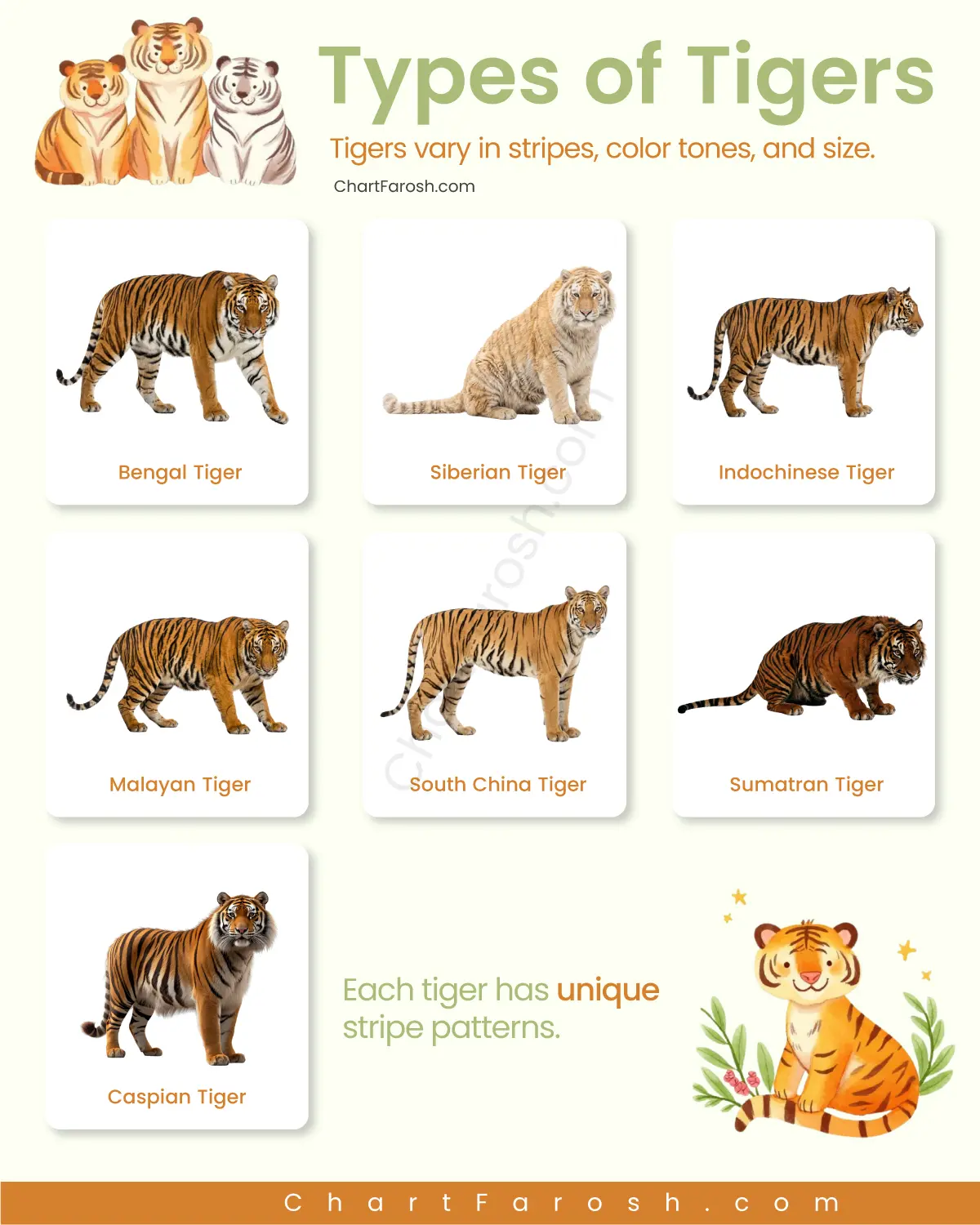
Table of Contents
Types of Tigers
Before diving into names, sizes, or regions, it helps to get one thing straight: when people say types of tigers, they’re usually mixing up subspecies, color variations, and extinct populations.
Tigers all belong to the same species, Panthera tigris, but within that species are several recognized subspecies, each adapted to a specific region.
This is where terms like types of Tigers species and Types of Tigers and their names actually matter.
Understanding this structure also makes it easier to follow conservation discussions and compare populations worldwide.
Whether you’re looking for a Types of Tigers chart for quick reference or a deeper explanation to go with a printable list of Tigers, starting with the basics keeps everything grounded and factual.
| Tiger Type | Scientific Name | Key Feature | Habitat | Fun Fact |
| Bengal Tiger | Panthera tigris tigris | Orange coat, black stripes | India, Bangladesh | Most numerous tiger species |
| Siberian Tiger | Panthera tigris altaica | Largest tiger, thick fur | Russia (Far East) | Can survive extreme cold |
| Indochinese Tiger | Panthera tigris corbetti | Smaller, dark stripes | Southeast Asia | Elusive & solitary |
| Malayan Tiger | Panthera tigris jacksoni | Small subspecies | Malaysia | Critically endangered |
| South China Tiger | Panthera tigris amoyensis | Smallest tiger | China | Functionally extinct in wild |
| Sumatran Tiger | Panthera tigris sumatrae | Small, striped | Sumatra, Indonesia | Strong swimmer |
| Caspian Tiger | Panthera tigris virgata | Extinct | Central Asia | Once in Iran & Turkey |
How Many Tiger Subspecies Exist Today?
As of now, scientists generally agree that six tiger subspecies still exist in the wild. This number used to be higher, but habitat loss, poaching, and human conflict wiped out several populations during the 20th century.
Modern genetic research helped clean up older classifications, which is why some outdated list of Tigers breeds you’ll see online no longer hold up.
Today’s living subspecies include the Bengal, Siberian (Amur), Indochinese, Malayan, South China, and Sumatran tiger.
Each one differs slightly in size, stripe pattern, and behavior. If you’re searching for Types of Tigers with pictures, these visual differences become even more obvious, especially when you line them up side by side.
| Subspecies Name | Primary Region | Estimated Wild Population |
| Bengal Tiger | India, Nepal, Bhutan | ~2,500 |
| Siberian (Amur) Tiger | Russia, NE China | ~500 |
| Sumatran Tiger | Indonesia (Sumatra) | ~400 |
| Malayan Tiger | Malaysia | ~150 |
| Indochinese Tiger | SE Asia | ~350 |
Types of Tigers by Size
Tiger size isn’t just about genetics, it’s deeply tied to climate and prey availability. Generally, tigers living in colder regions grow larger, while those in dense tropical forests tend to be smaller and more agile.
This is why the Siberian tiger often tops any Types of Tigers chart focused on size, while the Sumatran tiger sits at the smaller end.
Size affects everything from hunting strategy to territory range, which is why conservation plans can’t take a one-size-fits-all approach.
When people look for a printable list of Tigers ranked by size, it’s usually because this physical difference is one of the most noticeable traits across subspecies.
| Subspecies | Average Male Weight | Body Length |
| Siberian Tiger | 180–300 kg | Up to 3.3 m |
| Bengal Tiger | 180–260 kg | Up to 3.1 m |
| Indochinese Tiger | 150–195 kg | Up to 2.9 m |
| Sumatran Tiger | 100–140 kg | Up to 2.6 m |
Rare and Least-Seen Tiger Subspecies
Some tigers aren’t famous because they’re rare, not flashy. These subspecies live in fragmented habitats, avoid human contact, and exist in low numbers, which makes sightings uncommon.
The Malayan and South China tigers are prime examples. You’ll often see them listed in conservation-focused types of Tigers species discussions because their survival status is so critical.
Unlike Bengal tigers, which appear frequently in documentaries, these cats rarely show up in mainstream media.
If you’ve ever searched for Types of Tigers with pictures and noticed the same subspecies repeating, this rarity is the reason.
| Subspecies | Status | Main Threat |
| South China Tiger | Functionally extinct in wild | Habitat loss |
| Malayan Tiger | Critically endangered | Poaching |
| Indochinese Tiger | Endangered | Low prey density |
White Tigers: Mutation or Separate Type?
White tigers aren’t a separate subspecies, and they definitely aren’t a unique entry in a scientific list of Tigers breeds.
They’re Bengal tigers with a rare genetic mutation that affects coat color. This mutation requires both parents to carry the gene, which is why white tigers are so uncommon in the wild.
Most white tigers today exist in captivity, often due to selective breeding, a practice that raises ethical concerns.
You’ll still see them included in casual Types of Tigers and their names lists, but biologically, they’re not their own category.
Understanding this clears up a lot of confusion, especially when browsing a Types of Tigers chart online.
| Trait | Detail |
| Subspecies | Bengal Tiger |
| Cause | Genetic mutation |
| Wild Occurrence | Extremely rare |
| Eye Color | Blue or green |
Extinct Tiger Subspecies You Should Know About
Not all tiger subspecies made it into the modern era. Three well-known subspecies, the Bali, Javan, and Caspian tigers, are now extinct.
Their disappearance wasn’t ancient history; it happened within the last century, largely due to hunting and land conversion.
These lost tigers still appear in older references and outdated printable list of Tigers resources, which is why it’s important to know which ones are no longer around.
Learning about extinct subspecies adds context to why conservationists take current declines so seriously.
| Subspecies | Region | Extinction Period |
| Bali Tiger | Bali, Indonesia | 1940s |
| Javan Tiger | Java, Indonesia | 1970s |
| Caspian Tiger | Central Asia | 1950s |
Types of Tigers in Russia
Russia is home to just one tiger subspecies, but it’s a heavyweight, literally. The Siberian, or Amur, tiger dominates the forests of the Russian Far East.
These tigers are built for cold weather, with thicker fur and larger bodies that help conserve heat.
Their presence plays a key role in maintaining ecosystem balance, as they control prey populations over vast territories.
When people search region-specific lists like Types of Tigers with pictures, the Russian section is almost always synonymous with the Amur tiger alone.
| Tiger Species | Location | Key Feature | Status |
| Siberian Tiger | Russian Far East | Thick coat, massive size | Endangered, largest tiger species |
| Amur Leopard-Tiger Hybrids (Occasional in reserves) | Russia | Rare crossbreeds in captivity | Extremely rare |
Types of Tigers in Malaysia
Malaysia’s forests are home to the Malayan tiger, a subspecies officially recognized in the early 2000s after genetic studies separated it from the Indochinese tiger.
Smaller and more elusive, Malayan tigers are perfectly adapted to dense tropical habitats.
Sadly, they’re also among the most endangered, which is why they frequently appear in updated types of Tigers species conservation lists.
Malaysia’s tiger population has declined sharply, making protection efforts urgent and ongoing.
| Tiger Species | Habitat | Key Feature | Status |
| Malayan Tiger | Malaysian forests | Small, agile | Critically endangered |
| Indochinese Tiger | Occasional | Darker stripes | Rare in northern forests |
Types of Tigers in China
China’s tiger history is complicated. Historically, multiple subspecies roamed different regions, but today, the South China tiger is functionally extinct in the wild. Small numbers survive in captivity, with rewilding efforts still experimental.
China also shares territory with Amur tigers along its northeastern border. If you’re compiling a Types of Tigers chart by country, China’s entry tells a powerful story about how quickly large predators can disappear without protection.
| Tiger Species | Habitat | Key Feature | Status |
| South China Tiger | Southern China (historically) | Small size | Functionally extinct in the wild |
| Siberian Tiger | Northeast China | Thick coat | Rare but some protected reserves |
FAQs
Frequently Asked Questions
How many types of tigers are there today?
There are six living tiger subspecies recognized by most scientists.
Are white tigers a separate species?
No, white tigers are Bengal tigers with a rare genetic mutation.
What is the largest tiger subspecies?
The Siberian (Amur) tiger is the largest in terms of body size and weight.
Why are some tiger subspecies extinct?
Habitat loss, hunting, and human expansion led to their extinction.
Is there a complete printable list of Tigers?
Yes, many conservation sites offer a printable list of Tigers, but make sure it’s updated to exclude extinct subspecies.