Types of Grasshoppers
A grasshopper once cleared a whole row of my mother’s beans in an afternoon. I was maybe ten. She stood over the bare stems, furious, while the culprit chewed away on a fence post.
I thought a grasshopper was just a grasshopper. One green bug that jumps.
I was wrong. There are more than eleven thousand species worldwide. Some are tiny and live in moss. Some are the size of your thumb and too heavy to fly well. A few turn into locusts, swarm by the billion, and strip whole farms bare.
They come in groups you can learn to read. Spur-throated ones with a spike under the chin. Band-winged ones that flash bright wings in flight. Slant-faced ones with a pointed head. Heavy, slow lubbers that warn you off with color.
Below are the grasshoppers worth knowing. What each looks like, where it lives, how big it gets, and the feature that gives it away.
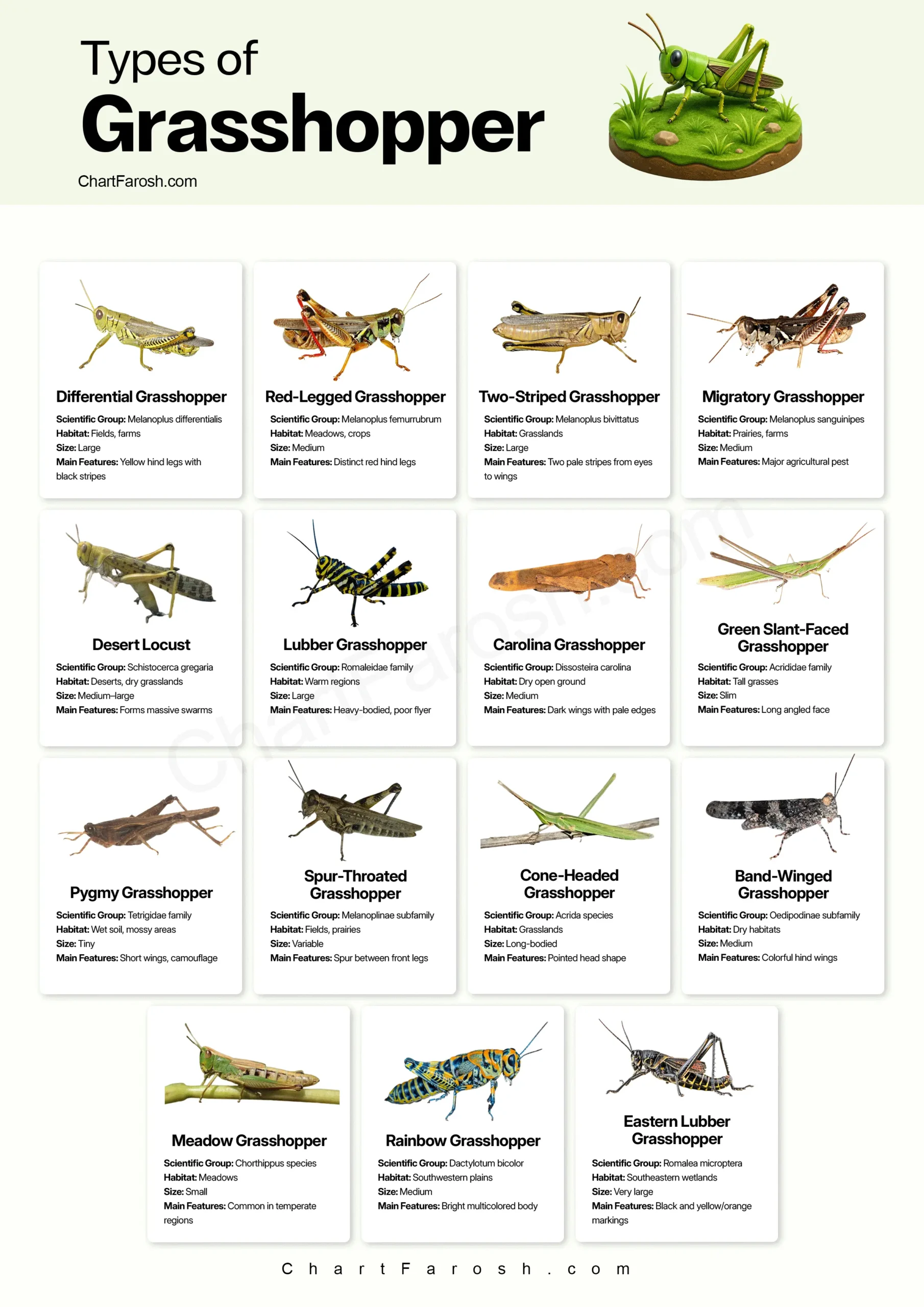
Table of Contents
Grasshopper identification chart
There are more than eleven thousand grasshopper species worldwide. The fifteen below are the ones people see and ask about most. The chart sorts each by name, scientific group, home, size, and the feature that gives it away.
| Common Name | Scientific Group | Habitat | Size | Main Features |
| Differential Grasshopper | Melanoplus differentialis | Fields, farms | Large | Yellow hind legs with black stripes |
| Red-Legged Grasshopper | Melanoplus femurrubrum | Meadows, crops | Medium | Red hind legs |
| Two-Striped Grasshopper | Melanoplus bivittatus | Grasslands | Large | Two pale stripes, eyes to wings |
| Migratory Grasshopper | Melanoplus sanguinipes | Prairies, farms | Medium | Major crop pest |
| Desert Locust | Schistocerca gregaria | Deserts, dry grasslands | Med-large | Forms massive swarms |
| Lubber Grasshopper | Romaleidae (Brachystola magna) | Warm regions, plains | Large | Heavy body, poor flier |
| Carolina Grasshopper | Dissosteira carolina | Dry open ground | Medium | Dark hind wings, pale edges |
| Green Slant-Faced Grasshopper | Gomphocerinae | Tall grasses | Slim | Long angled face |
| Pygmy Grasshopper | Tetrigidae | Wet soil, mossy areas | Tiny | Long pronotum, camouflage |
| Spur-Throated Grasshopper | Melanoplinae | Fields, prairies | Variable | Spur under the throat |
| Cone-Headed Grasshopper | Acrida spp. | Grasslands | Long-bodied | Pointed head |
| Band-Winged Grasshopper | Oedipodinae | Dry habitats | Medium | Colorful hind wings |
| Meadow Grasshopper | Chorthippus spp. | Meadows | Small | Common in temperate regions |
| Rainbow Grasshopper | Dactylotum bicolor | Southwestern plains | Medium | Bright multicolored body |
| Eastern Lubber Grasshopper | Romalea microptera | Southeastern US | Very large | Black with yellow-orange markings |
Most grasshoppers fall into a few natural groups. The next section breaks them down. One tip while you read the chart. Many entries here are single species, like the differential grasshopper.
A few are whole groups, like the band-winged and spur-throated grasshoppers, that hold dozens of species each. To match a grasshopper to a photo, the bug identification chart sets each one beside a clear image.
The main grasshopper groups
Nearly all of these belong to one family, the short-horned grasshoppers (Acrididae). They get the name from their short, thick antennae. Inside that family, a few subfamilies cover most of what you will meet.
University guides like the one from Oklahoma State use these same groups to sort species.
| Group | Family or Subfamily | How to Spot It |
| Spur-throated | Melanoplinae | A small spine or spur under the throat |
| Band-winged | Oedipodinae | Bright hind wings flashed in flight, with a crackling sound |
| Slant-faced | Gomphocerinae | Pointed, angled face and no throat spur |
| Lubbers | Romaleidae | Heavy body, short wings, slow and poor fliers |
| Pygmy | Tetrigidae | Tiny, with a long shield reaching over the back |
Learn those five and you can place most grasshoppers at a glance.
Spur-throated grasshoppers
Spur-throated grasshoppers (subfamily Melanoplinae) carry a small spine between the front legs. The genus Melanoplus holds many of North America’s most common and most destructive species.
The differential grasshopper (Melanoplus differentialis) is large and yellow-green. Its yellow hind legs carry black, herringbone stripes. It swarms onto farms and gardens in late summer.
The red-legged grasshopper (Melanoplus femurrubrum) is medium-sized with bright red hind legs. It is one of the most common grasshoppers in North America.
The two-striped grasshopper (Melanoplus bivittatus) is large. Two pale stripes run from the eyes back to the wing tips.
The migratory grasshopper (Melanoplus sanguinipes) is a leading crop pest across the prairies. It eats a wide range of plants and moves in large numbers.
Band-winged, slant-faced, and cone-headed grasshoppers
Band-winged grasshoppers (subfamily Oedipodinae) hide drab forewings over bright hind wings. In flight they flash color and crackle, a sound called crepitation. The Carolina grasshopper (Dissosteira carolina) is the classic example. Its dark hind wings with pale edges look like a butterfly in the air.
Slant-faced grasshoppers (subfamily Gomphocerinae) have a pointed, angled face and no throat spur. They are slim, well camouflaged, and stay low in the grass.
The green slant-faced grasshopper is one of many in this group. The meadow grasshopper (Chorthippus species) is a small, common slant-faced grasshopper of temperate meadows.
The cone-headed grasshopper (genus Acrida) takes the slant face to an extreme. It has a long pointed head and a slim body that hides in tall grass. Do not confuse it with the conehead katydids, which are a separate group with long antennae.
Lubbers, the rainbow grasshopper, and the desert locust
A few grasshoppers stand out for size, color, or sheer numbers.
Lubber grasshoppers (family Romaleidae) are big, heavy, and slow. They have short wings and can barely fly. The plains lubber (Brachystola magna) is the stocky western version.
The eastern lubber grasshopper (Romalea microptera) is the famous one. It grows large, wears black with bright yellow, orange, and red, and oozes a foul, toxic foam when threatened. The bright color is a warning, and predators that ignore it get sick.
The rainbow grasshopper (Dactylotum bicolor) of the southwestern plains is small but unmistakable. Its body is painted in blue, red, orange, and black. Like the lubber, the color warns that it tastes bad.
The pygmy grasshopper (family Tetrigidae) goes the other way. It is tiny, drab, and hard to see in wet soil and moss. A long shield over its back is the giveaway.
The desert locust (Schistocerca gregaria) is the one that makes history. It is a grasshopper that changes under crowding. Lone insects are shy and green.
Pack them together and they turn yellow and black, gather into swarms, and travel for miles. A single swarm can cover hundreds of square miles. The locust plagues of the Bible and of modern East Africa come from this species and its relatives.
Grasshopper vs cricket vs katydid
People mix up grasshoppers, crickets, and katydids. They all jump and they all belong to the order Orthoptera. A few traits tell them apart fast. The clearest is the antennae. Grasshoppers have short, thick ones.
As the Missouri Department of Conservation notes, that is why they are called short-horned, while crickets and katydids are the long-horned group.
| Feature | Grasshopper | Cricket | Katydid |
| Antennae | Short and thick | Long, thread-like | Long, thread-like |
| Active | Mostly by day | Mostly at night | Mostly at night |
| Body | Robust, green or brown | Flattened, brown or black | Leaf-like, often green |
| Makes sound by | Rubbing legs on wings | Rubbing forewings | Rubbing forewings |
| Suborder | Caelifera | Ensifera | Ensifera |
Are grasshoppers harmful?
Grasshoppers do not bite or sting people. They have no venom. A large one might pinch if you grab it, and that is the worst of it.
The real damage is to plants. Grasshoppers eat leaves, stems, and crops. In normal numbers they do little harm and feed birds, lizards, and other wildlife. In outbreak years they can ruin a field. Locust swarms remain one of the oldest threats to farming on Earth.
A couple of grasshoppers are toxic to eat. The eastern lubber and the rainbow grasshopper both carry poisons and advertise them with bright color.
They are safe to look at and to handle. They are not safe for a pet or a bird to swallow. Grasshoppers fly in short, clumsy bursts, so a flying insect identification guide can help when one zips past and you are not sure what it was.
FAQs
How many types of grasshoppers are there?
There are more than eleven thousand grasshopper species worldwide. Most belong to the short-horned grasshopper family, Acrididae. The common groups are spur-throated, band-winged, and slant-faced grasshoppers, plus the lubbers and the tiny pygmy grasshoppers.
What is the difference between a grasshopper and a locust?
A locust is a grasshopper. The desert locust and a few relatives change behavior when crowded. They shift color, gather into huge swarms, and travel long distances. The same insect lives a quiet, solitary life when numbers are low.
How do I tell a grasshopper from a cricket?
Look at the antennae. Grasshoppers have short, thick antennae and feed by day. Crickets and katydids have long, thread-like antennae and sing at night. Grasshoppers also make sound by rubbing their legs against their wings, not by rubbing the wings together.
Are grasshoppers harmful to humans?
No. Grasshoppers do not bite or sting and carry no venom. The eastern lubber and the rainbow grasshopper are toxic if eaten, but they are harmless to handle.
What is the largest grasshopper here?
The eastern lubber grasshopper (Romalea microptera) is the largest on this list. It can reach about three inches long. It is heavy, slow, and a poor flier.
Why do grasshoppers spit brown liquid?
Many grasshoppers release a brown fluid, often called tobacco juice, when handled. It is a defense meant to startle and repel a predator. It is harmless to people. For help telling insects apart, see the bug identification chart, and browse the wider Animals Chart collection for more guides.