Types of Crocodiles
Last summer I stood on a riverbank in northern Australia. A guide pointed at a log near the far side. Then the log blinked. It was a saltwater crocodile, close to five meters long. I did not move for a full minute.
I had always thought a crocodile was just a crocodile. One big reptile with a lot of teeth. That trip showed me how wrong I was.
There are many types of crocodiles, and they are not all the same. Some grow longer than a car. One is barely the size of a large dog. True crocodiles make up the family Crocodylidae. Scientists count around 14 to 18 living species, depending on how they split them. They live across Africa, Asia, Australia, and the Americas. A few are common. Several are nearly gone.
This guide covers the main crocodile species. You will see how big each one gets, where it lives, what makes it different, and which ones are endangered. I have put the key facts into clear charts so you can compare them fast.
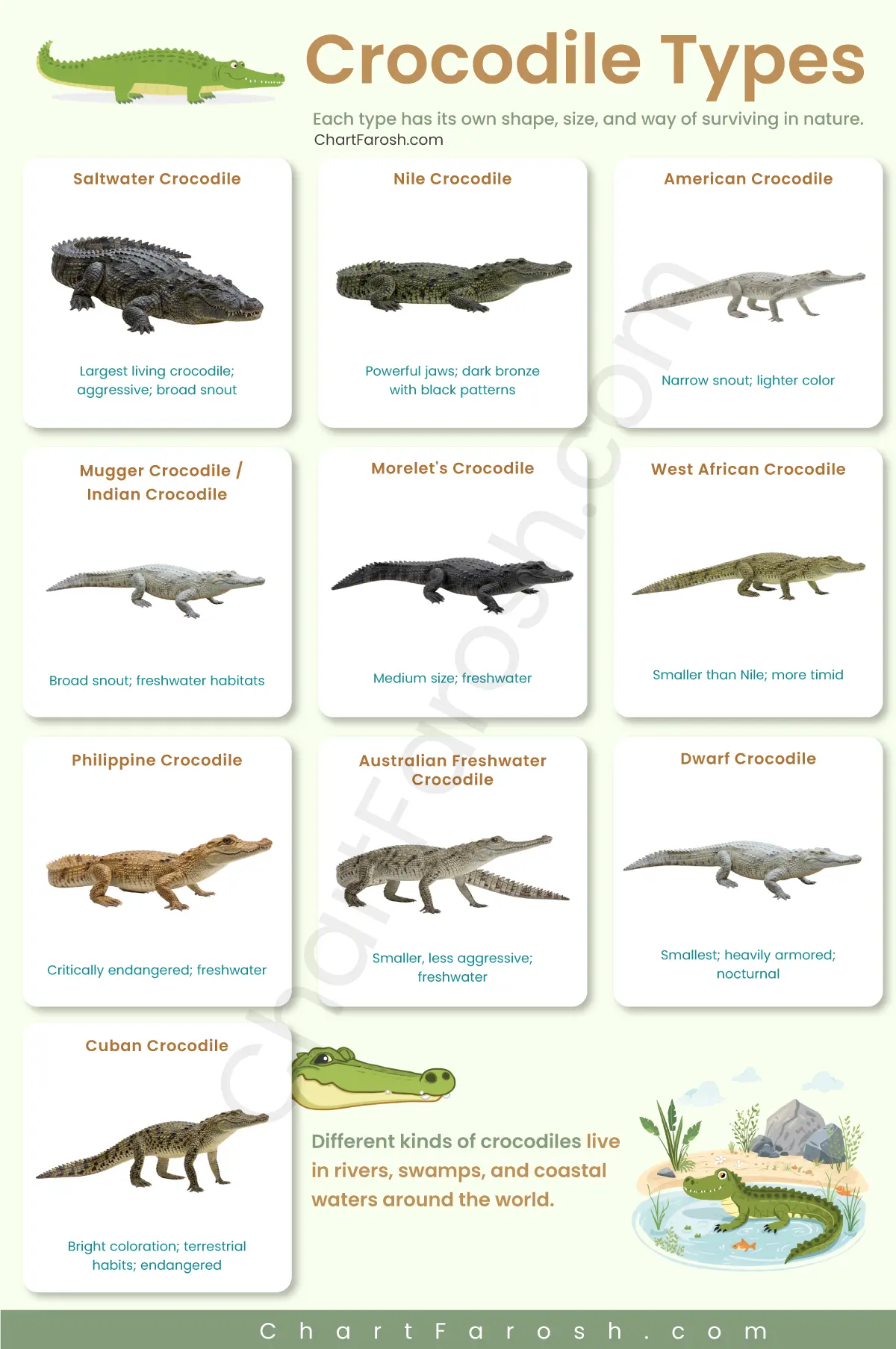
Table of Contents
What Is a Crocodile? Classification, Family, and Key Features
A crocodile is a large, semi-aquatic reptile in the order Crocodilia. True crocodiles sit in one family, Crocodylidae. The same order holds alligators, caimans, and the gharial, but those belong to other families.
Crocodiles are old. Their relatives shared the planet with dinosaurs more than 200 million years ago, and the basic body plan barely changed. The eyes, ears, and nostrils sit on top of the head. So a crocodile can lie almost fully underwater and still watch, listen, and breathe.
Most species share a few traits. A long, V-shaped snout. A fourth tooth on the lower jaw that stays visible when the mouth shuts. Bony plates, called osteoderms, set into the skin like armor. Many also have salt glands on the tongue, which let them cope with seawater.
| Feature | Detail |
| Order | Crocodilia |
| Family | Crocodylidae (true crocodiles) |
| Genera | 3 (Crocodylus, Mecistops, Osteolaemus) |
| Living species | About 14 to 18 |
| Typical lifespan | 30 to 70+ years |
| Diet | Carnivore (fish, birds, mammals) |
| First appeared | Over 200 million years ago |
Difference Between Crocodiles, Alligators, and Caimans
People mix these three up all the time. They look alike, but they are not the same. The quickest tell is the snout and the teeth.
| Trait | Crocodile | Alligator | Caiman |
| Snout shape | Narrow, V-shaped | Broad, U-shaped | Medium, pointed |
| Teeth when mouth shut | Top and bottom show | Only top teeth show | Mostly top teeth |
| Family | Crocodylidae | Alligatoridae | Alligatoridae |
| Salt tolerance | High (salt glands) | Low, prefers freshwater | Low, freshwater |
| Skin color | Olive or tan | Dark gray to black | Olive-brown |
| Main range | Africa, Asia, Australia, Americas | US southeast, China | Central and South America |
One more trick. Crocodiles have tiny sensory dots over the whole body. Alligators and caimans carry them only on the head. If you want more reptile comparisons, see our turtle species guide.
List of All Crocodile Species
Here is the full list of living crocodile species, with size, range, and conservation status. Status codes follow the IUCN Crocodile Specialist Group. Sizes show the largest length adults usually reach.
| Common Name | Scientific Name | Max Length | Region | Status |
| Saltwater crocodile | Crocodylus porosus | 6–7 m (20–23 ft) | N. Australia, SE Asia, Pacific | Least Concern |
| Nile crocodile | Crocodylus niloticus | 4–5 m (13–16 ft) | Sub-Saharan Africa | Least Concern |
| American crocodile | Crocodylus acutus | 4–5 m (13–16 ft) | Americas, Caribbean | Vulnerable |
| Orinoco crocodile | Crocodylus intermedius | Up to 5 m (16 ft) | Venezuela, Colombia | Critically Endangered |
| Mugger crocodile | Crocodylus palustris | 3–4 m (10–13 ft) | India, Pakistan, Sri Lanka, Iran | Vulnerable |
| Morelet’s crocodile | Crocodylus moreletii | 2–3 m (7–10 ft) | Mexico, Belize, Guatemala | Least Concern |
| Cuban crocodile | Crocodylus rhombifer | 2.5–3.5 m (8–11 ft) | Cuba (two swamps) | Critically Endangered |
| Siamese crocodile | Crocodylus siamensis | 2.5–3 m (8–10 ft) | Southeast Asia | Critically Endangered |
| Philippine crocodile | Crocodylus mindorensis | 1.5–3 m (5–10 ft) | Philippines | Critically Endangered |
| Australian freshwater crocodile | Crocodylus johnstoni | 2–3 m (7–10 ft) | Northern Australia | Least Concern |
| New Guinea crocodile | Crocodylus novaeguineae | 2.5–3.5 m (8–11 ft) | New Guinea | Least Concern |
| West African crocodile | Crocodylus suchus | 2–4 m (7–13 ft) | West and Central Africa | Not fully assessed |
| Slender-snouted crocodile | Mecistops cataphractus | Up to 4 m (13 ft) | West and Central Africa | Critically Endangered |
| Dwarf crocodile | Osteolaemus tetraspis | 1.5–1.9 m (5–6 ft) | West and Central Africa | Vulnerable |
Nile Crocodile: Largest African Crocodile
The Nile crocodile is Africa’s largest crocodile. It lives in rivers, lakes, and swamps across sub-Saharan Africa. Adults reach 4 to 5 meters, and a few old males pass 6 meters. It is a bold hunter and will take fish, antelope, zebra, and sometimes people. After the saltwater croc, it is the species most often tied to fatal attacks.
| Feature | Detail |
| Scientific name | Crocodylus niloticus |
| Length | 4–5 m (13–16 ft), rarely to 6 m |
| Weight | Up to 750 kg (1,650 lb) |
| Habitat | Rivers, lakes, marshes in sub-Saharan Africa |
| Diet | Fish, birds, large mammals |
| Conservation status | Least Concern |
Saltwater Crocodile: World’s Biggest Living Reptile
The saltwater crocodile is the biggest reptile alive. Males can reach 6 to 7 meters and weigh more than 1,000 kilograms. Its bite is the strongest ever measured in a living animal, about 3,700 psi, recorded by biologist Gregory Erickson. Australians call it the saltie. It swims far out to sea and turns up on islands across the Pacific.
| Feature | Detail |
| Scientific name | Crocodylus porosus |
| Length | 6–7 m (20–23 ft) for large males |
| Weight | 1,000+ kg (2,200+ lb) |
| Bite force | About 3,700 psi, the strongest of any animal |
| Habitat | Estuaries, coasts, rivers from India to Australia |
| Conservation status | Least Concern |
American Crocodile: Coastal Crocodile of the Americas
The American crocodile has a narrow snout and a pale, gray-green color. It likes brackish water, so you find it where rivers meet the sea. Its range runs from southern Florida down through Central America and into northern South America. In Florida it shares ground with the American alligator, which is rare for two crocodilians.
| Feature | Detail |
| Scientific name | Crocodylus acutus |
| Length | 4–5 m (13–16 ft) |
| Weight | Up to 500 kg (1,100 lb) |
| Habitat | Coastal lagoons, estuaries, mangroves |
| Range | Florida, Caribbean, Central and South America |
| Conservation status | Vulnerable |
Morelet’s Crocodile: Central American Freshwater Crocodile
Morelet’s crocodile is a medium freshwater species from Mexico, Belize, and Guatemala. It hides in swamps and slow rivers. Heavy hunting for its skin almost wiped it out by the 1970s. Protection helped it recover, and it now sits at Least Concern. It rarely passes 3 meters.
| Feature | Detail |
| Scientific name | Crocodylus moreletii |
| Length | 2–3 m (7–10 ft) |
| Habitat | Freshwater swamps, marshes, slow rivers |
| Range | Mexico, Belize, Guatemala |
| Main threat | Past skin hunting, habitat loss |
| Conservation status | Least Concern |
Orinoco Crocodile: Critically Endangered South American Crocodile
The Orinoco crocodile is one of the rarest large reptiles on Earth. It lives only in the Orinoco River basin in Venezuela and Colombia. Hunters killed huge numbers for their hides in the early 1900s. Only a few thousand are thought to remain in the wild. Big males can still reach 5 meters.
| Feature | Detail |
| Scientific name | Crocodylus intermedius |
| Length | Up to 5 m (16 ft) |
| Habitat | Freshwater rivers of the Orinoco basin |
| Range | Venezuela and Colombia |
| Main threat | Past hide hunting, egg collection |
| Conservation status | Critically Endangered |
Mugger Crocodile: Freshwater Crocodile of South Asia
The mugger, also called the marsh or Indian crocodile, has a broad snout that looks almost alligator-like. It lives in lakes, rivers, and man-made reservoirs across India, Pakistan, Sri Lanka, and Iran. The name comes from the Hindi word magar, meaning water monster. It often digs burrows to escape heat and drought.
| Feature | Detail |
| Scientific name | Crocodylus palustris |
| Length | 3–4 m (10–13 ft) |
| Habitat | Lakes, rivers, reservoirs, marshes |
| Range | India, Pakistan, Sri Lanka, Iran, Nepal |
| Behavior | Digs burrows; broad snout |
| Conservation status | Vulnerable |
Philippine Crocodile: Endangered Species of the Philippines
The Philippine crocodile is small and in serious trouble. It grows to about 1.5 to 3 meters and lives only in freshwater on a few Philippine islands. Wild numbers may sit near 100 adults. That makes it one of the most endangered crocodiles in the world. Local groups now guard nests so more hatchlings survive.
| Feature | Detail |
| Scientific name | Crocodylus mindorensis |
| Length | 1.5–3 m (5–10 ft) |
| Habitat | Freshwater rivers, ponds, marshes |
| Range | Philippines only |
| Wild population | Around 100 mature adults |
| Conservation status | Critically Endangered |
Siamese Crocodile: Southeast Asian Freshwater Crocodile
The Siamese crocodile is a freshwater species from Southeast Asia. It was thought nearly gone from the wild until small groups turned up in Cambodia and Laos. Many living Siamese crocodiles now sit on farms, often crossed with other species. Pure wild ones are rare and Critically Endangered.
| Feature | Detail |
| Scientific name | Crocodylus siamensis |
| Length | 2.5–3 m (8–10 ft) |
| Habitat | Slow rivers, lakes, swamps |
| Range | Cambodia, Laos, and parts of SE Asia |
| Main threat | Habitat loss, farming, hybridization |
| Conservation status | Critically Endangered |
Dwarf Crocodile: Smallest Crocodile in Africa
The dwarf crocodile is the smallest crocodile on the planet. It rarely passes 1.9 meters. It lives in the rainforests of West and Central Africa and hunts at night. Heavy bony armor protects its small body. People hunt it for bushmeat, which is the main threat, and the IUCN lists it as Vulnerable.
| Feature | Detail |
| Scientific name | Osteolaemus tetraspis |
| Length | 1.5–1.9 m (5–6 ft) |
| Habitat | Rainforest streams and swamps |
| Range | West and Central Africa |
| Behavior | Nocturnal; heavily armored |
| Conservation status | Vulnerable |
FAQs
How many types of crocodiles are there?
Scientists recognize around 14 to 18 living species in the family Crocodylidae, spread across three genera. The exact count shifts as DNA studies split some species apart.
What is the largest type of crocodile?
The saltwater crocodile. Big males reach 6 to 7 meters and can weigh more than a ton, which makes it the largest living reptile.
What is the smallest crocodile?
The dwarf crocodile of Africa. It rarely grows past 1.9 meters and is the smallest of all true crocodiles.
Which crocodiles are most dangerous to humans?
The saltwater and Nile crocodiles. Both are large, bold, and account for most fatal attacks on people each year.
What is the difference between a crocodile and an alligator?
A crocodile has a narrow, V-shaped snout and shows teeth from both jaws when its mouth is shut. An alligator has a broad, U-shaped snout and hides most of its lower teeth.
Are any crocodile species endangered?
Yes. Several are Critically Endangered, including the Philippine, Cuban, Orinoco, Siamese, and slender-snouted crocodiles. You can check the current status of any species on the IUCN Red List.
Where do crocodiles live?
True crocodiles live in tropical regions of Africa, Asia, Australia, and the Americas. They need warm water and stay near rivers, lakes, swamps, and coasts. For more reptile charts, see our full Animals Chart section.