
Types of Sea Turtles
Sea turtles have always fascinated me. Watching them glide effortlessly through the water feels both calming and humbling.
Beyond their elegance, what truly drew me in was the complexity of their world. I realized that understanding their types, sizes, habitats, and behaviors could reveal how delicately ocean life is balanced.
I began reading, observing, and even sketching different species, noticing their unique patterns and features.
Each type of sea turtle plays an essential role in marine ecosystems. Their diets, migration routes, and nesting habits are closely tied to ocean health.
Learning about them made me more environmentally conscious and eager to share what I discovered, so others could appreciate these incredible creatures too.
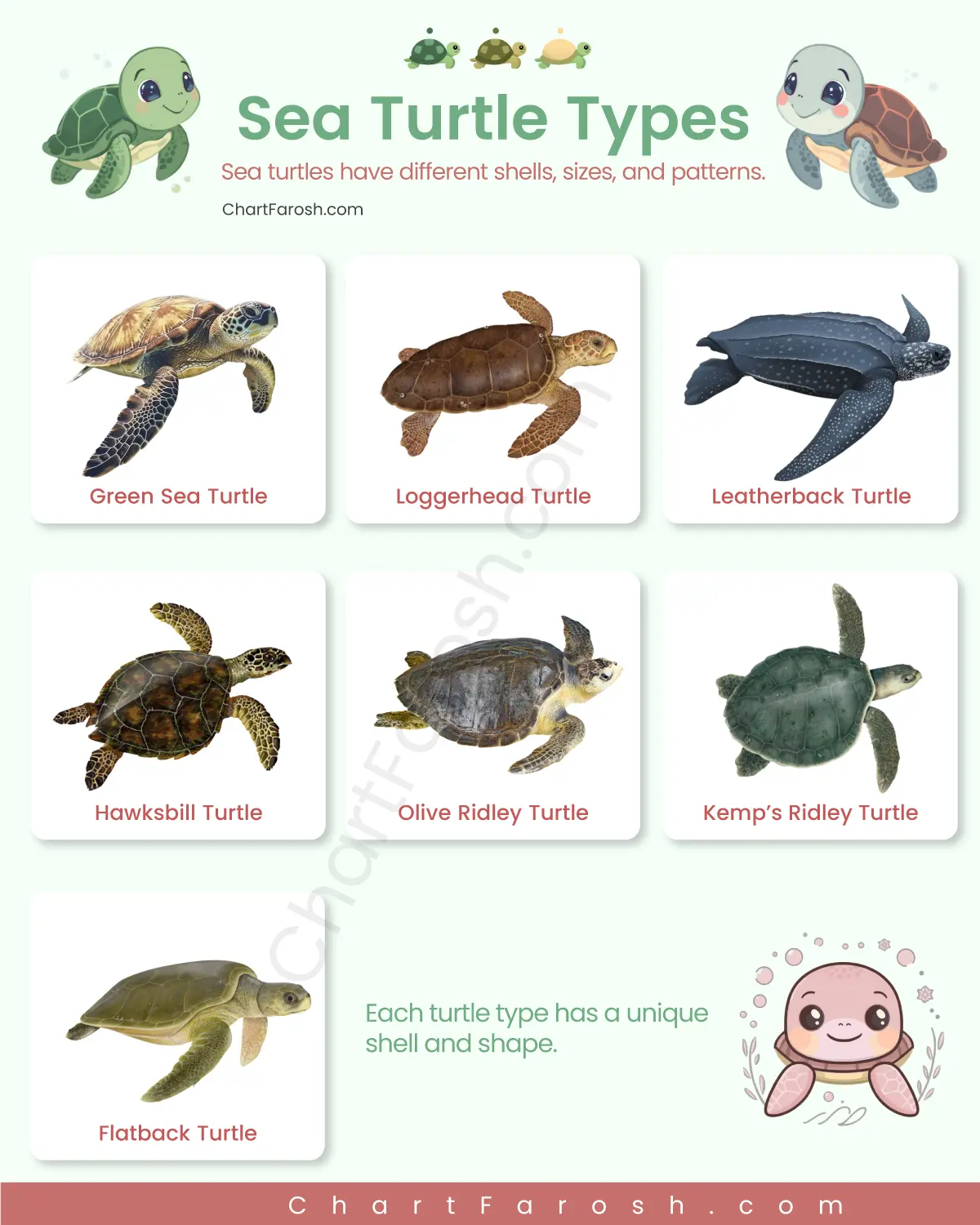
Table of Contents
Types of Sea Turtles Found Worldwide
Sea turtles are not all the same. Across the globe, there are seven recognized species, each with its own characteristics, behaviors, and preferred habitats.
Understanding the differences between these types of sea turtles is essential for both conservation efforts and general knowledge.
While some species, like the green turtle, are relatively common and well-studied, others, such as the hawksbill, are rarer and face more threats.
Each species has unique physical features such as shell shape, color, and size.
Diets also vary, with some species feeding mainly on seagrass or algae, while others focus on jellyfish or sponges.
For anyone interested in marine life, having a clear understanding of the different species can enrich your appreciation for these ancient ocean travelers and highlight the importance of protecting their environments.
| Sea Turtle Type | Key Features | Diet | Habitat | Fun Fact |
| Green Sea Turtle | Smooth shell, large body | Seagrass, algae | Tropical & subtropical oceans | Named for green body fat |
| Loggerhead Turtle | Large head, strong jaws | Crabs, shellfish | Coastal oceans worldwide | Powerful bite for hard prey |
| Leatherback Turtle | Soft, leathery shell | Jellyfish | Open oceans | Largest sea turtle species |
| Hawksbill Turtle | Narrow beak, patterned shell | Sponges | Coral reefs | Shell once used for jewelry |
| Olive Ridley Turtle | Small size, olive shell | Omnivorous | Warm ocean waters | Famous for mass nesting |
| Kemp’s Ridley Turtle | Smallest sea turtle | Crabs | Gulf of Mexico | Rarest sea turtle species |
| Flatback Turtle | Flat shell edges | Soft-bodied prey | Australian waters | Nests only in Australia |
Types of Sea Turtles by Size
Sea turtles vary dramatically in size, from the giant leatherbacks to smaller species like the Kemp’s ridley. Size often affects their behavior, diet, and survival strategies.
Larger turtles can travel longer distances and face fewer predators, while smaller turtles may be more agile but vulnerable to more threats. Measuring size helps researchers identify species and understand growth patterns.
Shell length, weight, and overall body dimensions provide critical data for conservation and scientific studies.
Understanding these differences is essential for anyone studying sea turtles or participating in conservation projects.
It also provides a clear perspective on how diverse these creatures are, despite being part of the same family.
| Species | Average Shell Length | Average Weight | Notes |
| Leatherback | 180 cm | 600 kg | Largest species |
| Green Turtle | 120 cm | 200 kg | Herbivore focus |
| Hawksbill | 95 cm | 80 kg | Shell with overlapping scales |
| Kemp’s Ridley | 70 cm | 45 kg | Smallest sea turtle |
Types of Sea Turtles by Habitat
Sea turtles inhabit a variety of marine environments, from open oceans to coastal reefs and estuaries. Habitat plays a crucial role in their survival, feeding, and reproduction.
Some species prefer shallow, warm waters, while others are capable of long migrations across oceans. Coral reefs, seagrass beds, sandy beaches, and even rocky coastlines are essential habitats that support feeding and nesting behaviors.
Knowing the preferred habitats of different species helps in conservation planning and protecting critical areas from human impact.
It also allows researchers to understand migration routes and nesting patterns. Habitat preferences can even influence shell shape, coloration, and behavior.
| Species | Main Habitat | Feeding Area | Nesting Location |
| Leatherback | Open ocean | Jellyfish | Sandy beaches |
| Green Turtle | Coastal waters | Seagrass beds | Tropical beaches |
| Hawksbill | Coral reefs | Sponges | Remote islands |
| Loggerhead | Nearshore waters | Crustaceans | Sandy shores |
Largest Sea Turtle Species
The largest sea turtles are truly impressive. The leatherback stands out not just for its size but also for its deep-diving abilities and long migrations.
These giants can weigh over 600 kilograms and grow more than six feet long. Their massive size provides protection against most predators but also comes with the challenge of high energy needs.
Despite their size, they can be surprisingly agile swimmers, traveling thousands of kilometers during migrations.
Observing these turtles in the wild is awe-inspiring. Their sheer presence commands attention and respect.
Studying their size also reveals insights into their life cycle, feeding habits, and vulnerability to environmental changes.
| Species | Average Length | Average Weight | Notable Feature |
| Leatherback | 180 cm | 600 kg | Largest sea turtle |
| Green Turtle | 120 cm | 200 kg | Herbivorous diet |
| Loggerhead | 110 cm | 135 kg | Strong jaws |
| Olive Ridley | 70 cm | 45 kg | Mass nesting behavior |
Smallest Sea Turtle Species
On the opposite end of the spectrum are the smallest sea turtles, like Kemp’s ridley. Despite their size, these turtles have a strong presence in the marine ecosystem.
Small species often rely on agility and group behaviors to evade predators. They grow quickly and mature early compared to larger species.
Their smaller size makes them more sensitive to environmental changes, and they often require protected nesting areas to thrive.
Studying these turtles provides insight into survival strategies, reproductive cycles, and habitat use.
| Species | Average Length | Average Weight | Notable Feature |
| Kemp’s Ridley | 70 cm | 45 kg | Smallest sea turtle |
| Olive Ridley | 75 cm | 50 kg | Mass nesting patterns |
| Hawksbill | 95 cm | 80 kg | Coral reef dweller |
| Flatback | 110 cm | 90 kg | Coastal preference |
Rarest Sea Turtles in the World
Some sea turtles are incredibly rare, making sightings special for researchers and enthusiasts.
Species like the Kemp’s ridley and the hawksbill face threats from habitat loss, poaching, and climate change. Rarity often means smaller populations and higher vulnerability.
Understanding which species are rare is vital for conservation prioritization. Protecting rare sea turtles involves safeguarding habitats, regulating fisheries, and supporting breeding programs.
Charts highlighting rare species help communicate urgency and importance to the public and policymakers.
| Species | Population Status | Main Threat | Conservation Efforts |
| Kemp’s Ridley | Critically Endangered | Egg poaching | Protected nesting |
| Hawksbill | Critically Endangered | Shell trade | Marine reserves |
| Olive Ridley | Vulnerable | Fishing nets | Hatchling releases |
| Flatback | Data Deficient | Coastal development | Monitoring programs |
Common & Popular Sea Turtle Species
Several species are commonly recognized and widely studied due to their prevalence and accessibility. Green turtles, loggerheads, and hawksbills are popular for ecotourism and educational programs.
Their frequent sightings make them ideal for research on migration, nesting, and feeding behaviors.
Their recognizable shapes, colors, and patterns make them favorites among divers, snorkelers, and photographers.
Understanding common species provides a foundation for learning about rarer types and supports ongoing conservation efforts.
Visual charts help categorize these popular species, showing key features for easy identification.
| Species | Distribution | Diet | Notable Behavior |
| Green Turtle | Tropical oceans | Seagrass | Herbivore |
| Loggerhead | Global | Crustaceans | Strong jaws |
| Hawksbill | Coral reefs | Sponges | Shell used in trade |
| Leatherback | Open oceans | Jellyfish | Deep diver |
Endangered Sea Turtle Species
Many sea turtles face critical threats, making them endangered or vulnerable. Overfishing, coastal development, pollution, and climate change significantly impact populations.
Leatherbacks, hawksbills, and Kemp’s ridleys are among the most endangered.
Protecting nesting beaches, regulating fishing practices, and reducing marine pollution are essential steps.
Educating the public about endangered species increases awareness and support for protection efforts.
Detailed charts allow for a quick visual understanding of which species need the most urgent attention.
| Species | IUCN Status | Main Threat | Conservation Measures |
| Leatherback | Vulnerable | Bycatch, habitat loss | Beach protection |
| Hawksbill | Critically Endangered | Illegal trade | Marine reserves |
| Kemp’s Ridley | Critically Endangered | Egg collection | Hatchling releases |
| Olive Ridley | Vulnerable | Fishing nets | Monitoring programs |
Types of Sea Turtles in Hawaii
Hawaii is home to several sea turtle species, mostly green turtles and hawksbills. These turtles are commonly spotted along the islands’ coasts and are an integral part of local marine ecosystems.
Hawaiian beaches provide vital nesting grounds, particularly for green turtles, which return year after year to lay eggs.
Conservation efforts in Hawaii are strong, with protected areas and public education programs helping reduce human impact.
The warm waters and abundant feeding grounds make Hawaii an important habitat for these species.
| Sea Turtle | Local Status | Key Trait | Fun Fact |
| Green Sea Turtle (Honu) | Most common | Large, smooth shell | Protected & sacred in Hawaiian culture |
| Hawksbill Turtle | Rare | Narrow beak | Critically endangered |
| Loggerhead Turtle | Occasional | Large head | Seen offshore, not near beaches |
| Olive Ridley Turtle | Rare visitor | Small size | Mostly pelagic |
Types of Sea Turtles in Australia
Australia hosts a wide variety of sea turtle species along its extensive coastline. Green turtles, loggerheads, flatbacks, and hawksbills are commonly found here.
The Great Barrier Reef and other marine reserves provide essential habitats. Australia has one of the most successful conservation programs, including monitoring nesting sites and protecting juveniles from predators.
Understanding which species are present helps prioritize conservation strategies. The diversity of habitats, from tropical reefs to sandy beaches, supports multiple species simultaneously, showcasing Australia’s importance in global sea turtle conservation.
| Sea Turtle | Commonality | Key Trait | Fun Fact |
| Green Sea Turtle | Very common | Herbivorous adult | Large nesting sites in GBR |
| Loggerhead Turtle | Common | Strong jaws | Long migrations |
| Leatherback Turtle | Uncommon | Leathery shell | Deep-diving species |
| Hawksbill Turtle | Common (north) | Beak-like mouth | Reef specialist |
| Olive Ridley Turtle | Rare | Small body | Nests in mass events |
| Flatback Turtle | Australia-only | Flat shell edges | Endemic to Australia |
Types of Sea Turtles in Oahu
Oahu’s coastal waters are home to green turtles and occasionally hawksbills. These species are frequently spotted by snorkelers and divers, making Oahu a hotspot for sea turtle observation.
The island’s beaches serve as important nesting grounds, especially for green turtles.
Conservation initiatives, such as signage on nesting beaches and local patrols, help protect these turtles from human disturbances.
Oahu’s unique combination of feeding grounds and nesting sites makes it a critical location for studying and supporting sea turtle populations.
| Sea Turtle | Frequency | Habitat | Fun Fact |
| Green Sea Turtle (Honu) | Very common | Reefs & beaches | Seen year-round |
| Hawksbill Turtle | Rare | Coral reefs | Mostly juveniles spotted |
| Loggerhead Turtle | Rare | Offshore waters | Not typical beach visitor |
Types of Sea Turtles in Florida
Florida is a major nesting site for several sea turtle species, including loggerheads, green turtles, and leatherbacks. Its warm waters and sandy beaches provide optimal conditions for egg laying.
Conservation programs in Florida are extensive, focusing on monitoring nests, rescuing injured turtles, and reducing artificial lighting that can disrupt hatchlings.
The diversity of habitats along Florida’s coastline supports multiple species, highlighting its global importance in sea turtle preservation.
| Sea Turtle | Nesting Status | Key Trait | Fun Fact |
| Loggerhead Turtle | Most common nester | Large head | Florida is global hotspot |
| Green Sea Turtle | Common nester | Plant-based diet | Nesting increasing |
| Leatherback Turtle | Seasonal | Very large body | First to nest each year |
| Hawksbill Turtle | Rare | Sharp beak | Reef-dependent |
| Kemp’s Ridley Turtle | Very rare | Smallest species | Rarest sea turtle worldwide |
FAQs
What do different types of sea turtles eat?
Different species have varied diets. Green turtles are primarily herbivores, feeding on seagrass and algae.
How long do sea turtles live?
Most sea turtles can live 50 to 100 years, depending on the species and environmental conditions.
Are sea turtles endangered or protected?
Many sea turtle species are endangered or vulnerable due to habitat loss, pollution, fishing practices, and climate change. Conservation laws, marine reserves, and international treaties help protect them worldwide.
Do sea turtles migrate long distances?
Yes, sea turtles are known for their long migrations. Some species, like leatherbacks, travel thousands of kilometers across oceans to reach feeding or nesting grounds.
Can sea turtles live in freshwater?
Sea turtles are primarily marine animals, but some species, such as freshwater-adapted sliders, can survive in rivers and lakes. True sea turtles, however, rely on saltwater habitats.


One Comment