Types of Owls List with Pictures
Owls are fascinating creatures that have captured human curiosity for centuries. I became interested in them while trying to understand the wildlife around my backyard.
At night, I would hear mysterious calls and watch shadows glide silently across the trees. Curious, I started reading about all owl types and their habits.
I wanted to know which types of owls with pictures could be found in my region, what they ate, and how they behaved.
Studying their behaviors, hunting techniques, and nesting patterns revealed just how adaptable and skilled they are as nocturnal hunters.
Some owls are strikingly large and powerful, while others are small, almost invisible among branches.
Learning about different types of owl species, their names, and creating a mental printable list of owls helped me understand the differences between species, from the common barn owl to rarer owls like the snowy owl or the elf owl.
Each species has unique features, calls, and adaptations that make them perfectly suited to their habitats.
Owls are not just mysterious nighttime hunters, they are integral parts of their ecosystems, controlling rodent populations and maintaining balance in the wild.
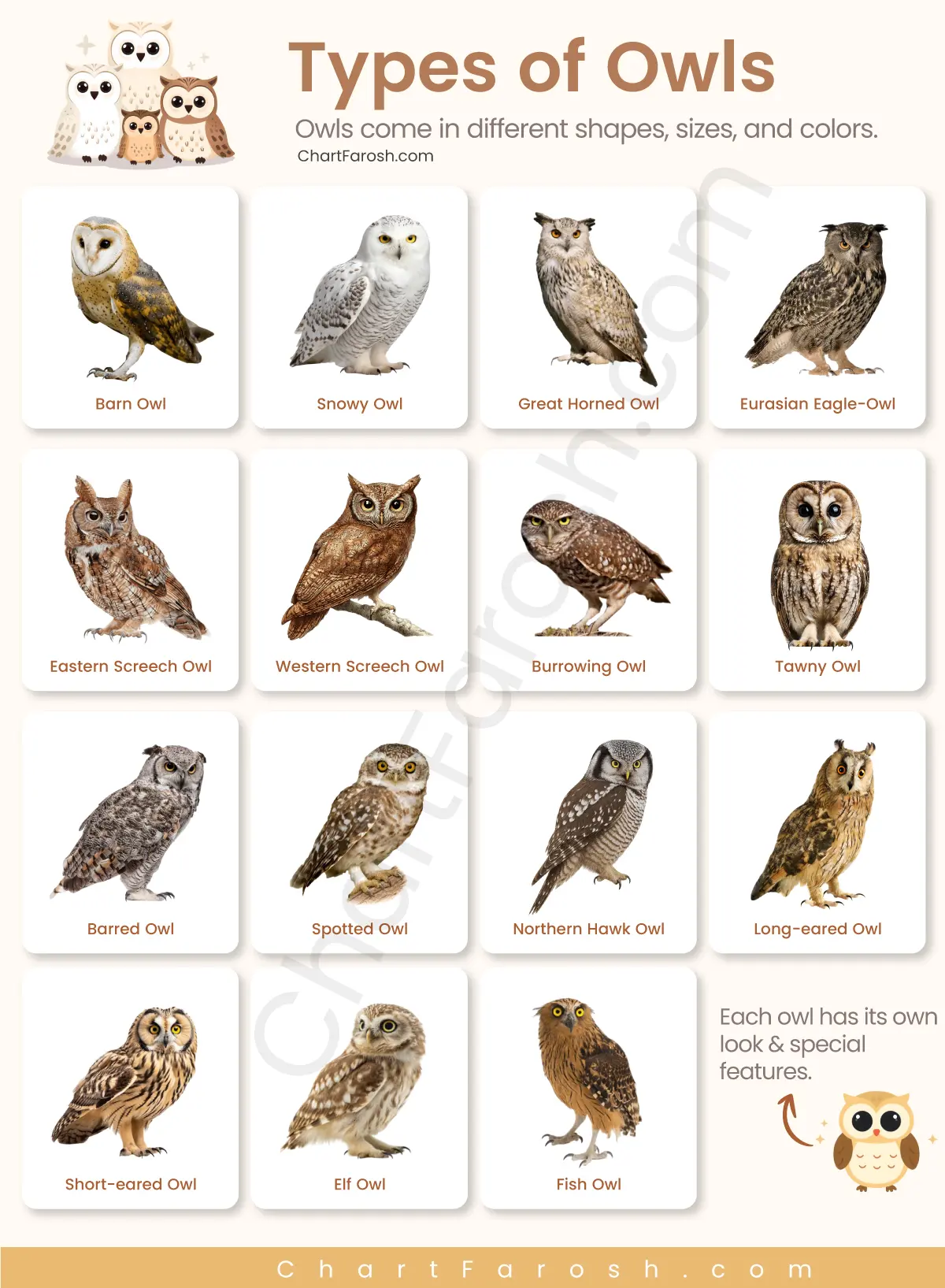
Table of Contents
Types of Owls
Owls are a diverse group of birds with over 200 species worldwide, each with unique characteristics and behaviors.
Types of owl and their names range from large, iconic species like the great horned owl to tiny species like the elf owl.
Some species have striking facial discs, unique coloration, or remarkable camouflage abilities. Studying types of owl with pictures helps visualize these differences, while compiling a list of owl breeds or a printable list of owl species can make tracking them easier.
Owls can inhabit forests, grasslands, deserts, and even urban areas, demonstrating their incredible adaptability.
Each type of owl species has evolved specialized hunting skills, including silent flight, acute hearing, and night vision.
Understanding the diversity of owls is not only fascinating for enthusiasts but also vital for conservation efforts, as it highlights which species are rare, endangered, or thriving.
With so many all owl types, each bird offers insight into the richness of the avian world and the complexity of nocturnal ecosystems.
| Owl Name | Key Feature | Habitat / Region |
| Barn Owl | Heart-shaped face; excellent hearing | Farmland, grasslands, worldwide |
| Snowy Owl | White feathers; active during daytime | Arctic tundra (North America, Europe, Asia) |
| Great Horned Owl | Large ear tufts; powerful hunter | Forests, deserts, North & South America |
| Eurasian Eagle-Owl | One of the largest owls; orange eyes | Mountains, forests (Europe & Asia) |
| Eastern Screech Owl | Small size; excellent camouflage | Woodlands, North America |
| Western Screech Owl | Small owl; mottled gray or brown | Forests, western North America |
| Burrowing Owl | Lives in underground burrows | Grasslands, Americas |
| Tawny Owl | Brown feathers; strong territorial calls | Woodlands, Europe & Asia |
| Barred Owl | Vertical brown stripes; hooting call | Forests, North America |
| Spotted Owl | Dark eyes; endangered species | Old-growth forests, North America |
| Northern Hawk Owl | Hunts like a hawk; long tail | Boreal forests, Northern Hemisphere |
| Long-eared Owl | Long ear tufts; slender body | Woodlands, Europe, Asia, North America |
| Short-eared Owl | Short ear tufts; flies in open fields | Grasslands, worldwide |
| Elf Owl | World’s smallest owl | Desert regions, southwestern USA & Mexico |
| Fish Owl | Feeds mainly on fish | Rivers and wetlands, Asia |
Largest Owl Species
Some owls are truly remarkable for their size. The largest owls are powerful hunters, capable of taking prey much larger than themselves.
These owls have broad wingspans that allow for silent flight and strong talons to catch animals like rabbits or even small deer.
Observing the largest owls shows how they dominate their habitats and play a crucial role in controlling populations of other wildlife.
Types of owl charting by size highlights these differences and helps enthusiasts compare the largest species with smaller ones.
Their impressive wingspans and robust build make them icons among all owl types.
| Owl Species | Average Length | Wingspan | Distinctive Features |
| Blakiston’s Fish Owl | 70 cm | 2 m | Powerful build, fish hunter |
| Eurasian Eagle-Owl | 66–75 cm | 1.6–2 m | Ear tufts, large eyes |
| Great Horned Owl | 46–63 cm | 1.2–1.5 m | Prominent ear tufts, versatile hunter |
| Snowy Owl | 52–71 cm | 1.3–1.5 m | White plumage, Arctic hunter |
Smallest Owl Species
At the other end of the spectrum are the tiny owls, which are almost delicate in size yet fully equipped for hunting.
Smallest owls, like the elf owl, often inhabit deserts or forest edges and prey on insects and small rodents. Despite their size, they have incredible hearing and night vision, allowing them to hunt effectively.
A types of owl chart for the smallest species demonstrates how even diminutive owls are perfectly adapted to their environments.
Observing these small species reveals their energy, agility, and vital role in ecosystems, despite often going unnoticed compared to their larger relatives.
| Owl Species | Average Length | Weight | Distinctive Features |
| Elf Owl | 13–15 cm | 40 g | Tiny, nocturnal insect hunter |
| Northern Pygmy Owl | 15–18 cm | 60 g | Active hunter, daytime activity |
| Little Owl | 21 cm | 180 g | Camouflaged, small woodland owl |
| Ferruginous Pygmy Owl | 14–17 cm | 50 g | Tropical regions, fast hunter |
Rarest Owls in the World
Some owls are extremely rare, often restricted to very specific habitats or facing threats that limit their populations.
Studying rare owls highlights the importance of conservation and monitoring biodiversity. These species often have unique physical characteristics, calls, or hunting behaviors that set them apart from common owls.
Types of owl charting for rare species helps visualize their differences and understand which species need protection.
Observing these owls in photographs or in the wild is a reminder of how delicate ecosystems can be and how vital each species is to the balance of its environment.
| Owl Species | Habitat | Approximate Population | Distinctive Features |
| Forest Owlet | India | <250 | Tiny, elusive, forest specialist |
| Blakiston’s Fish Owl | Russia, Japan | <1,500 | Largest owl, fish hunter |
| Spotted Owl | North America | ~7,000 | Forest-dependent, threatened |
| Boreal Owl | Northern forests | Rare | Small, secretive, excellent hunter |
Common & Popular Owl Species
Some owl species are widely known and easily spotted due to their adaptability or striking appearance. Common owls, like the barn owl, are familiar to people in both rural and urban areas.
Studying popular owls helps enthusiasts understand general behaviors, hunting patterns, and habitats.
These species are often used in educational programs or featured in documentaries.
Types of owl charting for common species allows easy comparison of sizes, habitats, and distinctive traits, giving a clear overview of owls that are widespread versus those that are rare.
| Owl Species | Habitat | Average Population | Key Behavior |
| Barn Owl | Global | Common | Silent hunter, rodent control |
| Great Horned Owl | North & South America | Common | Versatile hunter, prominent ear tufts |
| Eastern Screech Owl | North America | Common | Small, adaptable, nocturnal |
| Snowy Owl | Arctic regions | Seasonal | Migratory, hunts lemmings |
Nocturnal vs Diurnal Owls
Most owls are nocturnal, hunting and being active during the night. However, some species are diurnal or crepuscular, active during the day or twilight hours.
Nocturnal owls have specialized adaptations like large eyes and acute hearing, allowing them to hunt in low-light conditions.
Diurnal owls often rely more on vision and can be easier to observe in natural settings.
A type of owl chart comparing nocturnal and diurnal species helps illustrate these behavioral differences and shows how all owl types have evolved for specific ecological niches.
| Owl Species | Activity Pattern | Habitat | Hunting Strategy |
| Barn Owl | Nocturnal | Grasslands, farms | Hunts rodents silently |
| Snowy Owl | Diurnal | Arctic tundra | Hunts lemmings in daylight |
| Eastern Screech Owl | Nocturnal | Woodlands | Ambush hunter |
| Burrowing Owl | Diurnal/Crepuscular | Grasslands | Active during day, insects & small rodents |
Types of Owls in Michigan
Michigan’s extensive forests, wetlands, and Great Lakes shorelines provide excellent habitats for a wide variety of owl species.
Types of owls in Michigan range from small screech owls, which are often heard more than seen, to large predators like the great horned owl and barred owl.
Snowy owls visit Michigan during winter, particularly in northern and open areas, while other species like long-eared and short-eared owls inhabit grasslands and marshes.
Observing types of owl species in Michigan allows bird enthusiasts to study hunting behaviors, seasonal migration, and habitat preferences.
A printable list of owl species and types of owl with pictures can assist in identifying these birds in different regions of the state.
| Owl Name | Feature |
| Great Horned Owl | Large owl with ear tufts; year-round resident |
| Barred Owl | Brown-and-white striped; prefers forests |
| Eastern Screech Owl | Small; excellent camouflage; common |
| Northern Saw-whet Owl | Very small; secretive; migratory |
| Snowy Owl | White plumage; winter visitor from Arctic |
| Long-eared Owl | Long ear tufts; prefers wooded areas |
| Short-eared Owl | Open fields and marshes; daytime hunter |
| Great Gray Owl | Very large; rare winter visitor |
Types of Owls in Indiana
Indiana’s mix of forests, wetlands, and agricultural lands makes it home to a rich variety of owl species.
Types of owls in Indiana include both small species, like the eastern screech owl, and larger, more dominant species, such as the great horned owl.
Barn owls are also present, often nesting in barns, silos, and other structures near farmland.
Nocturnal owls dominate the night, using their keen hearing and silent flight to hunt rodents, while some species are crepuscular, active during dawn and dusk.
Seasonal visitors, such as the snowy owl, occasionally appear during harsh winters, providing unique opportunities for observation.
| Owl Name | Feature |
| Great Horned Owl | Powerful predator; statewide resident |
| Barred Owl | Common forest owl; loud hooting calls |
| Eastern Screech Owl | Small owl; gray or reddish color |
| Barn Owl | Heart-shaped face; farmland habitats |
| Long-eared Owl | Rare; prefers dense woods |
| Short-eared Owl | Open grasslands; active at dusk |
| Snowy Owl | Rare winter visitor |
Types of Owls in Illinois
Illinois hosts a remarkable range of owl species thanks to its combination of woodlands, prairies, and suburban areas.
Types of owls in Illinois include familiar species like the barn owl, eastern screech owl, and great horned owl, which adapt well to human presence and are often seen hunting near farmlands.
Barred owls are also common in Illinois forests, known for their distinctive calls and secretive nature.
Seasonal visitors, like the snowy owl, sometimes arrive during winter, adding to the diversity of all owl types in the state.
Studying these owls provides insight into prey availability, habitat use, and how urbanization affects nocturnal predators.
| Owl Name | Feature |
| Great Horned Owl | Most common large owl; year-round |
| Barred Owl | Forest-dwelling; expanding range |
| Eastern Screech Owl | Small, adaptable; common |
| Barn Owl | Agricultural areas; declining population |
| Long-eared Owl | Uncommon; wooded habitats |
| Short-eared Owl | Grasslands and marshes |
| Snowy Owl | Irregular winter visitor |
Types of Owls in Ontario (Canada)
Ontario’s diverse landscapes, from dense boreal forests to wetlands and farmlands, provide ideal habitats for a wide variety of owl species.
Types of owls in Ontario include both nocturnal hunters, like the great horned owl and barred owl, as well as species that are active during the day, such as the snowy owl during winter migrations.
These owls have adapted to different environments; some prefer forested areas for nesting, while others thrive in open fields hunting small mammals.
Birdwatchers in Ontario often report sightings of screech owls and long-eared owls, while rarer species like the northern hawk-owl can occasionally be spotted in remote northern regions.
| Owl Name | Feature |
| Great Horned Owl | Provincial bird of Ontario; year-round |
| Barred Owl | Common in southern forests |
| Eastern Screech Owl | Small owl; southern Ontario |
| Northern Saw-whet Owl | Small; migratory; widespread |
| Snowy Owl | Arctic species; winter visitor |
| Great Gray Owl | Very large; northern forests |
| Boreal Owl | Northern species; rare in south |
| Long-eared Owl | Forest edges; uncommon |
| Short-eared Owl | Open fields and wetlands |
FAQs
Where do owls live?
Owls inhabit diverse environments worldwide, including forests, grasslands, deserts, mountains, and even urban areas.
What do different types of owls eat?
Most owls eat small mammals, insects, and birds. Some larger species may hunt fish or larger prey, depending on their habitat.
How long do owls live?
Owls generally live 5–25 years in the wild, depending on species, with larger species tending to live longer.
Can owls see in complete darkness?
Owls cannot see in complete darkness, but their large eyes and excellent night vision allow them to see well in very low light conditions.
Are owls endangered or protected?
Some owl species are endangered or threatened due to habitat loss and human activities, while others are widespread and protected by law in many regions.