Types of Sharks
Sharks are some of the most fascinating creatures in the ocean, and learning about them goes far beyond the fearsome image we often see in movies.
Their diversity alone is remarkable, sharks come in all shapes and sizes, from tiny dwarf species that could fit in your hand to massive predators that dominate entire marine ecosystems.
I became curious about sharks while researching ocean life, especially the variety of types of shark with pictures I could find and the scientific distinctions between them.
I wanted to understand their behavior, how different species hunt, and why some are more common while others are extremely rare.
Exploring types of shark species introduced me to an entirely new world, from harmless reef sharks to the largest predators like the great white and whale shark.
Compiling a list of shark breeds and a printable list of shark names helped me organize this information in a way that made sense.
What amazed me most is how each species is perfectly adapted to its environment, whether it’s the deep open ocean, coral reefs, or even river systems.
Sharks are not just predators, they are key players in maintaining healthy marine ecosystems and have incredible biological adaptations that make them some of the most successful creatures on the planet.
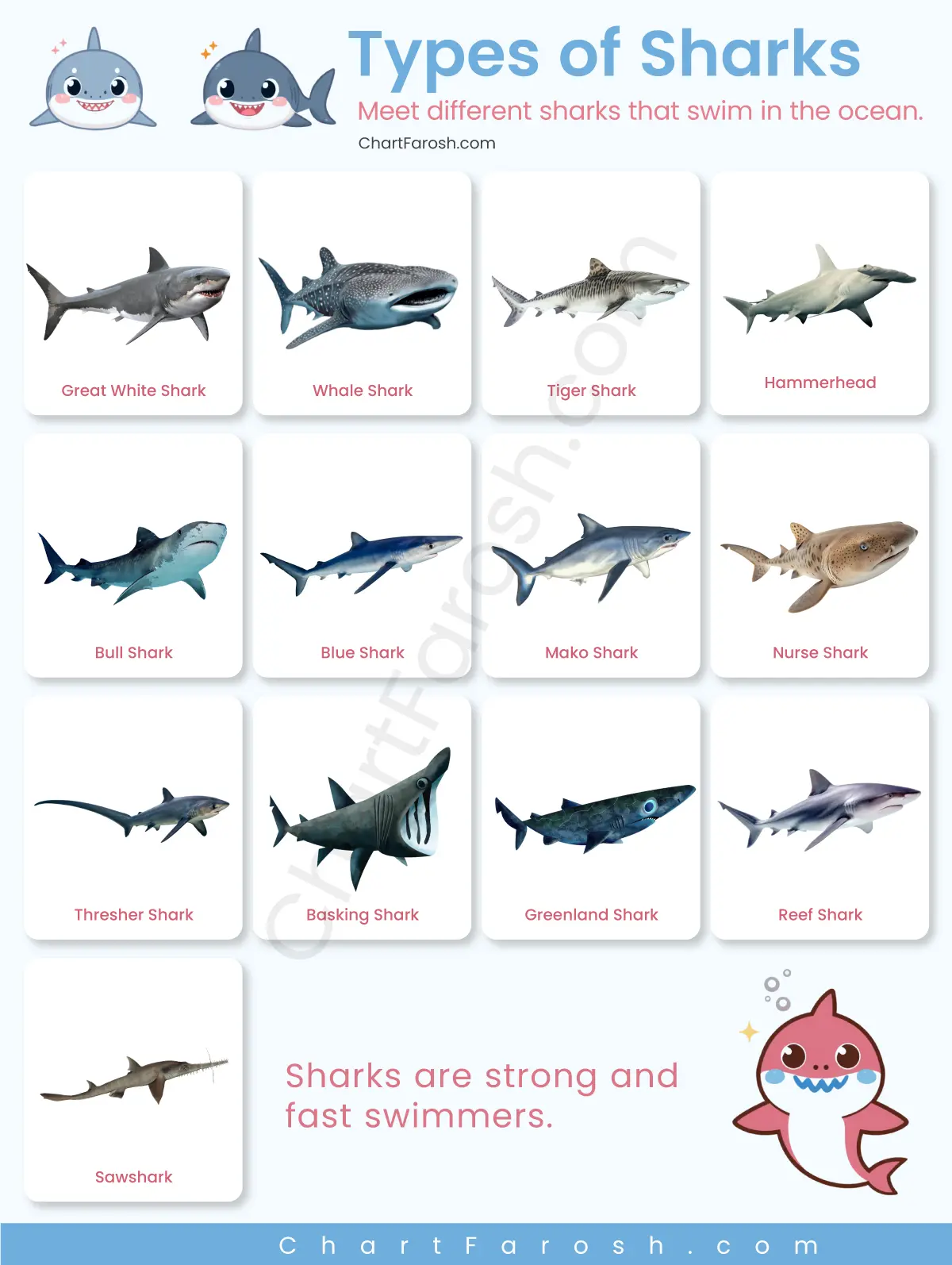
Table of Contents
Types of Sharks And Their Names
Sharks are one of the oldest and most diverse groups of animals in the ocean, with more than 500 recognized types of shark species.
They vary significantly in size, appearance, behavior, and habitat, which makes studying them both challenging and exciting.
Types of shark and their names include iconic species like the great white shark, tiger shark, and hammerhead, as well as lesser-known species such as the frilled shark or the goblin shark.
Understanding different types of sharks with pictures is a great way to visualize these differences, from body shape and coloration to fin structure and teeth.
Some sharks are bottom dwellers, while others are open-water hunters or reef dwellers. Many people compile a list of shark breeds or a printable list of shark species to help track this diversity.
Each species plays a unique role in its ecosystem, whether controlling fish populations, maintaining coral health, or even supporting tourism.
Sharks have evolved over millions of years, and their adaptations, from specialized senses to incredible swimming abilities, make them some of the most impressive animals in the ocean.
| Shark Type | Scientific Name | Size Range | Habitat | Notable Traits |
| Great White Shark | Carcharodon carcharias | 15–20 ft | Coastal & open oceans | Apex predator, powerful bite |
| Whale Shark | Rhincodon typus | 18–40 ft | Tropical oceans | Largest shark, filter feeder |
| Tiger Shark | Galeocerdo cuvier | 10–14 ft | Warm coastal waters | Striped body, opportunistic feeder |
| Hammerhead Shark | Sphyrna species | 10–20 ft | Coastal & offshore | Hammer-shaped head, enhanced vision |
| Bull Shark | Carcharhinus leucas | 7–11 ft | Coastal & rivers | Can live in freshwater |
| Blue Shark | Prionace glauca | 6–12 ft | Open ocean | Slender body, deep blue color |
| Mako Shark | Isurus species | 10–13 ft | Open ocean | Fastest shark species |
| Nurse Shark | Ginglymostoma cirratum | 7–10 ft | Coastal reefs | Bottom-dwelling, docile nature |
| Thresher Shark | Alopias species | 10–20 ft | Open ocean | Long tail used for hunting |
| Basking Shark | Cetorhinus maximus | 20–26 ft | Temperate oceans | Second-largest shark, filter feeder |
| Greenland Shark | Somniosus microcephalus | 8–21 ft | Arctic waters | Extremely long lifespan |
| Reef Shark | Carcharhinus species | 5–8 ft | Coral reefs | Common tropical shark |
| Sawshark | Pristiophoridae | 3–5 ft | Deep waters | Saw-like snout |
Largest Shark Species
Sharks vary enormously in size, and learning about the largest species can be truly mind-blowing.
Some sharks, like the whale shark, are gentle giants, growing over 12 meters in length and feeding mostly on plankton.
Others, such as the great white shark, are apex predators with powerful jaws and incredible hunting abilities.
Knowing the largest sharks helps scientists study ocean food chains and migration patterns, as these massive animals require enormous amounts of food and vast ranges to survive.
Types of shark charting by size also makes it easier to visualize how these giants compare to smaller species in the ocean.
Observing the largest sharks in the wild, even from a safe distance, demonstrates the scale and power of these incredible creatures.
| Shark Species | Average Length | Average Weight | Distinctive Features |
| Whale Shark | 12 m | 15,000 kg | Filter feeder, largest shark |
| Great White Shark | 6 m | 2,000 kg | Apex predator, sharp teeth |
| Basking Shark | 10 m | 6,000 kg | Slow-moving filter feeder |
| Tiger Shark | 5 m | 1,400 kg | Striped pattern, wide diet |
Smallest Shark Species
Not all sharks are giants. Some are surprisingly small, demonstrating the incredible range of shark diversity.
The smallest sharks, like the dwarf lanternshark, can be less than 20 centimeters long and often inhabit deep-sea environments.
Despite their size, these sharks play important roles in marine ecosystems, feeding on tiny prey and serving as indicators of ocean health.
Learning about the smallest sharks in a types of shark chart helps us appreciate that sharks are not just predators, they are diverse species with adaptations for every corner of the ocean.
Many small sharks are elusive and rarely seen, making them even more fascinating to marine biologists and enthusiasts alike.
| Shark Species | Average Length | Average Weight | Distinctive Features |
| Dwarf Lanternshark | 20 cm | 150 g | Bioluminescent, deep-sea dweller |
| Pygmy Shark | 25 cm | 200 g | Small, deep ocean habitat |
| Spined Pygmy Shark | 30 cm | 250 g | Tiny predator, spine near dorsal fin |
| Australian Swell Shark | 60 cm | 1.5 kg | Inflates body when threatened |
Rarest Sharks in the World
Some sharks are extremely rare and rarely encountered, either because they inhabit remote regions or have tiny populations.
Studying rare sharks helps scientists understand biodiversity and the challenges these species face, such as habitat loss and climate change.
Rare sharks often have unique physical features, such as unusual teeth, elongated snouts, or bioluminescent bodies.
Creating a types of shark chart for rare species highlights how special and vulnerable these sharks are. Even though they may not be as well-known as great whites or tiger sharks, they are equally important to maintaining ocean health.
| Shark Species | Habitat | Approximate Population | Distinctive Traits |
| Megamouth Shark | Deep waters | Unknown | Huge mouth, rare sightings |
| Goblin Shark | Deep sea | Unknown | Pink skin, long snout |
| Frilled Shark | Deep oceans | Rare | Ancient-looking, eel-like body |
| Green Lanternshark | Deep sea | Rare | Bioluminescent, tiny size |
Common & Popular Shark Species
Some sharks are well-known due to their size, behavior, or media coverage. Popular species like the great white shark or bull shark are familiar to most people and are often studied for safety, conservation, and scientific purposes.
Common sharks are easier to observe in their natural habitats, and many people track them through whale and shark-watching tours.
These sharks are also important for tourism and marine education, as they give people a closer look at ocean predators without harming them.
| Shark Species | Habitat | Average Population | Key Behavior |
| Great White Shark | Global | ~3,500 | Apex predator, hunts seals |
| Bull Shark | Tropical & subtropical waters | Unknown | Can enter freshwater rivers |
| Blacktip Reef Shark | Indo-Pacific | Common | Shallow reef dweller |
| Sand Tiger Shark | Coastal waters | Moderate | Feeds mainly on fish |
Dangerous Sharks vs Harmless Sharks
Not all sharks pose a threat to humans. Some species, like the great white, tiger, and bull sharks, are potentially dangerous due to their size and feeding habits.
However, the majority of sharks are harmless, feeding on plankton, small fish, or squid.
Understanding the difference between dangerous sharks and harmless sharks helps reduce fear and encourages safe coexistence.
A types of shark chart comparing these species also shows that sharks are not mindless predators, they are specialized and adapted to their ecological niches.
| Shark Species | Danger Level | Average Size | Diet |
| Great White Shark | High | 6 m | Seals, fish |
| Tiger Shark | High | 5 m | Fish, turtles, birds |
| Whale Shark | Low | 12 m | Plankton |
| Nurse Shark | Low | 4 m | Small fish, crustaceans |
Endangered Shark Species
Many shark species are endangered due to overfishing, habitat loss, and finning. Protecting these sharks is critical for maintaining healthy oceans. Endangered sharks vary from large apex predators to smaller, rare species.
Tracking their population numbers and habitat through a types of shark chart helps scientists monitor conservation progress.
Raising awareness about endangered sharks also highlights the importance of sustainable fishing practices and marine protection initiatives.
| Shark Species | Habitat | Status | Threats |
| Scalloped Hammerhead | Tropical & subtropical | Endangered | Overfishing, finning |
| Oceanic Whitetip | Open ocean | Critically Endangered | Bycatch, finning |
| Great Hammerhead | Tropical & subtropical | Vulnerable | Overfishing |
| Basking Shark | Temperate seas | Vulnerable | Bycatch, habitat degradation |
Types of Sharks in Australia
Australia’s waters host a rich variety of shark species due to its diverse marine environments. From coral reefs to deep ocean trenches, sharks here include both small reef sharks and large predatory species.
Types of sharks in Australia show how sharks adapt to both tropical and temperate waters, and the region is known for both popular and rare species.
Shark-watching programs and conservation initiatives highlight the diversity of these animals while promoting safe human interactions.
| Common Name | Scientific Name | Size (Adult) | Traits |
| Great White Shark | Carcharodon carcharias | 11–20 ft (3.5–6 m) | Large, powerful, serrated teeth, coastal & offshore |
| Tiger Shark | Galeocerdo cuvier | 10–14 ft (3–4.3 m) | Striped body, opportunistic feeder |
| Bull Shark | Carcharhinus leucas | 7–11 ft (2.1–3.4 m) | Aggressive, tolerates freshwater |
| Spinner Shark | Carcharhinus brevipinna | 6–10 ft (1.8–3 m) | Leaps while spinning, slender body |
| Blacktip Shark | Carcharhinus limbatus | 5–8 ft (1.5–2.4 m) | Black fin tips, fast swimmer |
| Great Hammerhead | Sphyrna mokarran | 12–20 ft (3.7–6 m) | Large hammer-shaped head |
| Dusky Shark | Carcharhinus obscurus | 9–14 ft (2.7–4.3 m) | Slow-growing, coastal |
| Port Jackson Shark | Heterodontus portusjacksoni | 3–5 ft (1–1.5 m) | Blunt head, harmless, bottom-dweller |
| Zebra Shark | Stegostoma tigrinum | 8–11 ft (2.5–3.5 m) | Spotted as adult, long tail |
| Blue Shark | Prionace glauca | 6–12 ft (1.8–3.8 m) | Slim, deep blue color, pelagic |
Types of Sharks in Florida
Florida’s warm waters and extensive coastline make it a hotspot for shark diversity. From shallow coastal areas to deep ocean habitats, Florida hosts species ranging from harmless reef sharks to potentially dangerous bull and tiger sharks.
Studying types of sharks in Florida provides insight into seasonal migrations, breeding grounds, and the interaction between humans and sharks.
Many of these species are critical for local ecosystems and help maintain healthy fish populations.
| Common Name | Scientific Name | Size (Adult) | Traits |
| Bull Shark | Carcharhinus leucas | 7–11 ft (2.1–3.4 m) | Freshwater tolerance, aggressive |
| Blacktip Shark | Carcharhinus limbatus | 5–8 ft (1.5–2.4 m) | Seasonal migrations, coastal |
| Spinner Shark | Carcharhinus brevipinna | 6–10 ft (1.8–3 m) | Aerial spinning jumps |
| Tiger Shark | Galeocerdo cuvier | 10–14 ft (3–4.3 m) | Broad head, eats varied prey |
| Silky Shark | Carcharhinus falciformis | 8–11 ft (2.4–3.4 m) | Smooth skin, offshore |
| Scalloped Hammerhead | Sphyrna lewini | 10–14 ft (3–4.3 m) | Scalloped head edge, schooling |
| Sandbar Shark | Carcharhinus plumbeus | 6–8 ft (1.8–2.4 m) | Tall dorsal fin |
| Lemon Shark | Negaprion brevirostris | 8–10 ft (2.4–3 m) | Yellow-brown color, shallow waters |
| Whale Shark | Rhincodon typus | 18–40 ft (5.5–12 m) | Largest fish, filter feeder |
| Great White Shark | Carcharodon carcharias | 11–20 ft (3.5–6 m) | Rare, migratory |
Types of Sharks in Hawaii
Hawaii is home to a fascinating mix of sharks, including both reef dwellers and large pelagic species. The region’s unique ocean currents and coral reefs provide excellent habitats for species such as tiger sharks, reef sharks, and hammerheads.
Types of sharks in Hawaii demonstrate how sharks adapt to isolated island environments while supporting local marine ecosystems.
Conservation and research efforts are essential here, as some shark populations are sensitive to overfishing and habitat changes.
| Common Name | Scientific Name | Size (Adult) | Traits |
| Tiger Shark | Galeocerdo cuvier | 10–14 ft (3–4.3 m) | Most common large shark in Hawaii |
| Grey Reef Shark | Carcharhinus amblyrhynchos | 6–8 ft (1.8–2.4 m) | Reef-associated, alert |
| Blacktip Reef Shark | Carcharhinus melanopterus | 4–6 ft (1.2–1.8 m) | Black fin tips, shallow reefs |
| Whitetip Reef Shark | Triaenodon obesus | 5–7 ft (1.5–2.1 m) | Nocturnal, rests on reef |
| Scalloped Hammerhead | Sphyrna lewini | 10–14 ft (3–4.3 m) | Forms large schools |
| Galapagos Shark | Carcharhinus galapagensis | 8–12 ft (2.4–3.7 m) | Robust body, offshore reefs |
| Blue Shark | Prionace glauca | 6–12 ft (1.8–3.8 m) | Open-ocean species |
| Shortfin Mako | Isurus oxyrinchus | 10–13 ft (3–4 m) | Extremely fast swimmer |
| Pelagic Thresher Shark | Alopias pelagicus | 10–12 ft (3–3.7 m) | Long tail used to stun prey |
Also read: Types of Wheals
FAQs
Do sharks live in freshwater?
Yes, a few species, such as bull sharks, can survive in freshwater rivers for extended periods. Most sharks, however, are marine animals.
What do different types of sharks eat?
Shark diets vary by species. Some feed on plankton, others on fish, squid, or marine mammals. Apex predators often consume larger prey.
How long do sharks live?
Shark lifespans vary widely. Some small species live around 20 years, while large species like the Greenland shark can live over 400 years.
Are sharks endangered or protected?
Many sharks are endangered or vulnerable due to overfishing, finning, and habitat loss. Conservation programs protect critical species.
What is the rarest shark in the world?
The megamouth shark is among the rarest, with very few sightings recorded since its discovery in 1976.
Why are sharks important to the ocean ecosystem?
Sharks regulate fish populations, maintain healthy marine ecosystems, and help balance food chains, making them critical for ocean health.