Types of Giraffes List with Pictures
The first time I saw a giraffe up close, I remember feeling oddly unprepared. Not because I didn’t know they were tall, we all know that, but because I didn’t realize how different each one could look.
I had always assumed a giraffe was just… a giraffe. Same long neck, same spotted coat, same calm expression.
But standing there, watching two of them feed side by side, I noticed their patterns weren’t the same at all. One had bold, blocky patches; the other looked almost lace-like.
That small moment sent me down a quiet rabbit hole of curiosity. The more I learned, the more I realized that the world of giraffes is far more layered than most of us imagine.
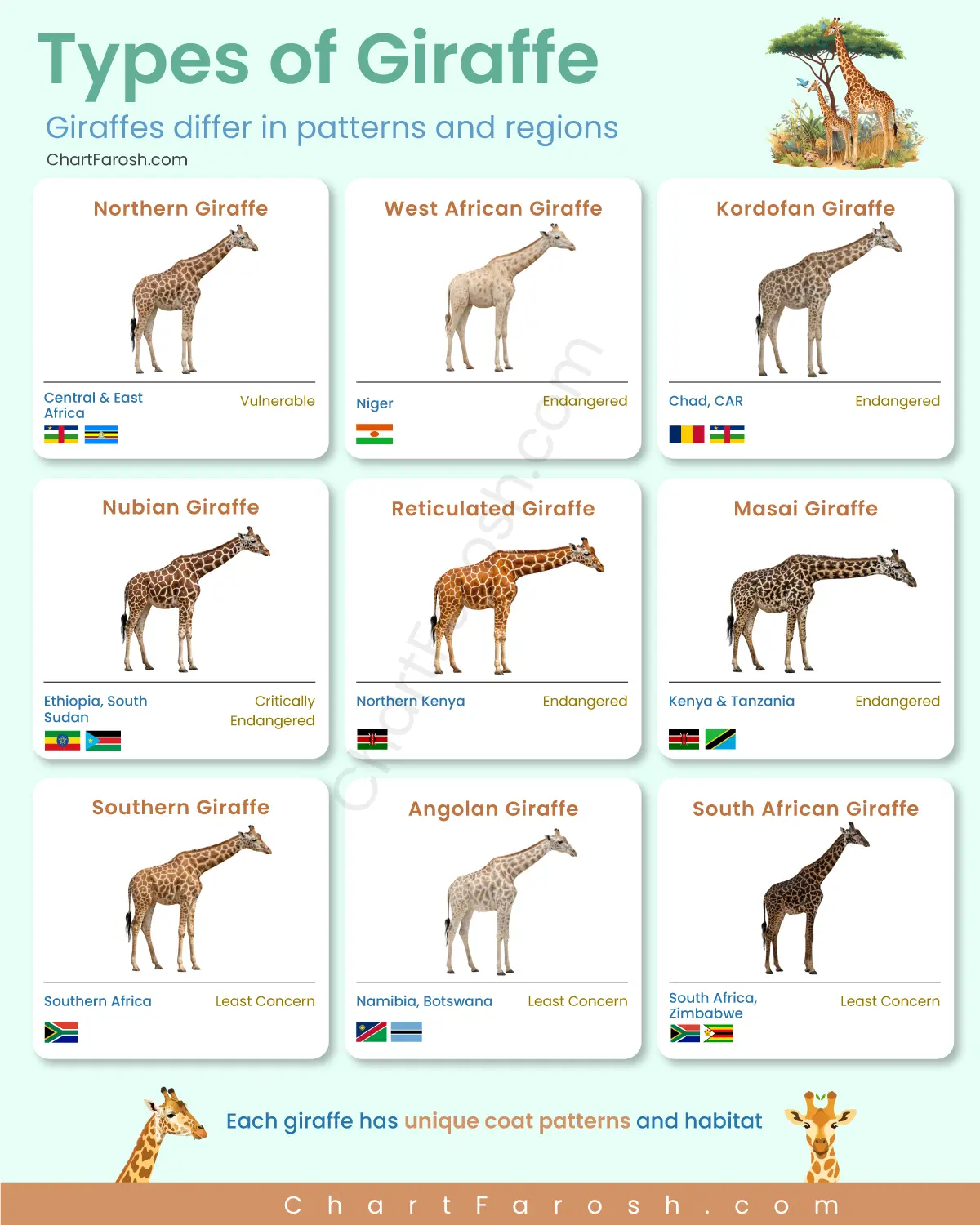
Table of Contents
Types of Giraffes
When people talk about types of giraffes, they’re usually referring to distinct species and subspecies spread across Africa.
For years, giraffes were grouped as one species, Giraffa camelopardalis, with several subspecies.
However, genetic research over the past decade suggests there may actually be four separate species: Northern, Southern, Reticulated, and Masai giraffes.
Each type differs in coat pattern, size, geographic range, and conservation status.
Understanding the different types of giraffes isn’t just interesting trivia, it plays a huge role in protecting them and preserving Africa’s biodiversity.
| Giraffe Type | Level | Scientific Name | Region | Key Feature | Conservation Status |
| Northern Giraffe | Species | Giraffa camelopardalis | Central & East Africa | Large irregular patches | Vulnerable |
| West African Giraffe | Subspecies | G. c. peralta | Niger | Very light coat | Endangered ⚠️ |
| Kordofan Giraffe | Subspecies | G. c. antiquorum | Chad, CAR | Small fragmented population | Endangered ⚠️ |
| Nubian Giraffe | Subspecies | G. c. camelopardalis | Ethiopia, South Sudan | Large chestnut patches | Critically Endangered ⚠️ |
| Reticulated Giraffe | Species | Giraffa reticulata | Northern Kenya | Sharp white lines between spots | Endangered ⚠️ |
| Masai Giraffe | Species | Giraffa tippelskirchi | Kenya & Tanzania | Jagged, vine-like spots | Endangered ⚠️ |
| Southern Giraffe | Species | Giraffa giraffa | Southern Africa | Lighter coat, star-shaped spots | Least Concern |
| Angolan Giraffe | Subspecies | G. g. angolensis | Namibia, Botswana | Irregular light patches | Least Concern |
| South African Giraffe | Subspecies | G. g. giraffa | South Africa, Zimbabwe | Rounded dark patches | Least Concern |
Rarest Types of Giraffes in the World
Not all giraffes roam in large, stable populations. Some are incredibly rare and face serious threats due to habitat loss, poaching, and political instability in their native regions.
The rarest types of giraffes tend to have limited geographic ranges and smaller, fragmented populations.
Conservationists are especially concerned about these unique genetic lineages because once they’re gone, they can’t be replaced.
Protecting rare giraffe species isn’t just about numbers, it’s about preserving distinct evolutionary histories that took thousands of years to develop.
| Giraffe Type | Estimated Population | Primary Location | Conservation Status |
| West African giraffe | Fewer than 1,000 | Niger | Vulnerable |
| Nubian giraffe | ~2,000 | South Sudan, Ethiopia | Critically Endangered |
| Kordofan giraffe | ~2,000 | Central Africa | Critically Endangered |
| Rothschild’s giraffe | ~2,500 | Uganda, Kenya | Near Threatened |
Most Common Giraffe Species
While some types of giraffes are rare, others are relatively more widespread. The most common giraffe species tend to have larger ranges and more stable populations, although “common” doesn’t mean safe
Even the more numerous types of giraffes have experienced significant population declines over the last few decades.
Their survival often depends on well-managed national parks and conservation programs. These giraffes are usually the ones people spot on safari, especially in East and Southern Africa.
| Giraffe Type | Estimated Population | Main Range | Notes |
| Masai giraffe | 30,000+ | Kenya, Tanzania | Largest population |
| Southern giraffe | 20,000+ | Namibia, Botswana, South Africa | Stable in protected areas |
| Reticulated giraffe | 15,000+ | Northern Kenya | Distinct net-like pattern |
| Angolan giraffe | 13,000+ | Namibia | Subspecies of Southern giraffe |
Largest Types of Giraffes
All giraffes are tall, there’s no getting around that, but some types are noticeably larger and heavier than others.
The Masai giraffe, for instance, is often considered one of the largest types of giraffes, with males reaching heights of up to 18 feet.
Size can vary depending on sex, habitat quality, and genetics. Larger giraffes tend to dominate feeding hierarchies and mating competitions.
Their immense height allows them to browse on acacia trees that other herbivores simply can’t reach.
| Giraffe Type | Average Male Height | Weight (Male) | Region |
| Masai giraffe | Up to 18 ft | 2,600–3,000 lbs | East Africa |
| Southern giraffe | 16–18 ft | 2,400–2,800 lbs | Southern Africa |
| Reticulated giraffe | 16–17 ft | 2,400–2,800 lbs | Kenya |
| Nubian giraffe | 16–17 ft | 2,300–2,700 lbs | Northeast Africa |
Endangered Giraffe Species
It surprises many people to learn that giraffes are facing what scientists call a “silent extinction.” Certain types of giraffes have seen population drops of up to 40% in the last 30 years.
Habitat fragmentation, expanding agriculture, and illegal hunting are major threats.
The Northern giraffe species, in particular, is under serious pressure. Conservation organizations are working hard to establish protected areas and breeding programs to prevent further decline.
| Giraffe Type | Population Trend | Main Threats | Status |
| Nubian giraffe | Decreasing | Poaching, habitat loss | Critically Endangered |
| Kordofan giraffe | Decreasing | Civil conflict, hunting | Critically Endangered |
| West African giraffe | Slowly Increasing | Habitat pressure | Vulnerable |
| Reticulated giraffe | Declining | Habitat fragmentation | Endangered |
Northern vs Southern Giraffes
The debate over Northern vs Southern giraffes centers on genetics and geography. Northern giraffes live primarily in Central and parts of East Africa, while Southern giraffes are found further down the continent.
The key differences lie in coat patterns and genetic markers.
Northern giraffes often have lighter patches with less defined borders, whereas Southern giraffes typically display larger, irregular spots.
These distinctions might seem subtle, but they’re important for conservation planning and species classification.
| Feature | Northern Giraffe | Southern Giraffe |
| Range | Central, East Africa | Southern Africa |
| Coat Pattern | Lighter, uneven patches | Larger, irregular spots |
| Population | Lower | Higher |
| Conservation Risk | Higher | Moderate |
How to Identify Different Types of Giraffes
Telling apart the types of giraffes gets much easier once you know what details actually matter.
Their coat patterns are often compared to fingerprints, completely unique to each individual, but each species follows a recognizable style in shape, spacing, and color contrast.
Location is another major clue, since most species stick to specific regions. With a trained eye and a little practice, identifying a giraffe from a single photo becomes surprisingly doable.
- Look closely at the shape of the patches.
- Notice the color contrast between patches and background.
- Check the geographic location.
- Observe the size and build.
- Examine the ossicones.
- Compare photos with species references.
Types of Giraffes in Kenya
Kenya is one of the best places in the world to observe different types of giraffes in the wild. The country hosts three main species: the Masai, Reticulated, and Rothschild’s giraffe.
Each occupies specific regions, from open savannahs to semi-arid landscapes.
Kenya’s strong conservation programs have played a major role in stabilizing certain populations, particularly Rothschild’s giraffe.
For wildlife lovers, Kenya offers a unique opportunity to compare giraffe species side by side.
| Giraffe Type | Region in Kenya | Population Status | Notes |
| Masai giraffe | Southern Kenya | Stable | Most widespread |
| Reticulated giraffe | Northern Kenya | Declining | Distinct net pattern |
| Rothschild’s giraffe | Western Kenya | Recovering | Protected areas |
| Nubian giraffe | Northwestern Kenya | Vulnerable | Limited range |
Types of Giraffes in Africa
Across Africa, giraffes are distributed unevenly depending on habitat, climate, and human impact.
East and Southern Africa host the highest numbers, while Central and West Africa have smaller, fragmented populations.
The types of giraffes found across the continent reflect deep evolutionary divisions shaped by rivers, deserts, and ecological zones.
Understanding this continental spread is crucial for conservation strategies that cross national borders.
| Giraffe Type | Region | Approximate Range | Status |
| Northern giraffe | Central Africa | Scattered pockets | Endangered |
| Southern giraffe | Southern Africa | Broad range | Least Concern |
| Reticulated giraffe | East Africa | Limited to Kenya | Endangered |
| Masai giraffe | East Africa | Kenya, Tanzania | Vulnerable |
Types of Giraffes in Tanzania
Tanzania is especially known for the Masai giraffe, which is also the country’s national animal. Vast ecosystems like the Serengeti provide ideal habitat with plenty of acacia trees.
While Masai giraffes dominate, conservation monitoring remains important due to pressures from land use changes.
Tanzania’s protected areas play a key role in maintaining one of the largest populations of this iconic species.
| Giraffe Type | Location in Tanzania | Population Trend | Notes |
| Masai giraffe | Serengeti, Tarangire | Stable | National symbol |
| Reticulated giraffe | Northern border areas | Limited | Rare sightings |
| Southern giraffe | Southern zones | Minimal | Not widespread |
| Nubian giraffe | Very limited | Rare | Border regions |
Types of Giraffes in Nairobi National Park
Nairobi National Park is one of the few wildlife reserves located near the capital city.
Here, visitors primarily encounter the Rothschild’s giraffe, thanks to focused conservation efforts. The park’s open grasslands and acacia woodlands create a suitable habitat.
While the skyline of Nairobi looms in the background, these giraffes continue to thrive in protected spaces just outside urban expansion.
| Giraffe Type | Presence in Park | Status | Notes |
| Rothschild’s giraffe | Common | Protected | Main species present |
| Masai giraffe | Occasional | Stable | Nearby regions |
| Reticulated giraffe | Rare | Not typical | Outside main range |
| Nubian giraffe | Very rare | Vulnerable | Limited sightings |
FAQs
Are there really four species of giraffes?
Yes, modern genetic research supports the classification of four distinct species instead of one single species with subspecies.
What is the rarest type of giraffe?
The West African giraffe is considered one of the rarest, with fewer than 1,000 individuals remaining.
Which country has the most giraffes?
Kenya and Tanzania host some of the largest populations, particularly of Masai giraffes.
How can you tell giraffe species apart?
Mainly by coat pattern, geographic location, and subtle physical differences like ossicone shape.
Are giraffes endangered?
Some species are critically endangered, while others are more stable. Overall, giraffes are facing significant conservation challenges.