Types of Octopus lists with Pictures
A few years ago, I went on a coastal trip where everyone else seemed excited about dolphins and sea turtles.
I was too, don’t get me wrong, but what caught my attention was a small octopus tucked between rocks in a tide pool.
It wasn’t flashy. It wasn’t enormous. It just sat there, shifting colors almost absentmindedly, blending from sandy beige to speckled brown in seconds.
I remember crouching there longer than I expected, watching it move with slow, deliberate intelligence. That moment stuck with me.
Later, I realized I couldn’t even name more than one or two species. That bothered me more than it should have.
So I started digging into research papers, marine biology forums, and underwater photography archives. What I found completely reshaped how I see these animals.
Octopuses aren’t just clever sea creatures with eight arms. They are wildly diverse, specialized, and surprisingly complex.
The deeper I looked, the more I realized how many different forms they take, and how little most of us actually know about them.
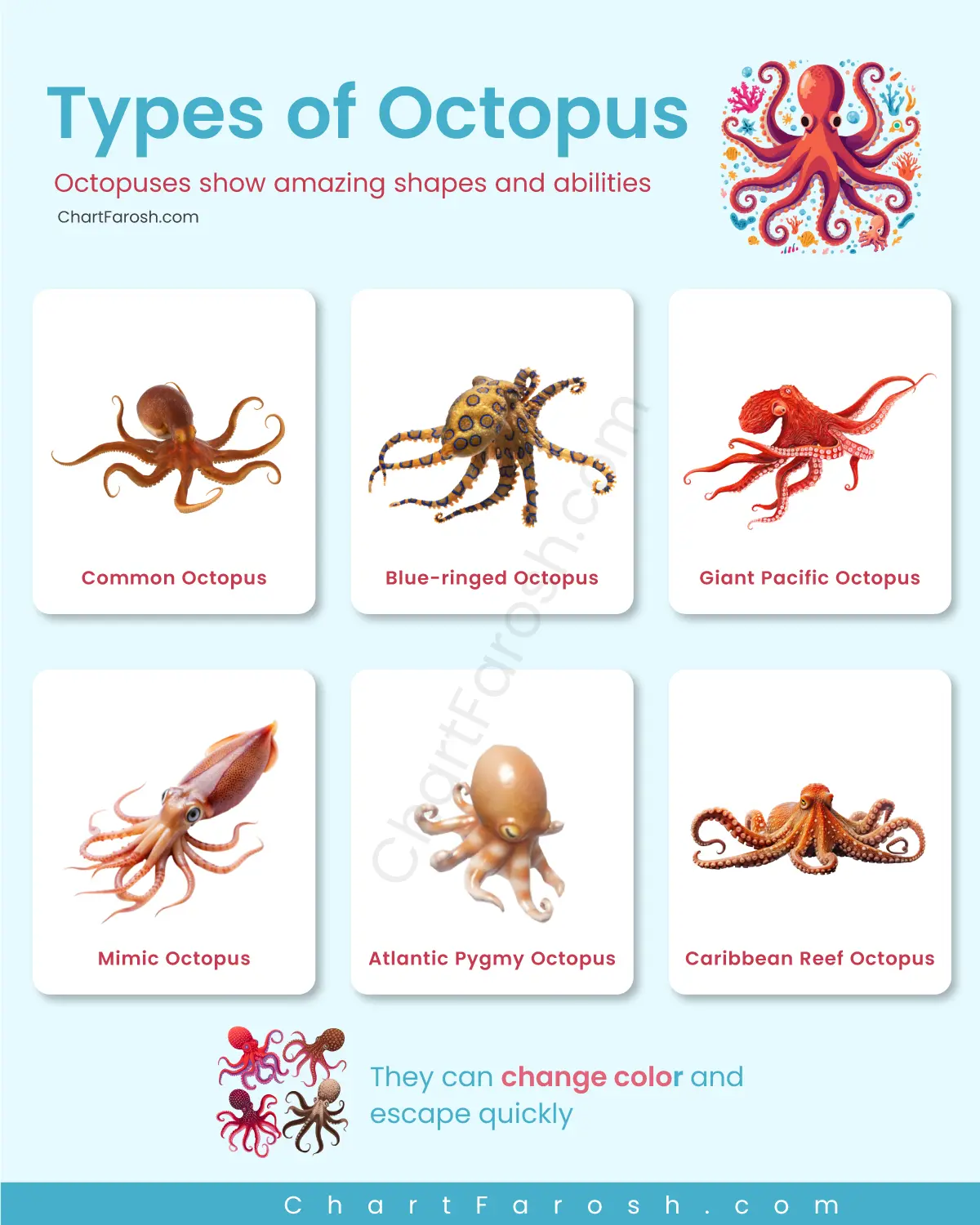
Table of Contents
Types of Octopus
When people search for Types of Octopus and their names, they’re often expecting a short, tidy answer. In reality, the world of octopuses is anything but small.
There are reef specialists, deep-sea drifters, venomous miniatures, and cold-water giants.
The types of Octopus species span tropical shallows, temperate kelp forests, and abyssal ocean floors thousands of feet below sunlight.
If you’ve ever looked up types of Octopus with pictures, you’ve probably noticed how dramatically their appearance can vary, smooth-skinned, spiky, translucent, bright blue-ringed, or ghostly pale.
Marine scientists continue updating the list of Octopus breeds, and for anyone who loves marine life, it’s worth keeping a printable list of Octopus or even a personal Types of Octopus chart to appreciate just how diverse this group truly is.
| Octopus Type | Species | Key Feature | Habitat | Fun Fact |
| Common Octopus | Octopus vulgaris | Highly intelligent | Tropical & temperate waters | Can change color & texture |
| Blue-ringed Octopus | Hapalochlaena spp. | Small, venomous, bright blue rings | Indo-Pacific | Extremely venomous, deadly to humans |
| Giant Pacific Octopus | Enteroctopus dofleini | Very large, up to 600 lbs | North Pacific | Strong arms, escapes predators cleverly |
| Mimic Octopus | Thaumoctopus mimicus | Can imitate other animals | Southeast Asia | Mimics flounder, lionfish, sea snakes |
| Atlantic Pygmy Octopus | Octopus joubini | Tiny size | Atlantic Ocean | Short lifespan, hides in shells |
| Caribbean Reef Octopus | Octopus briareus | Reef dweller | Caribbean waters | Can swim and crawl; changes color rapidly |
How Many Octopus Species Exist in the World?
One of the most common questions people ask is how many octopus species actually exist.
As of current scientific classification, there are more than 300 recognized species worldwide, and researchers believe that number may increase as deep-sea exploration expands.
The ocean remains largely unexplored, especially at extreme depths, meaning new types of Octopus species are likely waiting to be identified.
When compiling a Types of Octopus chart, scientists typically divide them into two main suborders: Incirrata (the more common finless octopuses) and Cirrata (deep-sea octopuses with fins).
If you’ve ever searched for a printable list of Octopus, you may have noticed that taxonomy is constantly evolving as DNA studies refine classifications. It’s a reminder that marine science is still very much a living, breathing field of discovery.
| Category | Estimated Count | Habitat Range | Notes |
| Total Known Species | 300+ | Global oceans | Number increasing |
| Incirrate Octopus | Majority | Coastal & open ocean | No fins |
| Cirrate Octopus | Smaller group | Deep sea | Have fins |
| Undiscovered Species | Unknown | Deep oceans | Ongoing research |
Common Features of Octopuses: Intelligence and Adaptations
Despite the wide range within the Types of Octopus and their names, all octopuses share certain remarkable characteristics.
They have eight arms lined with sensitive suction cups, a hard beak similar to a parrot’s, and three hearts that efficiently circulate copper-rich blue blood.
Their bodies are soft and boneless, allowing them to squeeze through openings barely larger than their eyes. Across all types of Octopus species, intelligence stands out as a defining trait.
Octopuses can solve puzzles, open jars, remember solutions, and even display distinct personalities in controlled studies.
Camouflage abilities, powered by specialized skin cells called chromatophores, allow them to instantly change color and texture.
Any well-made Types of Octopus chart highlights these adaptations because they explain how octopuses thrive in such varied marine environments.
| Feature | Function | Survival Benefit | Example |
| Chromatophores | Color change | Camouflage & signaling | Reef octopus |
| Three Hearts | Oxygen transport | Cold-water survival | Giant Pacific |
| Beak | Crush prey | Eat crabs & mollusks | Common octopus |
| Flexible Body | No bones | Escape predators | Most species |
Giant Pacific Octopus: The Largest Octopus Species
The Giant Pacific Octopus (Enteroctopus dofleini) is widely recognized as the largest of all types of Octopus species.
Native to the North Pacific Ocean, this species can reach arm spans of up to 16 feet and weigh over 100 pounds, though most individuals are smaller. Cold, oxygen-rich waters support their size and metabolism.
When browsing types of Octopus with pictures, this species often stands out because of its massive proportions and thick arms.
Despite their intimidating size, they are generally shy and prefer rocky dens along coastal shelves.
In aquariums, they have demonstrated impressive intelligence, recognizing caretakers and solving complex enrichment puzzles.
Any serious list of Octopus breeds would feel incomplete without including this ocean giant.
| Trait | Detail | Habitat | Diet |
| Arm Span | Up to 16 ft | North Pacific | Crabs |
| Weight | 100+ lbs | Cold coastal waters | Fish |
| Lifespan | 3–5 years | Rocky dens | Shellfish |
| Behavior | Intelligent & curious | Kelp forests | Carnivorous |
Common Octopus: Found in Coastal Waters Worldwide
The Common Octopus (Octopus vulgaris) is one of the most widespread and well-studied species.
Found in tropical and temperate waters across the Atlantic and Mediterranean, it represents what most people picture when thinking about octopuses.
If you’ve searched for Types of Octopus and their names, this species likely appeared first.
It thrives in rocky reefs, coral systems, and seagrass beds, often hiding in crevices during the day and hunting at night.
Its camouflage abilities are exceptionally advanced, allowing it to mimic surrounding textures almost seamlessly.
Because of its broad distribution and adaptability, it appears frequently in marine biology research and educational Types of Octopus charts used worldwide.
| Trait | Detail | Habitat | Diet |
| Size | 12–36 inches | Coastal waters | Crustaceans |
| Activity | Mostly nocturnal | Mediterranean | Fish |
| Camouflage | Advanced | Rocky reefs | Mollusks |
| Distribution | Global warm seas | Atlantic | Carnivorous |
Blue-Ringed Octopus: Tiny but Highly Venomous
The Blue-Ringed Octopus may be small, but it commands enormous respect in the marine world. Native primarily to Australia and the Indo-Pacific region, this species grows only about 5–8 inches long.
However, it carries tetrodotoxin, a powerful neurotoxin capable of causing paralysis.
When threatened, its body flashes bright, iridescent blue rings as a warning signal. Among all types of Octopus species, this one is most often discussed in relation to venom.
Despite its toxicity, it is not aggressive and typically bites only when handled or provoked. If you’ve ever looked through types of Octopus with pictures, those glowing blue rings are impossible to forget.
| Trait | Detail | Habitat | Warning |
| Size | 5–8 inches | Tide pools | Highly venomous |
| Display | Blue rings | Indo-Pacific | Visual warning |
| Venom | Tetrodotoxin | Shallow reefs | Dangerous |
| Temperament | Shy | Coastal areas | Defensive |
Dumbo Octopus: Deep-Sea Dweller With Ear-Like Fins
Dumbo octopuses belong to the cirrate suborder and live at depths ranging from 3,000 to over 13,000 feet.
Their nickname comes from the ear-like fins protruding from their mantle, which resemble elephant ears.
Unlike many shallow-water species, they do not rely heavily on crawling; instead, they gently propel themselves through the water using their fins.
In many types of Octopus with pictures, Dumbo octopuses appear almost cartoonish because of their rounded bodies and soft appearance.
They feed on small crustaceans and worms drifting near the ocean floor. Their extreme habitat makes them one of the least directly observed types of Octopus species, increasing their mystery.
| Trait | Detail | Habitat | Movement |
| Depth | 3,000–13,000 ft | Deep ocean | Fin swimming |
| Fins | Ear-like | Abyssal plains | Gentle propulsion |
| Size | 8–12 inches | Global deep sea | Drifting |
| Diet | Small prey | Ocean floor | Carnivorous |
Mimic Octopus: Master of Disguise and Mimicry
Discovered in 1998 near Indonesia, the Mimic Octopus (Thaumoctopus mimicus) is one of the most behaviorally fascinating species ever documented.
It doesn’t just change color, it imitates the movements and shapes of other marine animals, including lionfish, sea snakes, and flatfish.
This adaptive mimicry helps deter predators by copying more dangerous species.
Among all entries in the list of Octopus breeds, this one stands out for strategy and deception. It typically lives in sandy, shallow waters where camouflage and mimicry are essential for survival.
In any comprehensive Types of Octopus chart, the Mimic Octopus earns attention not for size or venom, but for sheer creativity.
| Trait | Detail | Habitat | Defense |
| Discovery | 1998 | Indonesia | Mimic predators |
| Size | Medium | Sandy seabeds | Deception |
| Skill | Shape shifting | Indo-Pacific | Camouflage |
| Intelligence | High | Shallow waters | Strategy |
Coconut Octopus: Innovative Tool Users of the Sea
The Coconut Octopus (Amphioctopus marginatus) gained global attention when researchers observed it carrying coconut shell halves across the seafloor.
It uses these shells as portable shelters, assembling them when needed for protection. Tool use is rare among invertebrates, making this behavior especially notable.
Within the broader types of Octopus species, this one demonstrates clear planning and foresight.
Found primarily in the Indo-Pacific region, it prefers sandy habitats where natural shelter is limited.
For anyone compiling a printable list of Octopus, the Coconut Octopus represents the innovative side of cephalopod intelligence.
| Trait | Detail | Habitat | Innovation |
| Tool Use | Coconut shells | Indo-Pacific | Portable shelter |
| Size | Small-medium | Sandy seabeds | Burrowing |
| Behavior | Observed planning | Tropical reefs | Problem-solving |
| Diet | Crabs & clams | Shallow waters | Carnivorous |
Rare and Little-Known Octopus Species
Beyond the well-known species, dozens of lesser-known octopuses inhabit remote or extreme marine environments.
Some, like the Glass Octopus, have nearly transparent bodies, allowing them to remain invisible in open water.
Others, like the Blanket Octopus, display dramatic webbing that stretches between their arms.
These species often appear in advanced marine biology references rather than mainstream Types of Octopus and their names searches.
As deep-sea robotics improve, researchers continue adding new discoveries to the evolving list of Octopus breeds. The ocean’s depth ensures that the story of octopus diversity is far from complete.
| Species | Habitat | Unique Trait | Status |
| Glass Octopus | Deep sea | Transparent body | Limited data |
| Blanket Octopus | Open ocean | Large webbing | Rare |
| Seven-Arm Octopus | Atlantic | One hidden arm | Misnamed |
| Flapjack Octopus | Deep Pacific | Flattened body | Under study |
Types of Octopus in Florida
Florida’s warm Atlantic and Gulf waters support a variety of octopus species, especially in reef systems and shallow coastal habitats.
The Atlantic Pygmy Octopus, Caribbean Reef Octopus, and Common Octopus are among the most frequently observed.
These species thrive in coral reefs, rocky crevices, and seagrass beds where camouflage provides effective protection from predators.
For divers and snorkelers, Florida offers a unique opportunity to observe multiple types of Octopus species within relatively accessible waters.
Seasonal changes and water temperature shifts influence sightings, but biodiversity remains strong year-round due to the region’s favorable marine conditions.
| Octopus Species | Habitat | Key Feature | Fun Fact |
| Caribbean Reef Octopus | Coral reefs, shallow waters | Reef-dwelling, camouflages | Active at night |
| Atlantic Pygmy Octopus | Shallow waters, seagrass | Tiny size, hides in shells | Short lifespan |
| Common Octopus | Offshore waters | Intelligent predator | Hunts crustaceans & fish |
| Day Octopus | Coastal waters | Active during the day | Rarely seen by humans |
Types of Octopus in Australia
Australia is home to some of the most distinctive and widely recognized octopus species in the world.
The Blue-Ringed Octopus is perhaps the most famous, but the Southern Sand Octopus and Maori Octopus are also found in surrounding waters.
Australia’s extensive reef systems, tidal pools, and temperate southern coastlines create diverse habitats for different types of Octopus species.
Marine researchers frequently document new behavioral observations in this region, adding to the global Types of Octopus chart used for classification and education.
| Octopus Species | Habitat | Key Feature | Fun Fact |
| Blue-ringed Octopus | Tide pools & reefs | Tiny, deadly venom | Can be fatal to humans |
| Common Sydney Octopus | Coastal waters | Camouflages | Hunts crabs & fish |
| Giant Australian Octopus | Deep waters | Large & strong | Can manipulate objects |
| Mimic Octopus | Northern Australian waters | Imitates other species | Masters of disguise |
Types of Octopus in Hawaii
Hawaii’s volcanic reefs and clear waters host several unique species, including the Day Octopus and Night Octopus. Known locally as “heʻe,” octopuses hold cultural and ecological significance in the islands.
Isolation has influenced the evolution of certain species, making Hawaii particularly interesting when reviewing regional Types of Octopus and their names.
The reef structures and lava rock formations provide ideal den sites and hunting grounds for these intelligent marine animals.
| Octopus Species | Habitat | Key Feature | Fun Fact |
| Day Octopus | Coral reefs | Active during daylight | Often seen by divers |
| Night Octopus | Reef crevices | Nocturnal hunter | Uses jet propulsion to escape |
| Common Octopus | Shallow waters | Intelligent predator | Hunts crabs, shrimp, and fish |
| Mimic Octopus | Rare sightings | Can imitate predators | Camouflage specialist |
Types of Octopus in San Diego
San Diego’s Pacific coastline features cooler waters influenced by ocean currents, supporting species like the Two-Spot Octopus and juvenile Giant Pacific Octopus.
Kelp forests and rocky tide pools provide shelter and feeding grounds.
While the variety may be smaller compared to tropical regions, the species present are well adapted to temperate environments.
For coastal explorers and divers, San Diego offers reliable sightings of specific types of Octopus species known for their distinctive eye spots and bold coloration.
| Octopus Species | Habitat | Key Feature | Fun Fact |
| Giant Pacific Octopus | Deep kelp forests | Huge, strong arms | Can weigh up to 600 lbs |
| California Two-spot Octopus | Coastal reefs | Two blue eye spots | Camouflages into surroundings |
| Day Octopus | Rocky reefs | Active during daylight | Hunts small fish & crustaceans |
| Common Octopus | Shallow waters | Intelligent & flexible | Known for problem-solving skills |
FAQs
What is the rarest type of octopus?
Deep-sea species like the Glass Octopus are considered rare due to limited sightings and challenging habitats.
How intelligent are octopuses compared to other animals?
Octopuses are considered the most intelligent invertebrates, capable of problem-solving and memory retention.
Can octopuses recognize humans?
Some species, particularly in captivity, have shown the ability to distinguish between individual caretakers.
Why do octopuses change color?
They use specialized skin cells to camouflage, communicate, and express stress or warning signals.
Are octopuses endangered?
Most species are not currently endangered, but habitat loss and climate change pose potential future risks.