All Bear Species List with Pictures
A few years ago, I went on a hiking trip thinking I was prepared for everything, good boots, snacks, even bear spray. What I wasn’t prepared for was how little I actually knew about bears.
When our guide casually mentioned that not all bears are the same and started explaining the differences between black bears and brown bears, I realized I’d lumped them all into one mental category: “big, furry, and intimidating.”
That moment sent me down a rabbit hole. I started researching the all bear species list, comparing habitats, behaviors, and sizes.
The deeper I looked, the more I appreciated how diverse these animals are. From Arctic ice to tropical forests, bears have adapted in incredible ways.
If you’ve ever wondered how many species exist or searched for all bear species by size, this guide will walk you through everything in a way that’s practical, clear, and actually interesting to read.
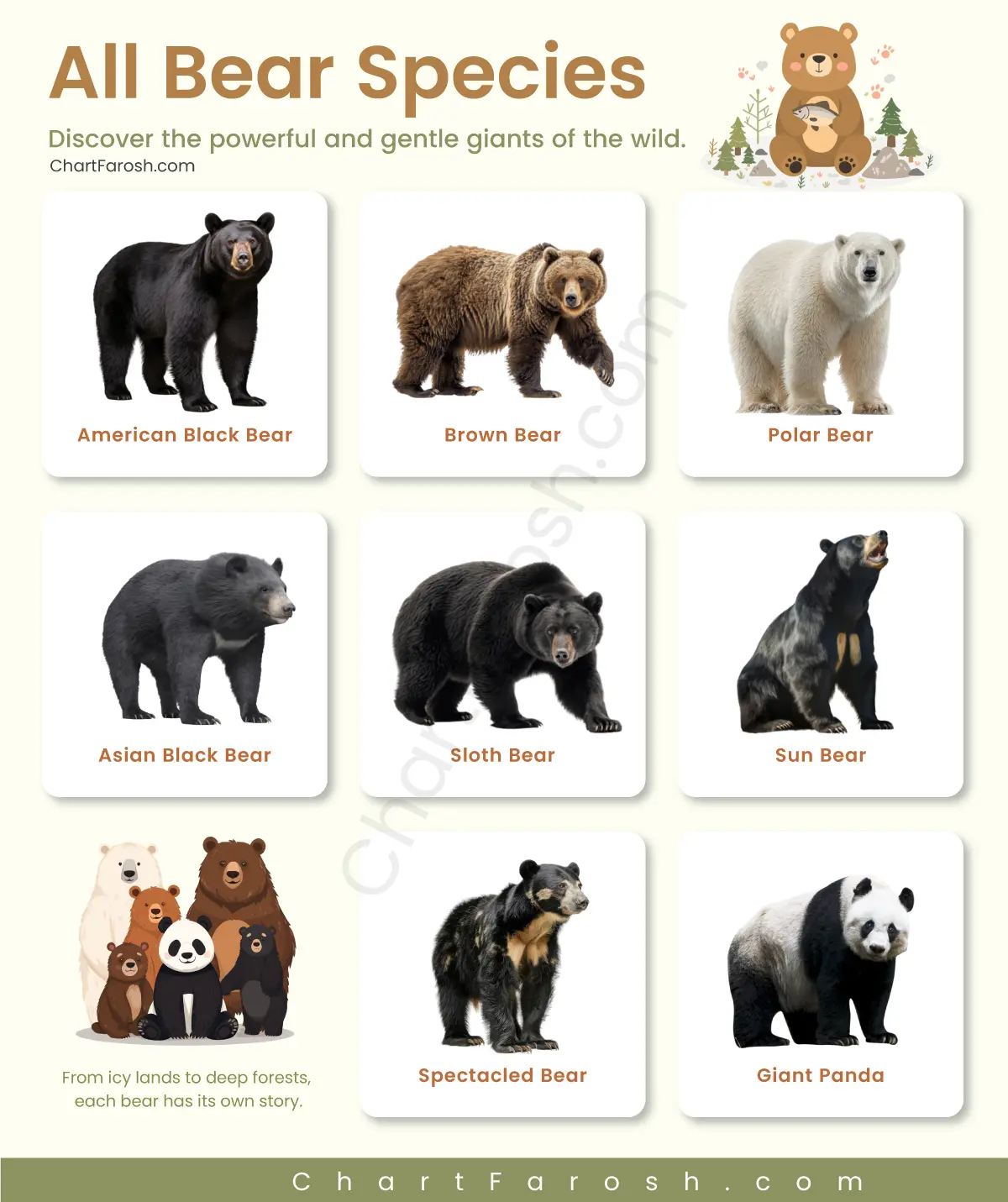
Table of Contents
All Type of Bears
When people search for “all types of bears,” they’re usually surprised to learn there are only eight living bear species worldwide.
Despite the small number, the diversity among them is impressive. The all bear species list includes the American black bear, brown bear, polar bear, Asian black bear, sloth bear, sun bear, spectacled bear, and giant panda.
Each species has evolved to fit a specific environment, from icy tundras to dense rainforests.
Bears are members of the family Ursidae and are generally large, strong mammals with thick fur, powerful limbs, and sharp claws.
While many people imagine bears as aggressive predators, most species are omnivorous, feeding on plants, insects, fish, and occasionally mammals.
Looking at all bear species by size shows dramatic differences, from the small sun bear to the massive polar bear.
Understanding these variations helps us appreciate how adaptable and ecologically important bears truly are.
| Bear Species | Scientific Name | Region | Key Feature | Conservation Status |
| American Black Bear | Ursus americanus | North America | Most widespread bear species | Least Concern |
| Brown Bear | Ursus arctos | North America, Europe, Asia | Large size, hump on shoulders | Least Concern |
| Polar Bear | Ursus maritimus | Arctic Circle | Excellent swimmer, white fur | Vulnerable ⚠️ |
| Asian Black Bear | Ursus thibetanus | Asia | White chest crescent | Vulnerable ⚠️ |
| Sloth Bear | Melursus ursinus | India, Sri Lanka | Long snout, insect eater | Vulnerable ⚠️ |
| Sun Bear | Helarctos malayanus | Southeast Asia | Smallest bear, sun-shaped chest mark | Vulnerable ⚠️ |
| Spectacled Bear | Tremarctos ornatus | South America | Light markings around eyes | Vulnerable ⚠️ |
| Giant Panda | Ailuropoda melanoleuca | China | Black & white fur, bamboo diet | Vulnerable ⚠️ |
Common Types of Bear
When discussing common types of bear, a few species tend to stand out due to their wide distribution and frequent human encounters.
The American black bear and brown bear are among the most widespread, found across North America and parts of Europe and Asia.
These species adapt well to forests, mountains, and even areas near human settlements. The polar bear, though less commonly seen by most people, is iconic and widely recognized due to its Arctic habitat.
Giant pandas are also well-known globally, even though their natural range is limited to China. These common species often dominate wildlife documentaries and conservation discussions.
Reviewing the all bear species list helps clarify why these particular bears are more familiar: they have broader ranges or strong cultural visibility.
When comparing all bear species by size, brown bears and polar bears typically rank among the largest, which also contributes to their reputation and prominence in media and public awareness.
Rare Type of Bears
Some bear species are far less commonly seen, either because of restricted habitats or declining populations.
The spectacled bear of South America, for example, lives primarily in Andean cloud forests and is rarely encountered outside that region.
The sun bear, native to Southeast Asia, is another lesser-known species despite being part of the all bear species list.
These rare bears often suffer from habitat loss and limited geographic distribution, which makes conservation efforts critical.
Unlike more common species, rare bears may have highly specialized diets or environmental needs
When reviewing all bear species by size, these rarer species often fall on the smaller end of the scale, yet they play equally important ecological roles.
Understanding rare types of bears reminds us that even animals we rarely hear about are essential parts of global biodiversity and deserve focused protection efforts.
Endangered Bear Species
Several bears face significant threats due to habitat destruction, poaching, and climate change.
While the all bear species list includes only eight species, more than half are considered vulnerable or endangered in parts of their range.
Conservation efforts are crucial to ensure their survival for future generations.
When comparing all bear species by size, it’s clear that both large and small bears face risks, proving that size doesn’t guarantee safety.
Protecting endangered bears requires habitat preservation, anti-poaching laws, and global awareness campaigns.
- Giant panda: Vulnerable due to habitat fragmentation in China.
- Polar bear: Threatened by melting Arctic sea ice.
- Sun bear: Impacted by deforestation and illegal wildlife trade.
- Sloth bear: Affected by habitat loss in India and Sri Lanka.
- Spectacled bear: Vulnerable due to shrinking Andean forests.
Largest and Smallest Bear Species Compared
Looking at all bear species by size is fascinating because the differences are dramatic. The polar bear holds the title as the largest bear species, with adult males weighing up to 1,500 pounds.
Close behind are certain brown bear subspecies, such as the Kodiak bear. On the opposite end of the scale is the sun bear, the smallest member of the all bear species list, typically weighing between 60 and 150 pounds.
Despite its small size, the sun bear is agile and incredibly strong for its build. Size influences diet, habitat, and behavior.
Larger bears often dominate colder regions where fat storage is crucial, while smaller bears thrive in tropical forests where climbing ability matters more than bulk.
Comparing sizes across all species highlights how evolution shaped each bear to survive specific environmental pressures efficiently.
All Bear Species in India
India is home to several bear species, each adapted to different habitats across the country. The sloth bear is the most widespread and commonly associated with Indian forests and grasslands.
The Himalayan brown bear inhabits high-altitude regions, while the Asian black bear is found in forested mountain areas.
Reviewing the all bear species list shows that India hosts a unique combination of species compared to many other countries.
These bears vary significantly in diet and behavior, from termite-eating sloth bears to omnivorous Asian black bears.
While India doesn’t contain the largest bears of all the bear species by size ranking, its species are ecologically vital.
Human-wildlife conflict remains a concern, making conservation programs and awareness initiatives essential for long-term coexistence and habitat preservation.
All Bear Species in America
America hosts several well-known members of the all bear species list, particularly across North America, where bear diversity is both iconic and ecologically important.
From the frozen Arctic coastline to dense temperate forests and rugged mountain ranges, bears occupy an impressive range of habitats.
These species are not just symbols of wilderness, they are keystone animals that influence entire ecosystems through their feeding habits, migration patterns, and interactions with other wildlife.
When comparing all bear species by size, North America stands out because it is home to both some of the largest bears on Earth and more moderately sized species.
The Polar Bear and certain populations of the Brown Bear rank among the biggest bears globally, especially in coastal regions with rich food sources.
Meanwhile, the American Black Bear represents a mid-sized but highly adaptable species found across forests, swamps, and even near suburban areas.
- American black bear: Most widespread in North America.
- Brown bear: Includes grizzly and Kodiak subspecies.
- Polar bear: Found in Arctic regions of Alaska and Canada.
- Spectacled bear: Native to South America’s Andes.
- American populations vary greatly in behavior and diet.
FAQs
How many bear species are there?
There are eight living bear species worldwide according to the current all bear species list.
What is the largest bear species?
The polar bear is the largest bear species in the world.
What is the smallest bear species?
The sun bear is the smallest of all bear species by size.
Are all bears dangerous to humans?
Most bears avoid humans and attacks are rare, usually occurring when bears feel threatened.
Which countries have the most bear species?
Countries like Russia, the United States, Canada, China, and India host multiple bear species due to diverse habitats.