All Turtle Species List with Pictures
A few summers ago, I was walking along a quiet beach, hoping for a peaceful escape from the city
Suddenly, I noticed tiny tracks leading from the dunes to the sea, and there, struggling against the surf, was a baby turtle making its first journey into the ocean.
Watching it reminded me how little I actually knew about turtles, their variety, habitats, and behaviors.
That curiosity led me to research all turtle species and discover a fascinating world that stretches from freshwater ponds to vast oceans.
Learning about turtles taught me that these creatures are far more diverse than the “slow, shelled reptile” stereotype.
From massive sea turtles to tiny freshwater species, every turtle has a story of adaptation, survival, and ecological importance.
This guide will explore the all turtle species, their classification, and key traits while keeping it friendly and easy to understand.
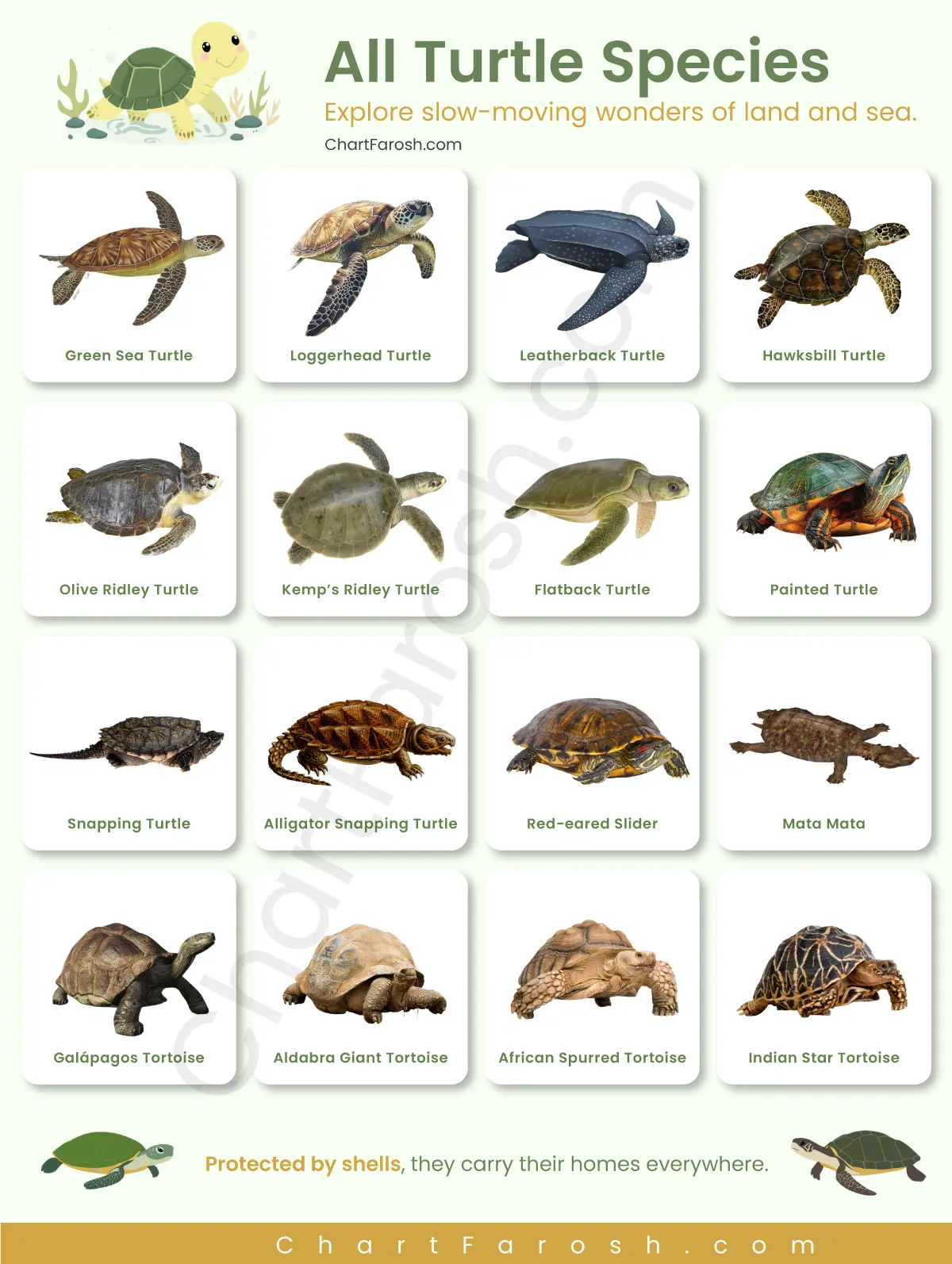
Table of Contents
All Turtle Species
When people search for “all turtle species,” they are often surprised by how diverse this group really is. Turtles belong to the order Testudines, and there are over 350 recognized species worldwide.
They are broadly categorized into sea turtles, freshwater turtles, and terrestrial tortoises, each adapted to very different environments.
Some species are tiny, barely larger than a coin, while others, like the leatherback sea turtle, can reach lengths of over two meters.
Each species has unique adaptations, webbed feet or flippers for swimming, domed shells for protection, and specialized diets ranging from vegetation to small animals.
Studying all turtle species highlights their ecological roles, from controlling insect populations to dispersing seeds.
Understanding species distribution and classification is crucial not only for research but also for conservation efforts.
Turtles are ancient reptiles, yet they face modern challenges that make knowledge about each species more important than ever.
| Turtle Type | Common Name | Scientific Name | Region | Key Feature | Conservation Status |
| Sea Turtle | Green Sea Turtle | Chelonia mydas | Tropical & Subtropical Oceans | Herbivorous sea turtle | Endangered ⚠️ |
| Sea Turtle | Loggerhead Turtle | Caretta caretta | Worldwide Oceans | Large powerful head | Vulnerable ⚠️ |
| Sea Turtle | Leatherback Turtle | Dermochelys coriacea | Global Oceans | Largest turtle species | Vulnerable ⚠️ |
| Sea Turtle | Hawksbill Turtle | Eretmochelys imbricata | Coral Reefs | Sharp curved beak | Critically Endangered ⚠️ |
| Sea Turtle | Olive Ridley Turtle | Lepidochelys olivacea | Tropical Oceans | Mass nesting behavior | Vulnerable ⚠️ |
| Sea Turtle | Kemp’s Ridley Turtle | Lepidochelys kempii | Gulf of Mexico | Smallest sea turtle | Critically Endangered ⚠️ |
| Sea Turtle | Flatback Turtle | Natator depressus | Northern Australia | Flat shell | Data Deficient |
| Freshwater Turtle | Painted Turtle | Chrysemys picta | North America | Colorful shell | Least Concern |
| Freshwater Turtle | Snapping Turtle | Chelydra serpentina | North America | Strong jaws | Least Concern |
| Freshwater Turtle | Alligator Snapping Turtle | Macrochelys temminckii | USA | Large prehistoric look | Vulnerable ⚠️ |
| Freshwater Turtle | Red-eared Slider | Trachemys scripta elegans | Americas | Popular pet species | Least Concern |
| Freshwater Turtle | Mata Mata | Chelus fimbriata | South America | Camouflage expert | Least Concern |
| Tortoise (Land) | Galápagos Tortoise | Chelonoidis niger | Galápagos Islands | Giant land tortoise | Vulnerable ⚠️ |
| Tortoise (Land) | Aldabra Giant Tortoise | Aldabrachelys gigantea | Seychelles | Long lifespan | Vulnerable ⚠️ |
| Tortoise (Land) | African Spurred Tortoise | Centrochelys sulcata | Africa | Large desert tortoise | Vulnerable ⚠️ |
| Tortoise (Land) | Indian Star Tortoise | Geochelone elegans | India & Sri Lanka | Star-pattern shell | Vulnerable ⚠️ |
| Softshell Turtle | Chinese Softshell | Pelodiscus sinensis | East Asia | Leathery shell | Vulnerable ⚠️ |
| Softshell Turtle | Florida Softshell | Apalone ferox | USA | Long snorkel nose | Least Concern |
| Softshell Turtle | Indian Softshell | Nilssonia gangetica | India | Large river turtle | Vulnerable ⚠️ |
How Many Turtle Species Are There in the World?
The exact number of turtle species in the world depends on classification, but current estimates recognize over 350 living species.
This includes a wide range of marine, freshwater, and terrestrial turtles. Some species are widespread, like the red-eared slider, while others are highly localized, such as the Pig-nosed turtle found only in parts of Papua New Guinea and northern Australia.
Each species is uniquely adapted to its habitat, with variations in shell shape, limb structure, diet, and behavior.
Turtles have existed for more than 200 million years, making them one of the most ancient reptile lineages.
This long evolutionary history means that even closely related species may show surprising differences in ecology and anatomy.
Studying the all turtle species list gives researchers insight into evolutionary patterns, habitat requirements, and the challenges these animals face today.
Conservation priorities often focus on rare or endangered species, but understanding all species helps paint a complete picture of turtle biodiversity worldwide.
Turtle Classification Explained: Order Testudines
All turtles are classified under the order Testudines, which unites all species with a shell and a slow-moving, reptilian body plan.
Within this order, species are further divided into suborders and families based on habitat and anatomical features.
The two main divisions are Cryptodira (hidden-neck turtles) and Pleurodira (side-neck turtles), reflecting how they retract their heads for protection.
Cryptodian turtles include most sea turtles, freshwater turtles, and many land tortoises, whereas pleurodirans are mostly freshwater species found in the Southern Hemisphere.
Families are based on traits such as shell shape, limb structure, and diet. For example, marine turtles in the family Cheloniidae have flippers for swimming, while freshwater Emydidae turtles have webbed feet for paddling.
Understanding turtle classification is important not just for taxonomy but for conservation and research, as closely related species often share ecological needs and threats.
Sea Turtle Species
Sea turtles are among the most iconic of all turtle species, thriving in oceans around the world. They are adapted for marine life with streamlined bodies and flippers designed for long-distance swimming.
These species play important ecological roles, including controlling jellyfish populations and maintaining healthy seagrass beds.
Most sea turtles are endangered due to habitat destruction, climate change, and bycatch in fishing gear. Studying sea turtles helps conservationists design marine protected areas and hatchling release programs.
- Green Sea Turtle – Herbivorous and widely distributed.
- Loggerhead Turtle – Known for strong jaws, omnivorous diet.
- Hawksbill Turtle – Coral reef specialist.
- Leatherback Turtle – Largest sea turtle, deep ocean diver.
- Olive Ridley Turtle – Famous for mass nesting, “arribadas.”
Freshwater Turtle Species
Freshwater turtles inhabit rivers, ponds, lakes, and swamps around the globe. Unlike sea turtles, they rely on freshwater systems for food, reproduction, and shelter.
These turtles vary greatly in size and behavior, from tiny musk turtles to medium-sized sliders and snapping turtles.
Many species feed on both plant and animal matter, including insects, fish, and aquatic vegetation.
Freshwater turtles are important for ecosystem health. They help control insect populations, disperse seeds, and serve as prey for larger predators.
Human activities such as water pollution, dam construction, and overharvesting threaten many freshwater turtle populations.
Studying these species provides critical insight into freshwater ecosystem management and highlights the need for global conservation initiatives.
Largest Turtle Species in the World
Turtles are often admired for their slow and steady pace, but some species are absolute giants in both length and weight.
When considering all turtle species by size, the largest turtles are not only fascinating to observe but also play significant ecological roles.
Many giant turtles are marine species, using their massive size to travel thousands of kilometers across oceans, while some terrestrial giants inhabit islands or remote regions with few predators.
The Leatherback Sea Turtle is the undisputed largest turtle species, reaching lengths of over two meters and weighing up to 900 kilograms.
Its unique, flexible, leathery shell allows it to dive to extreme depths in search of jellyfish. Other enormous species include the Green Sea Turtle and the Aldabra Giant Tortoise, the latter dominating island ecosystems.
These giants are slow to mature and highly sensitive to environmental changes, making conservation efforts vital to their survival.
Smallest Turtle Species
While some turtles grow to impressive sizes, others are tiny marvels of evolution, perfectly adapted to their specific habitats.
Small turtles often live in freshwater ponds, slow-moving streams, forest floors, or even among leaf litter, where their compact size provides protection from predators and allows them to navigate dense vegetation with ease.
Despite their diminutive stature, these turtles play vital ecological roles. They feed on insects, algae, and detritus, helping to control small animal populations and recycle nutrients within their ecosystems.
These miniature species also serve as an important food source for birds, mammals, and larger reptiles, linking different levels of the food chain.
Some notable small turtles include the Speckled Padloper, Bog Turtle, and Cantor’s Leaf Turtle.
Their survival highlights the incredible adaptability of turtles and the importance of conserving even the smallest species to maintain healthy, balanced ecosystems.
- Speckled Padloper – South Africa’s tiny tortoise, 6–8 cm long.
- Bog Turtle – Rare North American freshwater turtle, 8–10 cm.
- Rough-Shell Musk Turtle – Tiny aquatic species in North America.
- Cantor’s Leaf Turtle – Small, Asian forest streams specialist.
- Black-Breasted Leaf Turtle – Critically endangered Southeast Asian forest turtle.
Endangered Turtle Species
Today, many turtle species around the world face significant threats, making them vulnerable or endangered.
Habitat destruction is one of the primary challenges, coastal development, deforestation, and wetland drainage reduce the areas where turtles can feed, nest, and live safely.
Climate change adds another layer of risk, affecting nesting beaches, water temperatures, and food availability.
Rising temperatures can even skew the sex ratios of hatchlings, particularly for species like sea turtles, which rely on temperature-dependent s** determination. Both terrestrial and aquatic turtles encounter unique challenges.
Sea turtles often face disturbance at nesting sites due to tourism, artificial lighting, or beach erosion, while freshwater turtles struggle with dam construction, pollution, and the draining of wetlands.
Terrestrial tortoises are vulnerable to habitat fragmentation and predation by introduced species.
Extinct Turtle Species
Turtles have a long and fascinating evolutionary history, existing for over 200 million years, yet not all species have survived to the present day.
Fossil evidence shows that many extinct turtles were remarkable in size and form, some grew to massive proportions, while others developed highly specialized adaptations for unique habitats.
These adaptations, though effective in their original environments, sometimes made them vulnerable to dramatic climate shifts, habitat changes, or later human impacts.
Studying extinct turtle species provides valuable insights into evolutionary trends, ecological roles, and the environmental pressures that shaped modern species.
For example, giant freshwater turtles like Stupendemys reveal how ancient river systems supported enormous reptiles, while marine giants such as Archelon demonstrate the adaptations needed to survive in vast prehistoric oceans.
Turtle Species Found in North America
North America hosts an impressive variety of turtle species, ranging from freshwater dwellers in rivers and ponds to coastal marine turtles and terrestrial tortoises.
These reptiles play essential roles in maintaining ecosystem balance, controlling populations of insects and small animals, dispersing seeds, and serving as a food source for larger predators, including birds, mammals, and even larger reptiles.
Their presence often indicates healthy aquatic and terrestrial habitats, making them important ecological indicators.
Beyond their ecological significance, North American turtles hold cultural and scientific value. They appear in indigenous folklore and traditional practices, while researchers study their behavior, migration patterns, and population dynamics to inform conservation strategies.
Wildlife photographers and nature enthusiasts also highlight these turtles, raising public awareness about the importance of protecting their habitats.
- Snapping Turtle – Large freshwater predator with strong jaws.
- Painted Turtle – Colorful freshwater species, common in ponds and lakes.
- Bog Turtle – Tiny marsh turtle, highly endangered.
- Loggerhead Sea Turtle – Coastal species found in oceans and estuaries.
- Alligator Snapping Turtle – Powerful freshwater turtle, apex predator in rivers.
Turtle Species in South America
South America boasts an incredible diversity of freshwater and terrestrial turtles, ranging from river-dwelling species to giant tortoises inhabiting isolated islands.
The continent’s vast ecosystems, including tropical rainforests, extensive wetlands, and winding river basins, have allowed turtles to evolve unique adaptations suited to each habitat.
Many species are highly specialized, reflecting the rich ecological diversity and complexity of South American environments.
Turtles such as the Yellow-Spotted River Turtle and the Giant South American Tortoise play crucial roles in maintaining river and wetland ecosystems by dispersing seeds and regulating aquatic vegetation.
Other species, like the Red-Footed Tortoise, thrive in forested regions, showcasing remarkable land and water adaptations.
However, human pressures such as deforestation, illegal hunting, and water pollution threaten these turtles.
Turtle Species Native to Africa
Africa is home to an impressive diversity of freshwater and terrestrial turtles, with species uniquely adapted to a wide range of habitats, from arid deserts and expansive savannahs to rivers, lakes, and wetlands.
These turtles have evolved remarkable strategies to survive extreme temperatures, seasonal droughts, and fluctuating water levels.
Iconic species such as the African Helmeted Turtle and the Leopard Tortoise demonstrate resilience, thriving in both dry and wet ecosystems.
African turtles play critical roles in maintaining ecosystem balance. By feeding on insects, vegetation, and small animals, they help regulate populations and recycle nutrients, while their movement aids in seed dispersal, supporting plant diversity.
However, many species face increasing threats from habitat loss, pollution, and human encroachment.
Conserving these turtles not only protects individual species but also ensures the continued health and resilience of Africa’s freshwater and terrestrial ecosystems.
Turtle Species in Asia
Asia is home to a remarkable diversity of turtles, ranging from riverine and freshwater species to forest-dwelling and marine turtles.
These species inhabit an incredible variety of habitats, including fast-flowing rivers, quiet ponds, dense tropical forests, mangroves, and even coastal marine environments.
Many Asian turtles have adapted to warm tropical and subtropical climates, developing behaviors and diets suited to high humidity and abundant rainfall.
Understanding all turtle species in Asia is crucial for conservation, as this region hosts both widespread and highly localized species.
Some, like the Cantor’s Leaf Turtle, are restricted to specific forest streams, while others, like the Asian Giant Softshell Turtle, require large river systems to survive.
Studying these turtles not only provides insights into their ecological roles, such as controlling invertebrate populations and dispersing seed, but also informs habitat protection strategies.
- Cantor’s Leaf Turtle – Forest streams specialist.
- Black-Breasted Leaf Turtle – Critically endangered forest turtle.
- Asian Giant Softshell Turtle – River-dwelling giant turtle.
- Indian Flapshell Turtle – Common in Indian wetlands.
- Malayan Box Turtle – Forest-dwelling semi-aquatic species.
Turtle Species in Australia
Australia is home to an impressive variety of freshwater and terrestrial turtles, showcasing some of the most unique adaptations among all turtle species.
Many species, such as the Eastern Long-Necked Turtle, have evolved to thrive in rivers, ponds, wetlands, and even ephemeral waterholes, allowing them to survive in regions with seasonal water availability.
Others, like the Pig-Nosed Turtle, are highly specialized, possessing unique physical features that help them navigate fast-flowing rivers and feed efficiently on aquatic vegetation and small invertebrates.
Australian turtles play vital ecological roles. They help control insect and small invertebrate populations, disperse seeds, and contribute to the overall health of aquatic and terrestrial ecosystems.
Many species are also indicators of freshwater ecosystem health, as their presence often reflects water quality and habitat integrity.
Unfortunately, some Australian turtles are increasingly threatened by habitat destruction, water pollution, and invasive predators such as foxes and feral pigs.
FAQs
How many turtle species exist worldwide?
There are over 350 recognized turtle species, spanning marine, freshwater, and terrestrial habitats.
What is the largest turtle species?
The Leatherback Sea Turtle is the largest, growing over 2 meters in length.
What is the smallest turtle species?
The Speckled Padloper is the tiniest, measuring just 6–8 cm.
Are all turtles endangered?
Not all, but many species are threatened due to habitat loss, poaching, and climate change.
Where are turtles most diverse?
Tropical regions like Southeast Asia, South America, and Africa host the greatest turtle diversity.