Types of Frogs with pictures
There was a stretch of time when my evenings were filled with a chorus of croaks coming from a nearby drainage canal.
At first, I barely noticed it. Then one night after heavy rain, the sound was so layered and loud that I actually stepped outside to figure out how many different frogs could possibly be calling at once.
I realized I couldn’t even name half of them. Some were tiny and sharp-voiced, others deep and slow like a bassline.
That curiosity turned into a quiet obsession with understanding the real diversity hiding behind what we casually call just frogs.
What surprised me most was how incredibly varied the types of Frogs species actually are, bright rainforest climbers, transparent-bodied forest dwellers, chunky pond giants, desert survivors.
Once you start organizing the Types of Frogs and their names, everything becomes clearer. A good Types of Frogs chart or even a simple printable list of Frogs makes you realize just how wildly different these amphibians can be.
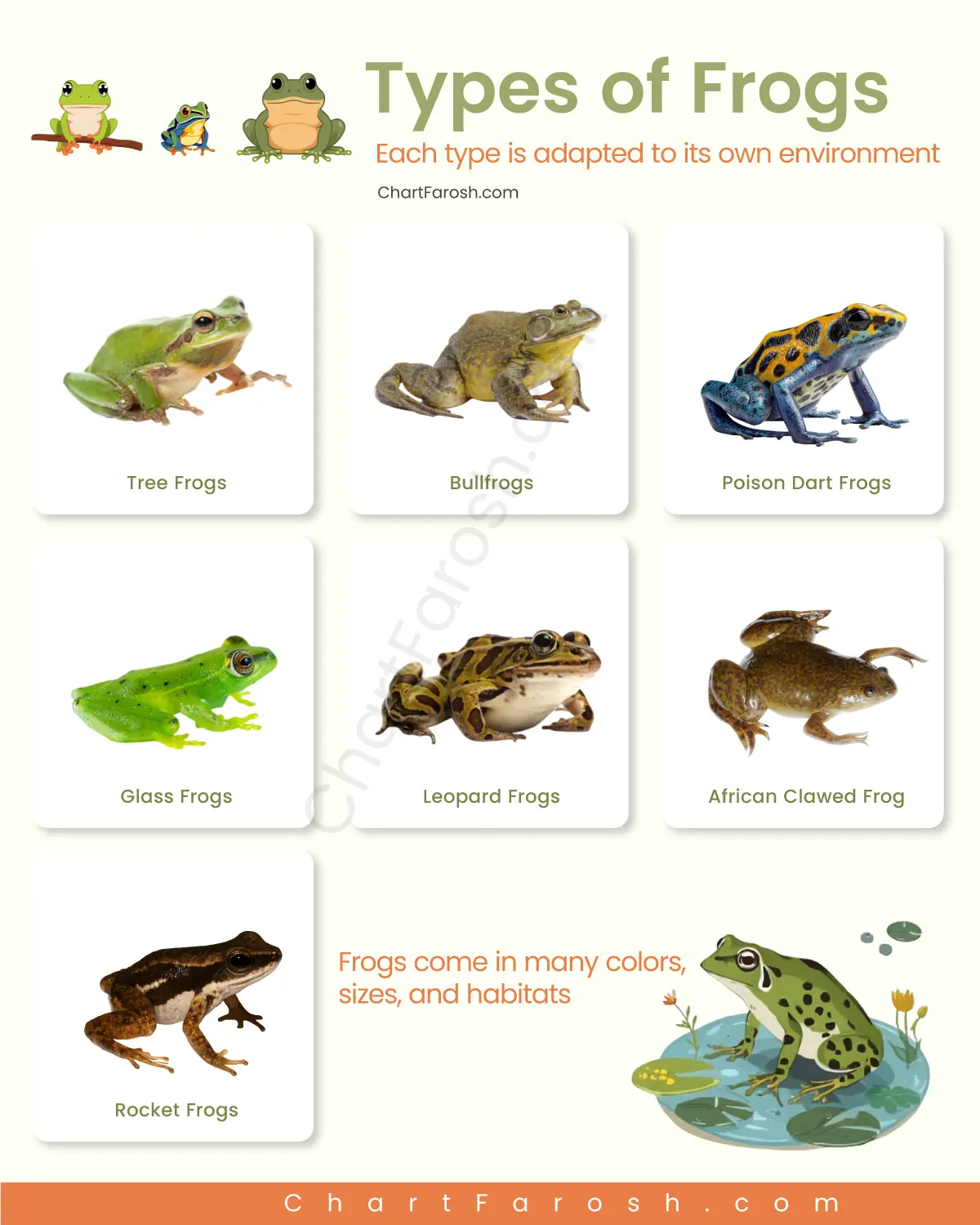
Table of Contents
Types of Frogs
Frogs belong to the order Anura, which includes more than 7,000 known species worldwide. That alone should tell you we’re not dealing with a small, simple group.
When people search for types of Frogs with pictures, they’re often surprised by the sheer color, size, and habitat variation.
From thumbnail-sized poison dart frogs to dinner-plate-sized bullfrogs, frogs have adapted to nearly every environment except Antarctica.
If you’re building a list of Frogs breeds (technically species, since frogs don’t have breeds like dogs), it helps to organize them by habitat, behavior, or family groups.
A well-structured Types of Frogs chart can simplify the chaos and make learning the Types of Frogs and their names much more manageable.
| Frog Type | Examples | Key Feature | Habitat | Fun Fact |
| Tree Frogs | Red-eyed Tree Frog | Sticky pads, bright colors | Trees, tropical forests | Excellent climbers |
| Bullfrogs | American Bullfrog | Large size, deep croak | Ponds, lakes | Can eat small animals |
| Poison Dart Frogs | Dendrobates spp. | Brightly colored, toxic | Rainforests | Skin toxins used by indigenous people |
| Glass Frogs | Centrolenidae | Transparent skin on underside | Tropical forests | Can see organs through skin |
| Leopard Frogs | Lithobates spp. | Spotted patterns | Grasslands, ponds | Common in North America |
| African Clawed Frog | Xenopus laevis | Webbed feet | Freshwater | Fully aquatic |
| Rocket Frogs | Colostethus spp. | Small, agile | Central & South America | Quick jumper |
Frogs vs Toads
People use the words frog and toad interchangeably, but there are real differences. Technically, all toads are frogs, but not all frogs are toads.
Toads generally have drier, bumpier skin and shorter legs, while frogs tend to have smooth, moist skin and longer legs for jumping.
When looking through types of Frogs with pictures, you’ll often spot these skin differences immediately. If you’re adding this distinction to your printable list of Frogs, it’s one of the first clarifications worth making.
| Feature | Frogs | Toads |
| Skin | Smooth, moist | Dry, bumpy |
| Legs | Long, strong jumpers | Shorter, more walking |
| Habitat | Near water | Can tolerate drier areas |
| Eggs | Clusters | Long chains |
Poison Dart Frogs
Poison dart frogs are small, brightly colored frogs found mostly in Central and South American rainforests.
Their vivid blues, yellows, and reds aren’t just for show – they signal toxicity to predators. Interestingly, their poison comes from their diet in the wild.
If you’ve searched for types of Frogs with pictures, these are usually the stars of the page.
When organizing a Types of Frogs and their names list, species like the Blue Poison Dart Frog and Golden Dart Frog are among the most recognizable.
They’re a reminder that in nature, bright often means don’t touch.
| Feature | Poison Dart Frogs |
| Size | 0.5–2 inches |
| Habitat | Tropical rainforests |
| Color | Bright, warning colors |
| Defense | Toxic skin secretions |
Tree Frogs
Tree frogs are built for climbing. They have adhesive toe pads that allow them to stick to leaves, branches, and even glass. Most species are found in tropical forests, but some live in temperate regions as well.
In many types of Frogs species classifications, tree frogs fall under the family Hylidae. If you’re compiling a printable list of Frogs, you’ll notice tree frogs appear across continents.
A proper Types of Frogs chart often separates them by climbing adaptations.
| Feature | Tree Frogs |
| Adaptation | Sticky toe pads |
| Habitat | Trees, shrubs |
| Activity | Mostly nocturnal |
| Color | Often green or camouflaged |
Bullfrogs
Bullfrogs are the heavyweights of the frog world. The American Bullfrog, in particular, can grow over 8 inches long and has a deep, resonant call that carries far across ponds and lakes.
If you’re exploring a list of Frogs breeds, bullfrogs stand out due to size alone. They are opportunistic feeders, eating insects, small mammals, fish, and even other frogs. In a Types of Frogs chart, they usually rank near the top in size.
| Feature | Bullfrogs |
| Size | Up to 8 inches |
| Habitat | Ponds, lakes |
| Diet | Carnivorous, varied |
| Call | Deep, booming |
Glass Frogs
Glass frogs are one of the most fascinating types of Frogs species because of their translucent skin. In some species, you can actually see their internal organs through their belly. They are mostly found in Central and South America.
When browsing types of Frogs with pictures, glass frogs often surprise people the most. Including them in a printable list of Frogs adds a unique category for transparency and arboreal life.
| Feature | Glass Frogs |
| Skin | Translucent underside |
| Habitat | Rainforest streams |
| Size | Small |
| Behavior | Arboreal |
Leopard Frog
Leopard frogs are named for their dark, rounded spots that resemble leopard markings. They are common in North America and are often found in meadows, ponds, and marshes.
When listing the Types of Frogs and their names, the Northern Leopard Frog is one of the more familiar species in temperate climates.
In many Types of Frogs chart layouts, they’re categorized under true frogs (family Ranidae).
| Feature | Leopard Frog |
| Markings | Dark leopard-like spots |
| Habitat | Wetlands, grasslands |
| Region | North America |
| Skin | Smooth |
Rare and Endangered Frog Species
Frogs are among the most threatened groups of animals on Earth. Habitat destruction, pollution, climate change, and fungal diseases like chytridiomycosis have devastated populations worldwide.
If you’re organizing a printable list of Frogs, conservation status deserves its own column. Many types of Frogs species are now critically endangered, particularly in tropical regions.
| Species | Main Threat | Status | Region |
| Golden Toad | Habitat loss | Extinct | Costa Rica |
| Panamanian Golden Frog | Disease | Critically Endangered | Panama |
| Mountain Yellow-Legged Frog | Disease | Endangered | USA |
| Corroboree Frog | Climate change | Critically Endangered | Australia |
Frogs of Tropical Rainforests vs Temperate Regions
Tropical frogs tend to be more colorful and diverse due to stable warm climates. Temperate frogs often rely on camouflage and hibernation to survive seasonal changes.
If you’re building a Types of Frogs chart, separating frogs by climate reveals fascinating adaptations. Anyone reviewing a list of Frogs breeds will notice tropical regions hold far greater diversity.
| Feature | Tropical Frogs | Temperate Frogs |
| Color | Bright, varied | Camouflaged |
| Diversity | Extremely high | Moderate |
| Activity | Year-round | Seasonal |
| Size Range | Wide variation | Moderate |
Types of Frogs in Thailand
Thailand is home to an impressive range of tropical frog species, including tree frogs, narrow-mouthed frogs, and various endemic species found only in Southeast Asia.
Dense rainforests and wetlands provide ideal habitats.
If you’re researching Types of Frogs and their names in Thailand, you’ll encounter species adapted to humid, forested environments. A regional Types of Frogs chart helps track endemic and migratory species.
| Frog Species | Habitat | Key Feature | Fun Fact |
| Flying Frog | Rainforests | Webbed feet for gliding | Can glide between trees |
| Green Paddy Frog | Rice fields | Small, green | Common in agricultural areas |
| Horned Frog | Forest floor | Camouflage, horn-like projections | Ambush predator |
| Poison Dart Frog (local) | Tropical forest | Bright colors | Rare, highly toxic |
Types of Frogs in Georgia
Georgia (USA) has a rich mix of tree frogs, bullfrogs, leopard frogs, and chorus frogs. Wetlands and swamps provide excellent breeding grounds.
A printable list of Frogs for Georgia would include species like the Green Tree Frog and American Bullfrog. The southeastern climate supports high amphibian diversity.
| Frog Species | Habitat | Key Feature | Fun Fact |
| American Bullfrog | Ponds & lakes | Large, croaking | Introduced species in some areas |
| Green Tree Frog | Trees, swamps | Sticky pads | Popular in backyards |
| Southern Leopard Frog | Grasslands, wetlands | Spotted back | Active in spring & summer |
| Spring Peeper | Forests, wetlands | Tiny, high-pitched call | Famous for spring choruses |
Types of Frogs in Texas
Texas offers diverse habitats ranging from deserts to wetlands, which means a surprisingly wide range of frogs. Species include the Rio Grande Leopard Frog and various toads and tree frogs.
When organizing types of Frogs species by state, Texas stands out because of its ecological variety. A local Types of Frogs chart would reflect this diversity.
| Frog Species | Habitat | Key Feature | Fun Fact |
| Green Tree Frog | Forests, wetlands | Sticky pads | Most common in southern Texas |
| American Bullfrog | Ponds & lakes | Large, aggressive | Can eat small birds & insects |
| Couch’s Spadefoot | Deserts, sandy areas | Burrowing frog | Emerges after rains |
| Rio Grande Leopard Frog | Rivers, wetlands | Large, spotted | Native to Rio Grande basin |
Types of Frogs in Australia
Australia is home to some of the most unique frog species, including the Green Tree Frog and the critically endangered Corroboree Frog. Isolation has allowed unusual evolutionary traits to develop.
If you’re compiling a list of Frogs breeds by continent, Australia deserves special attention for its endemic species and conservation challenges.
| Frog Species | Habitat | Key Feature | Fun Fact |
| Green Tree Frog | Forests, wetlands | Smooth, bright green | Iconic Australian frog |
| Australian Rocket Frog | Tropical & coastal | Fast jumper | Small, agile |
| Corroboree Frog | Snowy Mountains | Black & yellow stripes | Critically endangered |
| Tusked Frog | Forests | Tiny tusk-like projections | Rare species, carnivorous tadpoles |
| Cane Toad | Urban & rural | Large, invasive | Introduced, toxic to predators |
FAQs
How many frog species exist worldwide?
There are over 7,000 recognized frog species globally.
Are all toads considered frogs?
Yes, toads are a type of frog, but not all frogs are toads.
What is the largest frog species?
The Goliath Frog of West Africa is the largest frog species in the world.
Why are so many frogs endangered?
Habitat loss, pollution, climate change, and fungal diseases are major threats.
Do frogs live only near water?
Most frogs need water to reproduce, but many species can live far from permanent water sources outside breeding season.