Types of Elephants
I remember sitting with a wildlife documentary playing in the background while I worked, half-paying attention until a scene of elephants crossing a dusty riverbed caught my eye.
There was something steady and grounding about them. Later that week, I found myself going down a rabbit hole trying to understand how many kinds of elephants actually exist.
I kept seeing different names, African bush, forest, Asian, Indian, and realized I didn’t have a clear picture of the real differences.
It wasn’t just curiosity; I wanted to understand them properly, beyond the generic big ears vs small ears explanation.
The more I researched, the more I realized that the types of Elephants species are more distinct and complex than most of us think.
From body size and ear shape to habitat and conservation status, each one has its own story. And if you’re someone who loves having a clear, organized Types of Elephants chart or even a printable list of Elephants, this guide will help you see them clearly and confidently.
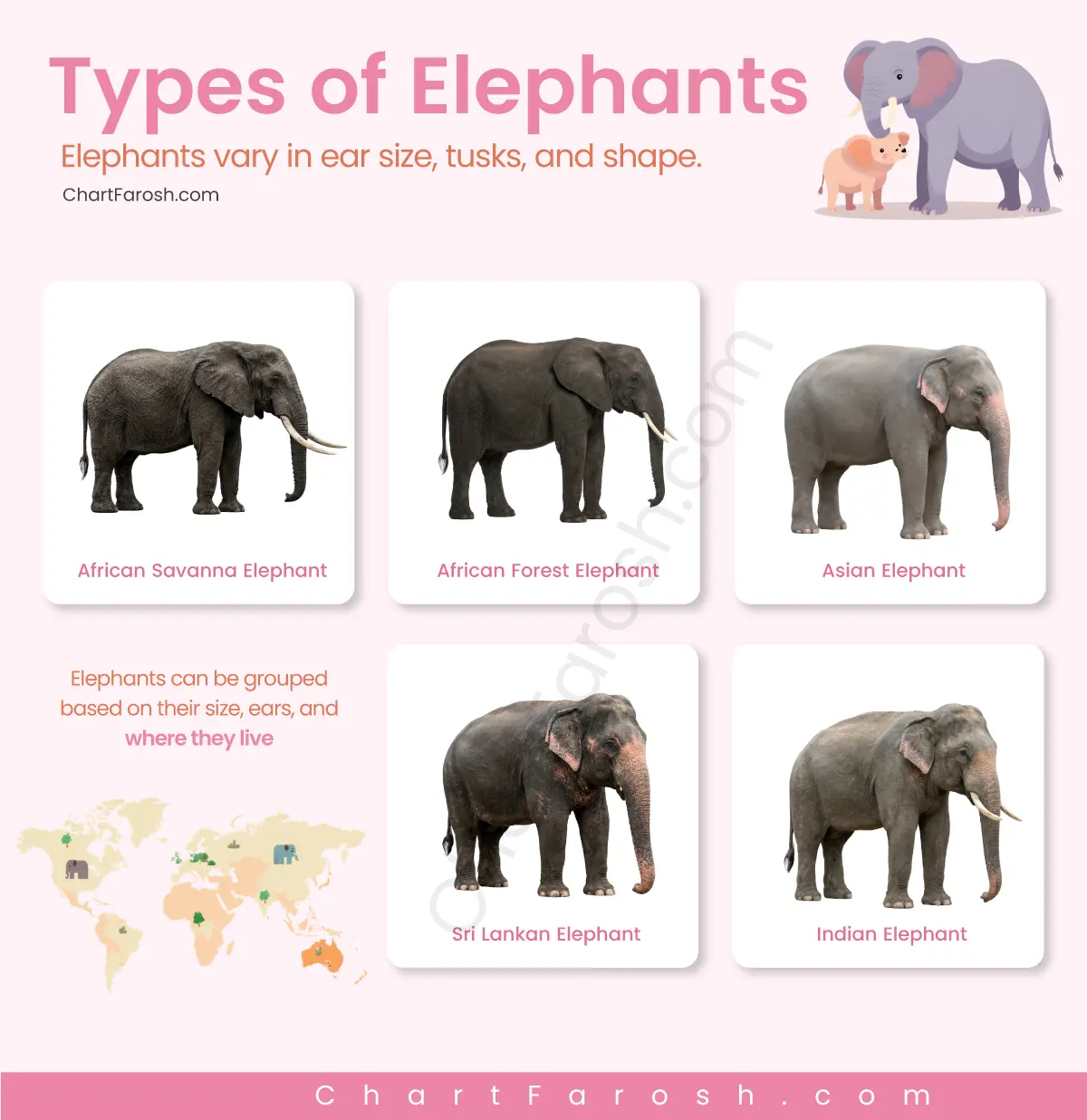
Table of Contents
Types of Elephants
Elephants today are divided into two main groups: African elephants and Asian elephants. Within these, there are recognized species and subspecies.
If you’ve ever searched for Types of Elephants and their names, you’ve probably seen terms like African Savanna Elephant, African Forest Elephant, and Asian Elephant. Scientists now recognize three living species in total.
For those looking for a list of Elephants breeds, it’s important to note that elephants don’t have breeds like dogs; instead, they have species and subspecies shaped by geography and evolution.
Many wildlife lovers also search for types of Elephants with pictures to visually compare ear size, tusks, and body shape.
A simple Types of Elephants chart makes it easier to understand these differences at a glance.
| Elephant Type | Species | Key Feature | Habitat | Fun Fact |
| African Savanna Elephant | Loxodonta africana | Large ears, tusks | Grasslands & savannas | Largest land animal on Earth |
| African Forest Elephant | Loxodonta cyclotis | Smaller size, rounder ears | Dense forests | Shy & elusive species |
| Asian Elephant | Elephas maximus | Smaller ears, single domed head | Forests & grasslands | Used historically in work and festivals |
| Sri Lankan Elephant | Elephas maximus maximus | Subspecies of Asian elephant | Sri Lanka forests & grasslands | Darker skin, often with freckled ears |
| Indian Elephant | Elephas maximus indicus | Smaller than African | India forests & grasslands | Endangered, cultural significance |
African Elephants vs Asian Elephants
At first glance, telling African and Asian elephants apart seems simple—but the differences go beyond ear size.
African elephants are generally larger, with broader ears shaped somewhat like the African continent. Asian elephants are slightly smaller, with more rounded ears and a more domed forehead.
When comparing the types of Elephants species, African elephants include two distinct species (Savanna and Forest), while Asia has one species with several subspecies.
If you’re making a printable list of Elephants for reference, separating them by continent is the easiest starting point. Below is a simple comparison.
| Feature | African Elephants | Asian Elephants |
| Species Count | 2 species | 1 species |
| Size | Larger | Slightly smaller |
| Ear Shape | Large, fan-shaped | Smaller, rounded |
| Tusks | Both sexes (mostly) | Mainly males |
African Savanna (Bush) Elephant: The Giant of the Grasslands
The African Savanna Elephant is the largest land animal on Earth. Found across open plains and grasslands in sub-Saharan Africa, this species is known for its massive size, long curved tusks, and impressive social structures.
When people imagine elephants roaming wide landscapes, this is usually the one they’re picturing.
Among the Types of Elephants and their names, this one stands out because of its sheer scale.
Many types of Elephants with pictures feature this species due to its iconic appearance. If you’re building a Types of Elephants chart, this species always tops the list in size.
| Feature | African Savanna Elephant |
| Scientific Name | Loxodonta africana |
| Habitat | Grasslands, savannas |
| Average Weight | 6,000–13,000 lbs |
| Conservation Status | Endangered |
African Forest Elephant: The Lesser-Known Species
The African Forest Elephant was once considered a subspecies but is now recognized as its own species.
Smaller and darker than the Savanna Elephant, it lives deep within Central and West African rainforests. Its tusks are straighter and thinner, adapted for navigating dense vegetation.
When updating a list of Elephants breeds (technically species), this distinction is important. The forest elephant plays a key role in seed dispersal, making it essential for rainforest ecosystems.
In many types of Elephants with pictures, you’ll notice its more compact body and rounded ears compared to its savanna cousin.
| Feature | African Forest Elephant |
| Scientific Name | Loxodonta cyclotis |
| Habitat | Tropical rainforests |
| Size | Smaller than savanna |
| Conservation Status | Critically Endangered |
Asian Elephant: The Most Iconic Asian Species
The Asian Elephant is the only living elephant species found in Asia. It inhabits forests and grasslands across India, Sri Lanka, Thailand, and parts of Southeast Asia.
Compared to African elephants, it has smaller ears, a smoother back, and a twin-domed head.
If you’re creating a printable list of Elephants, the Asian elephant deserves its own section because of its distinct regional subspecies.
Among the types of Elephants species, this one has a long cultural and historical connection with humans, especially in South and Southeast Asia.
| Feature | Asian Elephant |
| Scientific Name | Elephas maximus |
| Habitat | Forests, grasslands |
| Ear Size | Smaller |
| Conservation Status | Endangered |
Subspecies of Asian Elephants: Indian, Sri Lankan, and Sumatran
Within the Asian Elephant species, there are recognized subspecies shaped by geography. The Indian Elephant is widespread across mainland Asia.
The Sri Lankan Elephant is generally larger with fewer tusked males. The Sumatran Elephant is smaller and critically endangered.
If you’re organizing a Types of Elephants chart, these subspecies deserve careful listing. Anyone searching for a detailed list of Elephants breeds often means these regional variations.
When reviewing Types of Elephants and their names, these subspecies frequently come up in wildlife references.
| Subspecies | Region | Size | Status |
| Indian Elephant | Mainland Asia | Medium-Large | Endangered |
| Sri Lankan Elephant | Sri Lanka | Largest Asian subspecies | Endangered |
| Sumatran Elephant | Sumatra | Smaller | Critically Endangered |
Rare and Critically Endangered Elephants
Elephant populations worldwide face habitat loss, poaching, and human-wildlife conflict. The African Forest Elephant and Sumatran Elephant are among the most threatened.
Conservation efforts focus on anti-poaching laws, protected reserves, and community engagement.
If you’re compiling a printable list of Elephants for conservation awareness, highlighting their status is essential.
Many types of Elephants with pictures used in awareness campaigns focus on endangered populations to show what’s at stake. Understanding the conservation status adds depth to any Types of Elephants chart.
| Species/Subspecies | Main Threat | Status | Region |
| African Forest | Ivory poaching | Critically Endangered | Central Africa |
| Sumatran Elephant | Habitat loss | Critically Endangered | Indonesia |
| African Savanna | Poaching | Endangered | Sub-Saharan Africa |
| Asian Elephant | Habitat loss | Endangered | South Asia |
Types of Elephants in Sri Lanka
Sri Lanka is home to the Sri Lankan Elephant, a subspecies of the Asian Elephant. It is the largest of the Asian subspecies and is deeply woven into the country’s culture and history.
National parks like Udawalawe and Yala are known for relatively large elephant populations.
If you’re searching for Types of Elephants and their names specific to Sri Lanka, you’ll mainly find this subspecies.
However, variations in size, tusk presence, and habitat behavior can be observed within regional populations.
A well-organized Types of Elephants chart can help distinguish these subtle differences when studying them closely.
| Elephant Species | Habitat | Key Feature | Fun Fact |
| Sri Lankan Elephant | National parks & forests | Darker skin, freckled ears | Largest subspecies of Asian elephant in weight and height |
| Asian Elephant (general) | Forest corridors | Domed head, smaller ears | Used in festivals and tourism |
Types of Elephants in Africa
Africa is home to two distinct elephant species: the African Savanna Elephant and the African Forest Elephant. These are the only two elephant species native to the continent today.
When creating a printable list of Elephants, Africa’s classification is straightforward but ecologically diverse.
From open plains in Kenya and Tanzania to dense Congo Basin forests, the types of Elephants species found here adapt to dramatically different environments.
Any complete list of Elephants breeds must clearly separate these two species due to their evolutionary differences.
| Elephant Species | Habitat | Key Feature | Status |
| African Savanna Elephant | Grasslands, savannas | Largest elephant | Vulnerable |
| African Forest Elephant | Central & West African forests | Smaller, tusks straighter | Critically endangered |
Types of Elephants in Kenya
Kenya is primarily home to the African Savanna Elephant. Large populations roam protected areas like Amboseli National Park and Tsavo National Park. These elephants are famous for their massive tusks and large herd structures.
If you’re looking at types of Elephants with pictures from Kenya, you’ll likely see stunning images of elephants walking beneath Mount Kilimanjaro.
While Kenya does not have forest elephants in significant numbers, regional variations in tusk size and herd behavior can still be observed across different parks.
| Elephant Species | Location | Key Feature | Fun Fact |
| African Savanna Elephant | National parks & reserves | Huge ears, massive tusks | Often spotted in Amboseli & Maasai Mara |
| African Forest Elephant | Rare | Dense forests | Mostly in Western Kenya, very elusive |
Types of Elephants in India
India is home to the Indian Elephant, a subspecies of the Asian Elephant. It is widely distributed across southern, northeastern, and central India. States like Karnataka, Kerala, and Assam hold significant populations.
Anyone searching for Types of Elephants and their names in India will mainly encounter the Indian Elephant.
However, regional differences in habitat, from dense forests to grasslands, shape their movement patterns and social structures. Including them in a structured Types of Elephants chart helps clarify how they differ from Sri Lankan and Sumatran elephants.
| Elephant Species | Habitat | Key Feature | Note |
| Indian Elephant | Forests & grasslands | Domed head, smaller ears than African | Endangered, used in cultural events |
| Asian Elephant (general) | Protected forests | Work and tourism | Subspecies includes Sri Lankan elephant for comparison |
FAQs
How many types of elephants are there in the world?
There are three recognized living elephant species: African Savanna Elephant, African Forest Elephant, and Asian Elephant. The Asian Elephant has three main subspecies.
What is the largest type of elephant?
The African Savanna Elephant is the largest land animal on Earth.
Are forest elephants different from savanna elephants?
Yes. Forest elephants are smaller, have straighter tusks, and live in dense rainforests, while savanna elephants are larger and live in open grasslands.
Which elephant species is most endangered?
The African Forest Elephant and Sumatran Elephant are classified as Critically Endangered.
Do all male and female elephants have tusks?
In African elephants, both males and females usually have tusks. In Asian elephants, typically only males develop prominent tusks.