Types of Wild Cats
There was a phase when I couldn’t tell one wild cat from another unless it was very obvious, lion mane, tiger stripes, done.
Everything else blurred into “some kind of spotted cat.” That changed the day I tried identifying a blurry paw-print near a forest road and realized how wildly different these cats actually are.
Some thrive in snow, some in mangroves, some in deserts that barely seem survivable.
That curiosity sent me down a rabbit hole of names, sizes, behaviors, and habitats, and the deeper I went, the clearer it became: wild cats are not just variations of the same animal.
They’re specialists, shaped by geography and survival pressure in fascinating ways. From massive apex predators to stealthy, tree-loving hunters, understanding the types of Wild Cats species gives you a new respect for how precise nature can be, and how much there still is to protect.
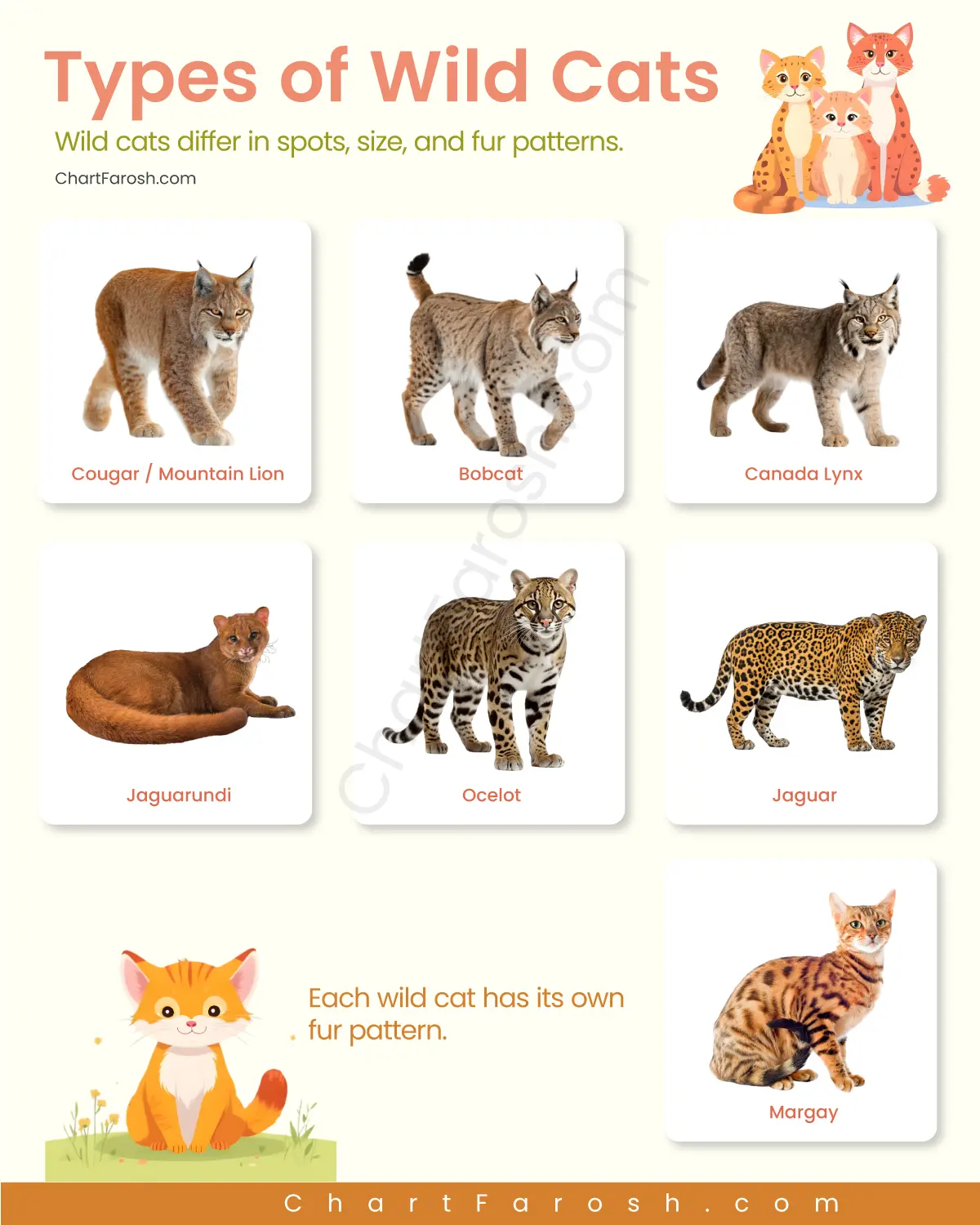
Table of Contents
Types of Wild Cats
Wild cats belong to the Felidae family and are spread across almost every continent except Antarctica and Australia.
Scientists usually group them into big cats (like lions, tigers, and leopards) and small wild cats (like lynx, servals, and fishing cats), but that’s just the start. There are over 40 recognized species, each adapted to its environment.
When people look for Types of Wild Cats and their names, they’re often surprised by how long the list actually is.
From mountain ranges to rainforests, the global list of Wild Cats breeds shows incredible diversity in size, coat patterns, and behavior.
| Wild Cat Type | Examples | Key Feature | Habitat | Fun Fact |
| Cougar / Mountain Lion | Puma concolor | Large, tawny | Mountains, forests | Wide-ranging predator |
| Bobcat | Lynx rufus | Short tail, spotted coat | Forests, deserts | Most widespread North American cat |
| Canada Lynx | Lynx canadensis | Large paws, thick fur | Canada & Alaska | Arctic-adapted, snow hunter |
| Jaguarundi | Puma yagouaroundi | Small, slender | Central & South America | Rare in southern US |
| Ocelot | Leopardus pardalis | Spotted coat | Southern US, Central America | Nocturnal & elusive |
| Jaguar | Panthera onca | Large, powerful | Southern US to South America | Largest wild cat in Americas |
| Margay | Leopardus wiedii | Small, agile | Rainforests | Excellent climber |
Big Cats vs Small Wild Cats: Key Differences
At first glance, size seems like the main difference, but it goes much deeper than that. Big cats (genus Panthera) can roar due to a flexible larynx, while small wild cats cannot.
Hunting style, social behavior, and even eye shape vary between the two groups.
Understanding these distinctions helps when reading a Types of Wild Cats chart or browsing a printable list of Wild Cats, you start seeing patterns instead of random species.
| Feature | Big Cats | Small Wild Cats |
| Ability to Roar | Yes (lion, tiger) | No |
| Hunting Style | Power-based ambush | Stealth and agility |
| Social Behavior | Often social or semi-social | Mostly solitary |
| Examples | Lion, Tiger, Leopard | Lynx, Serval, Ocelot |
=
Jaguars and Cheetahs
Jaguars and cheetahs are often confused because of their spotted coats, but they couldn’t be more different in how they live and hunt.
Jaguars are built like tanks, short, muscular, and capable of crushing skulls with their bite.
Cheetahs, on the other hand, are built for speed, relying on explosive acceleration rather than strength.
Seeing them side by side in a types of Wild Cats with pictures layout really highlights how evolution took two completely different paths.
| Cat | Habitat | Hunting Style | Unique Trait |
| Jaguar | Rainforests, wetlands | Ambush | Strongest bite force |
| Cheetah | Grasslands | High-speed chase | Fastest land animal |
| Leopard | Forests, savannas | Ambush | Extreme adaptability |
Snow Leopards
Snow leopards feel almost mythical, mostly because so few people ever see them in the wild. Living in high-altitude mountain ranges, they’ve evolved thick fur, wide paws, and long tails for balance.
Unlike other big cats, they’re incredibly elusive and prefer solitude. When people search for a printable list of Wild Cats, snow leopards often stand out as one of the most endangered and least understood species.
| Feature | Snow Leopard |
| Habitat | Himalayan mountains |
| Key Adaptation | Thick fur, long tail |
| Conservation Status | Vulnerable |
| Hunting Style | Ambush on steep terrain |
Lynx and Bobcats
Lynx and bobcats are compact, tough, and incredibly adaptable. Found across North America and parts of Eurasia, they thrive in forests, deserts, and even snowy regions.
The tufted ears of lynx help with sound detection, while bobcats are known for surviving close to human settlements. These cats often appear together in a list of Wild Cats breeds because of their shared ancestry.
| Cat | Range | Size | Distinct Feature |
| Canada Lynx | Northern forests | Medium | Thick fur, ear tufts |
| Bobcat | North America | Medium | Short tail |
| Eurasian Lynx | Europe, Asia | Large | Powerful build |
Caracal and Serval
Both caracals and servals are built for precision hunting, but in different ways. Servals have long legs for spotting prey in tall grass, while caracals are famous for their explosive vertical jumps.
Watching slow-motion footage of caracal hunting birds makes you realize how refined these predators are.
| Cat | Habitat | Hunting Skill | Notable Trait |
| Caracal | Dry regions | High jumps | Ear tufts |
| Serval | Grasslands | Stealth stalking | Long legs |
| African Wildcat | Savannas | Versatile | Domestic cat ancestor |
Wild Cats of Asia: Clouded Leopard and Fishing Cat
Asia hosts some of the most unique wild cats on the planet. Clouded leopards are tree specialists, capable of climbing down headfirst, while fishing cats are semi-aquatic and hunt in wetlands.
Including these species in a Types of Wild Cats chart shows just how niche-specific evolution can be.
| Cat | Habitat | Diet | Special Skill |
| Clouded Leopard | Rainforests | Mammals, birds | Tree climbing |
| Fishing Cat | Wetlands | Fish | Swimming |
| Asiatic Golden Cat | Forests | Small prey | Color variation |
Wild Cats of the Americas: Ocelot, Margay, and Puma
The Americas are home to an impressive range of wild cats, from tree-dwelling margays to the widely roaming puma. These cats are masters of adaptability, surviving in jungles, mountains, and deserts alike.
They often feature prominently in Types of Wild Cats and their names searches because of their wide distribution.
| Cat | Habitat | Size | Adaptability |
| Ocelot | Rainforests | Small | Nocturnal |
| Margay | Forest canopies | Small | Arboreal |
| Puma | Mountains, deserts | Large | Extremely adaptable |
Rare and Critically Endangered Wild Cats
Some wild cats are so rare that even researchers struggle to study them. Habitat loss and poaching have pushed several species to the brink.
Seeing them listed in a printable list of Wild Cats can be sobering, it’s a reminder that documentation sometimes outpaces conservation.
| Cat | Region | Status | Threat |
| Iberian Lynx | Europe | Endangered | Habitat loss |
| Amur Leopard | Russia | Critically Endangered | Poaching |
| Flat-headed Cat | Asia | Endangered | Wetland destruction |
How Wild Cats Differ in Size, Hunting Style, and Behavior
Size doesn’t always determine dominance. Smaller cats often rely on stealth and precision, while larger cats use strength and intimidation.
Behavior also varies widely, some cats are solitary to an extreme, while others tolerate loose social structures. This diversity is why a list of Wild Cats breeds never feels repetitive.
| Factor | Small Cats | Big Cats | Medium Cats |
| Size | Under 20 kg | Over 100 kg | 20–100 kg |
| Hunting | Precision | Power | Mixed |
| Sociality | Solitary | Sometimes social | Mostly solitary |
Extinct Wild Cat Species You Should Know About
Extinct wild cats tell us a lot about climate change and human impact. From saber-toothed cats to giant prehistoric felines, these species once ruled their ecosystems.
Including them in a Types of Wild Cats species discussion adds important historical context.
| Species | Era | Size | Cause of Extinction |
| Smilodon | Ice Age | Very large | Climate change |
| American Lion | Ice Age | Larger than lion | Human activity |
| Cave Lion | Prehistoric | Massive | Environmental shifts |
Types of Wild Cats in Canada
Canada’s wild cats are shaped by cold climates, vast forests, and long winters. The most iconic is the Canada lynx, built specifically for snow with oversized paws that work like natural snowshoes.
Bobcats are found farther south, especially where forests meet open land, and they’re far more adaptable to changing conditions.
In rare cases, cougars (mountain lions) roam western regions, covering enormous territories.
These cats are quiet, elusive, and mostly nocturnal, which is why many people live near them without ever seeing one.
Canada’s wild cats play a crucial role in keeping prey populations balanced in fragile ecosystems.
| Wild Cat Species | Habitat | Key Feature | Status |
| Canada Lynx | Boreal forests | Thick fur, large paws | Protected, specialized predator |
| Cougar / Mountain Lion | Western forests | Solitary, large | Rare in eastern Canada |
| Bobcat | Forests & scrublands | Short tail | Widespread but elusive |
Types of Wild Cats in Arizona
Arizona’s mix of deserts, mountains, and grasslands supports an impressive range of wild cats. Bobcats are the most commonly seen, thriving in rocky terrain and scrubland.
Mountain lions dominate as apex predators, capable of surviving extreme heat and scarce water sources.
Southern Arizona is especially unique because it occasionally hosts jaguars and ocelots, crossing over from Mexico.
These sightings are rare but ecologically significant. Arizona’s wild cats are masters of stealth, often hunting at night to avoid heat, and they rely heavily on camouflage and patience rather than brute force.
| Wild Cat Species | Habitat | Key Feature | Status |
| Cougar / Mountain Lion | Mountains, deserts | Large predator | Widespread but elusive |
| Bobcat | Forests, desert edges | Spotted coat | Common |
| Ocelot | Southern Arizona | Rare, spotted | Critically rare in US |
| Jaguar | Border areas | Powerful, large | Rare sightings near Mexico |
Types of Wild Cats in Texas
Texas has one of the most diverse wild cat populations in the United States due to its massive size and varied landscapes.
Bobcats are widespread and highly adaptable, living everywhere from deserts to wooded areas.
Mountain lions are mostly found in western and southern regions, where open land allows for long-distance travel.
Texas is also one of the last U.S. strongholds for the ocelot, a small, spotted wild cat that prefers dense brush near the border.
These cats are vital indicators of habitat health and are closely monitored due to conservation concerns.
| Wild Cat Species | Habitat | Key Feature | Status |
| Bobcat | Forests, scrublands | Short tail, spotted | Common statewide |
| Cougar / Mountain Lion | Western & central Texas | Large predator | Rare, solitary |
| Ocelot | Southern Texas | Small, spotted | Endangered, protected |
| Jaguarundi | South Texas | Small, slender | Very rare |
Types of Wild Cats in North America
North America is home to a mix of large and small wild cats, from pumas roaming thousands of miles to elusive forest lynx.
Mountain lions range from Canada to South America, making them one of the most widespread wild cats in the world.
Bobcats are the most adaptable, surviving near cities, deserts, forests, and farmlands. The Canada lynx dominates colder northern regions, relying heavily on snowshoe hares for survival.
In southern areas, rare species like ocelots and jaguars appear. This diversity is why regional lists are such an important part of a complete printable list of Wild Cats.
| Wild Cat Species | Range | Key Feature | Fun Fact |
| Cougar / Mountain Lion | Most of US, Canada | Largest wild cat in North America | Solitary and territorial |
| Bobcat | Entire US, southern Canada | Medium size, spotted | Adaptable to human areas |
| Canada Lynx | Northern US, Canada | Snow-adapted | Feeds mainly on snowshoe hare |
| Ocelot | Southern US | Small, spotted | Nocturnal hunter |
| Jaguarundi | Southern US | Long body, short legs | Rare in US |
| Jaguar | Southern tip of US | Powerful, spotted | Historically ranged across SW US |
FAQs
What is the biggest wild cat species?
The Siberian tiger is the largest wild cat by weight and size.
How many types of wild cats exist?
There are over 40 recognized wild cat species worldwide.
Are all wild cats endangered?
No, but many face declining populations due to habitat loss.
Can wild cats be domesticated?
No. Even smaller wild cats retain strong natural instincts.
Why are wild cats important to ecosystems?
They regulate prey populations and maintain ecological balance.