Types of Deers
For a long time, deer all blurred together for me. Not in a careless way, more in that I know I’m missing something way.
I kept noticing how different they looked depending on where I was or what I was reading. Some had massive antlers like living chandeliers, others had none at all.
Some were built like forest tanks, others looked more like oversized rabbits on stilts. I wanted clarity, not trivia-night facts.
So I started paying closer attention: field guides, wildlife reports, even old regional records. Slowly, patterns emerged.
Deer aren’t just one or two familiar animals repeated everywhere, they’re a broad family shaped by geography, climate, and survival strategies.
Once you look closely, the variety becomes impossible to ignore, and that’s where things get genuinely interesting.
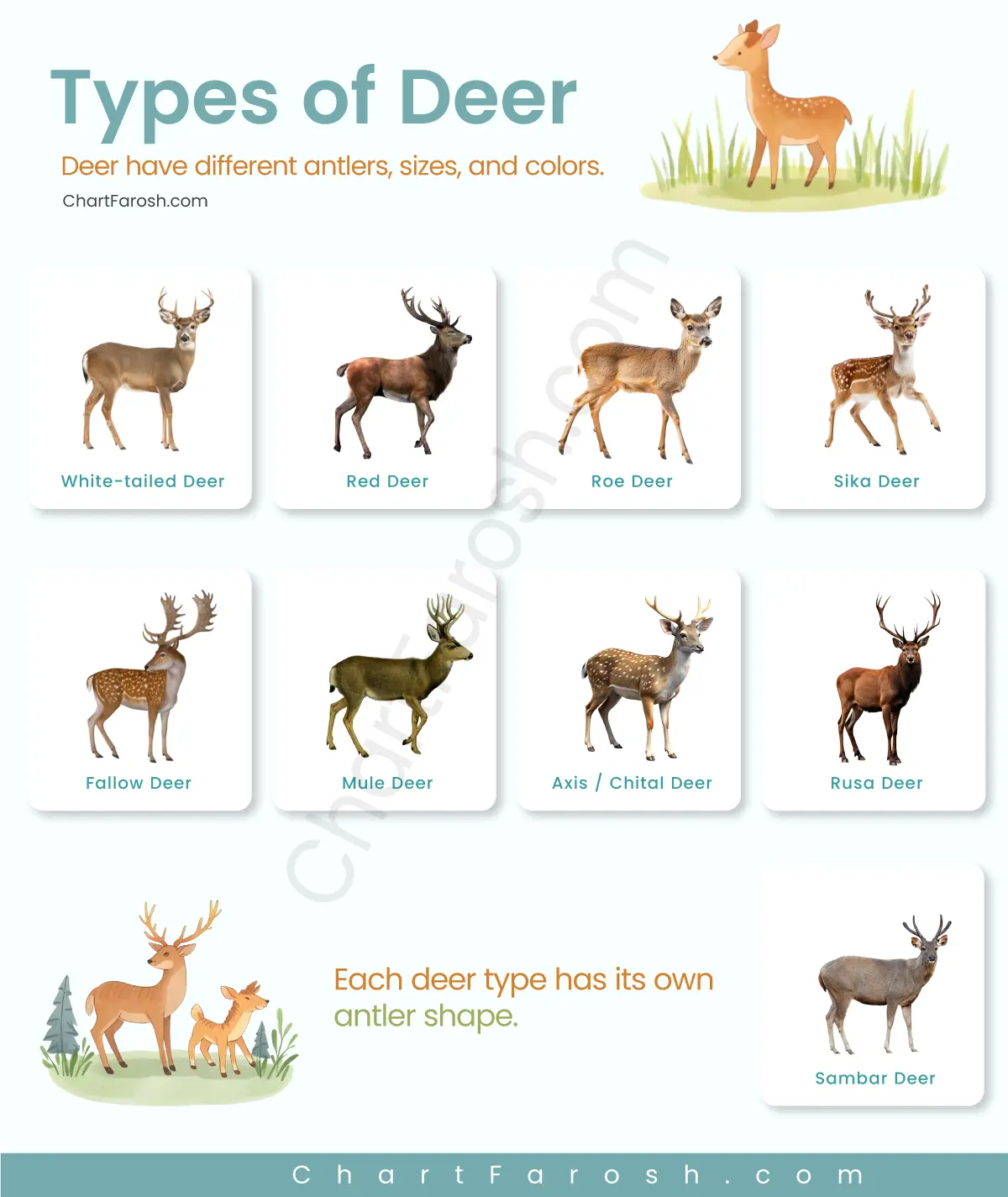
Table of Contents
Types of Deers
When people talk about “types of deers,” they’re usually blending a few ideas together: species, regional populations, and sometimes informal names.
Scientifically, deer belong to the family Cervidae, and within it are dozens of recognized species spread across the globe.
This is where phrases like types of Deer species and Types of Deer and their names start to matter.
Some species are closely related but live on opposite sides of the world, while others evolved very specific traits to survive in narrow habitats.
If you’ve ever searched for types of Deer with pictures or tried to make sense of a Types of Deer chart, understanding this foundation makes everything else fall into place.
I’ll let you add your own table here, but this section sets the context for everything that follows.
| Deer Type | Examples | Key Feature | Habitat | Fun Fact |
| White-tailed Deer | Odocoileus virginianus | White underside tail | North America | Can run up to 30 mph |
| Red Deer | Cervus elaphus | Large antlers | Europe & Asia | Popular in hunting & folklore |
| Roe Deer | Capreolus capreolus | Small size | Europe | Very agile, often in forests |
| Sika Deer | Cervus nippon | Spotted as fawns | East Asia | Introduced in multiple countries |
| Fallow Deer | Dama dama | Palmated antlers | Europe & introduced worldwide | Known for colorful coat patterns |
| Mule Deer | Odocoileus hemionus | Large ears | Western North America | Ears like a mule |
| Axis / Chital Deer | Axis axis | Spotted coat | India, Asia | Social species, forms herds |
| Rusa Deer | Rusa timorensis | Large, dark antlers | Indonesia & introduced | Strong swimmer |
| Sambar Deer | Rusa unicolor | Large body, shaggy coat | Southeast Asia | Solitary species |
Old World Deer vs New World Deer
One of the simplest ways to understand deer diversity is by geography. Old World deer come from Europe, Asia, and parts of North Africa, while New World deer evolved in the Americas.
These two groups split long ago and developed different physical and behavioral traits. Old World deer, like red deer and sika deer, often have more complex antler structures and stronger herd traditions.
New World deer, such as white-tailed deer and mule deer, tend to be more adaptable and widespread.
This division shows up clearly in any detailed list of Deer breeds or Types of Deer chart that compares continents side by side.
| Group | Primary Regions | Example Species |
| Old World Deer | Europe, Asia | Red deer, Sika deer |
| New World Deer | North & South America | White-tailed deer |
| Shared Traits | Forest & grassland habitats | Seasonal breeding |
Deer Species With Antlers vs Species Without Antlers
Antlers are the most recognizable deer feature, but not all deer have them. In most species, only males grow antlers, shedding and regrowing them yearly.
However, species like water deer break this rule entirely, no antlers at all. Instead, they rely on long canine teeth, which look almost tusk-like.
This contrast is a great example of how evolution offers multiple solutions to the same problem: competition.
When browsing a printable list of Deer, antlerless species often surprise people because they don’t fit the classic image most of us carry around.
| Category | Example Species | Key Trait |
| Antlered Deer | Red deer | Seasonal antlers |
| Mostly Antlered | White-tailed deer | Males only |
| Antlerless | Water deer | Long canines |
Large Deer Species of Forests and Mountains
Large deer tend to live in colder regions or rugged landscapes where size helps conserve heat and deter predators.
These animals shape entire ecosystems by controlling vegetation and influencing predator behavior. Moose, elk, and red deer fall into this category, and they’re often the centerpiece of regional types of Deer species discussions.
Their size also explains why they require vast territories and why conservation planning for them is so complex. Any Types of Deer chart that ranks by size usually starts with these heavyweights.
| Species | Habitat | Average Weight |
| Moose | Boreal forests | 400–600 kg |
| Elk | Mountains, forests | 300–450 kg |
| Red deer | Forests, plains | 160–240 kg |
Small and Medium-Sized Deer Species
Not all deer are giants. Many species stay small or medium-sized to move easily through dense forests or thick undergrowth.
These deer rely on agility and camouflage rather than brute strength. Species like roe deer, muntjac, and pudu fit this category.
They’re often overlooked in popular media, but they show up frequently in comprehensive Types of Deer and their names resources because of their ecological importance.
If you’ve ever searched types of Deer with pictures and noticed how different proportions can be, this group explains why.
| Species | Size Class | Region |
| Roe deer | Medium | Europe |
| Muntjac | Small | Asia |
| Pudu | Very small | South America |
Red Deer and Its Global Subspecies
Red deer are one of the most widely distributed deer species in the world, with numerous subspecies adapted to local conditions.
Found across Europe, Asia, and even introduced regions like New Zealand, red deer vary in size, coat color, and antler shape.
This adaptability is why they’re often used as a reference point in a Types of Deer chart. When people compile a list of Deer breeds, red deer subspecies usually take up several entries due to their regional diversity.
| Subspecies | Region | Notable Trait |
| European red deer | Europe | Large antlers |
| Central Asian red deer | Asia | Thicker coat |
| Wapiti (elk) | North America | Massive body size |
White-Tailed Deer: The Most Widespread Deer
White-tailed deer are the definition of adaptable. They live in forests, farmlands, suburbs, and even near cities across North America and parts of South America.
Their ability to thrive in human-altered landscapes makes them the most widespread deer species on the planet.
This is why they dominate many types of Deer species lists and are a staple in any printable list of Deer. Their signature white tail flash isn’t just iconic, it’s a communication tool to warn other deer of danger.
| Trait | Detail |
| Range | Americas |
| Habitat | Forests, suburbs |
| Key Feature | White tail underside |
Moose: The Largest Deer Species on Earth
Moose don’t just top the size charts they redefine them. With towering shoulder heights and broad, paddle-shaped antlers, moose are in a category of their own.
They’re built for cold climates, with long legs for moving through snow and wetlands.
Despite their size, moose are mostly solitary and surprisingly quiet. Any Types of Deer chart ordered by size puts moose firmly at number one, and no serious list of Deer breeds leaves them out.
| Feature | Measurement |
| Shoulder height | Up to 2.1 m |
| Weight | Up to 700 kg |
| Antler span | Up to 1.8 m |
Reindeer (Caribou): Deer That Thrive in the Arctic
Reindeer, also known as caribou in North America, are uniquely adapted to Arctic and sub-Arctic environments.
Unlike most deer species, both males and females grow antlers. They migrate in massive herds, covering thousands of kilometers each year.
This behavior sets them apart in any discussion of types of Deer species. If you’re looking at types of Deer with pictures, reindeer are instantly recognizable thanks to their thick coats and wide hooves.
| Trait | Detail |
| Habitat | Arctic tundra |
| Antlers | Both sexes |
| Migration | Long-distance |
Roe Deer: A Common European Species
Roe deer are one of Europe’s most familiar wild mammals, yet they’re often underestimated. Smaller than red deer, roe deer are agile, alert, and highly adaptable. They thrive in woodlands, farmland edges, and even near towns.
Because of this flexibility, they appear frequently in regional Types of Deer chart comparisons. Any accurate printable list of Deer covering Europe will include roe deer as a key species.
| Trait | Detail |
| Size | Medium |
| Habitat | Woodland, farmland |
| Range | Europe, Asia |
Sika Deer and Its Asian Range
Sika deer originated in East Asia and are known for their spotted coats, which many retain into adulthood.
They’re highly adaptable and have been introduced to other regions, sometimes causing ecological issues.
Sika deer often show up in discussions about invasive species, which adds another layer to types of Deer species conversations.
Visually, they’re a favorite in types of Deer with pictures searches because of their distinctive markings.
| Region | Status | Key Feature |
| East Asia | Native | Spotted coat |
| Europe | Introduced | Adaptable |
Muntjac (Barking Deer): One of the Smallest Deer
Muntjacs are small, secretive deer best known for their loud, bark-like calls. They also have short antlers and elongated canine teeth, giving them a unique look.
Their size and behavior make them stand out in any Types of Deer and their names list. Despite their small stature, they’re surprisingly bold and adaptable.
| Trait | Detail |
| Size | Small |
| Sound | Bark-like call |
| Region | Asia |
Water Deer: The Antlerless Deer With Tusks
Water deer look like they skipped the antler phase entirely, and they did. Instead, males have long, visible canine teeth used for fighting.
Native to East Asia, water deer challenge the classic deer image more than almost any other species.
They’re a great reminder that a list of Deer breeds isn’t just antlers and hooves, it’s evolutionary creativity.
| Feature | Description |
| Antlers | None |
| Canines | Long, tusk-like |
| Habitat | Wetlands |
Rare and Endangered Deer Species
Several deer species are struggling due to habitat loss, hunting, and climate change. From the Philippine spotted deer to the Père David’s deer, these animals often appear in conservation-focused types of Deer species lists.
Seeing them grouped together in a Types of Deer chart is sobering, but it also highlights where protection efforts matter most.
| Species | Status | Main Threat |
| Philippine spotted deer | Endangered | Habitat loss |
| Père David’s deer | Vulnerable | Limited range |
| Huemul | Endangered | Human activity |
Extinct Deer Species From Prehistoric Times
Prehistoric deer were often far larger and stranger than modern species. The Irish elk, with antlers spanning over three meters, is the most famous example.
These extinct species still appear in historical printable list of Deer resources, reminding us how environmental change shapes survival.
| Species | Era | Notable Trait |
| Irish elk | Ice Age | Massive antlers |
| Megaloceros | Prehistoric | Huge body |
How Deer Species Differ in Size, Antlers, and Behavior
Across all deer species, differences in size, antler shape, and behavior reflect their environments. Large deer favor open or cold habitats, while smaller deer thrive in dense cover. Some species migrate; others stay put.
These contrasts are why comprehensive Types of Deer chart comparisons are so useful, they show how flexible this family really is.
| Factor | Variation | Example |
| Size | Small to massive | Pudu vs moose |
| Antlers | None to huge | Water deer vs elk |
| Behavior | Solitary to social | Moose vs reindeer |
Types of Deer in Australia
Australia has no native deer, but several species were introduced and established wild populations. These include red deer, sika deer, and fallow deer. Today, they’re managed as wildlife or pests, depending on the region.
Any regional types of Deer species breakdown for Australia reflects this introduced status rather than native evolution.
| Deer Species | Origin | Key Feature | Status |
| Fallow Deer | Introduced | Spotted coat | Common in forests & parks |
| Red Deer | Introduced | Large antlers | Popular in hunting |
| Sambar Deer | Introduced | Dark, large | Found in national parks |
| Rusa Deer | Introduced | Large-bodied | Found in Queensland |
| Chital (Axis) Deer | Introduced | Spotted, social | Smaller herds |
Types of Deer in Scotland
Scotland is home to several iconic deer species, including red deer, roe deer, sika deer, fallow deer, and muntjac. Red deer dominate the Highlands, while roe deer are widespread.
This mix makes Scotland a fascinating case study in Types of Deer and their names across overlapping habitats.
| Deer Species | Habitat | Key Feature | Fun Fact |
| Red Deer | Highlands | Large antlers | Largest native deer in UK |
| Roe Deer | Lowlands, forests | Small, agile | Most common deer in Scotland |
| Fallow Deer | Parks & estates | Spotted coats | Introduced from Europe |
| Sika Deer | Highlands & islands | Spotted coat | Introduced, hybridizes with red deer |
Types of Deer in North America
North America hosts a diverse range of deer species, from white-tailed deer and mule deer to elk, moose, and caribou.
This diversity explains why North America features so prominently in types of Deer with pictures searches and printable list of Deer resources.
| Deer Species | Habitat | Key Feature | Fun Fact |
| White-tailed Deer | Forests, suburban areas | White underside tail | Most common North American deer |
| Mule Deer | Western US, Rockies | Large ears | Named after mule-like ears |
| Elk (Wapiti) | Rockies & forests | Large body & antlers | Sometimes called “giant deer” |
| Moose | Northern forests | Massive antlers | Largest deer species |
| Caribou / Reindeer | Arctic & tundra | Migratory | Only truly migratory deer |
Types of Deer in the UK
The UK has six established deer species: red, roe, fallow, sika, muntjac, and Chinese water deer. None are truly native except red and roe deer, but all now play roles in local ecosystems.
Any UK-focused Types of Deer chart reflects this blend of native and introduced species.
| Deer Species | Region | Key Feature | Note |
| Red Deer | Highlands & scattered | Large antlers | Native & iconic |
| Roe Deer | Most of UK | Small, agile | Native |
| Fallow Deer | Estates & parks | Spotted coat | Introduced from Europe |
| Sika Deer | Scotland & Wales | Spotted, medium | Introduced from Asia |
| Muntjac Deer | Southern England | Tiny, barking call | Introduced from Asia |
FAQs
How many types of deer are there worldwide?
There are over 40 recognized deer species globally.
Do all deer grow antlers?
No, some species lack antlers entirely, and in most species only males grow them.
What is the smallest deer species?
The southern pudu is considered the smallest deer species.
Are deer found on every continent?
They’re found on all continents except Antarctica and Australia (where they’re introduced).
Is there a reliable printable list of Deer?
Yes, many wildlife organizations provide updated printable lists, just make sure they reflect current classifications.