Types of Pangolin with Pictures
I remember sitting with a cup of chai one evening, halfway through editing wildlife photos, when I realized something slightly embarrassing, I couldn’t confidently name more than one type of pangolin.
I knew the basics: scales, long tongue, shy personality. But when someone casually asked me how many species there actually are, I had to pause. That question sent me down a surprisingly deep path.
The more I researched, the more I understood that pangolins aren’t just one uniform animal repeated across continents.
There are clear differences in size, habitat, behavior, and even scale texture depending on where they live.
Some prefer dry grasslands, others stick to dense rainforests. Some climb trees effortlessly; others dig powerful burrows.
And once you start looking at the types of Pangolin species closely, you realize how important it is to understand them individually.
Whether you’re searching for types of Pangolin with pictures, a Types of Pangolin chart, or a detailed list of Pangolin breeds, knowing the distinctions helps you appreciate just how diverse this quiet mammal family really is.
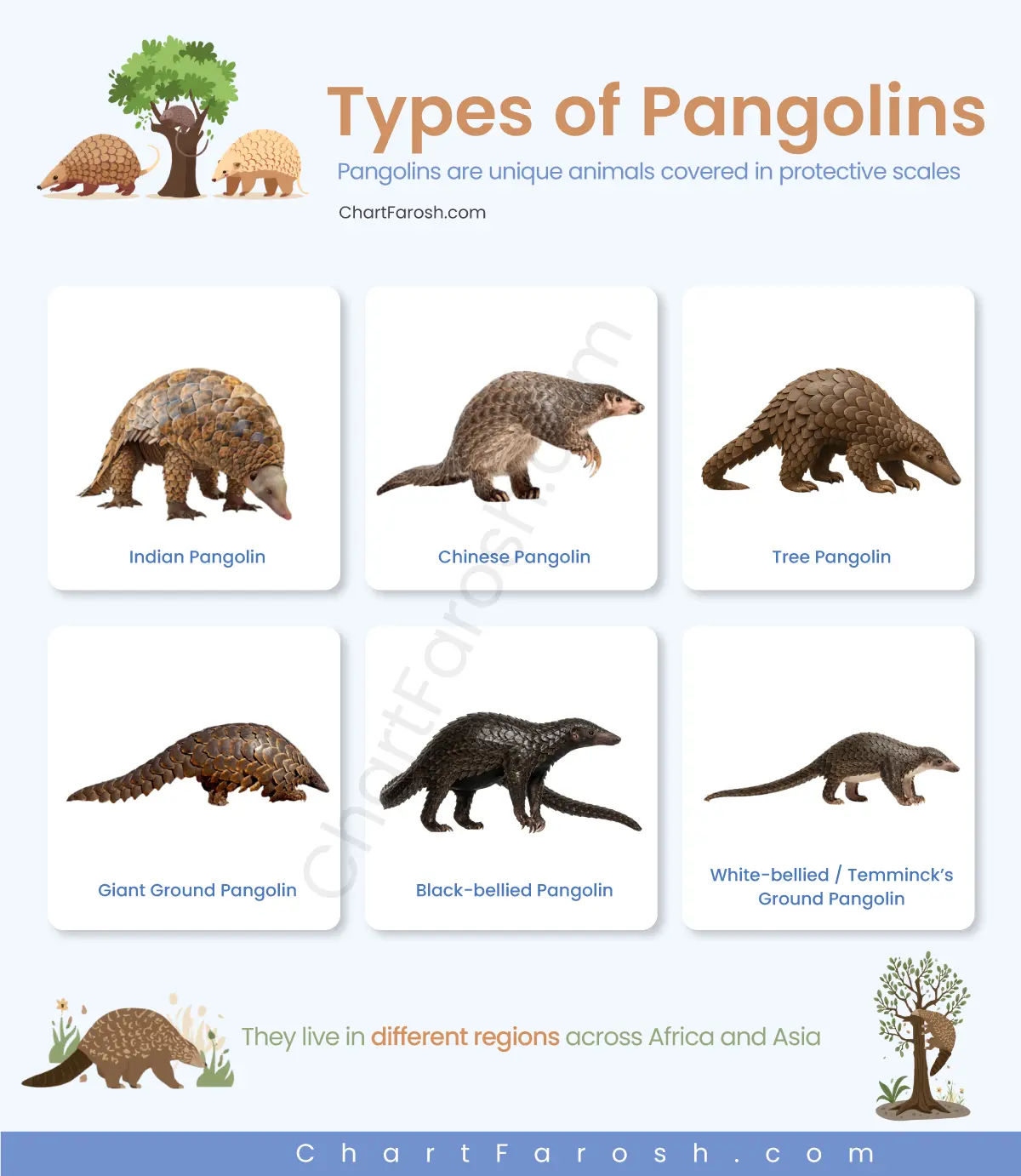
Table of Contents
Types of Pangolin
When people talk about pangolins, they often imagine a single scaly creature curling into a ball. But the reality is more layered.
There are multiple Types of Pangolin and their names, each with specific traits shaped by geography and environment. Scientists classify pangolins into eight recognized species divided between Africa and Asia.
While they all belong to the same family (Manidae), the variation among the types of Pangolin species becomes obvious once you compare their size, habitat, and behavior.
If you’ve ever searched online for types of Pangolin with pictures, you’ll notice that some have lighter scales, some darker, some larger and more robust, others slender and tree-adapted.
A proper Types of Pangolin chart makes these differences easier to understand.
And if you’re building a printable list of Pangolin for study or wildlife reference, you’ll quickly see that pangolins are fewer in number than many expect, yet incredibly diverse within those eight species.
| Pangolin Type | Region | Key Feature | Habitat | Fun Fact |
| Indian Pangolin | South Asia (India, Sri Lanka) | Large scales, nocturnal | Forests, grasslands | Good climber, eats ants & termites |
| Chinese Pangolin | East Asia | Small, elongated body | Forests | Critically endangered |
| Tree Pangolin | West Africa | Arboreal, prehensile tail | Rainforests | Sleeps in tree hollows |
| Giant Ground Pangolin | West & Central Africa | Largest African pangolin | Forests, savannas | Walks on hind legs sometimes |
| Black-bellied Pangolin | West Africa | Dark underside | Forests | Rare, shy species |
| White-bellied / Temminck’s Ground Pangolin | Central Africa | Pale underside | Savanna & forest | Solitary, nocturnal |
How Many Pangolin Species Exist in the World?
There are eight officially recognized types of Pangolin species worldwide. These species are evenly divided between two continents: four in Asia and four in Africa.
While the number may sound small compared to other mammals, each species occupies a unique ecological niche.
Anyone looking for Pangolin breeds often assumes there must be dozens, but scientifically, there are eight distinct species under one family.
Despite their limited number, the diversity within these eight types of Pangolin and their names is significant, especially when comparing body size and environmental adaptation.
African Pangolins vs Asian Pangolins
Although all pangolins share armor-like scales and long sticky tongues for catching ants and termites, African and Asian species differ in noticeable ways.
Many wildlife enthusiasts searching for types of Pangolin with pictures quickly spot differences in scale arrangement and body size.
African pangolins include the largest species, the Giant Ground Pangolin, while Asian species tend to be slightly smaller overall.
Another difference often highlighted in a Types of Pangolin chart is ear structure. Asian pangolins have more visible ear flaps compared to most African species.
Habitat also plays a role. African species are found in savannas, woodlands, and tropical forests, while Asian species are more concentrated in forested and grassland areas.
When organizing a list of Pangolin breeds, the continental split is the most logical first step.
Ground Pangolins
Ground pangolins are terrestrial specialists. These types of Pangolin species spend most of their lives on land, digging burrows and breaking open termite mounds with powerful claws.
The Giant Ground Pangolin and Temminck’s Ground Pangolin are classic African examples, while the Indian Pangolin also falls into this ground-dwelling category.
If you’re reviewing a Types of Pangolin chart, ground species are usually grouped separately from arboreal ones because their physical adaptations differ.
Their bodies are generally heavier, their claws stronger, and their tails less adapted for gripping branches. In many types of Pangolin with pictures, ground species appear bulkier and more muscular compared to tree pangolins.
- Lives mostly on the ground
- Found in eastern and southern Africa
- Eats ants and termites
- Rolls into a ball for defense
- Vulnerable to poaching and habitat loss
Tree Pangolins
Tree pangolins, also known as arboreal pangolins, are physically adapted for life in the trees, with bodies built quite differently from their ground-dwelling relatives.
One of their most distinctive features is their long, prehensile tail, which provides exceptional balance and allows them to grip branches securely while climbing or resting.
When you search for types of pangolin with pictures, arboreal species are often depicted curled around tree limbs, highlighting both their climbing skills and their compact, defensive posture.
Tree pangolins include species such as the White-bellied Pangolin and Black-bellied Pangolin in Africa, as well as the Sunda Pangolin of Southeast Asia.
In a comprehensive list of pangolin breeds, these species are often identified by their climbing ability, lighter body frame, and arboreal adaptations.
A clear “Types of Pangolin” chart frequently highlights tail strength as a defining feature for tree-dwelling species, along with smaller claws and a body structure optimized for maneuvering through forest canopies.
Indian Pangolin
The Indian Pangolin is one of the more widely recognized Asian pangolin species and is often featured prominently in wildlife discussions across South Asia.
It is found throughout India, Sri Lanka, and parts of Pakistan, where it inhabits a variety of environments.
The Indian pangolin stands out for its relatively thick, powerful tail and larger body size compared to other Asian species.
Its heavy, overlapping scales provide strong protection, and its muscular limbs make it an efficient digger.
It is primarily nocturnal, emerging at night to feed on ants and termites, and relies heavily on deep burrows for shelter and protection from predators and extreme temperatures.
Chinese Pangolin
The Chinese Pangolin is generally smaller and more reclusive than several other Asian pangolin species.
Native to parts of southern China, as well as countries like Nepal and neighboring regions of South and Southeast Asia, it prefers forested hills, subtropical woodlands, and mountainous terrain.
This species is highly adapted to cooler, elevated environments, where it spends much of its time hidden underground.
In many types of pangolin with pictures guides, the Chinese pangolin is recognizable by its relatively lighter coloration and narrower, more pointed scales compared to some of its relatives.
It is also known for digging extensive and complex burrow systems, which it uses for shelter and raising young.
Strictly nocturnal, this pangolin is rarely seen during daylight hours, emerging at night to forage for ants and termites.
Sunda Pangolin
The Sunda Pangolin is native to Southeast Asia and can be found in countries such as Malaysia and Indonesia, as well as parts of Thailand, Vietnam, and surrounding regions.
It inhabits tropical forests, plantations, and even areas close to human settlements, showing a degree of adaptability in its habitat choice.
One of its defining traits is its semi-arboreal lifestyle; it spends time foraging on the forest floor but is also an excellent climber, using its strong claws and prehensile tail to move through trees with surprising agility.
This adaptability once helped it survive in varied environments, but today it is not enough to protect it from human threats.
The species appears frequently in any comprehensive list of pangolin breeds that covers Asian wildlife, as it is one of the better-known Asian pangolins.
Sadly, it is now classified as Critically Endangered due to intense illegal wildlife trafficking, making it one of the most heavily traded mammals in the world.
Philippine Pangolin
The Philippine Pangolin is geographically restricted to the Palawan province in the Philippines, making it one of the most range-limited pangolin species in the world.
Its distribution is confined mainly to Palawan and nearby islands, which means its entire global population exists within a relatively small area.
This limited range makes the species particularly vulnerable to habitat loss, local hunting pressures, and illegal wildlife trade.
If you are preparing a printable list of pangolin species, this one deserves special attention because it exists nowhere else on Earth, a true example of island endemism. Basic characteristics are
- Endemic to Palawan province in the Philippines
- Found nowhere else globally
- Recognized as a distinct species through scientific research
- Highly vulnerable due to limited geographic range
- Threatened by habitat destruction and illegal wildlife trade
Rare Pangolin
When people refer to rare pangolins, they usually mean species that are seldom observed in the wild rather than simply those with low population numbers.
A strong example is the Black-bellied Pangolin, an elusive African species that spends much of its life high in the forest canopy.
Even within conservation and research circles, confirmed sightings are limited, and field studies are relatively scarce compared to more accessible mammals.
Searching for types of pangolin with pictures of rare species can be surprisingly difficult, largely because these animals are nocturnal, shy, and inhabit dense, hard-to-reach rainforests.
Rarity can stem from several factors, including small population sizes, highly remote or fragmented habitats, and naturally secretive behavior that makes detection challenging.
Common Pangolin
“Common” is a relative term because no pangolin species is truly abundant anymore.
However, the White-bellied Pangolin is often described as one of the more widespread African species, especially when compared to its rarer relatives.
It adapts well to life in trees and dense vegetation, which may explain its broader distribution. Even so, it remains endangered due to habitat loss and illegal wildlife trade.
A realistic list of pangolin breeds clearly shows that common does not mean safe or secure in today’s world. Key characteristics are:
- Found in Central and West African forests
- Known for its tree-climbing lifestyle
- Feeds primarily on ants and termites
- Considered endangered despite being widespread
- Threatened by deforestation and wildlife trafficking
Endangered Pangolin
Every single one of the eight types of pangolin species is currently threatened, whether classified as Vulnerable, Endangered, or Critically Endangered.
This unfortunate reality makes pangolins one of the most at-risk mammal groups on the planet.
According to the International Union for Conservation of Nature Red List assessments, all eight species face serious population declines.
Habitat destruction, driven by deforestation and agricultural expansion, continues to shrink their natural environments across Asia and Africa.
On top of that, illegal wildlife trade remains the primary and most devastating threat, as pangolins are trafficked for their scales and meat.
Types of Pangolin in India
India primarily hosts the Indian Pangolin (Manis crassicaudata). In some border regions, there may be overlap with the Chinese pangolin, but the Indian species is the dominant and officially recognized one within the country.
When searching for types of Pangolin with pictures specific to India, most wildlife documentation focuses on this single species.
A regional Types of Pangolin chart for India would therefore be straightforward, highlighting distribution, habitat, and conservation status.
Despite being the only main species in the country, its population is under pressure due to illegal hunting and shrinking habitats.
| Pangolin Species | Habitat | Key Feature | Status |
| Indian Pangolin | Forests, grasslands, farmland | Large, keratin scales, nocturnal | Vulnerable, heavily trafficked |
| Chinese Pangolin (occasional in NE India) | Forested regions | Smaller, elongated | Critically endangered, rare sightings |
Species of Pangolin in Africa
Africa is home to four distinct types of Pangolin species: Giant Ground, Temminck’s Ground, White-bellied, and Black-bellied pangolins.
These species cover a range of habitats from open savannas to dense tropical forests. Any accurate list of Pangolin breeds for Africa will include both terrestrial and arboreal representatives.
When building a printable list of Pangolin, the African continent shows slightly more habitat variation compared to Asia, especially because it includes the largest pangolin species in the world.
| Pangolin Species | Region | Key Feature | Status |
| Tree Pangolin | West Africa | Arboreal, prehensile tail | Vulnerable |
| Giant Ground Pangolin | West & Central Africa | Largest African pangolin | Vulnerable |
| Black-bellied Pangolin | West Africa | Dark underside | Rare & nocturnal |
| White-bellied / Temminck’s Ground Pangolin | Central Africa | Pale underside | Vulnerable |
FAQs
What are the 8 types of Pangolin and their names?
Indian, Chinese, Sunda, Philippine, Giant Ground, Temminck’s Ground, White-bellied, and Black-bellied pangolins.
What is the largest type of pangolin?
The Giant Ground Pangolin found in Africa is the largest species.
Are all pangolin species endangered?
Yes, all eight species are classified as threatened, ranging from Vulnerable to Critically Endangered.
Where can pangolins be found?
They live in parts of Asia and sub-Saharan Africa.
Is there a Types of Pangolin chart available for study?
Yes, wildlife conservation resources and field guides often provide a structured Types of Pangolin chart along with a printable list of Pangolin species.