Australian Possum Types list with pictures: Lives of Possums
A few months ago, I was scrolling through wildlife photos late at night when I stumbled across a set of pictures of possums in Australia.
At first, I assumed they were all the same animal, just small, fluffy creatures hanging around trees and rooftops.
But then I noticed the differences. Some had huge bushy tails, others had wide gliding membranes, and a few looked almost like tiny forest acrobats.
That little moment of curiosity turned into a mini research rabbit hole. I wanted to understand how many possums actually live in Australia and what makes each one unique.
It turns out the continent is home to a surprisingly diverse group of these nocturnal marsupials
From gliding species drifting between eucalyptus trees to suburban visitors nibbling fruit in gardens, possums are a fascinating part of Australia’s wildlife.
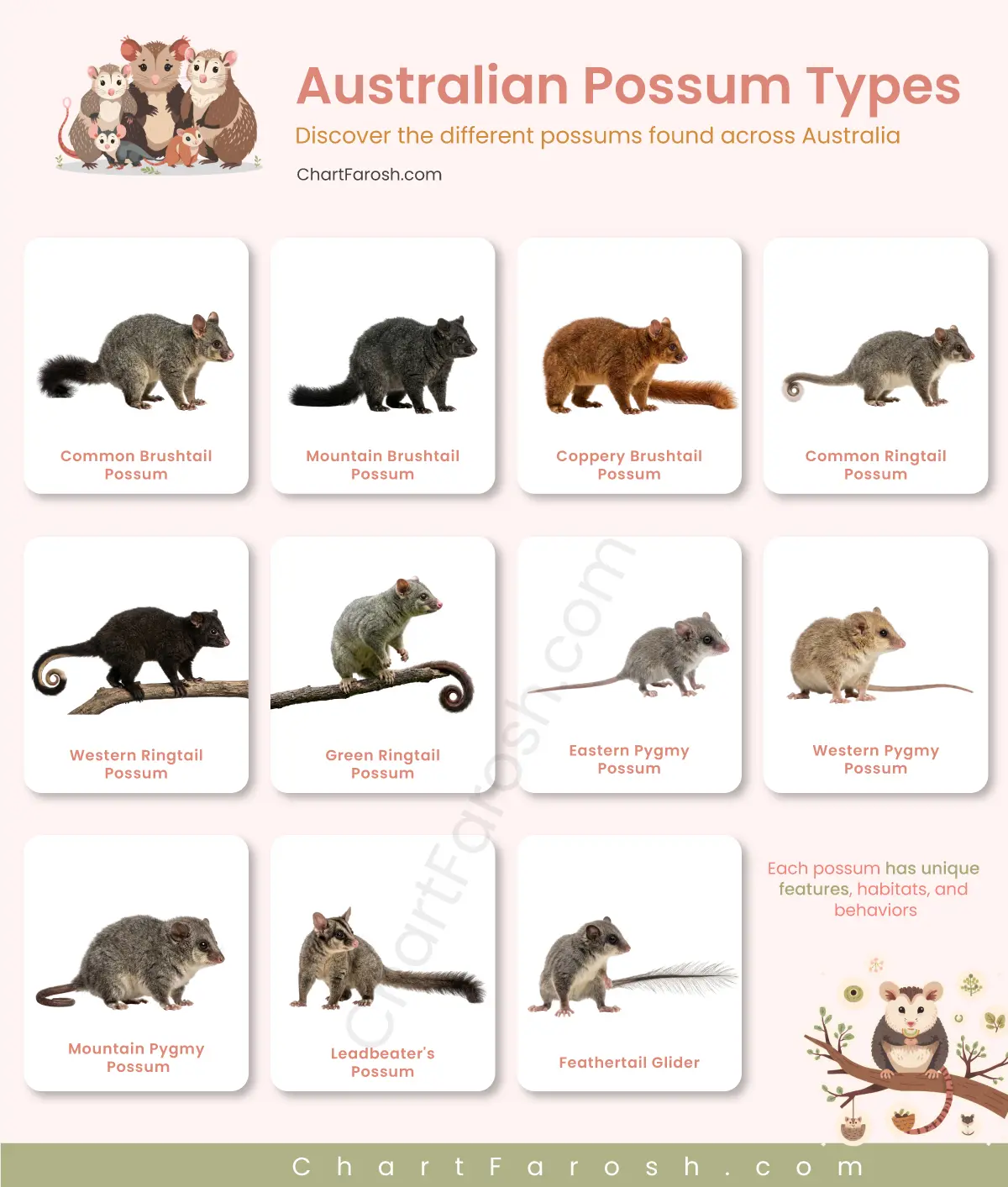
Table of Contents
Australian Possum Types
Australia is home to an impressive variety of possums, and learning about the different Australian possum types reveals just how adaptable these marsupials are.
Possums belong to a group of mammals called marsupials, meaning they carry their young in pouches, similar to kangaroos and koalas.
Species like the common brushtail possum are well known in cities, while others, such as the greater glider, live mostly in dense forests.
Because they are nocturnal, people often first notice them through rustling sounds in trees or by spotting glowing eyes in a flashlight beam.
Understanding these different possums makes exploring pictures of possums in Australia even more interesting, since each species has its own distinctive look and lifestyle.
| Common Name | Scientific Name | Family | Avg. Size (Body) | Key Features | Main Habitat/Region |
| Common Brushtail Possum | Trichosurus vulpecula | Phalangeridae | 35–55 cm | Bushy tail, adaptable, often urban | Forests, woodlands, cities (widespread) |
| Mountain Brushtail Possum | Trichosurus cunninghami | Phalangeridae | 35–50 cm | Darker fur, prefers cool climates | Southeastern Australia highlands |
| Coppery Brushtail Possum | Trichosurus johnstonii | Phalangeridae | 35–50 cm | Copper-toned coat | Northern Queensland rainforests |
| Common Ringtail Possum | Pseudocheirus peregrinus | Pseudocheiridae | 30–35 cm | Prehensile tail, white tail tip | Eastern & southern Australia |
| Western Ringtail Possum | Pseudocheirus occidentalis | Pseudocheiridae | 30–35 cm | Dark coat, white belly | Southwest Western Australia |
| Green Ringtail Possum | Pseudochirops archeri | Pseudocheiridae | 30–35 cm | Greenish-grey tint | NE Queensland rainforests |
| Eastern Pygmy Possum | Cercartetus nanus | Burramyidae | 7–10 cm | Tiny, mouse-sized | Eastern Australia |
| Western Pygmy Possum | Cercartetus concinnus | Burramyidae | 7–10 cm | Pale underside | Southern & Western Australia |
| Mountain Pygmy Possum | Burramys parvus | Burramyidae | 10–12 cm | Alpine specialist, endangered | Australian Alps |
| Leadbeater’s Possum | Gymnobelideus leadbeateri | Petauridae | 15–17 cm | Small, long tail, endangered | Central Victoria forests |
| Feathertail Glider | Acrobates pygmaeus | Acrobatidae | 6–8 cm | Smallest gliding marsupial | Eastern Australia |
How Many Types of Possums Are There in Australia?
Australia actually hosts more possum species than most people expect. Scientists recognize over twenty different species spread across several possum families.
These include brushtail possums, ringtail possums, pygmy possums, and gliding possums.
Each group represents a unique evolutionary path shaped by Australia’s diverse landscapes.
Some species thrive in tropical forests, while others prefer cooler mountain regions or woodland habitats. This wide distribution is one reason why Australian possum breeds appear so different from one another.
Brushtail possums are among the most commonly seen species and are famous for adapting to urban areas.
Ringtail possums, on the other hand, are smaller and often build round nests called dreys in tree branches. Gliders like the sugar glider use special skin membranes to travel from tree to tree.
What Is an Australian Possum Called?
In Australia, the word possum usually refers to a wide group of marsupials belonging to the suborder Phalangeriformes.
Locals simply call them possums, but the term actually covers many different species with unique traits.
The name itself has an interesting history. Early European settlers used the word because the animals reminded them of opossums from the Americas.
Over time, the shortened name possum became standard in Australia, even though these animals are quite different from their American relatives.
Today, when people talk about possums in Australia, they might be referring to common species like the brushtail possum or ringtail possum.
These animals are easily recognized in pictures of possums in Australia thanks to their big eyes, soft fur, and agile climbing abilities.
Because there are so many Australian possum breeds, the simple word possum often acts as a broad label rather than describing a single animal.
Each species still has its own scientific name and ecological role in the environment.
Are Australian Possums Harmless?
For the most part, possums are harmless animals that prefer to avoid confrontation. They are nocturnal, shy, and usually spend their nights quietly searching for food in trees or gardens.
Despite their sometimes mischievous reputation, these animals rarely pose any real danger to people.
Possums mainly eat leaves, flowers, fruits, and insects, making them an important part of forest ecosystems.
Their climbing skills help them move easily through trees where they spend most of their lives.
While they might occasionally wander into roofs or backyards, they are simply looking for shelter or food.
Many wildlife experts encourage people to view possums as beneficial neighbors rather than pests.
Learning about Australian possum breeds helps people understand why these animals behave the way they do in urban environments.
- They rarely attack unless cornered
- Their diet mostly consists of plants and insects
- They avoid human interaction whenever possible
- They play an important role in forest ecosystems
- Most urban encounters are harmless nighttime visits
Unique Things About Australian Possum
Possums are full of surprising traits that make them stand out among Australia’s wildlife. One of the most fascinating is their ability to glide.
Species like the sugar glider can launch themselves from tree branches and travel impressive distances through the air using skin membranes. Another unique trait is their excellent night vision.
Their large eyes allow them to navigate dark forests with ease, which is why many pictures of possums in Australia show their reflective eyes shining in the dark.
Possums also have strong, prehensile tails that help them grip branches while climbing. This tail works almost like an extra limb, giving them remarkable balance in the treetops.
Different Australian possum breeds also vary widely in size.
Some pygmy possums are tiny enough to fit in the palm of a hand, while larger species like the brushtail possum are much more robust and noticeable.
These traits make possums not just adorable but incredibly well adapted to life in Australia’s forests and urban landscapes.
What Is the Largest Possum Species in Australia?
The largest possum species in Australia is the common brushtail possum. This well-known marsupial can grow up to about 55 centimeters in body length, not including its thick bushy tail.
Brushtail possums are highly adaptable and can live in forests, woodlands, and even busy cities.
Their ability to adjust to urban life makes them one of the most commonly spotted animals in suburban neighborhoods.
Their thick fur, pointed ears, and strong climbing claws make them easy to recognize in pictures of possums in Australia.
These animals are also known for their loud nighttime calls and occasional roof-top adventures.
Among all Australian possum breeds, the brushtail possum stands out not only because of its size but also because of its success in surviving alongside humans.
Are Possums Endangered in Australia?
Most possums are not endangered, but some species face serious conservation challenges. Habitat loss, deforestation, and climate change have affected several forest-dwelling possums, especially those that rely on old tree hollows for shelter.
Urban development also reduces natural habitat, forcing some species into smaller and more fragmented environments.
While common possums remain widespread, rarer australian possum breeds need ongoing protection.
Conservation programs in Australia aim to protect forests, restore habitats, and monitor possum populations.
Public awareness is also important, especially when people encounter possums in suburban areas. Many wildlife organizations encourage protecting native trees and reducing habitat destruction to support possum populations.
- Some forest species are vulnerable to habitat loss
- Urban expansion affects natural nesting areas
- Conservation programs protect critical habitats
- Monitoring helps track possum populations
- Protecting trees supports possum survival
Types of Possums in Victoria
Victoria hosts several possum species thanks to its mix of forests, woodlands, and urban environments.
The most commonly seen are the common brushtail possum and the common ringtail possum. These animals are well adapted to the state’s temperate climate and often live close to human settlements.
In fact, many residents first discover possums through late-night noises on rooftops or glimpses of them moving through backyard trees.
Victoria’s forests also support gliding species that are less commonly seen by people. Because these animals are nocturnal, many sightings occur during wildlife tours or night walks.
Browsing pictures of possums in Australia from Victoria reveals how these animals blend beautifully with eucalyptus forests and leafy suburban neighborhoods.
Their presence highlights the importance of preserving green spaces where wildlife and people can coexist.
Types of Possums in Queensland
Queensland’s tropical and subtropical forests are home to a wide range of possum species. The warm climate and dense vegetation provide ideal habitats for both common and rare species.
Brushtail possums and ringtail possums are frequently found in urban areas, while gliders and other forest specialists live deeper within rainforest environments.
These habitats allow many australian possum breeds to thrive in relative abundance.
Queensland’s biodiversity makes it one of the best regions for wildlife enthusiasts hoping to observe possums in their natural habitats.
Many nature reserves and national parks offer nighttime wildlife tours where visitors may spot these animals in the trees.
Looking through pictures of possums in Australia from Queensland often shows them perched in lush tropical vegetation, highlighting the incredible diversity of environments these animals call home.
Types of Possums in Sydney
Sydney is surprisingly rich in possum life despite being a large urban city. Green parks, gardens, and surrounding bushland provide perfect habitats for several possum species.
Residents often encounter them climbing fences, exploring fruit trees, or quietly moving along rooftops at night.
The two most common species here are the brushtail possum and the ringtail possum. These animals have learned to adapt to city environments while still maintaining their natural behaviors.
Their presence reminds people that wildlife can thrive even in urban spaces when habitats are protected.
- Brushtail possums are the most frequently seen
- Ringtail possums often build nests in backyard trees
- They are strictly nocturnal animals
- Urban gardens provide food sources
- Protected laws prevent harming native possums
FAQs
How many possum species live in Australia?
Australia has more than 20 possum species across several families.
Are possums native to Australia?
Yes, possums are native marsupials that evolved in Australia and nearby regions.
Do possums make good pets?
In most places in Australia, keeping native possums as pets is illegal without permits.
What do Australian possums eat?
They mainly eat leaves, flowers, fruit, nectar, and insects.
Where can I see possums in Australia?
They are commonly seen in forests, national parks, and suburban areas with trees.