All Wolf Species list with Pictures
I’ll never forget the first time I saw a wolf in the wild, it was during a crisp, cold morning hike in the mountains.
I had always been fascinated by these elusive predators from books and documentaries, but seeing one in its natural habitat was an entirely different experience.
From a distance, I could observe its cautious movements, the way it paused to listen and scan its surroundings, and its graceful yet powerful stride. It made me realize how little I truly knew about wolves in real life.
That curiosity sparked a deep dive into research, discussions with wildlife experts, and countless hours studying wolf behavior in the wild and through scientific literature.
Over time, I discovered an entire, fascinating world of wolves, each perfectly adapted to its specific environment.
From Arctic tundras to desert plains, wolves play crucial roles in maintaining ecosystem balance, shaping prey populations, and influencing vegetation growth.
Observing their intelligence, complex social structures, and cooperative hunting strategies has been endlessly inspiring.
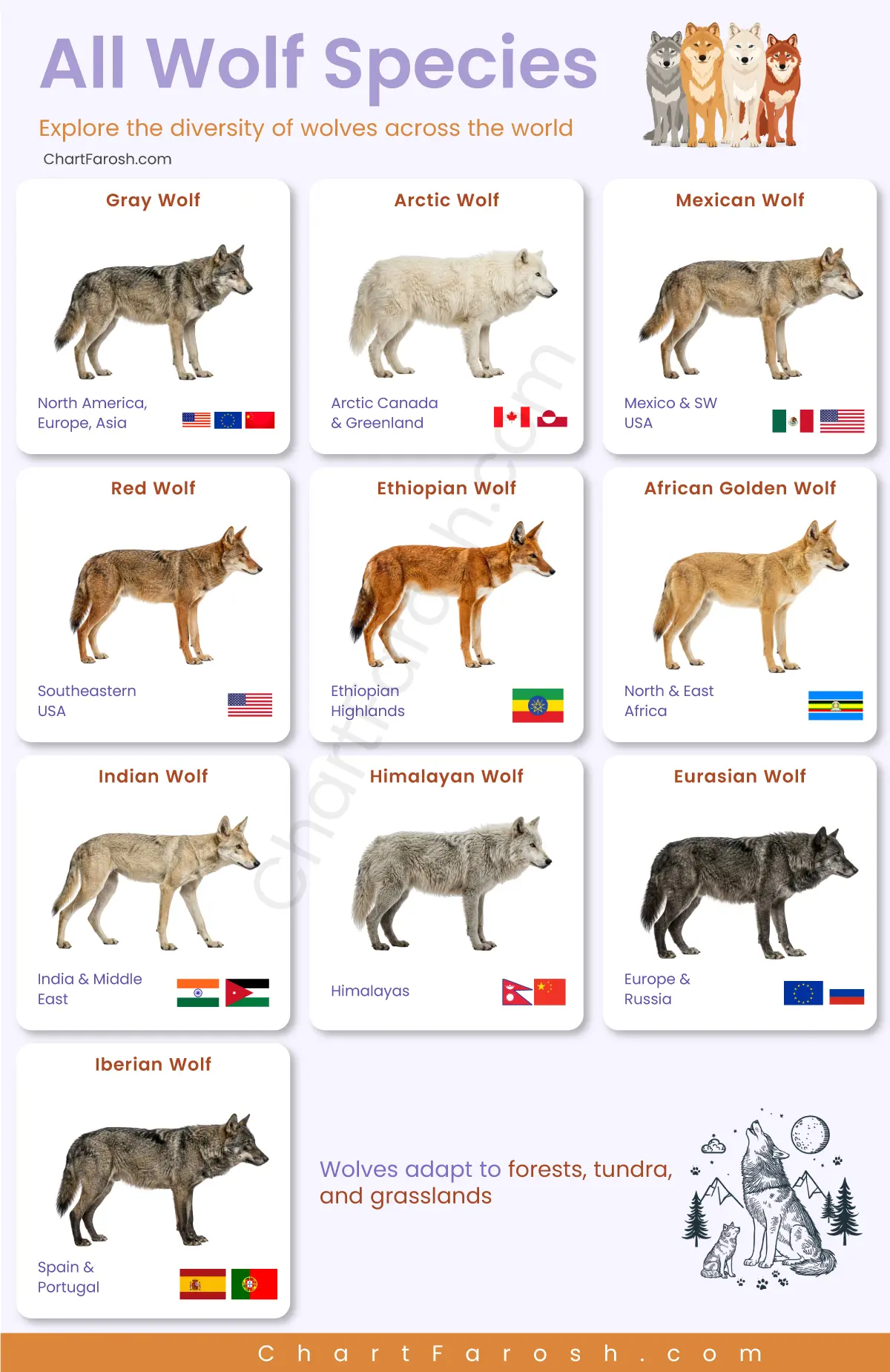
Table of Contents
All Wolf Species: The Complete List of Wolves Worldwide
The global diversity of wolves is fascinating. Across continents, wolves inhabit forests, tundras, deserts, and mountains, showing incredible adaptability.
Understanding all wolf species helps us appreciate their evolutionary history, ecological importance, and the threats they face.
Wolves vary widely in size, fur color, behavior, and hunting strategies. While some species travel in large packs, others are more solitary.
Their diets range from small mammals to large ungulates, depending on the ecosystem.
Studying the wolf species list gives insight into regional adaptations, interactions with humans, and conservation priorities.
From the familiar Gray Wolf of North America to the rare Ethiopian Wolf in Africa, each species has a unique story to tell.
By learning about them, we not only satisfy curiosity but also build awareness for protecting these remarkable animals and the ecosystems they sustain.
| Common Name | Scientific Name | Region | Key Feature | Conservation Status |
| Gray Wolf | Canis lupus | North America, Europe, Asia | Most widespread wolf | Least Concern |
| Arctic Wolf | Canis lupus arctos | Arctic Canada & Greenland | Thick white coat | Least Concern |
| Mexican Wolf | Canis lupus baileyi | Mexico & SW USA | Smallest gray wolf subspecies | Endangered ⚠️ |
| Red Wolf | Canis rufus | Southeastern USA | Reddish coat | Critically Endangered ⚠️ |
| Ethiopian Wolf | Canis simensis | Ethiopian Highlands | Rarest wolf species | Endangered ⚠️ |
| African Golden Wolf | Canis lupaster | North & East Africa | Recently reclassified species | Least Concern |
| Indian Wolf | Canis lupus pallipes | India & Middle East | Adapted to dry regions | Endangered ⚠️ |
| Himalayan Wolf | Canis lupus chanco | Himalayas | High-altitude adaptation | Data Deficient |
| Eurasian Wolf | Canis lupus lupus | Europe & Russia | Large forest wolf | Least Concern |
| Iberian Wolf | Canis lupus signatus | Spain & Portugal | Distinct leg markings | Near Threatened |
How Many Wolf Species Are There?
The exact number of wolf species depends on taxonomic interpretations, but generally, there are around six to eight recognized species, with numerous subspecies identified worldwide.
Wolves belong to the genus Canis, sharing common ancestry with domestic dogs, coyotes, and jackals.
Each species occupies distinct habitats and demonstrates specialized adaptations.
For example, the Gray Wolf (Canis lupus) thrives across North America, Europe, and Asia, while the Ethiopian Wolf (Canis simensis) is confined to Ethiopian highlands.
Wolf species vary in size, social behavior, and hunting strategies, reflecting environmental pressures.
Understanding how many wolf species exist and their distribution is crucial for conservation planning and ecosystem management.
Knowing which species are at risk allows targeted protection efforts, ensuring wolves continue to play their role as apex predators across the globe.
Gray Wolf (Canis lupus)
The Gray Wolf is the most widespread and studied of all wolf species. Found across North America, Europe, and Asia, these wolves exhibit remarkable adaptability, thriving in forests, tundras, deserts, and mountainous regions.
Gray Wolves live and hunt in packs, which increases their hunting success and helps protect their territory and young.
Gray Wolves are highly intelligent, communicating through vocalizations, body language, and scent marking.
Their diet consists mainly of large ungulates like deer, elk, and moose, but they can also hunt smaller animals if needed.
Conservation efforts have successfully reintroduced Gray Wolves to several regions, improving ecosystem balance.
Their presence influences prey populations, vegetation growth, and even the behavior of other predators, demonstrating their ecological importance.
Red Wolf (Canis rufus)
The Red Wolf is one of the rarest and most unique wolf species in the world, easily recognizable by its striking reddish-brown coat and slender, graceful build.
Historically, Red Wolves were found throughout the southeastern United States, roaming forests, swamps, and grasslands in small family packs.
However, over the past century, their population has experienced a drastic decline, primarily due to habitat loss from urban development, agriculture, and deforestation.
Human conflict, including hunting and vehicle collisions, has further threatened their survival.
Another major challenge for the Red Wolf is hybridization with coyotes, which has diluted their genetic purity and complicated conservation efforts.
Today, very few Red Wolves remain in the wild, and most exist within carefully managed recovery programs and protected reserves.
These wolves are incredibly important for maintaining ecological balance, as they help control populations of small to medium-sized mammals like rabbits, raccoons, and rodents.
- Size: Medium-sized, smaller than Gray Wolves.
- Habitat: Forests, swamps, and grasslands of the southeastern US.
- Diet: Small to medium-sized mammals, such as rabbits and raccoons.
- Social Structure: Live in small family packs.
- Conservation Status: Critically endangered; captive breeding and reintroduction programs exist.
Ethiopian Wolf (Canis simensis)
The Ethiopian Wolf is the rarest canid in Africa and one of the most specialized wolf species in the world, confined exclusively to high-altitude Afroalpine regions of Ethiopia.
Its striking red coat, slender build, and long legs make it perfectly adapted to hunting in open mountainous grasslands, where it primarily preys on rodents such as mole rats.
This diet specialization is a key factor in controlling rodent populations, which, if left unchecked, could have serious impacts on local agriculture and the overall ecosystem.
Unlike many other wolf species that rely on large packs for hunting, Ethiopian Wolves usually hunt alone or in small pairs, showcasing remarkable stealth and precision.
Social interactions are maintained through a complex system of vocalizations, scent marking, and visual cues to communicate territory boundaries and maintain cohesion among family groups.
Unfortunately, their survival is under severe threat from human encroachment, habitat fragmentation, and diseases transmitted by domestic dogs, particularly rabies and canine distemper
African Golden Wolf (Canis lupaster)
The African Golden Wolf is a medium-sized and highly adaptable wolf species native to North and East Africa.
For many years, it was mistakenly classified as a subspecies of the Golden Jackal, but modern genetic studies have confirmed that it is a distinct wolf species, more closely related to Gray Wolves than to jackals.
This discovery has reshaped our understanding of canid evolution in Africa and highlighted the ecological uniqueness of this species.
African Golden Wolves thrive in a variety of habitats, including savannahs, deserts, scrublands, and even semi-arid regions, demonstrating remarkable flexibility in adapting to different environmental conditions.
They are omnivorous, feeding on small mammals, birds, insects, and even fruits when available, which allows them to survive in habitats where larger prey is scarce.
Unlike Gray Wolves, African Golden Wolves often live alone or in small family pairs rather than forming large packs.
Their presence is critical to ecosystems, helping control prey populations, scavenge carrion, and limit the spread of disease.
Largest Wolf Species in the World
Some wolves are true giants of the canid world, with adult males weighing well over 80 kilograms and standing impressively tall at the shoulder.
These massive predators are not only physically imposing but also play a crucial role in maintaining ecosystem balance.
As apex predators, they influence the behavior and populations of prey species, which in turn affects vegetation growth and overall habitat health.
Their hunting strategies, often coordinated within packs, allow them to take down large ungulates such as elk, moose, and deer, regulating prey populations and preventing overgrazing.
These large wolf species, including the Mackenzie Valley Wolf and Alaskan Interior Wolf, require extensive territories to support their energy needs and hunting activities.
Their dominance in ecosystems also shapes the behavior of other predators, creating a cascading effect that maintains ecological balance.
- Mackenzie Valley Wolf – North America’s largest Gray Wolf subspecies.
- Alaskan Interior Wolf – Found in Alaska, powerful and resilient.
- Eurasian Gray Wolf – Widespread across Europe and Asia, large-bodied.
- Tundra Wolf – Inhabit Arctic regions, adapted to extreme cold.
- Kamchatka Wolf – Northern Russia, exceptionally large and robust.
Smallest Wolf Species
While some wolves are giants, others are remarkably small, demonstrating the incredible diversity within the wolf family.
Small wolf species often inhabit restricted or specialized regions, where prey availability is limited, and environmental conditions favor smaller, more agile predators. These wolves have adapted to survive in fragmented habitats, including forests, grasslands, and desert edges, where being compact and nimble provides a significant advantage.
Smaller wolves are generally more solitary or live in small family units, feeding primarily on rodents, birds, insects, and other small mammals.
Their reduced size makes them less competitive for large prey, but it also allows them to exploit niches that larger wolves cannot.
Notable examples include the Red Wolf (Canis rufus) of the southeastern United States and certain African Golden Wolves (Canis lupaster).
Their size influences hunting strategies, pack dynamics, and territory range, highlighting how evolution shapes behavior and ecology.
Extinct Wolf Species
Throughout history, several wolf species have gone extinct, leaving only traces in fossil records that tell the story of their evolution and ecological roles.
These extinctions were driven by a combination of climate change, human activity, and habitat loss, which drastically altered the environments these wolves relied on.
Some extinct wolves were significantly larger than most modern species, capable of taking down massive prey, while others had highly specialized adaptations that allowed them to thrive in unique ecological niches, from icy tundras to dense forests.
Studying these extinct species provides valuable insights into how wolves evolved over millions of years, revealing patterns in morphology, behavior, and adaptability.
It also helps scientists understand the pressures that modern wolves face and the ways in which environmental changes and human encroachment can impact survival.
Fossil evidence reminds us of the fragility of predator populations and underscores the importance of conserving the wolf species that still roam the world today, ensuring that their ecological and evolutionary legacy continues.
Endangered Wolf Species
Many wolf species around the world are currently facing significant threats that put their survival at risk.
The primary dangers they encounter include habitat loss, which reduces the areas where they can hunt, roam, and reproduce safely.
Additionally, hunting and poaching by humans, often for fur, sport, or fear-driven reasons, continue to take a heavy toll on wild populations.
Another growing concern is hybridization with domestic dogs, which can dilute the genetic purity of wild wolf species and impact their natural behaviors.
Protecting these incredible animals requires a multifaceted approach, including active conservation programs, strict legal protections, and dedicated efforts to restore and preserve their natural habitats.
By implementing these measures, we can help ensure that wolves continue to thrive in the wild, maintaining the ecological balance and biodiversity that depend on their presence.
- Red Wolf – Critically endangered in the US.
- Ethiopian Wolf – Rarest wolf in Africa.
- Mexican Gray Wolf – Reintroduced through breeding programs.
- Indian Wolf – Faces habitat fragmentation in South Asia.
- Italian Wolf – Endangered due to human encroachment.
Wolf Species Found in North America
North America is home to an impressive diversity of wolf species, each uniquely adapted to the continent’s varied landscapes.
In the vast wilderness of Alaska and northern Canada, the massive Alaskan Gray Wolves roam across snowy tundras and dense boreal forests, relying on their strength and pack coordination to hunt large prey like moose and caribou.
Farther south, in the southeastern United States, the smaller and rarer Red Wolves inhabit forests, swamps, and grasslands, carefully navigating fragmented habitats while avoiding human threats.
Across the continent, wolves have shown remarkable adaptability, thriving in environments as diverse as towering mountain ranges, arid deserts, and temperate woodlands.
This adaptability not only highlights their resilience but also underscores their important role in maintaining ecological balance in these varied ecosystems.
Wolf Species Native to Europe
Europe is home to several distinct subspecies of the Gray Wolf, each adapted to the continent’s diverse environments.
These wolves can be found roaming dense forests, rugged mountain ranges, and even rural landscapes where human activity is present.
By preying on deer, wild boar, and other herbivores, European wolves play a crucial role in maintaining healthy populations of prey species and shaping the overall balance of local ecosystems.
Compared to some of their larger North American relatives, European wolves tend to be slightly smaller in size, but they more than make up for it with their extraordinary ability to navigate and thrive in human-altered landscapes.
Over the years, they have learned to coexist with farmland, villages, and expanding infrastructure, demonstrating both intelligence and resilience.
This adaptability has allowed European wolves not only to survive but, in some regions, to slowly recover from periods of severe population decline caused by hunting and habitat loss.
Wolf Species in Asia
Asia is home to a remarkable diversity of wolf species, ranging from the massive, thick-furred wolves that roam the harsh Siberian tundras to the smaller, more nimble wolves that have adapted to arid deserts and semi-arid steppes.
Across the continent, wolves face a variety of climates and ecosystems, including dense forests, open grasslands, and mountainous regions, each shaping their behavior, hunting strategies, and social structures.
Some species, like the Indian wolf, have evolved to survive in regions with limited prey and scarce water, while others, such as the Mongolian gray wolf, traverse vast, open landscapes in search of larger herds.
This incredible adaptability highlights not only the resilience of wolves but also their important ecological role across Asia, where they help regulate prey populations, maintain biodiversity, and support the health of ecosystems spanning thousands of kilometers.
- Eurasian Gray Wolf
- Indian Wolf
- Himalayan Wolf
- Tibetan Wolf
- Arabian Wolf
Wolf Species in Africa
Africa is home to a unique and fascinating wolf species known as the African Golden Wolf (Canis lupaster), which is primarily found in regions of North and East Africa.
Unlike many other African canids, such as jackals and foxes, the African Golden Wolf is genetically closer to the Gray Wolf, making it an extraordinary example of evolutionary diversity on the continent.
This wolf is highly adaptable, thriving in a variety of habitats ranging from arid deserts to open savannahs and even scrublands near human settlements.
By preying on rodents, hares, and other small mammals, the African Golden Wolf plays a vital ecological role, helping to maintain healthy populations of these species and supporting the overall balance of its ecosystems.
Its presence also benefits other wildlife by indirectly influencing vegetation growth and the distribution of prey species.
Despite its adaptability, the African Golden Wolf faces threats from habitat loss, human-wildlife conflict, and hunting, making conservation efforts essential to ensure its continued survival across Africa’s diverse landscapes.
FAQs
How many wolf species exist worldwide?
There are six to eight recognized wolf species, including Gray, Red, Ethiopian, and African Golden Wolves.
What is the largest wolf species?
The Mackenzie Valley Wolf (Canis lupus occidentalis) is the largest, with adult males exceeding 80 kg.
What is the rarest wolf species?
The Ethiopian Wolf (Canis simensis) is considered the rarest, with fewer than 500 individuals remaining.
Are all wolves endangered?
Not all wolves are endangered, but several species, like the Red Wolf and Ethiopian Wolf, are critically threatened.
Where are wolves most diverse?
Wolves are most diverse across North America, Europe, and Asia, with unique species in Africa as well.