Types of Sloths List with Pictures
I remember planning a trip through a tropical rainforest and realizing how little I actually knew about the animals living above my head.
I could name big, flashy creatures without thinking, but when it came to sloths, my knowledge stopped at “they move slowly and hang from trees.” That didn’t sit right with me.
If an animal spends nearly its entire life in the canopy, surviving on leaves and patience, there has to be more to the story.
So I started digging into research papers, wildlife guides, and conservation reports.
What I found was surprisingly layered: different species, distinct habitats, unique traits, and even conservation statuses that vary wildly.
Sloths aren’t just slow mammals with permanent smiles. They’re a small but fascinating group with very specific adaptations that make them masters of energy efficiency and rainforest survival.
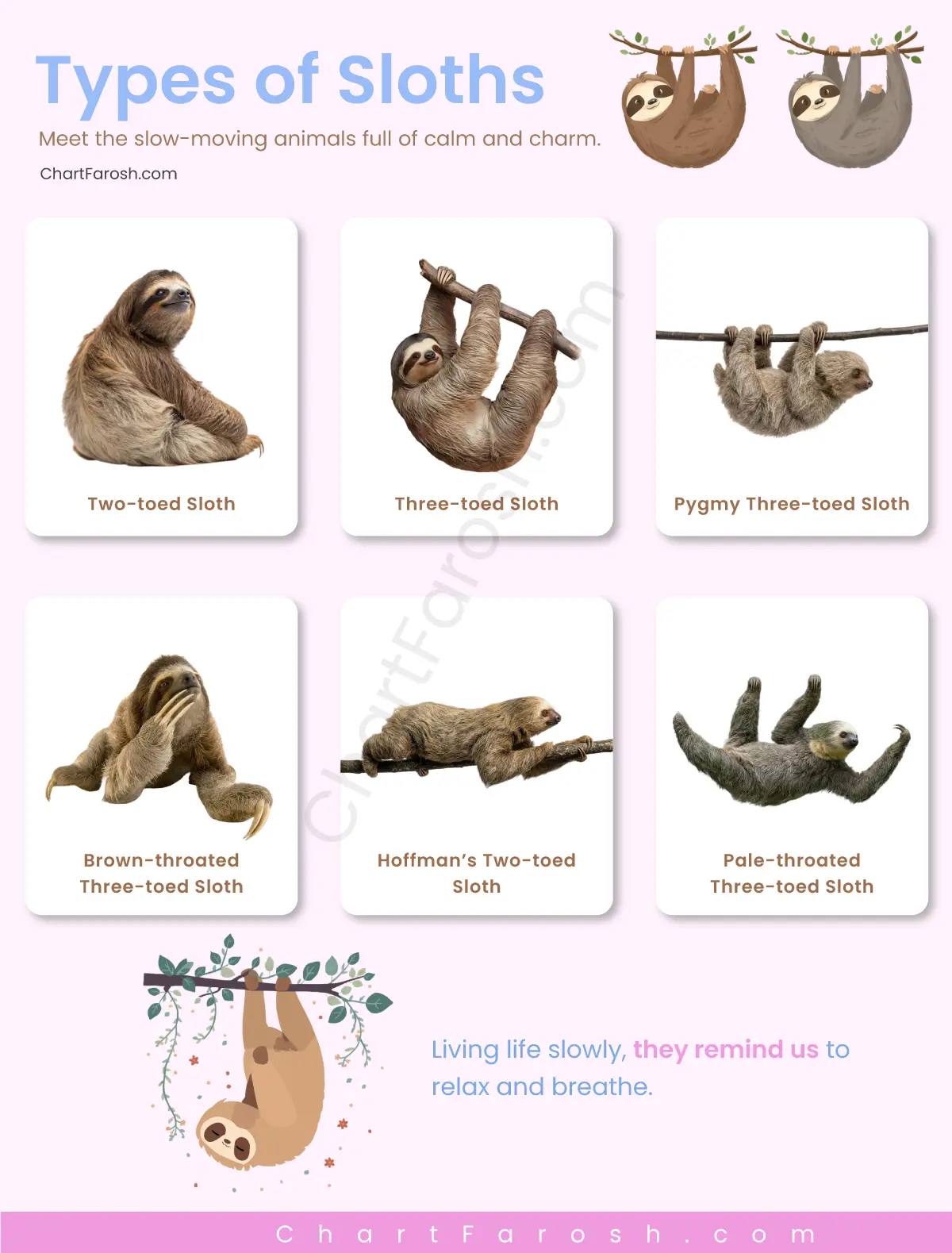
Table of Contents
Types of Sloths
Sloths belong to the order Pilosa and are divided into two main groups: two-toed and three-toed sloths. While they might look similar at first glance, they differ in anatomy, behavior, and even facial structure.
If you’re searching for Types of Sloths and their names or a detailed list of Sloths breeds, it’s important to know that modern sloths are grouped into six living species.
These species fall under two genera: Bradypus (three-toed) and Choloepus (two-toed). Understanding the types of Sloths species helps clear up common confusion and makes spotting differences much easier.
| Sloth Type | Species | Key Feature | Habitat | Fun Fact |
| Two-toed Sloth | Choloepus spp. | Two toes on front limbs | Rainforests | Faster climbers than three-toed sloths |
| Three-toed Sloth | Bradypus spp. | Three toes on front limbs | Rainforests | Famous for slow movement |
| Pygmy Three-toed Sloth | Bradypus pygmaeus | Tiny size, critically endangered | Isla Escudo, Panama | Rare, lives on one island only |
How Many Sloth Species Exist in the World?
There are currently six recognized living sloth species in the world. These are divided into two families: Bradypodidae (three-toed sloths) and Megalonychidae (two-toed sloths).
While ancient sloths once roamed the Americas in giant ground-dwelling forms, today’s sloths are strictly arboreal and much smaller.
If you’re compiling a printable list of Sloths or organizing a Types of Sloths chart, the modern count stands at six.
Each species occupies specific regions of Central and South America, and some have extremely limited ranges, which directly affects their conservation status.
| Family | Genus | Number of Species | Common Group Name |
| Bradypodidae | Bradypus | 4 | Three-Toed Sloths |
| Megalonychidae | Choloepus | 2 | Two-Toed Sloths |
| — | — | 6 Total | Modern Sloths |
Two-Toed vs Three-Toed Sloths
Despite their names, the key difference isn’t actually in their toes, it’s in their fingers. Two-toed sloths have two claws on their front limbs, while three-toed sloths have three.
Both have three toes on their hind limbs. Beyond claws, they differ in size, face shape, and activity patterns.
Two-toed sloths are generally larger and more nocturnal, while three-toed sloths tend to be slightly smaller and more active during the day.
When comparing the types of Sloths species, this distinction is the starting point for understanding their behavior and biology.
| Feature | Two-Toed Sloths | Three-Toed Sloths | Key Difference |
| Front Claws | 2 | 3 | Number of front claws |
| Activity | Mostly nocturnal | Mostly diurnal | Sleep patterns |
| Face | Pig-like snout | Rounded face, “smile” look | Facial structure |
| Size | Larger | Smaller | Body mass |
Brown-Throated Sloth: The Most Widespread Three-Toed Species
The Brown-Throated Sloth (Bradypus variegatus) is the most widespread of all three-toed sloths.
Found from Honduras down to northern Argentina, it adapts well to different forest types, including secondary growth forests. Its brownish fur and darker throat patch help identify it.
This species often appears in types of Sloths with pictures searches because it’s commonly photographed in Costa Rica and Panama.
If you’re building a Types of Sloths chart, this species is usually the most accessible example of a three-toed sloth in the wild.
| Scientific Name | Range | Conservation Status | Distinct Feature |
| Bradypus variegatus | Central & South America | Least Concern | Brown throat patch |
| Habitat | Rainforests | — | Arboreal |
| Diet | Leaves | — | Folivore |
Pygmy Three-Toed Sloth: Rare and Critically Endangered
The Pygmy Three-Toed Sloth (Bradypus pygmaeus) is one of the rarest mammals on Earth. It lives only on Isla Escudo de Veraguas in Panama.
Smaller than other three-toed species, this sloth’s limited habitat makes it highly vulnerable. Habitat destruction and human disturbance threaten its survival.
When discussing Types of Sloths and their names, this species stands out because of its critically endangered status.
It’s often included in conservation-focused types of Sloths species discussions due to its fragile existence.
| Scientific Name | Range | Conservation Status | Key Trait |
| Bradypus pygmaeus | Panama (Isla Escudo) | Critically Endangered | Small size |
| Habitat | Mangrove forest | — | Isolated island |
| Weight | ~2.5–3.5 kg | — | Smaller body |
Hoffmann’s Two-Toed Sloth: A Nocturnal Arboreal Species
Hoffmann’s Two-Toed Sloth (Choloepus hoffmanni) is found in Central America and parts of northern South America.
Unlike three-toed sloths, it tends to be more active at night and has a broader diet, occasionally eating fruits and small insects.
This species is frequently included in types of Sloths with pictures searches because it’s commonly seen in wildlife rescue centers.
For anyone creating a list of Sloths breeds, this is one of the two modern two-toed species worth noting.
| Scientific Name | Range | Activity | Diet |
| Choloepus hoffmanni | Central America | Nocturnal | Leaves, fruit |
| Size | 4–8 kg | — | Larger build |
| Habitat | Rainforest canopy | — | Arboreal |
Linnaeus’s Two-Toed Sloth: The Lesser-Known Species
Linnaeus’s Two-Toed Sloth (Choloepus didactylus) lives primarily in northern South America, including Brazil and the Guianas.
It resembles Hoffmann’s sloth but has subtle skull and fur differences. It’s generally more elusive and less commonly spotted by tourists.
When reviewing Types of Sloths and their names, this species rounds out the two-toed category. Adding it to a printable list of Sloths ensures your reference includes every living species.
| Scientific Name | Range | Activity | Conservation |
| Choloepus didactylus | Northern South America | Nocturnal | Least Concern |
| Size | 4–9 kg | — | Larger than 3-toed |
| Habitat | Tropical rainforest | — | Tree-dwelling |
Size, Fur, and Behavior Differences Among Sloth Species
While all sloths share slow metabolisms and leaf-based diets, noticeable differences exist in size, fur texture, and activity patterns.
Two-toed sloths are generally heavier and more flexible, while three-toed sloths have more defined facial markings. Their fur hosts algae, giving them a greenish tint that helps with camouflage.
If you’re designing a Types of Sloths chart, highlighting these distinctions makes comparisons clearer. These traits also help differentiate the various types of Sloths species in field observations.
| Trait | Two-Toed | Three-Toed | Notes |
| Weight | Heavier | Lighter | Size variation |
| Fur Texture | Shaggier | Smoother | Algae growth |
| Activity | Nocturnal | Diurnal | Sleep cycle |
| Neck Vertebrae | Fewer | Extra vertebrae | Head rotation |
Rare and Endangered Sloth Species
While some sloths are listed as Least Concern, others face serious threats.
The Pygmy Three-Toed Sloth is critically endangered, and the Maned Three-Toed Sloth (Bradypus torquatus) is classified as vulnerable due to habitat loss in Brazil’s Atlantic Forest.
Deforestation remains the biggest threat across all types of Sloths species. Any responsible printable list of Sloths should include conservation status, not just names, since awareness plays a key role in long-term protection.
| Species | Status | Main Threat | Location |
| Pygmy Three-Toed | Critically Endangered | Habitat loss | Panama |
| Maned Three-Toed | Vulnerable | Deforestation | Brazil |
| Others | Least Concern | Forest clearing | Central/South America |
types of sloths in costa rica
Costa Rica is home to two species: the Brown-Throated Three-Toed Sloth and Hoffmann’s Two-Toed Sloth.
Both thrive in the country’s protected rainforests and national parks. Travelers often search for types of Sloths with pictures after spotting one high in the canopy during guided tours.
These two species represent both major sloth groups, making Costa Rica one of the easiest places to observe differences between the main Types of Sloths and their names in real life.
| Sloth Species | Habitat | Key Feature | Fun Fact |
| Brown-throated Three-toed Sloth | Rainforests, canopy | Three toes, brown throat | Most common sloth in Costa Rica |
| Hoffman’s Two-toed Sloth | Forest canopy | Two toes, larger | Active mostly at night, slower climber |
| Pale-throated Three-toed Sloth | Rainforests | Pale-colored throat | Less common, mostly in southern forests |
types of sloths in panama
Panama hosts three species: the Brown-Throated Three-Toed Sloth, Hoffmann’s Two-Toed Sloth, and the rare Pygmy Three-Toed Sloth
The presence of the pygmy species makes Panama especially important in conservation discussions.
If you’re building a Types of Sloths chart focused on geographic distribution, Panama stands out for hosting both common and critically endangered sloths within its borders.
| Sloth Species | Habitat | Key Feature | Fun Fact |
| Brown-throated Three-toed Sloth | Tropical forests | Three toes, brown throat | Found throughout Panama |
| Hoffman’s Two-toed Sloth | Canopy forests | Two toes, larger | Mostly nocturnal |
| Pygmy Three-toed Sloth | Isla Escudo | Tiny, rare | Critically endangered, very small population |
FAQs
How many types of sloths are there?
There are six living sloth species divided into two groups: two-toed and three-toed sloths.
What are the main Types of Sloths and their names?
The six species are Brown-Throated, Pale-Throated, Maned, and Pygmy Three-Toed Sloths, plus Hoffmann’s and Linnaeus’s Two-Toed Sloths.
Are sloths endangered?
Some species, like the Pygmy Three-Toed Sloth, are critically endangered, while others are currently listed as least concern.
What is the difference between two-toed and three-toed sloths?
The difference lies mainly in the number of front claws, facial structure, size, and activity patterns.
Where can I find a printable list of Sloths?
A well-organized wildlife guide or conservation resource can provide a complete printable list of Sloths, including conservation status and habitat details.