Types of Lizards List with Pictures
There was a stretch of summer where I kept noticing quick flashes of movement along the garden wall. At first, I assumed it was just one persistent little reptile claiming the same sunny spot every afternoon.
But over a few weeks, I started seeing differences, longer tails, brighter colors, thicker bodies. It made me realize I’d been lumping every small, scaly visitor into one mental category: “just a lizard.” That didn’t sit right.
Lizards show up in deserts, forests, swamps, and even city neighborhoods. Some are delicate and twig-thin. Others are heavy-bodied predators with powerful jaws.
A few can glide. A few are venomous. And many look so different from one another that it’s hard to believe they share the same broader group.
Once you begin exploring the types of Lizards species, the range is almost overwhelming.
From people searching for types of Lizards with pictures to those wanting a clear Types of Lizards chart, the curiosity usually starts the same way: realizing there’s a lot more variety here than expected.
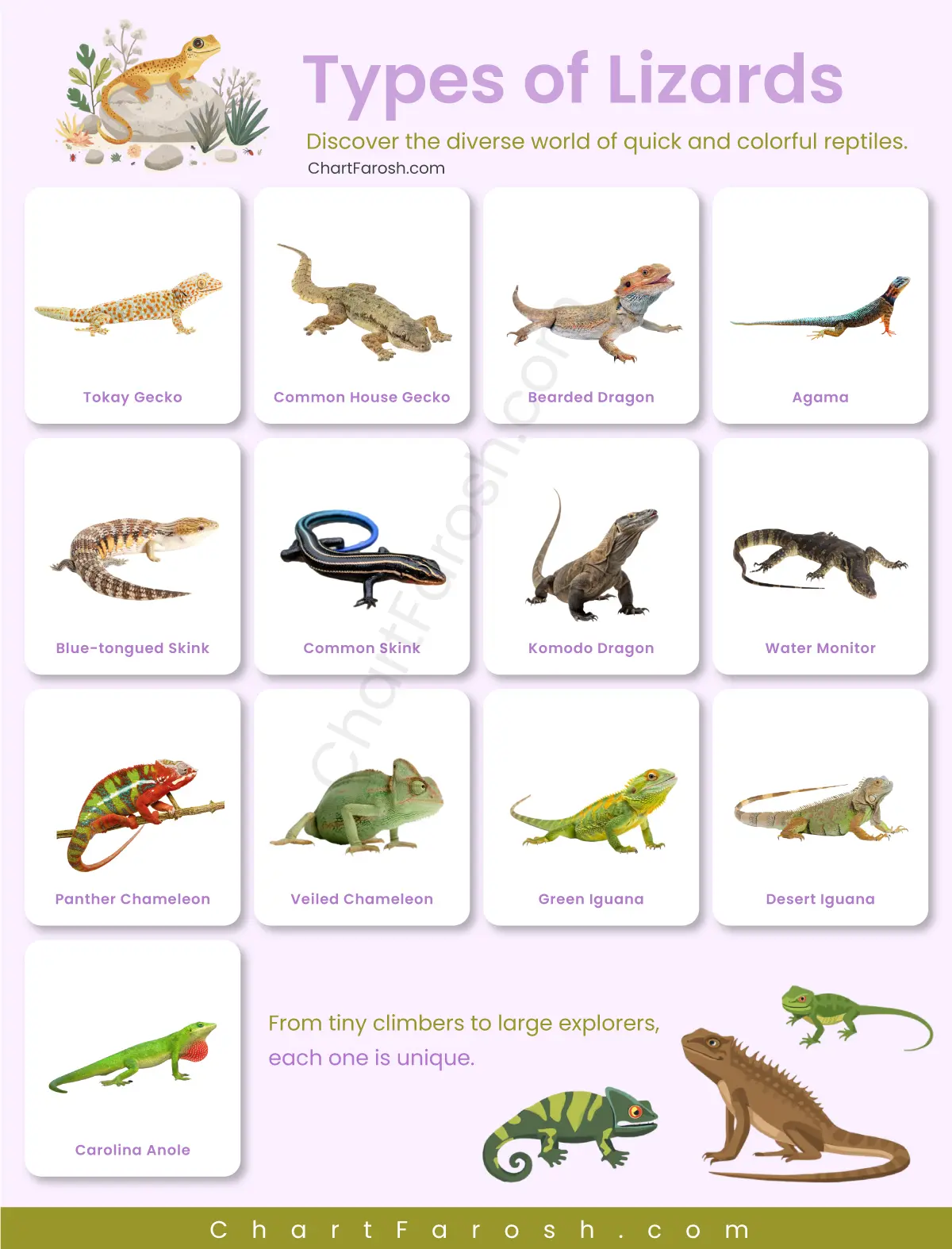
Table of Contents
Types of Lizards
Lizards belong to the order Squamata and represent one of the most diverse reptile groups on Earth.
When people look for Types of Lizards and their names, they’re often surprised by how wide the range is, from tiny geckos to massive monitor lizards.
A structured Types of Lizards chart helps organize them into families like Iguanas, Skinks, Chameleons, and Monitors.
If you’re building a printable list of Lizards, you’ll notice that classification typically happens by family first, then species.
The types of Lizards species vary in diet, habitat, and behavior. And while some might casually refer to a list of Lizards breeds, reptiles are classified by species rather than breeds.
Still, the diversity within the different types is remarkable.
| Lizard Type | Examples | Key Feature | Habitat | Fun Fact |
| Geckos | Tokay Gecko, Common House Gecko | Sticky toes, nocturnal | Forests, urban | Can climb smooth walls |
| Agamas / Dragon Lizards | Bearded Dragon, Agama | Spiny body, colorful throat | Deserts, savannas | Displays colors during mating |
| Skinks | Blue-tongued Skink, Common Skink | Smooth, shiny scales | Forests, grasslands | Can drop tail to escape predators |
| Monitor Lizards | Komodo Dragon, Water Monitor | Large, strong, carnivorous | Forests, rivers | Excellent swimmers |
| Chameleons | Panther Chameleon, Veiled Chameleon | Color-changing, prehensile tail | Forests, bushes | Independently moving eyes |
| Iguanas | Green Iguana, Desert Iguana | Large, herbivorous | Tropical forests | Can drop tail to escape |
| Anoles | Carolina Anole | Small, dewlap display | Trees, shrubs | Common in southern US |
How Many Lizard Species Exist in the World?
There are over 7,000 recognized types of Lizards species worldwide, and new species are still being discovered.
That number alone explains why creating a complete printable list of Lizards is no small task. Lizards live on every continent except Antarctica, thriving in climates ranging from scorching deserts to humid rainforests.
A proper Types of Lizards chart often divides them by family, geography, and ecological niche.
For anyone searching for types of Lizards with pictures, the sheer variety in shape and color makes it clear that lizards are one of the most adaptable reptile groups alive today.
| Category | Approximate Number | Example | Habitat |
| Total Species | 7,000+ | Various Families | Global (except Antarctica) |
| Largest Family | Skinks | 1,500+ species | Worldwide |
| Large Predators | Monitors | 80+ species | Africa, Asia, Australia |
| Arboreal Specialists | Chameleons | 200+ species | Africa, Madagascar |
Lizards vs Geckos: Understanding the Differences
Geckos are actually a type of lizard, but they have traits that set them apart. Many people searching for Types of Lizards and their names get confused here.
Geckos are known for their sticky toe pads, which allow them to climb smooth surfaces like glass. Most lizards don’t have that ability.
A Types of Lizards chart often lists geckos as their own family (Gekkonidae). Another key difference is vocalization, geckos can chirp or click, while most lizards are silent.
If you’re comparing types of Lizards species, geckos tend to be smaller and more nocturnal than many other families.
| Feature | Geckos | Other Lizards |
| Toe Pads | Sticky, adhesive | Usually clawed |
| Vocalization | Chirping sounds | Mostly silent |
| Activity | Often nocturnal | Often diurnal |
| Size | Small to medium | Wide range |
Monitor Lizards: Large Predatory Reptiles
Monitor lizards are among the most powerful types of Lizards species. This group includes the Komodo dragon, the largest living lizard.
Monitors are intelligent, strong swimmers, and skilled hunters. When reviewing types of Lizards with pictures, monitors are hard to miss due to their muscular bodies and long necks.
A Types of Lizards chart places them under the family Varanidae. They primarily live in Africa, Asia, and Australia. While some species are relatively small, others can exceed three meters in length.
| Feature | Detail |
| Family | Varanidae |
| Largest Species | Komodo Dragon |
| Diet | Carnivorous |
| Regions | Africa, Asia, Australia |
Iguanas: Leaf-Eating Lizards of the Tropics
Iguanas are primarily herbivorous lizards found in tropical regions. When people search for a list of Lizards breeds, iguanas often come up due to their popularity in the pet trade.
However, they are classified as species within the Iguanidae family.
These types of Lizards species are known for their crests, dewlaps, and long tails. The Green Iguana is one of the most recognized examples.
A well-organized Types of Lizards chart often groups iguanas separately due to their plant-based diet.
| Feature | Detail |
| Family | Iguanidae |
| Diet | Herbivorous |
| Habitat | Tropical forests |
| Notable Species | Green Iguana |
Chameleons: Masters of Camouflage
Chameleons are famous for their color-changing ability, though it’s more about communication and temperature regulation than simple camouflage.
Among the Types of Lizards and their names, chameleons stand out for their independently moving eyes and projectile tongues.
They are primarily found in Africa and Madagascar. In many types of Lizards with pictures, chameleons appear vividly colored, but their hues shift based on mood and environment.
A Types of Lizards chart lists them under the family Chamaeleonidae.
| Feature | Detail |
| Family | Chamaeleonidae |
| Eye Movement | Independent |
| Tongue | Long, projectile |
| Region | Africa, Madagascar |
Skinks: Smooth, Small, and Versatile Lizards
Skinks are one of the largest families within the types of Lizards species. They typically have smooth, shiny scales and small limbs.
If you’re creating a printable list of Lizards, skinks will likely take up a large portion due to their diversity.
Some skinks burrow underground, while others live in trees. A Types of Lizards chart often shows skinks as the largest family by species count.
| Feature | Detail |
| Family | Scincidae |
| Species Count | 1,500+ |
| Body Type | Smooth scales |
| Habitat | Global |
Gila Monster and Beaded Lizards: Venomous Species
The Gila Monster and Mexican Beaded Lizard are among the few venomous types of Lizards species. Found primarily in North America, they have thick bodies and bead-like scales.
When searching for types of Lizards with pictures, these species stand out due to their bold orange and black coloration. A Types of Lizards chart usually highlights venom as a rare trait among lizards.
| Feature | Detail |
| Venomous | Yes |
| Region | North America |
| Body | Thick, heavy |
| Activity | Mostly nocturnal |
Anoles: Colorful and Agile Lizards
Anoles are small, active lizards known for their throat fans (dewlaps). Many people searching for Types of Lizards and their names come across the Green Anole. These lizards can shift between green and brown shades.
They are common in the southeastern United States and Caribbean. A list of Lizards breeds in casual conversation might include anoles due to their visibility in urban areas.
| Feature | Detail |
| Family | Dactyloidae |
| Color Change | Limited (green/brown) |
| Habitat | Trees, shrubs |
| Region | Americas |
Rare and Endangered Lizard Species
Some types of Lizards species face serious conservation threats. Habitat destruction, invasive predators, and climate change have pushed certain island and desert species toward extinction.
If you were compiling a printable list of Lizards focused on conservation, species like the Jamaican Iguana or certain Madagascar chameleons would appear prominently.
A Types of Lizards chart that includes conservation status reveals how uneven survival rates are across regions.
| Species | Region | Status |
| Jamaican Iguana | Caribbean | Endangered |
| Komodo Dragon | Indonesia | Endangered |
| Certain Chameleons | Madagascar | Critically Endangered |
Lizards of Deserts, Forests, and Grasslands
Lizards adapt to nearly every terrestrial ecosystem. Desert species often have pale coloring and burrowing habits.
Forest lizards may have gripping toes or camouflage patterns. Grassland species rely on speed and agility.
When examining types of Lizards with pictures, habitat often explains physical traits. A structured Types of Lizards chart typically connects species with their ecosystems.
| Habitat | Adaptation | Example |
| Desert | Heat tolerance | Horned Lizard |
| Forest | Climbing ability | Chameleon |
| Grassland | Speed | Agama |
| Wetlands | Swimming | Water Monitor |
Types of Lizards in India
India hosts a wide range of types of Lizards species, including monitor lizards, geckos, skinks, and agamids. The Bengal Monitor is one of the most recognized large species in the region.
Desert areas host spiny-tailed lizards, while forests are home to colorful calotes (garden lizards).
A regional Types of Lizards chart for India would show impressive ecological diversity due to the country’s varied climate zones.
If someone were creating a printable list of Lizards specific to India, it would include both common urban species and rare forest specialists.
| Lizard Species | Habitat | Key Feature | Fun Fact |
| Indian Rock Agama | Rocks, forests | Colorful males | Males show bright colors in mating |
| Common House Gecko | Urban areas | Sticky toes, nocturnal | Eats insects around homes |
| Flying Lizard / Draco | Forests | Gliding flaps of skin | Can glide 30 feet between trees |
| Monitor Lizards | Rivers & wetlands | Large, carnivorous | Often hunt fish & small animals |
| Skinks | Forests & gardens | Smooth, shiny | Can drop tail to escape predators |
Types of Lizards in Florida
Florida’s warm climate supports native and invasive types of Lizards species. Green Anoles are native, while species like the Brown Anole and Argentine Black and White Tegu have been introduced.
When reviewing Types of Lizards and their names in Florida, it’s important to separate native from non-native populations. Wetlands, suburbs, and coastal zones all host different species.
| Lizard Species | Habitat | Key Feature | Fun Fact |
| Green Anole | Trees, shrubs | Color-changing (green/brown) | Common backyard lizard |
| Brown Anole | Urban & gardens | Small, invasive | Rapidly spreading in southern Florida |
| Giant Ameiva | Forests & sand | Fast, large lizard | Also called Giant Whiptail |
| Florida Glass Lizard | Grasslands, scrub | Legless lizard | Looks like a snake but has eyelids |
| Green Iguana | Tropical/suburban | Large, herbivorous | Often seen in canals & trees |
Types of Lizards in South Africa
South Africa is rich in desert and savanna-adapted types of Lizards species, including girdled lizards, agamas, and monitors.
Rocky outcrops often host sun-loving species that rely on camouflage. South Africa is home to over 200 different types of lizards, ranging from tiny, quick-footed geckos to impressively armored girdled lizards and colorful agamas that look like they walked straight out of a nature documentary.
Some thrive in the arid landscapes of the Kalahari Desert, while others cling to cliffs and mountains along the iconic Table Mountain. A regional Types of Lizards chart would highlight adaptation to arid environments.
| Lizard Species | Habitat | Key Feature | Fun Fact |
| Namaqua Chameleon | Deserts | Color-changing | Desert-adapted, eats insects |
| Cape Dwarf Gecko | Rocks & urban | Small, fast | Often hides under stones |
| Agama Lizard | Savannas | Colorful throat, spiny body | Territorial displays |
| Monitor Lizard | Rivers & forests | Large, carnivorous | Excellent hunter of small mammals |
| Skinks | Grasslands | Smooth scales | Burrows under rocks & soil |
Types of Lizards in Australia
Australia is home to some of the most unique types of Lizards species, including frilled lizards, blue-tongue skinks, and numerous monitor species.
The continent’s isolation allowed distinct reptile evolution. Australia isn’t just home to lizards, it’s one of the global hotspots for them, with hundreds of species adapted to almost every environment you can imagine.
From the fiery red sands of the Outback to the humid rainforests of Queensland, lizards have carved out their own niches across the continent.
You’ll find everything from tiny, delicate geckos hiding under bark to powerful goannas that dominate the landscape.
A printable list of Lizards in Australia would be impressively long, especially when including desert specialists.
| Lizard Species | Habitat | Key Feature | Fun Fact |
| Bearded Dragon | Deserts, savannas | Spiny throat beard | Popular pet worldwide |
| Blue-Tongued Skink | Forests & gardens | Bright blue tongue | Can scare predators with tongue display |
| Frilled Lizard | Northern forests | Neck frill for defense | Can run bipedally when threatened |
| Monitor Lizard (Goanna) | Forests & deserts | Large, carnivorous | Excellent climber and swimmer |
| Geckos | Urban & forests | Sticky toe pads | Active mostly at night |
FAQs
How many types of lizards are there?
There are over 7,000 recognized lizard species worldwide.
Are geckos considered lizards?
Yes, geckos are a family within the broader lizard group.
What is the largest lizard species?
The Komodo dragon is the largest living lizard.
Are all lizards venomous?
No, only a few species like the Gila Monster and Beaded Lizard are venomous.
Where do most lizards live?
Lizards live on every continent except Antarctica, in habitats ranging from deserts to rainforests.