Types of Crane Birds List with Pictures
For the longest time, I thought I knew the birds around me. Pigeons, crows, the occasional heron near water , nothing too mysterious.
Then one winter morning, while driving past a stretch of farmland just after sunrise, I noticed two tall birds standing completely still in a misty field.
They weren’t grazing like ducks or hopping like smaller birds. They stood upright, alert, almost statuesque. I pulled over out of pure curiosity.
Watching them for ten quiet minutes changed something for me. Their slow, deliberate steps, the way they called to each other, and how synchronized they seemed.
it felt intentional. I went home and tried to figure out what I had seen, which opened the door to learning about the different types of cranes birds across the world.
I hadn’t realized how diverse they were, or how deeply connected they are to wetlands, migration routes, and even cultural traditions.
That simple pause on the side of the road turned into weeks of reading, observing, and noticing cranes everywhere I hadn’t before.
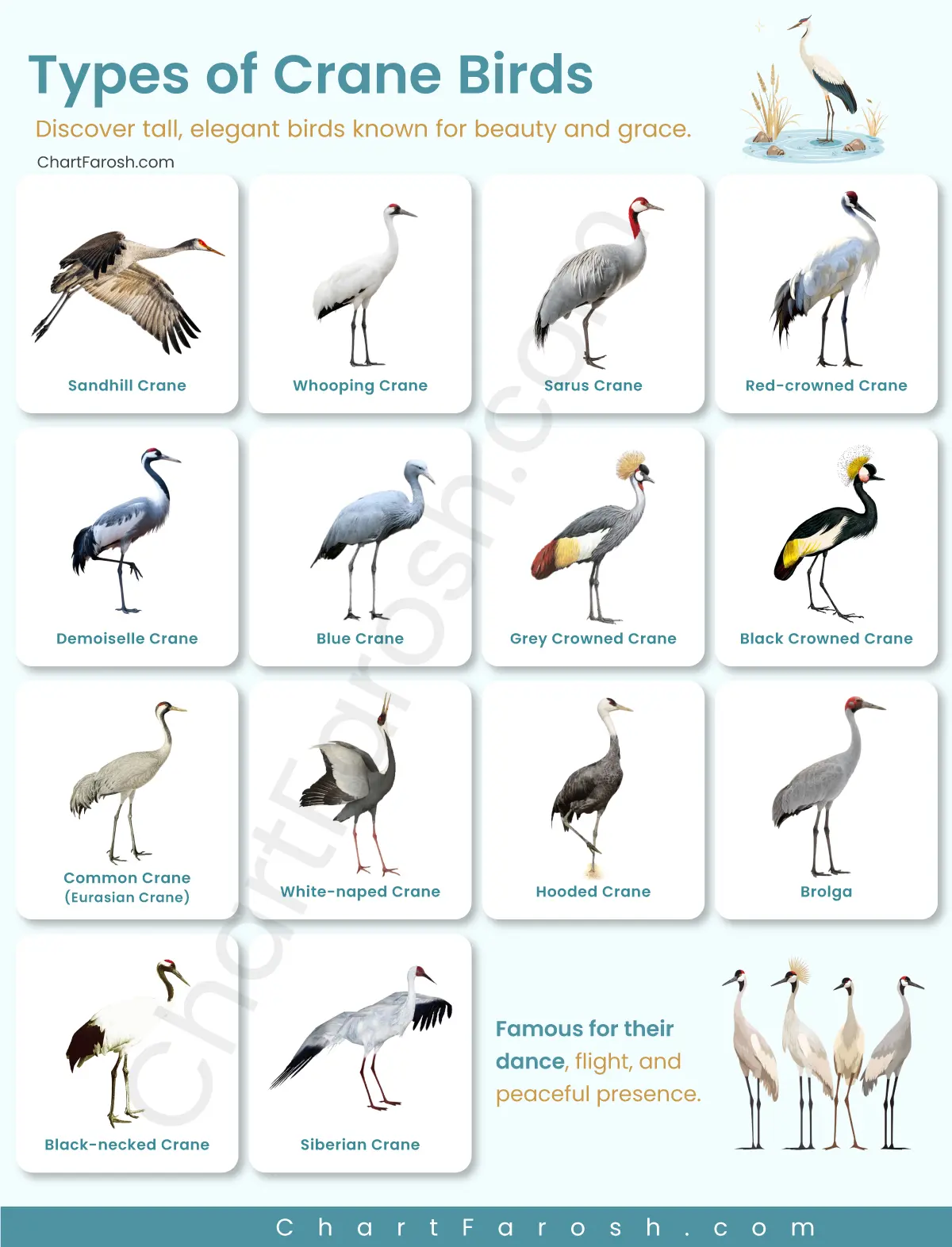
Table of Contents
Different Types of Cranes Birds
When people first start exploring the different types of cranes birds, they’re usually surprised to learn there are 15 recognized species worldwide.
All cranes belong to the family Gruidae, and while they share a similar tall, long-legged silhouette, each species carries its own personality in plumage, voice, and habitat preference.
Some are tundra travelers, breeding in the Arctic before migrating thousands of kilometers. Others remain year-round residents of tropical wetlands or open grasslands.
Cranes are found on every continent except South America and Antarctica. They rely heavily on wetlands, floodplains, marshes, and grasslands, habitats that are increasingly under pressure.
Despite their elegant appearance, cranes are resilient birds, capable of adapting to agricultural landscapes and seasonal changes.
Their courtship dances, involving leaps, bows, wing spreads, and synchronized calls, are among the most fascinating displays in the bird world.
| Crane Species | Scientific Name | Region | Key Feature | Conservation Status |
| Sandhill Crane | Antigone canadensis | North America, Siberia | Loud trumpeting call | Least Concern |
| Whooping Crane | Grus americana | North America | Tallest North American bird | Endangered ⚠️ |
| Sarus Crane | Antigone antigone | India, SE Asia, Australia | Tallest flying bird | Vulnerable |
| Red-crowned Crane | Grus japonensis | East Asia | White body, red crown | Endangered ⚠️ |
| Demoiselle Crane | Anthropoides virgo | Europe, Asia, Africa | Smallest crane species | Least Concern |
| Blue Crane | Anthropoides paradiseus | South Africa | National bird of South Africa | Vulnerable |
| Grey Crowned Crane | Balearica regulorum | Eastern & Southern Africa | Golden crown feathers | Endangered ⚠️ |
| Black Crowned Crane | Balearica pavonina | West Africa | Distinct black-and-gold crown | Vulnerable |
| Common Crane (Eurasian Crane) | Grus grus | Europe & Asia | Large migratory bird | Least Concern |
| White-naped Crane | Antigone vipio | East Asia | White stripe on neck | Vulnerable |
| Hooded Crane | Grus monacha | Russia, Japan, China | Small, dark plumage | Vulnerable |
| Brolga | Antigone rubicunda | Australia & New Guinea | Known for dance displays | Least Concern |
| Black-necked Crane | Grus nigricollis | Tibet, India, China | Black neck & head | Vulnerable |
| Siberian Crane | Leucogeranus leucogeranus | Arctic Russia, Asia | Pure white plumage | Critically Endangered ⚠️ |
Common Type of Crane?
When people ask about the most common crane species, the answer often depends on geography. Globally, the Sandhill Crane stands out for its large and stable population.
It is one of the most widespread members among the different types of cranes birds, with several subspecies found across North America and parts of Siberia.
What makes Sandhill Cranes so common compared to others is their adaptability. They use wetlands for breeding but also feed in agricultural fields, grasslands, and prairies.
During migration, massive gatherings, sometimes numbering in the hundreds of thousands, occur at stopover points. Their loud, rolling calls are often the first sign of their presence overhead.
| Species | Region | Estimated Population | Conservation Status |
| Sandhill Crane | North America | 650,000+ | Least Concern |
| Eurasian Crane | Europe & Asia | 600,000+ | Least Concern |
| Sarus Crane | South Asia & Australia | 15,000–20,000 | Vulnerable |
What is the Rarest Type of Crane?
Among the different types of crane birds, the rarest is widely considered to be the Whooping Crane. At one point in the 1940s, fewer than 20 individuals remained in the wild.
Habitat destruction, hunting, and migration risks pushed the species to the edge of extinction.
Today, thanks to decades of conservation work, their population has slowly increased, but they remain endangered.
Whooping Cranes require large, protected wetland habitats and safe migratory corridors between breeding grounds in Canada and wintering areas in the southern United States.
Their story is often cited as one of the most important crane recovery efforts in modern conservation.
| Species | Wild Population | Primary Region | Conservation Status |
| Whooping Crane | 800+ | USA & Canada | Endangered |
| Red-crowned Crane | ~3,000 | East Asia | Endangered |
| Wattled Crane | ~8,000 | Africa | Vulnerable |
What is the Biggest Crane Species?
If size is what impresses you most, the Sarus Crane holds the crown. Standing up to 1.8 meters tall, it is officially the tallest flying bird in the world.
Among the different types of cranes birds, this species commands attention simply by posture alone.
Beyond height, Sarus Cranes are known for their lifelong pair bonds and powerful, echoing calls that can carry across wetlands.
They are primarily found in South Asia and parts of northern Australia, often nesting in shallow wetlands during monsoon seasons.
Their impressive wingspan and synchronized courtship dances make them unforgettable to watch in the wild.
| Species | Height | Wingspan | Region |
| Sarus Crane | Up to 1.8 m | 2.5 m | South Asia & Australia |
| Whooping Crane | 1.5 m | 2.3 m | North America |
| Red-crowned Crane | 1.5 m | 2.4 m | East Asia |
Types of Crane Birds in Australia
Australia hosts two crane species, both elegant and unmistakable in open landscapes. Northern wetlands and grasslands provide ideal breeding grounds, particularly during the wet season.
Compared to other continents, Australia has fewer species, but both play a strong ecological role.
The Brolga is often associated with Aboriginal folklore and is well adapted to tropical savannas. Meanwhile, the Sarus Crane also has an Australian population, particularly in Queensland’s wetlands.
| Species | Habitat | Region in Australia | Status |
| Sarus Crane | Wetlands | Northern Australia | Vulnerable |
| Brolga | Grasslands & Marshes | Northern & Eastern Australia | Least Concern |
Types of Crane Birds in South Africa
South Africa is home to three crane species, each dependent on wetlands and grasslands that are increasingly threatened.
Among the different types of cranes birds, African cranes are especially striking in appearance.
The Blue Crane is the national bird of South Africa and thrives in open grasslands. The Grey Crowned Crane stands out due to its dramatic golden crown.
The Wattled Crane, the largest African crane, prefers marshy habitats.
| Species | Habitat | Status | Notes |
| Blue Crane | Grasslands | Vulnerable | National bird |
| Grey Crowned Crane | Wetlands | Endangered | Crowned feathers |
| Wattled Crane | Marshes | Vulnerable | Largest African crane |
Types of Cranes Birds in India
India plays a critical role in global crane conservation. Wetlands, agricultural fields, and seasonal floodplains support both resident and migratory species.
When discussing different types of cranes birds, India often stands out because of its stable Sarus Crane population.
The Sarus Crane is a year-round resident in northern India. Migratory visitors include the Demoiselle Crane and the Common Crane, which arrive during winter months.
| Species | Residency | Habitat | Status |
| Sarus Crane | Resident | Wetlands | Vulnerable |
| Demoiselle Crane | Migratory | Grasslands | Least Concern |
| Common Crane | Migratory | Wetlands | Least Concern |
FAQs
What do cranes eat?
Cranes are omnivores. They eat seeds, grains, insects, small reptiles, amphibians, and occasionally small mammals.
How long do cranes live?
In the wild, cranes typically live 20–30 years, though some can live longer in protected conditions.
Do all cranes migrate?
Not all species migrate. Some remain in the same region year-round, while others travel thousands of kilometers seasonally.
Why are wetlands important for cranes?
Wetlands provide nesting sites, food sources, and protection from predators.
Are cranes protected by law?
Many crane species are protected under national and international wildlife conservation laws due to habitat threats and declining populations.