Types of Maggots
I found my first batch of maggots in a trash can I forgot to empty before a week away. I lifted the lid and the bottom was moving. Pale, wriggling, busy. My stomach turned, and then I got curious.
What were they? Where did they come from so fast? I had not seen a single fly lay an egg.
It turns out maggots are baby flies. Every fly starts as one. Some eat garbage, like the ones in my bin. Some eat dead animals. Some bore into crops or live in water. A few are raised on purpose, to clean wounds or turn food waste into animal feed. And a few are not maggots at all, though people call them that.
There are dozens of kinds worth knowing. Below is what each one becomes, where it lives, and what it eats. By the end, a wriggling larva will not be a mystery.
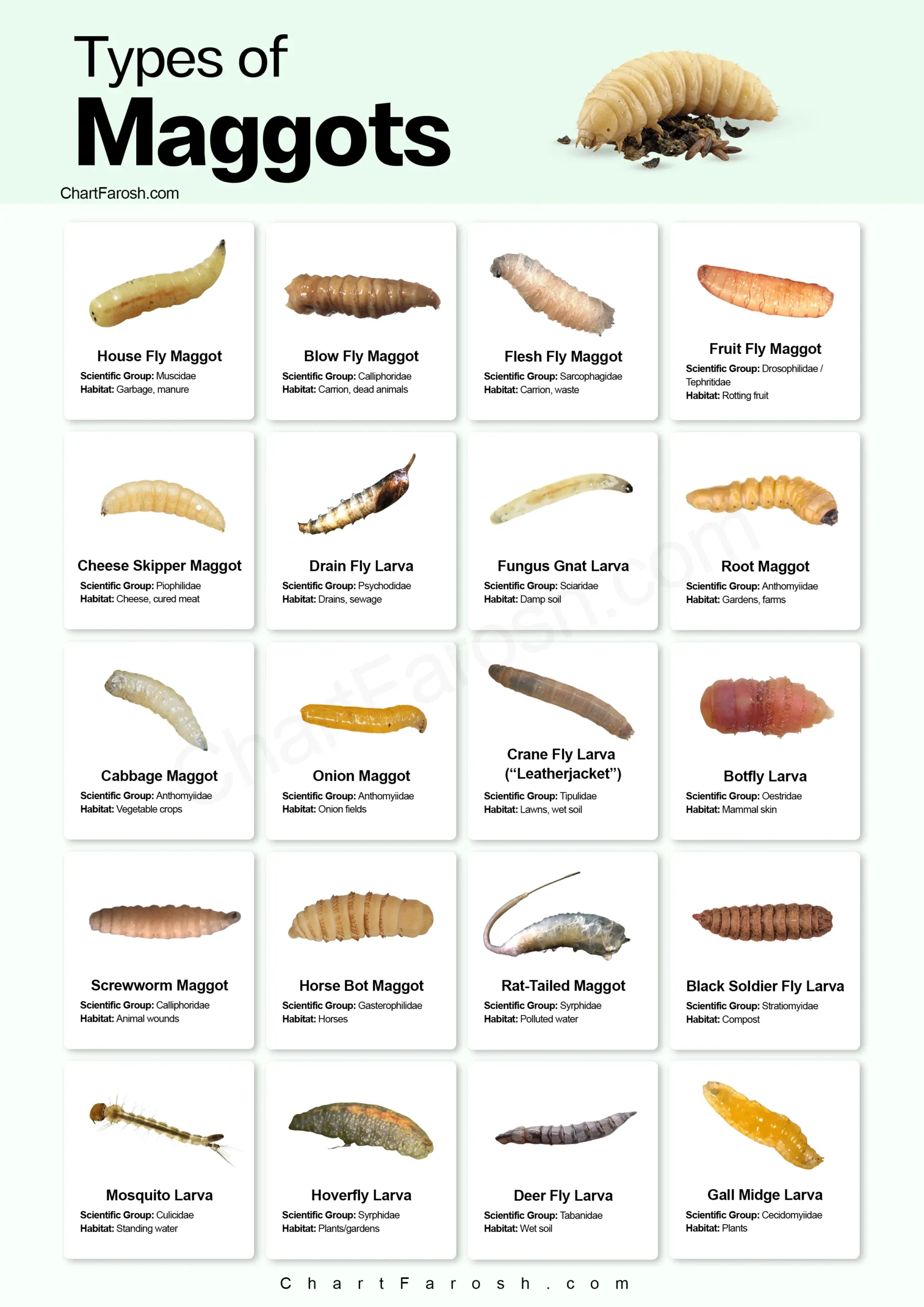
Table of Contents
Maggot and fly larva identification chart
Every maggot is the larva of a fly. The twenty below cover the ones people find most, in bins, gardens, drains, water, and on animals. The chart lists each by the adult fly it becomes, its scientific family, where it lives, and what it eats. A few are fly larvae but not true maggots. The next section explains the difference.
| Common Name | Adult Fly | Scientific Family | Habitat | Main Food Source |
| House Fly Maggot | House fly | Muscidae | Garbage, manure | Decaying organic matter |
| Blow Fly Maggot | Blow fly | Calliphoridae | Carrion, dead animals | Flesh and decaying meat |
| Flesh Fly Maggot | Flesh fly | Sarcophagidae | Carrion, waste | Dead tissue and dung |
| Fruit Fly Maggot | Fruit fly | Drosophilidae / Tephritidae | Rotting or growing fruit | Fermenting or fresh fruit |
| Cheese Skipper | Cheese fly | Piophilidae | Cheese, cured meat | Animal products |
| Drain Fly Larva | Moth / drain fly | Psychodidae | Drains, sewage | Sludge and biofilm |
| Fungus Gnat Larva | Fungus gnat | Sciaridae | Damp soil | Fungus and roots |
| Root Maggot | Root fly | Anthomyiidae | Gardens, farms | Plant roots |
| Cabbage Maggot | Cabbage root fly | Anthomyiidae | Vegetable crops | Cabbage-family roots |
| Onion Maggot | Onion fly | Anthomyiidae | Onion fields | Onion bulbs and roots |
| Crane Fly Larva (Leatherjacket) | Crane fly | Tipulidae | Lawns, wet soil | Grass roots |
| Botfly Larva | Botfly | Oestridae | Mammal skin | Living tissue (parasitic) |
| Screwworm Maggot | Screwworm fly | Calliphoridae | Animal wounds | Living flesh (parasitic) |
| Horse Bot Maggot | Horse botfly | Gasterophilidae | Horse stomach | Stomach lining (parasitic) |
| Rat-Tailed Maggot | Drone fly (hoverfly) | Syrphidae | Stagnant water | Organic matter (filter feeder) |
| Black Soldier Fly Larva | Soldier fly | Stratiomyidae | Compost | Food waste, manure |
| Mosquito Larva | Mosquito | Culicidae | Standing water | Microorganisms |
| Hoverfly Larva | Hoverfly | Syrphidae | Plants, gardens | Aphids (predatory) |
| Deer Fly Larva | Deer fly | Tabanidae | Wet soil | Small soil animals |
| Gall Midge Larva | Gall midge | Cecidomyiidae | Plants | Plant tissue (some eat aphids) |
To match an adult fly to its larva, the fly identification chart pairs the grown insects with their names.
What is a maggot, exactly?
A maggot is the larva of a fly. The word fits best for the larvae of higher flies, the group called Cyclorrhapha. These are the legless, tapered, almost headless grubs with a pair of tiny mouth hooks. House fly, blow fly, and cheese fly larvae are the classic maggots.
Larvae from other fly groups look and live differently. Mosquito and crane fly larvae have a clear head and bristles. Most people still call them larvae, not maggots. As entomology guides at NC State note, maggot is a common word, not a strict scientific one. In this list it helps to keep the true maggots separate from the rest.
Maggots and grubs are not the same thing either. A grub is a beetle larva, with six legs and a hard head. A maggot has neither. If you are not sure which you found, the grub identification chart sets them side by side.
| Group | What the Larvae Do | Examples Here |
| Decomposers | Eat waste, rotting food, and carrion | House, blow, flesh fly, cheese skipper |
| Crop pests | Bore into roots, bulbs, and fruit | Root, cabbage, onion, fruit fly maggots |
| Parasites (myiasis) | Feed on living animal tissue | Botfly, screwworm, horse bot |
| Beneficial | Compost waste or eat pests | Black soldier fly, hoverfly larva |
| Not true maggots | Larvae of other fly groups | Mosquito, crane fly, fungus gnat, gall midge |
Those five camps cover the whole list.
Maggots that break down waste and carrion
The most familiar maggots are nature’s cleanup crew. They eat waste, rotting food, and dead animals.
The house fly maggot (family Muscidae) is the one in the trash can. It feeds on garbage, manure, and any decaying matter.
The blow fly maggot (family Calliphoridae) is the metallic fly’s larva. It is the first to find a dead animal, often within minutes. This makes blow flies useful in forensic science, where the age of the maggots helps estimate a time of death.
The flesh fly maggot (family Sarcophagidae) does similar work on carrion, waste, and dung.
The cheese skipper (Piophila casei, family Piophilidae) infests cheese and cured meat. Its larva can flick itself into the air, which is how it earned the name skipper. It is the maggot found in the Sardinian cheese casu marzu.
Maggots that damage crops
Several maggots are quiet pests of farms and gardens. They feed underground, out of sight, until the plant wilts.
Root maggots, cabbage maggots, and onion maggots all belong to the family Anthomyiidae. The cabbage maggot (Delia radicum) tunnels into the roots of cabbage, broccoli, and other crucifers. The onion maggot (Delia antiqua) bores into onion bulbs. A wilting seedling with chewed roots is the usual sign.
Fruit fly maggots come from two different families, and they are worth telling apart. The tiny fruit fly in your kitchen is Drosophila (family Drosophilidae). Its larvae feed in fermenting, overripe fruit. The fruit flies that ruin crops are a separate family, the Tephritidae, which includes serious pests like the Mediterranean fruit fly. Their larvae develop inside growing fruit.
Parasitic maggots and myiasis
A small group of maggots feed on the living tissue of animals. The infestation they cause is called myiasis.
The botfly (family Oestridae) lays eggs that hatch into larvae which burrow under the skin of mammals and form a lump. The human botfly does this in parts of Central and South America.
The horse bot (Gasterophilus, family Gasterophilidae) is swallowed by horses and attaches to the stomach lining.
The screwworm (Cochliomyia hominivorax, family Calliphoridae) is the most serious. Unlike most blow flies, it lays eggs in the open wounds of living animals, and the maggots eat healthy flesh.
The screwworm was wiped out of North America decades ago using sterile flies. It has now returned. An outbreak has moved north since 2023, and in June 2026 the first US animal case of the current outbreak was confirmed in Texas. It mainly strikes livestock and wildlife and rarely people. The CDC tracks the current situation.
If you ever see maggots in a wound on a person or a pet, do not try to dig them out. See a doctor or a vet. Myiasis in people is uncommon and treatable when caught early.
Helpful maggots
Not every maggot is a problem. Some do real good.
The black soldier fly larva (family Stratiomyidae) is a composting star. It eats food waste and manure at high speed and turns it into rich castings and protein. Farms now raise these larvae as feed for chickens and fish.
The hoverfly larva (family Syrphidae) is a quiet hero of the garden. It is a small, legless, sluglike maggot that hunts aphids. One larva can eat hundreds before it pupates. These are some of the most useful beneficial insects you can host, as UC IPM explains.
The rat-tailed maggot is also a hoverfly larva, from the drone fly (Eristalis). It lives in stagnant water and breathes through a long tail like a snorkel. It looks alarming but does no harm. The adult is a bee mimic and a useful pollinator.
Maggots even work in medicine. Clinics use sterile blow fly larvae to clean dead tissue from wounds, a method called maggot debridement therapy.
Fly larvae that are not true maggots
Several larvae on this list are not maggots in the strict sense. They are the young of more primitive flies, and they have a different shape.
The mosquito larva, or wriggler, lives in standing water and feeds on microorganisms. It has a clear head and a breathing tube.
The crane fly larva, the leatherjacket, lives in lawns and wet soil and chews grass roots. Its tough gray skin gives it the name.
The fungus gnat larva lives in damp potting soil. It eats fungus and can damage seedling roots. The drain fly larva breeds in the slime inside drains.
The gall midge larva lives in plants, where many form swellings called galls, though a few are predators that eat aphids and mites. The deer fly larva develops in wet soil and hunts small animals there. All of these are true fly larvae. They are not the legless, headless maggots of the higher flies.
Maggots in the home
Most maggots indoors come from one source. A fly laid eggs on food or waste. You find them in trash cans, around pet bowls, or on forgotten food.
They are harmless to touch and carry no venom. The worry is sanitation, since the flies they came from visit waste. To clear them, remove the food source, bag it, and bin it, then clean the area with hot, soapy water. Take out the trash often and keep bin lids sealed. A tight kitchen gives flies nowhere to lay eggs in the first place.
FAQs
What is a maggot?
A maggot is the larva of a fly. The word fits the legless, tapered larvae of higher flies like house flies, blow flies, and cheese flies. They have no real head and feed with a pair of tiny mouth hooks before they pupate into adult flies.
Where do maggots come from?
Maggots hatch from eggs that adult flies lay on food, waste, or animal tissue. A female fly can lay hundreds of eggs at once, and they hatch within a day, which is why maggots seem to appear from nowhere.
Are maggots harmful to humans?
Most maggots are harmless to touch and carry no venom. A few parasitic kinds, like the botfly and the screwworm, can infest living tissue, a condition called myiasis. That is uncommon in people and treatable, but it needs a doctor.
What is the difference between a maggot and a grub?
A maggot is a fly larva with no legs and no hard head. A grub is a beetle larva with six legs and a hard, dark head. If it has legs, it is a grub, not a maggot.
Are any maggots useful?
Yes. Black soldier fly larvae compost food waste and feed livestock. Hoverfly larvae eat aphids in the garden. Clinics even use sterile maggots to clean wounds, a method called maggot debridement therapy.
How do I get rid of maggots?
Find and remove the food or waste they feed on, then clean the area with hot, soapy water. Take out the trash and seal bin lids to stop flies from laying more eggs. For help telling the adult flies apart.