Types of Centipedes
I found my first house centipede in the bathroom at midnight, and I nearly jumped out of my skin. It sat on the wall with dozens of legs fanned out, fast and silent. Once my heart slowed down, I got curious about what the thing was.
That curiosity turned into a small obsession with how many kinds of centipede there really are. Some are barely longer than a fingernail and live their whole lives under a rock. Others, like the Amazonian giant, stretch past a foot and hunt frogs and bats.
The chart below sorts the main types by scientific group, appearance, habitat, and how much their bite can hurt. Use it to place the one you found, whether it turned up in your basement or a photo from a trip abroad.
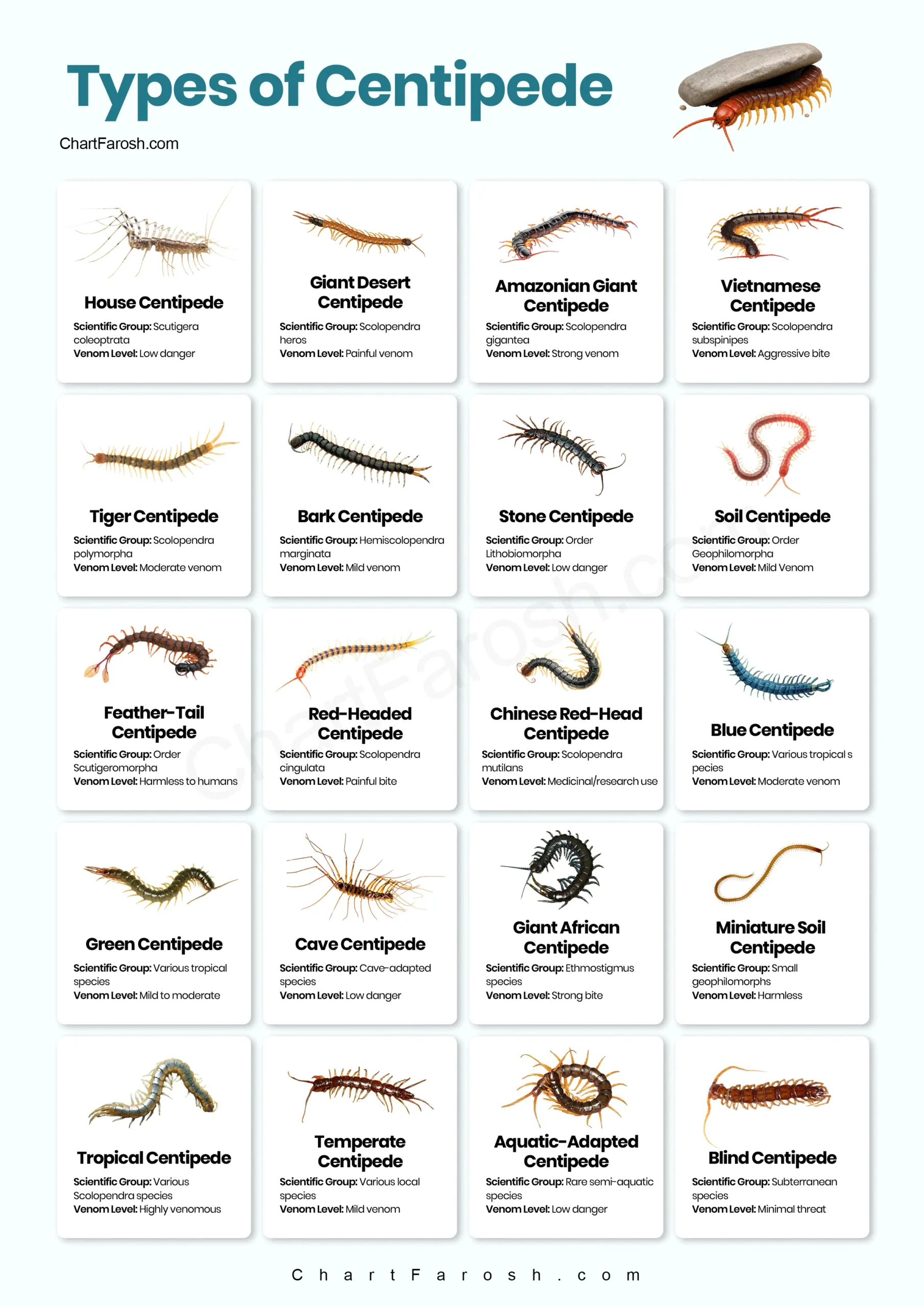
Table of Contents
Types of Centipedes and Their Names
Centipedes belong to the class Chilopoda, and scientists split them into four main orders. House centipedes sit in Scutigeromorpha. Stone centipedes are Lithomorpha’s well-known group, the Lithobiomorpha. The long thread-like soil centipedes are Geophilomorpha, and most of the large, brightly colored tropical and desert species are Scolopendromorpha.
Every centipede shares the same basic plan. It has one pair of legs per body segment and a pair of venom claws called forcipules behind the head. Those claws are how a centipede subdues prey, and they are why a few large species can give a painful bite.
Here are the centipede types people search for most, with the traits that set each one apart.
| Type | Scientific Group | Appearance | Habitat | Bite / Danger Level |
| House Centipede | Scutigera coleoptrata | Thin body, very long striped legs | Homes, basements, damp rooms | Mild; rarely breaks skin |
| Stone Centipede | Order Lithobiomorpha | Short flat reddish-brown body, quick | Under rocks, soil, leaf litter | Low; harmless to people |
| Soil Centipede | Order Geophilomorpha | Very long, thin, thread-like, many legs | Underground soil, gardens | Mild |
| Giant Redheaded (Giant Desert) Centipede | Scolopendra heros | Red head, black body, yellow legs; up to 8 in | Deserts of the US southwest and north Mexico | Painful, venomous bite |
| Amazonian Giant Centipede | Scolopendra gigantea | Very large, reddish-brown; up to ~12 in | Tropical forests of South America | Strong venom; very painful |
| Vietnamese Centipede | Scolopendra subspinipes | Dark body with orange legs; aggressive | Tropics worldwide, Southeast Asia | Painful, defensive bite |
| Chinese Red-Headed Centipede | Scolopendra mutilans | Red head, dark body, yellow legs | East Asia | Venomous; used in traditional medicine |
| Tiger Centipede | Scolopendra polymorpha | Banded tiger-like pattern, color varies | Dry regions of the US southwest | Moderate venom |
| Bark Centipede | Hemiscolopendra marginata | Flattened, blue-green to dark body | Under bark and logs, eastern US | Mild venom |
| Mediterranean Banded Centipede | Scolopendra cingulata | Alternating black and yellow-gold bands | Southern Europe, North Africa | Mild for its genus; bite still hurts |
| Giant African Centipede | Ethmostigmus species | Large, dark, heavily segmented body | African forests and savanna | Strong, painful bite |
| Waterfall (Amphibious) Centipede | Scolopendra cataracta | Greenish-black, long legs; swims | Streams in Thailand, Laos, Vietnam | Venomous, like other large Scolopendra |
| Cave Centipede | Cave-adapted species | Pale, elongated body, reduced eyes | Caves and deep crevices | Low |
| Blind Soil Centipede | Subterranean Geophilomorpha | Pale, thread-like, eyeless | Deep soil and tunnels | Minimal threat |
If the creature you found has a rounder body and short legs, it may be a different household visitor. Our bug identification chart covers the wider range of crawling indoor pests.
Largest Centipede Species
The giants of the group all sit in the order Scolopendromorpha. They live mostly in warm, humid regions, and a few can take down small vertebrates. The Amazonian giant is the heavyweight, with verified specimens close to a foot long and reports of larger ones.
| Species | Typical Length | Where Found | Notable Trait |
| Amazonian Giant Centipede | Up to ~30 cm (12 in) | South American rainforest | Hunts frogs, lizards, and bats |
| Giant Redheaded Centipede | Up to ~20 cm (8 in) | US southwest, north Mexico | Bright red head warns predators |
| Vietnamese Centipede | Up to ~20 cm (8 in) | Southeast Asia and tropics | Quick and defensive when handled |
| Waterfall Centipede | Up to ~20 cm (8 in) | Thailand, Laos, Vietnam | Swims and runs along stream beds |
| Giant African Centipede | 15–20 cm (6–8 in) | Sub-Saharan Africa | Heavy-bodied forest hunter |
Smallest Centipede Species
At the other end of the range sit the small, quiet species most people never notice. Stone centipedes spend their lives under rocks and rarely pass an inch. Many soil centipedes are thinner than a piece of thread, and the house centipede looks bigger than it is only because of its long legs.
| Species | Typical Length | Where Found | Notable Trait |
| Stone Centipede | 1–3 cm (under 1 in) | Worldwide, under rocks | Fast, reddish-brown, short-bodied |
| Soil Centipede | 1–7 cm, very thin | In soil and gardens | Thread-like with dozens of legs |
| Blind Soil Centipede | Around 2–4 cm | Deep soil and tunnels | Eyeless, pale, lives underground |
| House Centipede | ~3 cm body (longer with legs) | Homes and basements | Long legs make it look larger |
| Mediterranean Banded Centipede | 10–15 cm | Southern Europe | Small for the Scolopendra genus |
Dangerous vs Harmless Centipedes
Most centipedes you meet at home cannot hurt you. The small house, stone, and soil species either cannot break human skin or leave nothing worse than a pinprick. The bite that people fear comes from the large tropical and desert Scolopendra, and even those are painful rather than deadly for most healthy adults.
A bite from a large species can cause sharp pain, swelling, and redness that may spread up a limb for a few hours. Serious reactions are rare and usually involve an allergy or a bite to a child or older adult. The table below splits the common types by how much caution they call for.
| More painful / venomous | Mostly harmless to people |
| Amazonian giant centipede (S. gigantea) | House centipede (Scutigera coleoptrata) |
| Giant redheaded centipede (S. heros) | Stone centipedes (Lithobiomorpha) |
| Vietnamese centipede (S. subspinipes) | Soil and blind soil centipedes (Geophilomorpha) |
| Chinese red-headed centipede (S. mutilans) | Cave-dwelling centipedes |
| Giant African centipede (Ethmostigmus) | Mediterranean banded centipede (mild for its size) |
Despite the fear they cause, centipedes earn their keep. They are predators that eat cockroaches, silverfish, and spiders, which is why university extension programs list them as beneficial rather than a true pest. You can see other natural pest controllers in our beneficial insects chart.
Centipedes in the House
The centipede most people see indoors is Scutigera coleoptrata, the house centipede. It likes damp, dark spaces such as basements, bathrooms, and crawl spaces. It hunts at night and feeds on the smaller pests already living in your home, so a few of them quietly reduce your bug problem.
They get inside through gaps around pipes, doors, and foundations, drawn by moisture and prey. Drying out basements and sealing those gaps does more to move them along than any spray. If the count climbs, it usually means another insect is breeding nearby and feeding them.
House centipedes often share space with spiders, since both hunt the same small prey. Our spider identification chart helps you tell apart the other long-legged hunter in the corner of the room.
How to Tell a Centipede from a Millipede
Centipedes and millipedes get mixed up constantly, yet they are easy to separate once you know the trick. A centipede has one pair of legs per segment and moves fast. A millipede has two pairs per segment and moves slowly, often curling into a tight spiral when touched.
Diet tells them apart too. Centipedes are predators that chase down other small animals. Millipedes are detritivores that eat dead leaves and decaying plant matter, so they pose no bite risk at all.
| Feature | Centipede | Millipede |
| Legs per segment | One pair | Two pairs |
| Movement | Fast, darting | Slow, steady |
| Diet | Predator (insects, spiders) | Decaying plants and leaves |
| When threatened | Runs and may bite | Curls into a spiral |
| Risk to people | Minor bite from large species | Harmless |
Centipede Names That Overlap or Get Used Loosely
Several popular centipede names describe a color or a habitat rather than a single species, so it helps to know what they really point to. Keeping them straight saves you from chasing a name that does not exist in the science.
- Blue centipede and green centipede: color labels for various tropical Scolopendra, not separate species. Body color shifts with species, age, and region.
- Tropical and temperate centipede: climate labels, not scientific groups. They describe where a centipede lives, not what it is.
- Feather-tail centipede: a nickname for the long, delicate-legged house-centipede group (Scutigeromorpha), the same group as Scutigera coleoptrata.
- Miniature soil centipede: simply a small soil centipede in the order Geophilomorpha, not a distinct type.
- Cave and blind centipedes: habitat names for pale, often eyeless species adapted to darkness, mostly within the soil-centipede group.
The waterfall centipede (S. cataracta) shows why the science keeps shifting. It was confirmed as the first amphibious centipede only in 2016, and it both swims and runs along stream beds, as National Geographic reported on its discovery.
FAQs
How many types of centipedes are there?
Scientists have described roughly 3,000 species of centipede, grouped into four main orders. Most homes only ever see one of them, the house centipede.
What is the most common centipede in the house?
The house centipede, Scutigera coleoptrata, is the one found indoors almost everywhere. It is the thin-bodied centipede with very long, striped legs that darts across bathroom floors.
What is the largest centipede in the world?
The Amazonian giant centipede, Scolopendra gigantea, is the largest. It can reach around 30 centimeters and is strong enough to catch frogs, lizards, and even small bats.
Are centipede bites dangerous?
For most people a centipede bite causes pain, swelling, and redness rather than real harm. Bites from large tropical species hurt a lot, but serious reactions are rare and usually linked to an allergy.
What is the difference between a centipede and a millipede?
A centipede has one pair of legs per segment, moves fast, and hunts other animals. A millipede has two pairs per segment, moves slowly, and eats decaying plant matter.
Do centipedes really have 100 legs?
Not exactly. The name means hundred legs, but species range from about 30 to over 350, and a centipede always has an odd number of leg pairs.
Which centipede has the strongest venom?
Among commonly kept species, the large Scolopendra such as the Amazonian giant and the giant redheaded centipede deliver the most painful, potent bites.