Types of Rhinoceros
A few months ago I read that there are 76 Javan rhinos left in the wild. Not 76,000. Seventy-six.
That sent me down a rabbit hole. I’d always thought of “rhino” as one animal. Big, grey, horn on its nose, lives in Africa. It turns out there are five species. Three of them live in Asia. And most of them are running out of time.
This guide covers all five species. What they look like. Where they live. How they differ from each other. And why the numbers for some of them are as small as they are.
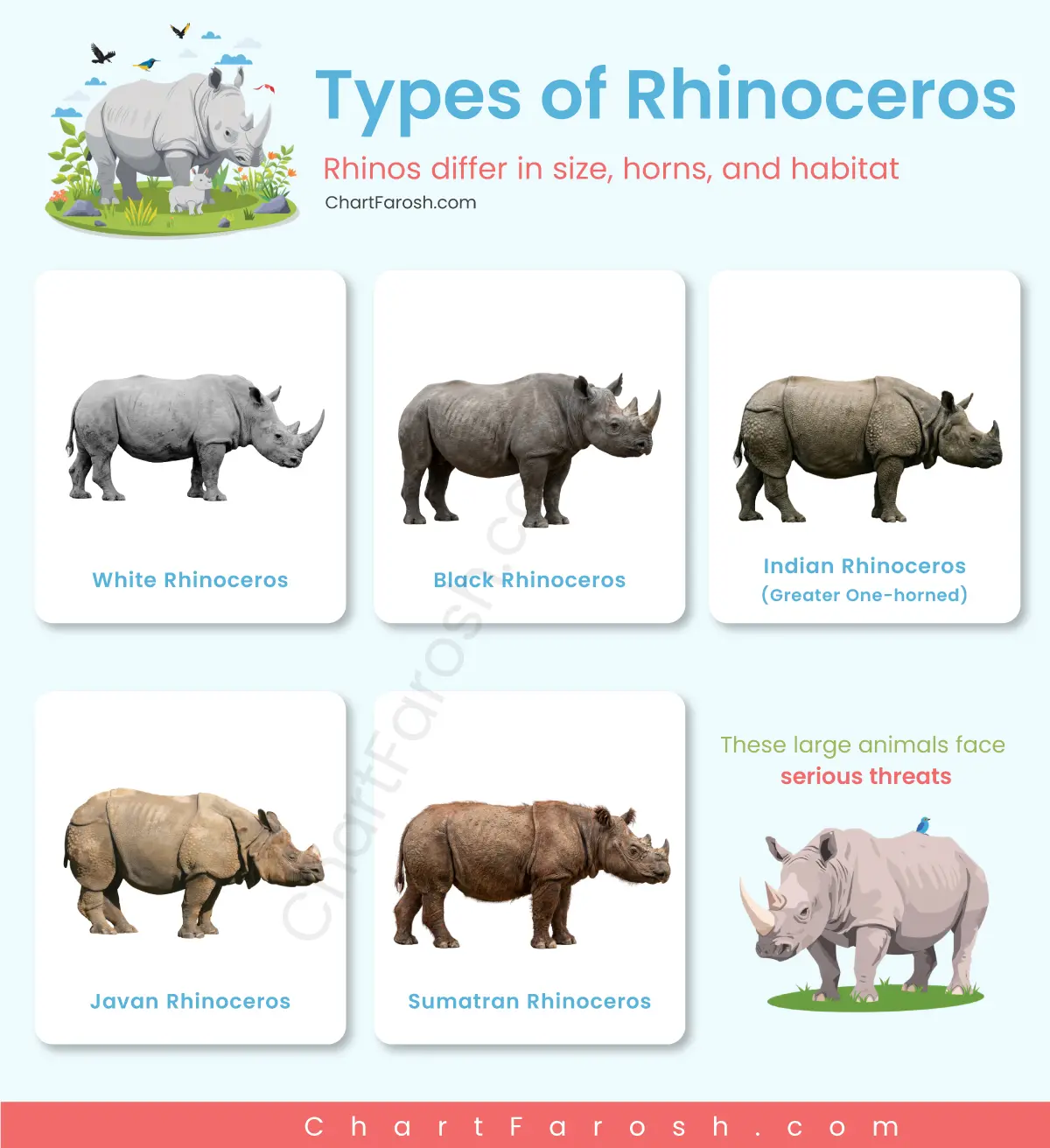
Table of Contents
Types of rhinoceros and their names
There are five living rhinoceros species. Two live in Africa. Three live in Asia. They split into two groups: the African rhinos (white and black) and the Asian rhinos (Indian, Javan, and Sumatran). All five sit somewhere on the threatened list.
The table below covers all five species at a glance. Each one gets its own section further down. For context on other large African mammals, see the types of elephants guide and the types of giraffes guide.
| Rhino Type | Scientific Name | Region | Key Feature | Conservation Status |
| White Rhinoceros | Ceratotherium simum | Southern Africa | Wide square lip, grazer | Near Threatened |
| Black Rhinoceros | Diceros bicornis | Eastern & Southern Africa | Hooked lip, browser | Critically Endangered |
| Indian Rhinoceros (Greater One-Horned) | Rhinoceros unicornis | India, Nepal | Single horn, armored skin folds | Vulnerable |
| Javan Rhinoceros | Rhinoceros sondaicus | Java, Indonesia | Single horn, smaller size | Critically Endangered |
| Sumatran Rhinoceros | Dicerorhinus sumatrensis | Sumatra, Borneo | Smallest rhino, hairy body | Critically Endangered |
African vs Asian rhinoceros
The split between African and Asian rhinos isn’t just geography. They look different. They behave differently. And the African species are larger on average than the Asian ones, with one exception.
African rhinos have two horns. Asian rhinos have either one horn or two depending on species. African rhinos have hairless grey skin. Asian rhinos have skin that folds into plates, which is where the “armored” look comes from.
| Trait | African Rhinos | Asian Rhinos |
| Number of species | 2 (white, black) | 3 (Indian, Javan, Sumatran) |
| Horns | Two | One or two |
| Skin | Smooth, hairless | Folded into plates |
| Size | Larger on average | Smaller, except Indian rhino |
| Habitat | Savanna and bushveld | Forest and swamp |
| Diet | Grazing or browsing | Browsing |
| Combined wild population | Around 22,000 | Around 4,100 |
Indian rhinos are the outlier. They’re as big as African white rhinos, sometimes bigger. The Javan and Sumatran rhinos are the small ones.
If you want a sense of how the Asian rhino habitat overlaps with other Asian megafauna, the types of tigers guide covers species that share the same forest range, including the Sumatran tiger.
White rhino vs black rhino
These are the two African species and they’re often confused. The names don’t help. Neither is white. Neither is black. Both are grey.
The real differences are in the lip, the size, and the temperament.
| Trait | White Rhino | Black Rhino |
| Lip shape | Wide, square | Hooked, pointed |
| Diet | Grazer (eats grass) | Browser (eats leaves and twigs) |
| Average weight | 1,800–2,500 kg | 800–1,400 kg |
| Shoulder height | 1.7–1.8 m | 1.4–1.7 m |
| Wild population | ~17,500 | ~6,400 |
| IUCN status | Near Threatened | Critically Endangered |
| Temperament | Generally docile | More aggressive when threatened |
The name “white rhino” comes from a mistranslation. The Dutch word “wijd” means “wide,” referring to the lip. Early English-speaking settlers heard it as “white.” The other species got called “black” by contrast, even though it isn’t.
Black rhinos are the more threatened of the two. There were around 70,000 of them in the 1970s. Poaching dropped the population to fewer than 2,500 by 1995. Conservation work has roughly tripled that number since then. They’re still listed as critically endangered.
Greater one-horned rhino (Indian rhino)
The greater one-horned rhino is the conservation success story of the group. Its population dropped to around 200 individuals in the early 1900s. It’s now back to about 4,000, mostly in India and Nepal.
This is the species with the armor-plated look. Its skin folds into distinct sections that resemble overlapping plates. It also has just one horn, unlike the African species.
| Trait | Detail |
| Scientific name | Rhinoceros unicornis |
| Other names | Greater one-horned rhino, Indian rhino |
| Range | Northeast India, southern Nepal |
| Habitat | Tall grassland, swamp, riverine forest |
| Weight | 1,800–2,700 kg |
| Shoulder height | 1.7–2.0 m |
| Horn count | One (20–60 cm) |
| Population | Around 4,000 (Vulnerable) |
| Key stronghold | Kaziranga National Park, India |
Kaziranga National Park in Assam holds around two-thirds of the global population. The park has strict anti-poaching patrols and an unusual shoot-on-sight policy for armed poachers. It’s controversial, but it works.
Javan rhino: the rarest rhino species
There are 76 Javan rhinos left. All of them live in one place: Ujung Kulon National Park on the western tip of Java, Indonesia.
That makes the Javan rhino one of the rarest large mammals on Earth. The species used to range across Southeast Asia, from northeast India to Vietnam. The Vietnamese population was declared extinct in 2010. The last known individual was found dead with its horn removed.
| Trait | Detail |
| Scientific name | Rhinoceros sondaicus |
| Range | Ujung Kulon National Park, Indonesia |
| Habitat | Dense lowland rainforest |
| Weight | 900–2,300 kg |
| Shoulder height | 1.4–1.7 m |
| Horn count | One in males, often absent in females |
| Population | ~76 (Critically Endangered) |
| Main threats | Habitat loss, disease, low genetic diversity |
The whole population sitting in one location is dangerous. A single disease outbreak or eruption from nearby Anak Krakatau could wipe them out. Indonesian conservation groups have a plan to move some individuals to a second site. Progress has been slow.
Sumatran rhino: the smallest rhino
The Sumatran rhino is the smallest living rhino species and the only one with significant body hair. It looks more like a small bull with horns than a typical rhino.
It’s also the closest living relative of the extinct woolly rhinoceros. Fewer than 80 individuals remain, scattered across Sumatra and Borneo.
| Trait | Detail |
| Scientific name | Dicerorhinus sumatrensis |
| Range | Sumatra and Borneo, Indonesia |
| Habitat | Dense mountain rainforest |
| Weight | 600–950 kg |
| Shoulder height | 1.0–1.5 m |
| Horn count | Two (front horn 15–25 cm) |
| Body covering | Reddish-brown hair, denser in young animals |
| Population | Fewer than 80 (Critically Endangered) |
Sumatran rhinos are notoriously hard to breed in captivity. They need specific habitat conditions to reproduce. A captive program at Way Kambas in Sumatra has produced a few births since 2012. The wild population keeps shrinking. The Malaysian sub-population was declared extinct in 2019.
The Sumatran rhino shares its habitat with several other endangered species. The types of pangolins guide covers another mammal in the same range that’s facing similar pressure from poaching.
Largest rhinoceros species in the world
The white rhino is the largest. The biggest individuals reach 2,500 kg and stand 1.8 m at the shoulder. The largest verified white rhino on record weighed around 3,600 kg, though that’s an outlier.
The Indian rhino is a close second. Adult males often pass 2,500 kg. The two species are roughly the same length, but the white rhino has more bulk through the chest and shoulders.
| Species | Average Weight | Shoulder Height | Notes |
| White Rhino | 1,800–2,500 kg | 1.7–1.8 m | Largest by total mass |
| Indian Rhino | 1,800–2,700 kg | 1.7–2.0 m | Tallest at the shoulder |
| Black Rhino | 800–1,400 kg | 1.4–1.7 m | Smaller, more agile |
| Javan Rhino | 900–2,300 kg | 1.4–1.7 m | Wide weight range, similar to black |
| Sumatran Rhino | 600–950 kg | 1.0–1.5 m | Smallest living rhino |
For comparison with other large land mammals, the all bear species guide covers a group that includes the polar bear and brown bear. Large brown bears can reach 700 kg, which is less than a small Sumatran rhino.
Endangered rhinoceros species
Three of the five rhino species are critically endangered. One is vulnerable. Only the southern white rhino is in something close to a stable position, and even that population is under heavy poaching pressure.
| Species | IUCN Status | Wild Population | Main Threats |
| White Rhino (southern) | Near Threatened | ~17,500 | Poaching for horn |
| White Rhino (northern) | Functionally extinct | 2 females | Poaching, civil unrest |
| Black Rhino | Critically Endangered | ~6,400 | Poaching, habitat loss |
| Indian Rhino | Vulnerable | ~4,000 | Habitat fragmentation, poaching |
| Javan Rhino | Critically Endangered | ~76 | Single-site risk, low gene pool |
| Sumatran Rhino | Critically Endangered | <80 | Habitat loss, low breeding rate |
Sudan, the last male northern white rhino, died in March 2018 at Ol Pejeta Conservancy in Kenya. The two remaining females, Najin and Fatu, are his daughter and granddaughter.
Scientists at the IUCN and partner organizations are working on in-vitro fertilization using stored sperm from deceased males. As of 2024, no calf has been born from the program.
Rhino horn is made of keratin, the same material as human fingernails. It has no proven medicinal value. But the illegal trade is one of the most profitable wildlife crimes in the world. Organizations like Save the Rhino International track poaching numbers and conservation responses across all five species.
Types of rhinos in Africa
Africa hosts the two African rhino species across roughly a dozen countries. Most of those populations are concentrated in a handful of strongholds. South Africa, Namibia, and Kenya hold the bulk of the global numbers.
Types of rhinos in Kenya
Kenya has both African species: the eastern black rhino and the southern white rhino. The southern whites were introduced from South Africa, since Kenya isn’t part of their natural range.
Kenya’s rhino conservancies are some of the best-known in the world. Ol Pejeta holds the last two northern white rhinos and a large eastern black rhino population. Lewa is one of the most successful private rhino sanctuaries. Solio Ranch played a key role in rebuilding Kenya’s black rhino numbers in the 1980s.
| Reserve | Species Present | Notable For |
| Ol Pejeta Conservancy | Eastern black, southern white, northern white | Last two northern white rhinos |
| Lewa Wildlife Conservancy | Eastern black, southern white | Private conservancy model |
| Solio Game Reserve | Eastern black, southern white | Helped rebuild Kenya’s black rhinos |
| Tsavo East National Park | Eastern black | Intensive protection zone |
| Nairobi National Park | Eastern black, southern white | Rhinos visible from the city skyline |
Types of rhinos in South Africa
South Africa holds the largest rhino population of any country in the world. Both African species live here. The southern white rhino is the most abundant. The south-central black rhino is also present. Kruger National Park and the private reserves of KwaZulu-Natal are the two main population centers.
Kruger has also been the epicenter of rhino poaching since 2008. At the 2014 peak, more than 1,200 rhinos were killed in South Africa in a single year. Numbers have dropped since. Dehorning programs in private reserves have helped. The pressure hasn’t stopped.
| Reserve | Species Present | Notable For |
| Kruger National Park | Southern white, black | Largest white rhino population in the world |
| Hluhluwe-iMfolozi Park | Southern white, black | Where the southern white rhino was saved from extinction |
| Pilanesberg National Park | Southern white, black | Reintroduced rhino populations |
| Phinda Private Reserve | Southern white, black | Black rhino breeding stronghold |
Hluhluwe-iMfolozi deserves a separate mention. In the early 1900s, fewer than 100 southern white rhinos remained, all of them in this park. Conservation work there is the reason there are 17,500 today. Every southern white rhino in the world traces back to that population.
FAQs
How many types of rhinoceros are there?
There are five living species. Two in Africa (white and black) and three in Asia (Indian, Javan, and Sumatran). A sixth species, the woolly rhinoceros, went extinct around 10,000 years ago.
What is the rarest rhino species?
The Javan rhinoceros, with around 76 individuals left. All of them live in one park on the island of Java in Indonesia. The Sumatran rhino is a close second with fewer than 80 individuals.
What is the largest rhinoceros species?
The white rhinoceros. Adults weigh 1,800 to 2,500 kg on average. The Indian rhino is a close second and can match the white rhino in height, sometimes exceeding it at the shoulder.
Why is it called a white rhino if it isn’t white?
The name comes from the Dutch word “wijd,” meaning “wide,” which describes its broad square lip. Early English settlers misheard it as “white.” The other African species got called “black” by contrast, even though it’s the same color.
Are rhinos endangered?
All five species are listed as threatened. Three (black, Javan, Sumatran) are critically endangered. The Indian rhino is vulnerable. The southern white rhino is near threatened. The northern white rhino is functionally extinct, with only two females alive.
Why are rhinos poached?
For their horns. Rhino horn is used in some traditional medicine systems and as a status symbol in parts of Asia. It has no proven medical value. The horn is made of keratin, the same material as human fingernails and hair.
What’s the difference between an African rhino and an Asian rhino?
African rhinos have two horns and smooth grey skin. Asian rhinos have one or two horns and folded “armored” skin. African rhinos live on savanna; Asian rhinos live in forest and swamp. African species tend to be larger, except the Indian rhino, which rivals the white rhino in size.