Types of Flies
I used to think a fly was a fly until one landed on my arm at a lake and left a welt. That was a deer fly, not the harmless one buzzing around my kitchen. The two looked nothing alike once I paid attention.
Flies are one of the largest insect groups on earth, with more than 150,000 known species. Some are familiar, like the housefly. Others are bright metallic bottle flies, blood-feeding mosquitoes, or long-legged giants. A few bite, a few carry disease, and others turn out to be useful.
Below you will find the main types of flies, what sets each one apart, and where they live. The charts group them by family, then by size, biting habits, and habitat. You can match a fly to its name in a few steps.
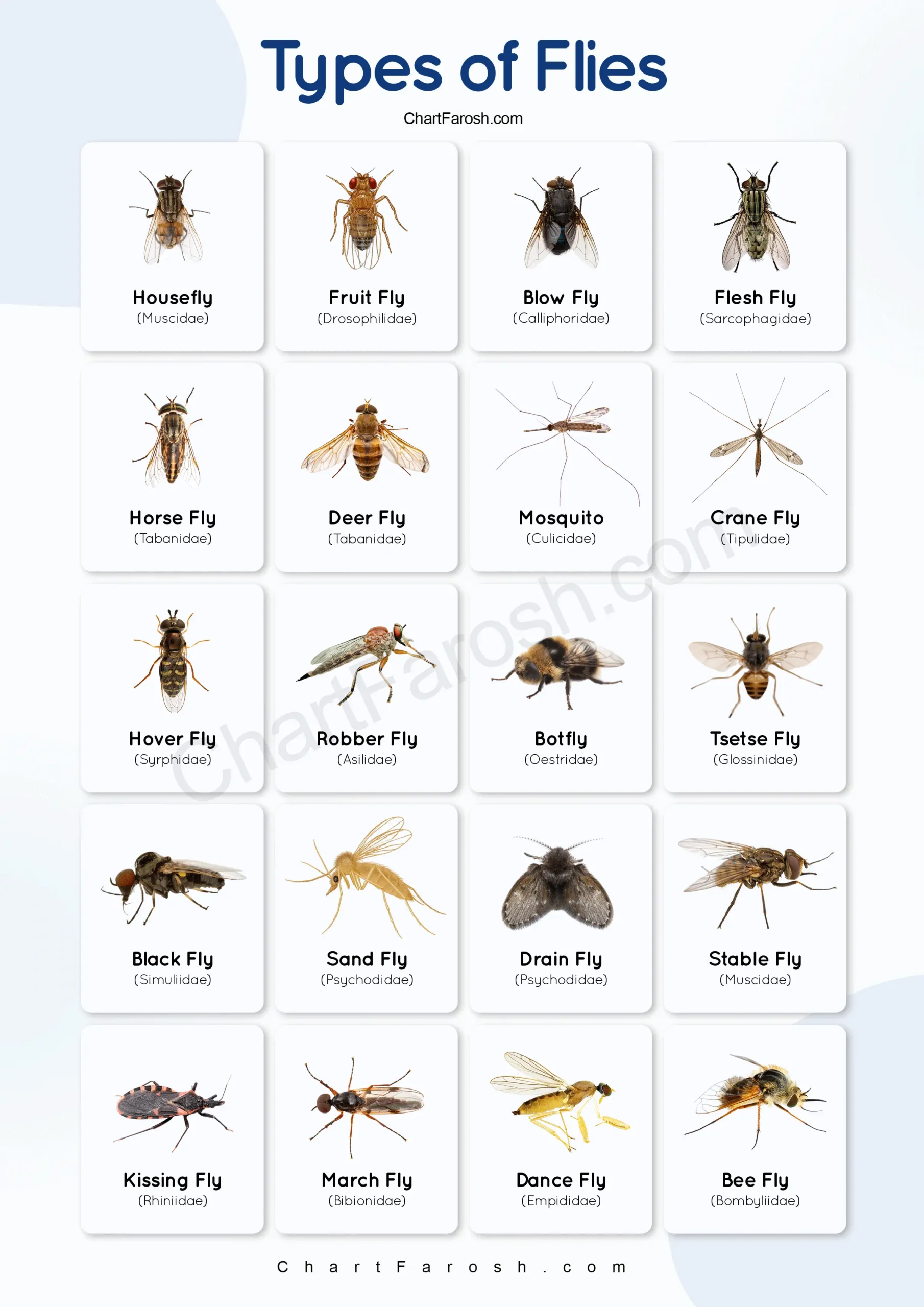
Table of Contents
Types of flies and their names
All true flies belong to the order Diptera. The name means “two wings,” and that is the key trait. A fly has one pair of wings. Its hindwings have shrunk into tiny knobs called halteres, which help it balance in flight.
Scientists sort flies into families by body shape, mouthparts, and life cycle. A few families cover most of the flies you will meet. The table below lays out the main ones so you can place a fly before you name it.
| Family | Scientific family | Key trait | Examples |
| House & stable flies | Muscidae | Drab gray bodies; the classic indoor fly | Housefly, stable fly |
| Blow & bottle flies | Calliphoridae | Shiny metallic blue or green | Blue bottle, green bottle |
| Horse & deer flies | Tabanidae | Large, with painful biting mouthparts | Horse fly, deer fly, yellow fly |
| Mosquitoes | Culicidae | Slender, long legs; females feed on blood | Common mosquito |
| Hover flies | Syrphidae | Bee or wasp mimics that hover in place | Flower flies, drone fly |
| Crane flies | Tipulidae | Very long legs; large but harmless | Giant crane fly |
| Fruit flies | Drosophilidae, Tephritidae | Tiny; drawn to fruit and crops | Common fruit fly, medfly |
| Robber flies | Asilidae | Bristly aerial predators of other insects | Giant robber fly |
Within those families sit tens of thousands of species. The chart below lists common and notable flies, with the family each belongs to, its size and colors, and a feature that helps you tell it apart.
| Common fly type | Family | Size | Main colors | Distinct feature | Where found |
| Housefly | Muscidae | Small | Gray, black | The common indoor pest | Homes & farms |
| Fruit fly | Drosophilidae | Tiny | Tan, yellow | Drawn to ripe fruit | Kitchens |
| Blow fly | Calliphoridae | Medium | Metallic blue/green | Feeds on decaying matter | Carrion |
| Flesh fly | Sarcophagidae | Medium | Gray, striped | Larvae feed on carrion | Garbage areas |
| Horse fly | Tabanidae | Large | Brown, black | Painful biting mouthparts | Near livestock |
| Deer fly | Tabanidae | Medium | Yellow, black | Colorful eyes; bites people | Wetlands |
| Mosquito | Culicidae | Small | Gray, brown | Females feed on blood | Standing water |
| Crane fly | Tipulidae | Large | Brown | Very long legs; harmless | Gardens & grass |
| Hover fly | Syrphidae | Small–medium | Yellow & black | Bee mimic; hovers in air | Flowers |
| Robber fly | Asilidae | Medium–large | Gray, black | Catches prey in flight | Open sunny areas |
| Botfly | Oestridae | Medium | Hairy brown | Parasitic larvae | Mammals |
| Tsetse fly | Glossinidae | Medium | Brown | Spreads sleeping sickness | Africa |
| Black fly | Simuliidae | Tiny | Black | Hump-backed biting fly | Rivers & streams |
| Sand fly | Psychodidae | Tiny | Pale brown | Can spread leishmaniasis | Tropical regions |
| Drain fly | Psychodidae | Tiny | Gray, fuzzy | Breeds in drains | Bathrooms |
| Stable fly | Muscidae | Medium | Gray | Biting housefly relative | Farms |
| Kissing fly | Rhiniidae | Medium | Metallic | Often mistaken for bees | Tropical habitats |
| March fly | Bibionidae | Medium | Black | Swarms in spring | Meadows |
| Dance fly | Empididae | Small | Black, gray | Courtship “dance” flight | Woodland edges |
| Bee fly | Bombyliidae | Small–medium | Hairy brown | Long proboscis; bee-like | Flower gardens |
| Scorpion fly* | Mecoptera (not a fly) | Medium | Yellow-black | Tail curls like a scorpion | Forest plants |
| Phorid fly | Phoridae | Tiny | Brown | Runs in a zigzag | Decaying material |
| Eye gnat | Chloropidae | Tiny | Black | Drawn to eyes and fluids | Humid climates |
| Hessian fly | Cecidomyiidae | Tiny | Dark gray | Wheat crop pest | Farm fields |
| Gall midge | Cecidomyiidae | Tiny | Orange, brown | Forms plant galls | Shrubs & crops |
| Olive fruit fly | Tephritidae | Small | Brown, clear wings | Olive pest | Mediterranean |
| Mediterranean fruit fly | Tephritidae | Small | Yellow-brown | Major fruit pest | Orchards |
| Apple maggot fly | Tephritidae | Small | Black, banded wings | Infests apples | Orchards |
| Phantom crane fly | Ptychopteridae | Medium | Black & orange | Long, dangling legs | Wet habitats |
| Fungus gnat | Sciaridae | Tiny | Black | Lives in moist soil | Houseplants |
| Midge | Chironomidae | Tiny | Gray | Mosquito-like but does not bite | Lakes & ponds |
| Lovebug | Bibionidae | Medium | Black, red thorax | Flies in mating pairs | Southeast U.S. |
| Blue bottle fly | Calliphoridae | Medium | Metallic blue | Loud, buzzing flight | Garbage & carrion |
| Green bottle fly | Calliphoridae | Medium | Metallic green | Used in maggot therapy | Decaying matter |
| Yellow fly | Tabanidae | Medium | Yellow-orange | Painful bite | Swamps |
| Window fly | Scenopinidae | Tiny | Black | Found on windows | Indoors |
| Soldier fly | Stratiomyidae | Medium | Black, metallic | Wasp mimic | Compost & flowers |
| Black soldier fly | Stratiomyidae | Medium | Black | Key composting species | Organic waste |
| Kelp fly | Coelopidae | Small | Brown | Lives on seaweed | Beaches |
| Dung fly | Scathophagidae | Small | Yellow-brown | Lives around manure | Pastures |
| *The scorpion fly and the “lantern fly” are not true flies. Scorpion flies belong to the order Mecoptera. The name “lanternfly” usually means a planthopper in the order Hemiptera, so the row above lists the phantom crane fly (Ptychopteridae), which is a real fly. True flies all sit in the order Diptera and have a single pair of wings. |
Largest fly species
Most large flies live in warm regions and belong to a few heavy-bodied families. The biggest true fly is the mydas fly of Brazil, which can reach a body length of about 7 cm. Crane flies look even larger because of their long legs, though their bodies stay slim.
The table below ranks the largest flies by size. Keep in mind that leg span and body length tell different stories, so a crane fly can span a hand while weighing almost nothing.
| Species | Family | Size | Where found |
| Mydas fly (Gauromydas heros) | Mydidae | Body up to ~7 cm | Brazil |
| Timber fly | Pantophthalmidae | Body up to ~8 cm | Tropical America |
| Giant crane fly | Tipulidae | Leg span up to ~10 cm | North America, Asia |
| Robber fly (large species) | Asilidae | Up to ~3 cm | Open sunny areas |
| Horse fly | Tabanidae | Up to ~2.5 cm | Worldwide, near livestock |
Smallest fly species
At the other end are the phorid flies, fungus gnats, and midges, many smaller than a sesame seed. The smallest known fly is a phorid, Euryplatea nanaknihali, at about 0.4 mm. Its larvae develop inside the heads of tiny ants.
Small flies are easy to overlook, but they matter. Fungus gnats swarm around houseplants, fruit flies appear near ripe produce, and midges rise in clouds over lakes at dusk. Most of them do not bite, even the ones that look like mosquitoes.
Biting flies and disease
This is the part that matters most for health. A small number of flies bite, and a few of those can carry disease. The risk depends on where you are. The same fly can be harmless in one region and a concern in another.
The table below sorts well-known flies by whether they bite and what health concern they raise. For most people, the everyday housefly is a nuisance rather than a danger, though it can still spread germs from waste to food.
| Fly | Does it bite? | Main health concern |
| Mosquito | Females bite | Can spread malaria, dengue, Zika, and West Nile, depending on the region. |
| Tsetse fly | Bites | Spreads African sleeping sickness in parts of sub-Saharan Africa. |
| Sand fly | Bites | Can spread leishmaniasis in tropical and subtropical areas. |
| Black fly | Bites | Spreads river blindness in parts of Africa and Latin America. |
| Horse & deer fly | Bites | Painful bites; they rarely spread disease to people. |
| Housefly | Does not bite | Carries germs on its body and can contaminate food. |
| Crane fly | Does not bite | Harmless. It does not bite, sting, or carry disease. |
Helpful flies you might not expect
Not every fly is a pest. Flies are the second most important pollinators after bees. Hover flies do much of that work in gardens, and their larvae eat aphids. That makes them a quiet ally for anyone growing vegetables.
Other flies clean up after us. Black soldier fly larvae break down food waste and manure, and farmers now raise them as animal feed. Green bottle fly maggots are even used in medicine to clean dead tissue from wounds, a practice called maggot therapy.
Common flies around the home
A few flies turn up indoors more than any others. The housefly comes through open doors and breeds in waste. Fruit flies appear near ripe or fermenting fruit, while drain flies and fungus gnats breed in damp drains and potted soil.
Most home infestations trace back to moisture and food. Clear the breeding source and the flies fade within a week or two. A drain fly problem points to a slow or dirty drain, and a cloud of fungus gnats usually means a houseplant is being overwatered.
Types of flies by habitat
Where you are shapes the flies you see. Kitchens draw houseflies and fruit flies, farms draw biting stable flies, and wetlands fill with mosquitoes and midges. The table below pairs each habitat with the flies you are most likely to find there.
| Habitat | Flies you’ll find there |
| Homes & kitchens | Housefly, fruit fly, drain fly, fungus gnat, phorid fly |
| Farms & livestock | Stable fly, horse fly, dung fly, deer fly |
| Water & wetlands | Mosquito, midge, black fly, crane fly |
| Gardens & flowers | Hover fly, bee fly, soldier fly |
| Carrion & waste | Blow fly, blue bottle, green bottle, flesh fly, black soldier fly |
FAQs
How many types of flies are there?
There are more than 150,000 known fly species in the order Diptera, and scientists keep finding more. Most fall into a handful of families you can learn to recognize.
What makes an insect a true fly?
A true fly has one pair of wings, with the hindwings shrunk into tiny balancing organs called halteres. Mosquitoes, midges, and gnats are all true flies, while scorpionflies and lanternflies are not.
What is the largest fly?
The mydas fly, Gauromydas heros, is the largest. Its body can reach about 7 cm, with a wingspan near 10 cm, and it lives in Brazil.
What is the smallest fly?
The smallest is a phorid fly, Euryplatea nanaknihali, at about 0.4 mm. That is smaller than a grain of salt.
Which flies bite people?
Several flies bite people: mosquitoes, horse flies, deer flies, black flies, sand flies, stable flies, and tsetse flies. With mosquitoes, only the females bite.
Do crane flies bite or sting?
No. Crane flies look like giant mosquitoes, but they do not bite, sting, or carry disease. The adults barely feed at all.
Are any flies helpful?
Yes. Hover flies pollinate plants, and their larvae eat aphids. Black soldier flies break down waste. Green bottle fly larvae are even used to clean wounds, a practice called maggot therapy.