Types of Rhinos
There was a time when rhinos felt distant to me. not scary, not mysterious, just oddly disconnected from everyday wildlife conversations.
I knew they existed, knew they were endangered, but couldn’t really picture how many types there were or what made them different from one another. That gap bothered me.
I wanted to understand where rhinos lived, how they survived in such different landscapes, and why some species seemed to vanish faster than others.
So I started reading beyond headlines and conservation posters, paying attention to patterns instead of just facts.
The more I learned, the clearer it became that rhinos aren’t a single story. They’re a collection of species shaped by geography, climate, and human pressure in very different ways.
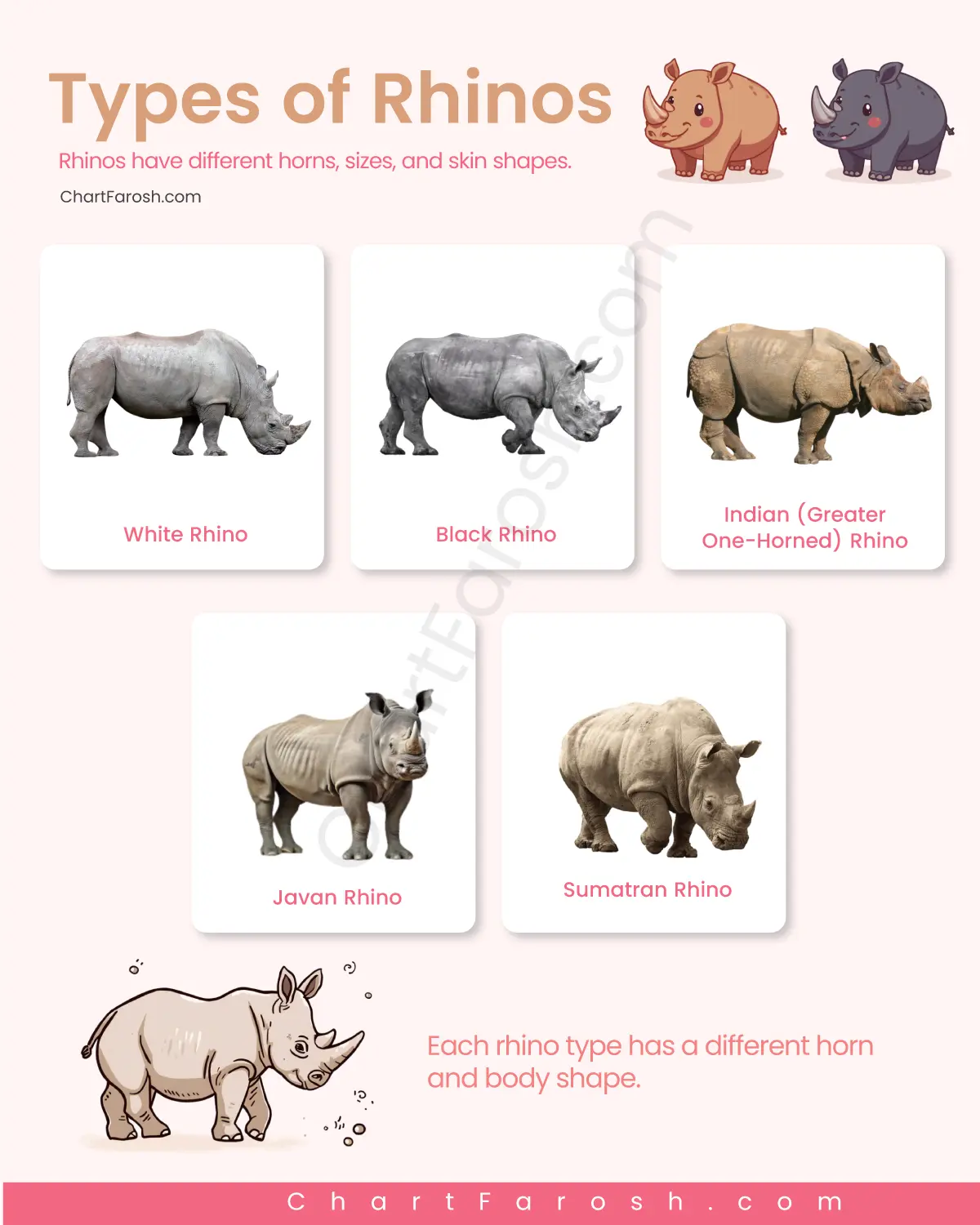
Table of Contents
Types of Rhinos
Rhinos are often spoken about as if they’re all the same, but there are meaningful differences between species.
These differences show up in size, horn shape, skin folds, behavior, and habitat preference.
Grouping rhinos into types helps make sense of why some live in grasslands while others depend on dense forests. It also explains why conservation strategies vary so widely between regions.
Understanding the basic types creates a foundation for learning Types of Rhinos and their names, building a list of Rhinos breeds, or even comparing them visually using a Types of Rhinos chart without getting overwhelmed by details.
| Rhino Species | Key Feature | Habitat | Conservation Status |
| White Rhino | Wide mouth, large body | African savannas | Near threatened |
| Black Rhino | Hooked lip | African bushland | Critically endangered |
| Indian (Greater One-Horned) Rhino | Single horn, armor-like skin | River grasslands | Vulnerable |
| Javan Rhino | Single horn, small population | Tropical forests | Critically endangered |
| Sumatran Rhino | Two horns, hairy body | Rainforests | Critically endangered |
How Many Types of Rhinos Are There?
There are currently five recognized species of rhinos in the world. While that number may seem small, each species is highly distinct and adapted to its environment.
Two species live primarily in Africa, while three are native to Asia. Within these species, there are also subspecies that differ slightly in size, range, or behavior.
Understanding how many types exist helps put conservation into perspective, when one species declines, a significant portion of global rhino diversity is affected.
Looking at the total number of types of Rhinos species highlights just how fragile their global population really is.
| Rhino Species | Region | Approximate Population |
| White Rhino | Africa | ~15,000 |
| Black Rhino | Africa | ~6,000 |
| Indian Rhino | Asia | ~4,000 |
| Javan Rhino | Asia | <80 |
| Sumatran Rhino | Asia | <80 |
Types of Rhinos Found Worldwide
Rhinos are spread across two continents, but their global distribution is far more limited than it once was.
African rhinos mainly inhabit savannas and grasslands, while Asian rhinos are found in forests and wetlands. This separation has shaped not only their physical traits but also their behavior and diet.
Understanding where rhinos live worldwide helps explain why threats differ by region and why conservation approaches must be tailored locally.
Seeing rhinos in a global context also makes resources like types of Rhinos with pictures or a printable list of Rhinos more meaningful.
| Continent | Rhino Species | Typical Habitat |
| Africa | White, Black | Savannas |
| Asia | Indian, Javan, Sumatran | Forests |
| Protected Reserves | All species | Managed areas |
Types of Rhinos by Size
Rhino size varies significantly between species, influencing everything from feeding habits to social behavior.
Larger rhinos tend to graze on grasses and dominate open landscapes, while smaller species navigate dense forests more easily.
Size also affects reproduction rates and vulnerability to threats. Grouping rhinos by size helps explain why certain species adapt better to conservation areas than others.
This perspective is useful when comparing species visually in a Types of Rhinos chart or organizing information into a list of Rhinos breeds.
| Size Category | Species | Average Weight |
| Largest | White Rhino | 2,300 kg |
| Medium | Indian Rhino | 2,200 kg |
| Smallest | Sumatran Rhino | 800 kg |
Types of Rhinos by Habitat
Habitat plays a defining role in how rhinos live and survive. Grassland species rely on wide open spaces for grazing, while forest species depend on dense cover and access to water.
Habitat influences horn shape, skin texture, and even temperament.
When habitats shrink or change, rhinos struggle to adapt quickly. Understanding habitat-based types helps explain why conservation is as much about land protection as it is about anti-poaching efforts.
This framework supports clearer comparisons across types of Rhinos species.
| Habitat | Rhino Species | Key Feature |
| Savanna | White Rhino | Wide mouth |
| Forest | Sumatran Rhino | Hairy skin |
| Wetlands | Indian Rhino | Thick folds |
Largest Rhino Species
The white rhino holds the title of the largest rhino species and one of the largest land mammals alive today. Its size allows it to graze efficiently over large areas, shaping entire ecosystems in the process.
However, large size also means higher food requirements and slower reproduction.
Understanding the largest species adds scale and context when browsing types of Rhinos with pictures, where size differences may not always be obvious.
| Rhino | Weight | Height | Region |
| White Rhino | 2,300 kg | 1.8 m | Africa |
| Indian Rhino | 2,200 kg | 1.75 m | India |
| Black Rhino | 1,400 kg | 1.6 m | Africa |
Smallest Rhino Species
The smallest rhino species are more agile and adapted to forest life. Their compact size helps them move through dense vegetation and survive in environments where larger rhinos would struggle.
However, smaller size does not mean safer, these species are often the most endangered due to limited habitat and low population numbers.
Learning about smaller rhinos highlights how vulnerability isn’t always tied to physical strength.
| Rhino | Weight | Habitat | Status |
| Sumatran Rhino | 800 kg | Rainforest | Critically Endangered |
| Javan Rhino | 900 kg | Forest | Critically Endangered |
| Black Rhino | 1,400 kg | Savanna | Endangered |
Rarest Rhinos in the World
Some rhino species exist on the edge of extinction, with populations so small they can be counted individually.
These rhinos often survive in a single protected area, making them extremely vulnerable to disease, disasters, or human activity.
Understanding rarity helps shift focus from numbers to resilience and long-term survival. These species are often missing from a typical printable list of Rhinos, despite needing the most attention.
| Rhino | Population | Location | Status |
| Javan Rhino | <80 | Indonesia | Critically Endangered |
| Sumatran Rhino | <80 | Indonesia | Critically Endangered |
| Northern White Rhino | 2 | Captive | Functionally Extinct |
Common Rhino Species
Common rhino species are those with relatively stable or recovering populations, largely due to intensive conservation efforts.
These rhinos are more frequently seen in reserves and wildlife documentaries, shaping public perception of rhinos overall.
Their relative success shows what long-term protection and management can achieve when resources and politics will align.
| Rhino | Region | Population Trend |
| White Rhino | Africa | Recovering |
| Indian Rhino | India/Nepal | Increasing |
| Black Rhino | Africa | Slowly recovering |
African Rhinos vs Asian Rhinos
African and Asian rhinos differ in appearance, habitat, and behavior. African rhinos typically have two horns and fewer skin folds, while Asian rhinos usually have one horn and thicker, armor-like skin.
These differences reflect adaptation to open versus forested environments. Comparing the two groups helps clarify Types of Rhinos and their names without confusion.
| Feature | African Rhinos | Asian Rhinos |
| Horns | Two | One |
| Habitat | Savanna | Forest |
| Skin | Smooth | Folded |
Endangered Rhino Species
All rhino species face threats, but some are at far greater risk than others. Poaching, habitat loss, and low reproduction rates combine to slow recovery.
Endangered rhinos often require constant monitoring and intervention. Understanding which species are endangered helps prioritize conservation action and resource allocation.
| Rhino | Status | Main Threat |
| Black Rhino | Endangered | Poaching |
| Sumatran Rhino | Critically Endangered | Habitat loss |
| Javan Rhino | Critically Endangered | Small population |
Types of Rhinos in India
India is home to the Indian one-horned rhino, a species that has become a conservation success story. Strict protection, habitat restoration, and community involvement have helped populations recover in certain regions.
However, limited range and human-wildlife conflict remain challenges. Understanding rhinos in India shows how focused efforts can make a measurable difference.
| Rhino Species | Where Found | Key Trait | Fun Fact |
| Indian One-Horned Rhino | Assam, West Bengal | Single horn | Largest rhino in Asia |
Types of Rhinos in Africa
Africa hosts both white and black rhinos, each adapted to different feeding strategies. These species are spread across multiple countries and protected areas.
While conservation has helped stabilize some populations, poaching continues to pose a serious threat. African rhinos remain central to global conservation efforts.
| Rhino Species | Horn Count | Region | Key Note |
| White Rhino | Two horns | Southern & East Africa | Most numerous rhino |
| Black Rhino | Two horns | Eastern & Southern Africa | Highly endangered |
Types of Rhinos in Kenya
Kenya plays a key role in rhino conservation, hosting both black and white rhinos in protected reserves. Intensive monitoring, anti-poaching units, and community programs have helped maintain stable populations.
Kenya’s approach highlights the importance of national commitment in protecting endangered species.
| Rhino Species | Location | Key Feature | Status |
| Black Rhino | National parks & reserves | Hooked lip | Critically endangered |
| White Rhino | Conservancies | Wide grazing mouth | Protected populations |
FAQs
How many types of rhinos exist today?
There are five living rhino species worldwide.
Which rhino is the largest?
The white rhino is the largest species.
Are all rhinos endangered?
Yes, all species face conservation threats.
Where do most rhinos live?
Africa and South Asia host most rhino populations.
Why are rhinos poached?
Primarily for their horns due to illegal trade.