Types of Bats
For most of my life, I didn’t pay much attention to what moved above me after sunset. If something fluttered across the sky at dusk, I assumed it was a late bird heading home.
It wasn’t until one warm evening, sitting outside after dinner, that I noticed the pattern was different. The wings were thinner, the movement quicker, almost elastic.
They dipped and turned mid-air in ways birds usually don’t. That small detail bothered me enough to look it up instead of brushing it off.
What started as a quick search turned into hours of reading. I began building my own types of bats list, trying to figure out what species could possibly be flying overhead.
The more I searched for Types of bats with Pictures, the clearer it became that bats are far more diverse, and far less spooky, than we tend to assume.
Looking through multiple types of bats with pictures, comparing faces, wings, and habitats, completely changed how I see the night sky.
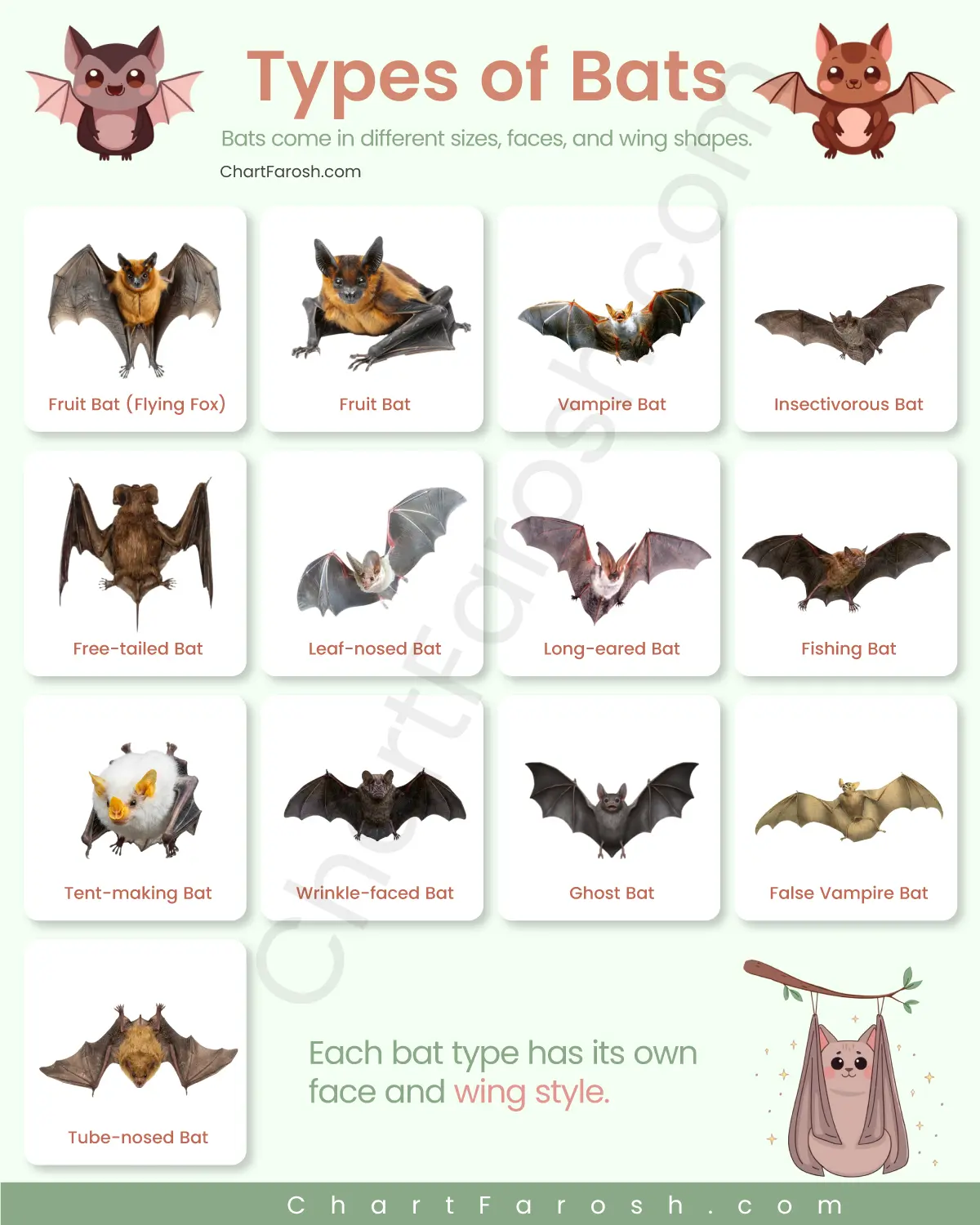
Table of Contents
Different Types of Bats
Once you start exploring different types of bats, it becomes obvious that this isn’t a small or simple group of animals.
There are more than 1,400 recognized species worldwide, which means any serious types of bats list gets long very quickly.
They range from tiny insect-eaters that weigh less than a coin to large fruit bats with wingspans wider than a tall adult human.
When scrolling through Types of bats with Pictures, the differences in facial structure, ear size, and wing shape tell a story about diet, climate, and survival strategies.
From tropical rainforests to deserts and temperate forests, bats have adapted to nearly every ecosystem on Earth except the polar regions.
| Bat Type | Name | Diet | Key Feature | Region |
| Fruit Bat (Flying Fox) | Large Flying Fox | Fruit, nectar | Large wingspan, strong vision | Asia, Australia |
| Fruit Bat | Egyptian Fruit Bat | Fruit | Strong sense of smell | Africa, Middle East |
| Vampire Bat | Common Vampire Bat | Blood | Heat-sensing nose | Central & South America |
| Vampire Bat | Hairy-legged Vampire Bat | Blood | Sharp incisors | South America |
| Insectivorous Bat | Little Brown Bat | Insects | Strong echolocation | North America |
| Insectivorous Bat | Big Brown Bat | Insects | Cold-tolerant | North America |
| Free-tailed Bat | Mexican Free-tailed Bat | Insects | Fast flyer (60+ mph) | Americas |
| Leaf-nosed Bat | Greater Horseshoe Bat | Insects | Leaf-shaped nose | Europe, Asia |
| Long-eared Bat | Brown Long-eared Bat | Insects | Extremely large ears | Europe |
| Fishing Bat | Greater Bulldog Bat | Fish | Long claws for fishing | Central & South America |
| Tent-making Bat | Honduran White Bat | Fruit | Builds leaf tents | Central America |
| Wrinkle-faced Bat | Wrinkle-faced Bat | Fruit | Folded facial skin | Central America |
| Ghost Bat | Australian Ghost Bat | Carnivorous | Pale color, hunts small vertebrates | Australia |
| False Vampire Bat | Greater False Vampire Bat | Small animals | Large size, carnivorous | Asia |
| Tube-nosed Bat | Tube-nosed Fruit Bat | Fruit | Tube-like nostrils | Papua New Guinea |
Small Size Bats
Small bats often go unnoticed because of how quiet and lightweight they are. Many weigh less than 15 grams, yet they can eat hundreds or even thousands of insects in a single night.
When adding species to a detailed types of bats list, small insectivorous bats dominate the numbers. They are built for agility: narrow wings for sharp turns and oversized ears for detecting tiny prey.
Looking through types of bats with pictures, you’ll notice their delicate bone structure and surprisingly expressive eyes.
Despite their size, they play a massive ecological role in pest control and crop protection across continents.
| Species | Average Weight | Region | Diet |
| Bumblebee Bat | 2 grams | Thailand & Myanmar | Insects |
| Little Brown Bat | 5–14 g | North America | Insects |
| Eastern Pipistrelle | 4–8 g | USA | Insects |
| Long-eared Bat | 6–12 g | Europe | Insects |
Largest Types of Bats
At the other end of the spectrum are fruit bats, often referred to as flying foxes. These are the giants of the bat world, and they look dramatically different from their smaller insect-hunting relatives.
In many collections of Types of bats with Pictures, fruit bats stand out immediately because of their large eyes and fox-like faces. Unlike most small bats, they rely more on sight and smell than echolocation.
They travel long distances each night in search of fruit, nectar, and blossoms, playing a critical role in pollinating plants and spreading seeds across tropical forests.
Any thorough types of bats list would feel incomplete without these impressive megabats.
| Species | Wingspan | Region | Diet |
| Giant Golden-crowned Flying Fox | 1.7 m | Philippines | Fruit |
| Indian Flying Fox | 1.5 m | South Asia | Fruit |
| Spectacled Flying Fox | 1.5 m | Australia | Fruit |
| Large Flying Fox | 1.5 m | Southeast Asia | Fruit |
Cute Types of Bats
It’s funny how the word “bat” automatically makes some people uncomfortable, but the moment you browse enough types of bats with pictures, that reaction tends to soften.
Some species are genuinely adorable, with soft fur, tiny button noses, and bright, curious eyes. When expanding a personal types of bats list, these visually striking species often become favorites simply because they challenge our stereotypes.
Their gentle faces and colorful fur patterns show just how diverse bat appearances can be. Many of these “cute” bats are fruit-eaters, which explains their larger eyes and softer facial features compared to sharp-faced insect hunters.
| Species | Feature | Region | Diet |
| Honduran White Bat | White fur | Central America | Fruit |
| Painted Bat | Orange wings | South Asia | Insects |
| Spotted Bat | Polka-dot fur | North America | Insects |
| Eastern Red Bat | Reddish coat | USA | Insects |
Rare Types of Bats
Not every species on a types of bats list is thriving. Some are critically endangered due to habitat destruction, disease outbreaks, and climate pressures.
White-nose syndrome alone has devastated bat populations across North America. When reviewing Types of bats with Pictures, it’s easy to focus on appearance, but conservation status is just as important.
Rare species often have specialized habitat requirements, which makes them more vulnerable to environmental change.
Protecting caves, forests, and wetlands is essential for ensuring these bats survive into future generations.
| Species | Status | Region | Threat |
| Indiana Bat | Endangered | USA | Disease |
| Rodrigues Flying Fox | Critically Endangered | Mauritius | Habitat loss |
| New Zealand Greater Short-tailed Bat | Possibly Extinct | New Zealand | Predators |
| Grey-headed Flying Fox | Vulnerable | Australia | Habitat loss |
Strangest Types of Bats Ever Found
Some bats look so unusual that they seem almost fictional. While building a detailed types of bats list, you quickly encounter species with exaggerated facial structures, massive ears, or unexpected diets.
These physical traits usually serve a clear purpose, attracting mates, amplifying sound, or adapting to a niche food source.
When browsing types of bats with pictures, these species tend to grab attention first because their faces are unlike anything else in the mammal world.
| Species | Unique Trait | Region | Diet |
| Hammer-headed Bat | Enlarged head | Africa | Fruit |
| Wrinkle-faced Bat | Folded facial skin | Central America | Fruit |
| Ghost Bat | Pale body | Australia | Carnivorous |
| Tube-nosed Bat | Tubular nostrils | Australia | Fruit |
Unique Bat Species You Didn’t Know Existed
Beyond the well-known fruit bats and insectivores, there are species that specialize in fishing, nectar feeding, or even hunting small vertebrates.
Expanding a types of bats list to include these unusual feeders shows just how adaptable bats truly are.
Looking at Types of bats with Pictures, you’ll notice elongated snouts for nectar feeding or strong claws for gripping slippery prey. Evolution has fine-tuned each species to its preferred food source.
| Species | Specialty | Region | Diet |
| Fishing Bat | Catches fish | Americas | Fish |
| Lesser Long-nosed Bat | Pollinator | Mexico | Nectar |
| Greater Bulldog Bat | Skims water | Central America | Fish |
| Vampire Bat | Blood-feeding | Americas | Blood |
Types of Bats That Drink Blood
Out of all known species, only three rely entirely on blood meals. This fact surprises many people who assume most bats are vampires. In reality, blood-feeding bats represent a tiny fraction of any types of bats list.
When looking at types of bats with pictures, vampire bats appear smaller and less dramatic than movies suggest. They have heat-sensing abilities that help them locate blood vessels on livestock and birds.
| Species | Prey | Region | Notes |
| Common Vampire Bat | Livestock | Americas | Most widespread |
| White-winged Vampire Bat | Birds | Central America | Rare |
| Hairy-legged Vampire Bat | Birds | South America | Small colonies |
Fruit-Eating vs Insect-Eating Bats
Diet shapes everything from skull structure to wing design. Fruit bats often have broader wings for gliding between trees, while insectivorous bats have narrower wings for rapid maneuvering.
Comparing them side by side in Types of bats with Pictures highlights these differences clearly. A well-rounded types of bats list always separates species by feeding strategy because it explains so much about behavior and habitat.
| Category | Example Species | Key Feature | Role |
| Fruit | Indian Flying Fox | Strong smell | Seed dispersal |
| Insect | Little Brown Bat | Echolocation | Pest control |
| Nectar | Lesser Long-nosed Bat | Long snout | Pollination |
| Carnivore | Ghost Bat | Sharp teeth | Hunts vertebrates |
Types of Bats in South Africa
South Africa supports a surprisingly rich bat diversity, thanks to its mix of savannas, forests, caves, and coastal regions.
From fruit-eating bats that roost in large colonies to small insectivorous species that quietly patrol suburban skies at night, bats play a major ecological role here.
Many species help control mosquito and agricultural pest populations, while fruit bats assist with pollination and seed dispersal.
Caves and old mines across the country provide critical roosting spaces, making habitat protection especially important for maintaining stable bat populations.
| Species | Habitat | Diet | Conservation Status |
| Egyptian Fruit Bat | Caves & forests | Fruit | Least Concern |
| Cape Serotine | Urban & rural areas | Insects | Stable |
| Geoffroy’s Horseshoe Bat | Caves | Insects | Stable |
| Banana Bat | Woodland edges | Insects | Stable |
Types of Bats in Australia
Australia is home to both megabats (fruit bats) and microbats (insect-eating bats), creating a fascinating mix of species across tropical and temperate regions.
Flying foxes are especially visible in urban and coastal areas, often roosting in large, noisy colonies. Meanwhile, smaller microbats use echolocation to hunt insects over wetlands and forests at night.
Australia’s bat populations are vital for pollination, particularly in eucalyptus forests, and for natural insect control in agricultural landscapes. Habitat loss and heatwaves remain ongoing challenges for several species.
| Species | Type | Region | Diet |
| Grey-headed Flying Fox | Megabat | Eastern Australia | Fruit |
| Little Red Flying Fox | Megabat | Northern Australia | Fruit |
| Ghost Bat | Microbat | Northern Australia | Carnivorous |
| Eastern Bent-wing Bat | Microbat | Southern Australia | Insects |
Types of Bats in Ohio
Ohio’s bat species are primarily insectivorous and play a critical role in maintaining ecological balance by consuming large quantities of night-flying insects. Forests, caves, barns, and even residential attics serve as roosting sites.
However, white-nose syndrome has significantly impacted several populations across the state, leading to noticeable declines in some species.
Conservation efforts now focus on monitoring caves and limiting disturbance during hibernation seasons to help protect vulnerable bat colonies throughout Ohio.
| Species | Habitat | Diet | Status |
| Little Brown Bat | Forests & caves | Insects | Declining |
| Indiana Bat | Caves | Insects | Endangered |
| Big Brown Bat | Urban & rural | Insects | Stable |
| Tri-colored Bat | Forest edges | Insects | Declining |
Common Bat Species in North America
North America hosts a wide range of bat species, most of which specialize in insect hunting. These bats are essential for agriculture, consuming beetles, moths, and mosquitoes nightly.
Some species migrate long distances, while others hibernate in caves during winter.
Despite their ecological importance, many populations have declined due to disease and habitat disturbance.
Monitoring programs across the United States and Canada continue to track population trends and promote habitat protection.
| Species | Range | Diet | Status |
| Big Brown Bat | USA & Canada | Insects | Stable |
| Mexican Free-tailed Bat | Southern USA | Insects | Stable |
| Little Brown Bat | USA & Canada | Insects | Declining |
| Hoary Bat | USA & Canada | Insects | Stable |
Bat Species Found in Tropical Regions
Tropical regions are biodiversity hotspots for bats, especially fruit and nectar-feeding species. Rainforests in Central America, Southeast Asia, and parts of Africa host dense bat populations that play a direct role in pollinating plants and dispersing seeds.
Many tropical fruits and flowering trees depend on bats for reproduction. Warm climates allow year-round activity for many species, reducing the need for hibernation.
However, deforestation remains a major threat to tropical bat habitats.
| Species | Region | Diet | Ecological Role |
| Large Flying Fox | Southeast Asia | Fruit | Seed dispersal |
| Hammer-headed Bat | Central Africa | Fruit | Pollination |
| Seba’s Short-tailed Bat | Central America | Fruit | Forest regeneration |
| Lesser Long-nosed Bat | Mexico & Central America | Nectar | Pollination |
Also read: Types of Owles
FAQs
Are bats dangerous to humans?
Most bats avoid human contact and pose little risk if left undisturbed.
Do all bats use echolocation?
Most insect-eating bats do, but many fruit bats rely more on sight and smell.
How long can bats live?
Some species live over 20–30 years, which is impressive for small mammals.
Why are bats important to ecosystems?
They control insect populations, pollinate plants, and disperse seeds.
How many bat species exist worldwide?
Scientists recognize more than 1,400 species globally, and new ones are occasionally discovered.