Raccoon Lifespan Chart
A raccoon tipped our garbage cans every night one summer. I assumed it was the same bandit each time. It probably was not. Most wild raccoons live only two to three years, so the cast changes fast. That surprised me, because a raccoon in a zoo can reach 20.
The gap between a wild raccoon and a cared-for one is one of the widest in the animal world. I wanted one place to see how long raccoons live, by type and by setting. The chart below covers the common raccoon and its island relatives, with wild and captive figures side by side.

Table of Contents
Raccoon lifespan chart by type
There is really one raccoon species behind this chart: the common raccoon, Procyon lotor. The island raccoons below are its subspecies. They were once named as separate species. Since 2005, most scientists list them under the common raccoon instead.
Wild numbers and captive numbers tell very different stories. In the wild, about half of all kits die in their first year. The survivors rarely pass five or six years. In a zoo or sanctuary, the same animal can live 15 to 20 years, with the oldest on record close to 21.
| Type / Population | Scientific Name | Wild Lifespan | In Captivity | Notes |
| Common Raccoon | Procyon lotor | 2–5 years | up to 20 years | Widespread across North America |
| Guadeloupe Raccoon | Procyon lotor minor | 3–6 years (est.) | 10–15 years (est.) | Island subspecies; once its own species |
| Barbados Raccoon (extinct) | Procyon lotor gloveralleni | Extinct since 1964 | N/A | Last recorded on Barbados in 1964 |
| Florida Raccoon | Procyon lotor elucus | 2–5 years | 10–15 years | Peninsula Florida subspecies |
| Tres Marías Raccoon | Procyon lotor insularis | 3–6 years (est.) | 10–15 years (est.) | Endangered; Mexican islands |
One brief note on names. Some lists still show the Florida raccoon as Procyon lotor simus. The peninsula subspecies is Procyon lotor elucus. The smaller Florida Keys forms carry their own names, such as Procyon lotor marinus.
Which raccoons live the longest?
The longest-lived raccoons are the ones people protect. In a zoo or sanctuary, steady food and vet care push lifespans to 15 to 20 years. The oldest documented raccoons reached about 21. Urban raccoons often outlive forest ones too, since cities offer easy food and fewer predators.
Captive figures show what the species can do when threats drop away. A raccoon is built to live close to two decades. Few ever get the chance, because the wild rarely allows it.
Which raccoons have the shortest lifespans?
Wild kits have the hardest time. About half die before their first birthday. Predators, cars, and disease take a heavy toll on young raccoons. Even the adults that survive rarely pass five or six years in the wild.
The first year is deadly for a reason. Kits stay with their mother for eight to ten months. During that time they have to learn to find food and read danger. A small, half-trained raccoon is an easy target. The ones that make it through that first winter have far better odds.
The island subspecies face extra pressure from small ranges and human activity. The Barbados raccoon shows the worst case. It was last recorded in 1964 and is now extinct. The Tres Marías raccoon is endangered, with fewer than 250 mature animals left on its islands.
Factors that affect raccoon lifespan
Two raccoons born on the same night can meet very different ends. One gets hit by a car at eight months. Another lives a decade behind someone’s shed. A few factors explain most of that gap.
- First-year mortality: the biggest single factor. Up to half of all kits die before age one.
- Predators: coyotes, bobcats, large owls, and dogs hunt young raccoons.
- Vehicles: roads are a leading cause of death for urban and suburban raccoons.
- Disease: rabies, distemper, and parvovirus can sweep through dense populations.
- Food access: steady food helps, but city trash can expose raccoons to toxins.
- Human care: veterinary treatment and shelter can add years in captivity.
- Habitat: tiny island ranges leave subspecies exposed to any new threat.
How raccoon lifespan compares to other mammals
A raccoon is short-lived for a mammal of its size. Placing it next to other animals shows how wide the range runs. The table below lines up a raccoon against a few others. Each one links to a related ChartFarosh page.
| Animal | Typical Wild Lifespan | In Human Care | Quick Note |
| Raccoon | 2–5 years | up to 20 years | Big wild-to-captive gap |
| Squirrel | 5–7 years | up to 18 years | Similar small mammal |
| Deer | 10–20 years | up to 20+ years | Larger, longer wild life |
| Bear | 20–35 years | up to 30+ years | Distant relative, far older |
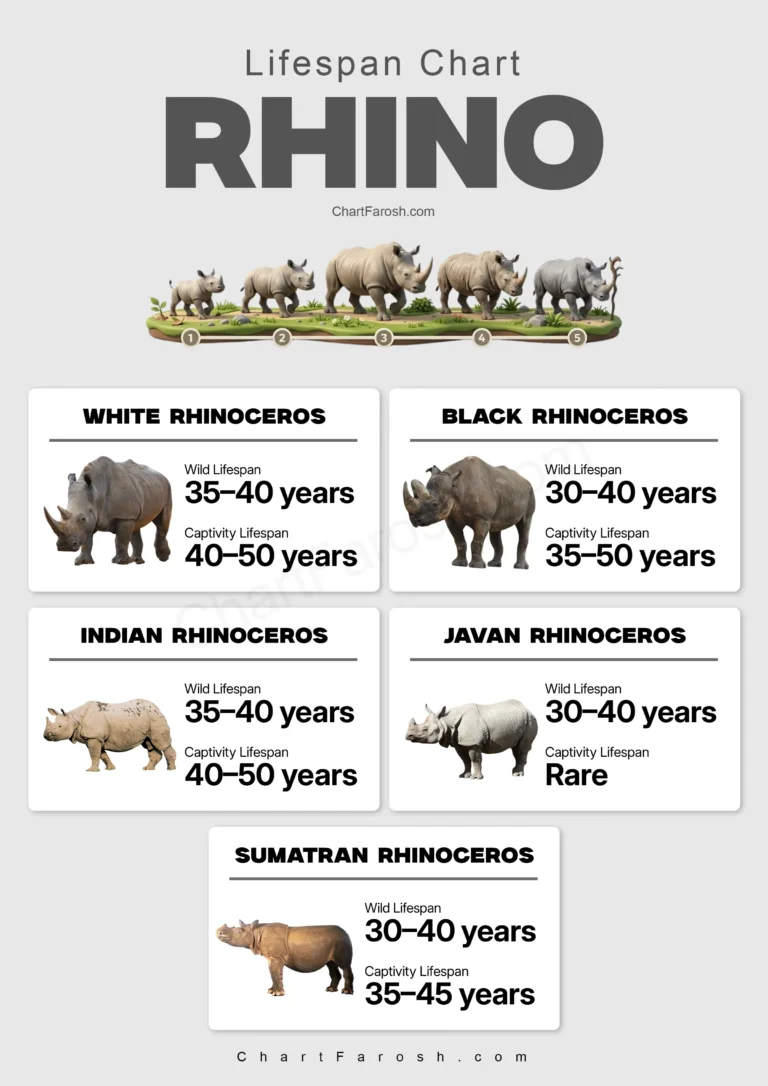
| Rhino | 30–45 years | 35–50 years | Decades-long lifespan |
| Elephant | 50–70 years | up to 60+ years | Among the longest-lived |
| Whale | 30–90+ years | varies widely | Bowheads can pass 200 |
A squirrel lives a little longer than a raccoon in the wild, but the pattern is the same. Small mammals turn over fast. A deer lives longer, and the gap only widens from there.
A bear is a distant cousin of the raccoon, yet it lives several times as long. The giants stretch the scale even more. A rhino can reach 40, and an elephant often passes 60. Some whale species pass 200. Next to them, a raccoon’s few years look brief.
Oldest raccoons on record
The record-holders show the ceiling. The oldest documented raccoons lived to about 21 years, all in captivity. One wild-born animal reached roughly that age after years of human care, as recorded in the AnAge longevity database. In the wild, almost none get close.
Online claims of raccoons living to their late 20s are unreliable. The famous “Bandit” was the heaviest pet raccoon on record, not the oldest, and he died at about 10. The solid figure to trust is roughly 20 to 21 years as the documented maximum.
Two edge cases are worth flagging. The Barbados raccoon is gone, last seen in 1964. The Cozumel raccoon, a separate species called Procyon pygmaeus, is critically endangered. Both show how fast an island population can vanish.
What helps a raccoon live longer
Raccoons are wild animals. The things that extend their lives mostly come down to safety and food. Fewer roads, fewer predators, and steady meals all push the average up.
Keeping a raccoon as a pet is not the answer, and it is illegal in many places. Captive lifespans look long because zoos and sanctuaries provide diet, shelter, and vet care that a home rarely matches. For wild raccoons, the best help is distance. Secure trash, seal dens, and let them keep their fear of people.
For conservation status on the rarer subspecies and the Cozumel species, the IUCN Red List is the place to check. For a detailed species profile, Animal Diversity Web from the University of Michigan covers the common raccoon in depth.
FAQs
How long do raccoons live on average?
Most wild raccoons live about two to three years. Many die in their first year. In captivity, raccoons commonly reach 15 to 20 years.
Why do raccoons live so much longer in captivity?
Captivity removes the main killers. There are no cars, few predators, and steady food. Vet care handles disease and injury, so the animal reaches its biological limit.
What is the oldest raccoon ever recorded?
The documented maximum is about 21 years, in captivity. Wild raccoons rarely pass five or six years.
Do urban raccoons live longer than forest raccoons?
Often, yes. Cities offer easy food and fewer natural predators. The trade-off is more traffic and more exposure to toxins.
Are any raccoon types extinct or endangered?
The Barbados raccoon is extinct, last seen in 1964. The Tres Marías raccoon is endangered, and the separate Cozumel raccoon is critically endangered.
Are island raccoons separate species?
No, for most of them. The Guadeloupe, Barbados, and Tres Marías raccoons are now subspecies of the common raccoon. The Cozumel raccoon is the exception and stays a separate species.
What is the biggest threat to a raccoon’s lifespan?
High first-year mortality is the biggest factor. Cars, predators, and disease take most young raccoons before they reach adulthood.