Types of Flying Ants
One muggy afternoon in July, the air outside my door filled with winged ants. They poured out of a crack in the pavement, paired off in the air, and were gone by evening. I had always assumed flying ants were their own kind of insect, until I looked closer.
A flying ant is not a species at all. It is an ordinary ant that has grown wings for one job, finding a mate. The chart below breaks down the two kinds of flying ant and the species you are most likely to see swarming. It also shows the fast way to tell a flying ant from a termite.
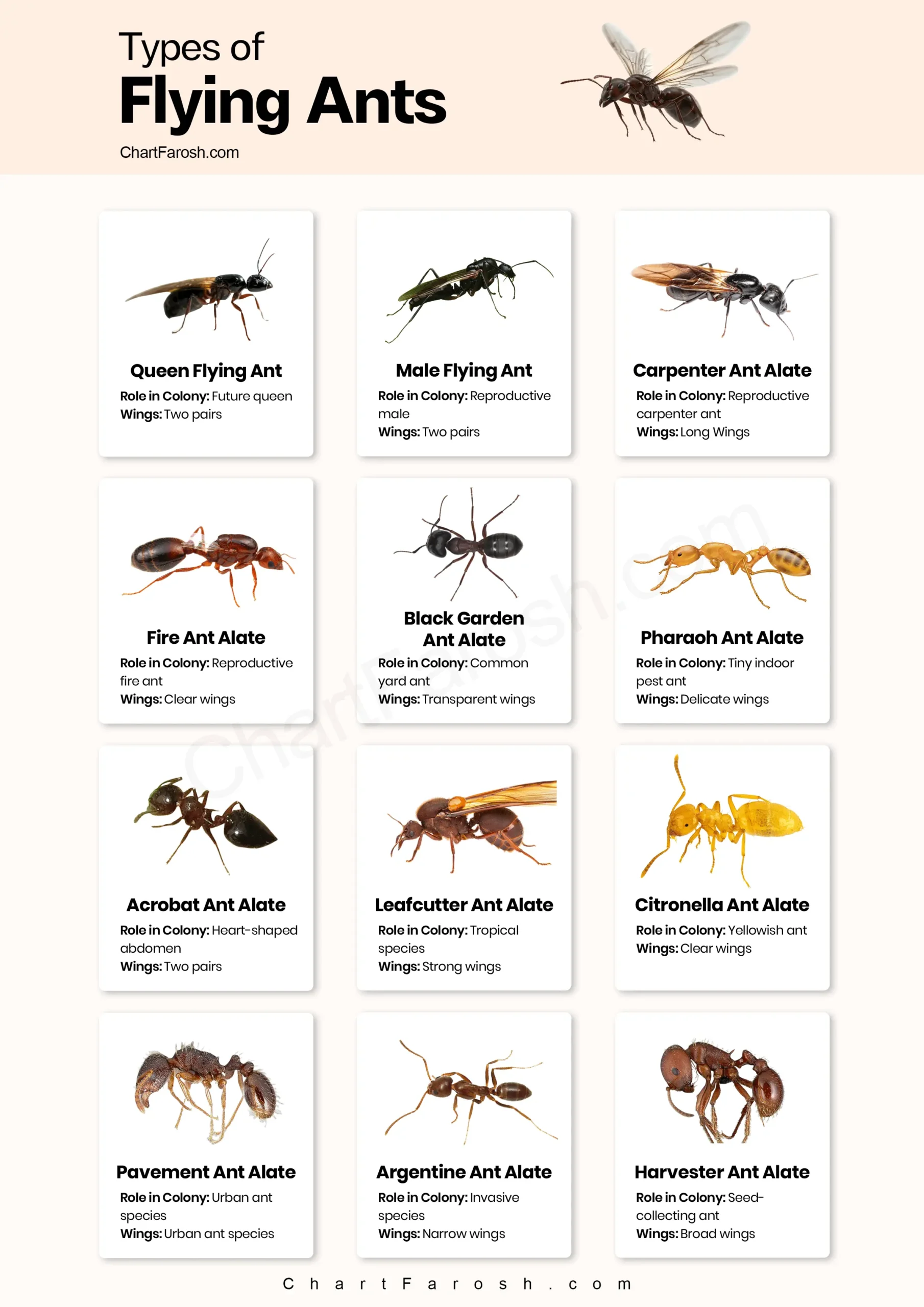
Table of Contents
What a Flying Ant Actually Is
Inside an ant colony, only two members ever grow wings. One is the future queen, a large female. The other is the male, whose only role is to mate. Workers, the ants you see every day, are wingless and stay that way for life.
Scientists call these winged ants alates. A mature colony releases them once a year so they can fly off, mate, and start new colonies. The queen sheds her wings after mating and digs in to lay eggs, while the male dies within a day or two.
| Type | Role | Size | Wings | What It Does |
| Winged Queen (female alate) | Future queen | Largest of the three castes | Two pairs, front larger | Mates, sheds wings, starts a colony |
| Winged Male (drone) | Reproductive male | Smaller, slender, large eyes | Two pairs, front larger | Mates with queens, then dies |
| Worker | Sterile female | Small | None, never flies | Forages and tends the nest |
Flying Ants by Species
The flying ant you spot belongs to a normal ant species, so the swarmer you find depends on which ants live nearby. In much of Europe the summer swarms are black garden ants. In North America, carpenter, pavement, and fire ant swarmers are the ones people notice most.
These are the species whose winged forms show up most often, with the detail that helps you place each one.
| Species | Scientific Group | Swarmer Size | Where / When You See Them | Note |
| Black Garden Ant | Lasius niger | Small (queen ~15 mm) | Yards and pavements, July–August | The classic mass swarm of “Flying Ant Day” |
| Carpenter Ant | Camponotus | Large (queen up to ~19 mm) | Near wood, spring and fall | Often mistaken for termites; nests in wood but does not eat it |
| Fire Ant | Solenopsis | Medium | Warm regions, after rain | Stinging species; swarms to spread |
| Pavement Ant | Tetramorium | Small | Sidewalks and driveways, late spring | Urban nuptial swarms |
| Citronella Ant | Lasius (Acanthomyops) | Medium, yellowish | Indoors near foundations, late summer | Lemon smell when crushed; mistaken for termites |
| Acrobat Ant | Crematogaster | Small | Trees and structures | Heart-shaped rear held up over the body |
| Harvester Ant | Pogonomyrmex | Medium | Open dry ground, summer | Large, synchronized flights; can sting |
| Leafcutter Ant | Atta / Acromyrmex | Medium–large | Tropics, after rains | Founds new fungus-farming colonies |
| Pharaoh Ant | Monomorium pharaonis | Very small | Indoors, year-round | Spreads mostly by budding, not flights |
| Argentine Ant | Linepithema humile | Small | Invasive, warm regions | Also spreads mostly by budding |
To match the wingless workers from any of these colonies, compare them in our ant identification chart, which sorts the common species by size, color, and waist shape.
Flying Ant vs Termite Swarmer
This is the comparison that matters most, because the two look alike at a glance and mean very different things for your home. A flying ant is usually a nuisance. A termite swarmer can point to wood damage that costs a lot to fix.
You can separate them with three features: the antennae, the waist, and the wings. A flying ant has bent, elbowed antennae, a pinched waist, and a front wing pair larger than the back. A termite has straight, bead-like antennae, a thick waist with no pinch, and four wings of equal length.
| Feature | Flying Ant | Termite Swarmer |
| Antennae | Bent, elbowed | Straight, bead-like |
| Waist | Pinched, narrow | Broad, no pinch |
| Wings | Two pairs, front larger than hind | Two pairs, all four equal |
| Wing length | About as long as the body | Much longer than the body |
| Color | Black, brown, or reddish | Dark brown to black |
| Swarm season (US) | Late spring to summer | Often early spring |
| Risk to the home | Usually a nuisance | Possible structural damage |
If the swarmers turn out to be termites, our termite identification chart covers the next steps. For the science behind the wing and waist differences, the University of Maryland Extension guide and the Mississippi State University Extension guide are clear references.
When and Why Flying Ants Swarm
Flying ants appear when a colony is ready to reproduce, and the timing is no accident. Most species wait for a warm, humid day, often right after rain, when the soft air helps the soft-bodied alates fly and survive. Colonies of the same species sync their flights, so winged ants seem to erupt everywhere at once.
In the United Kingdom this event is so reliable that people call it Flying Ant Day, though it really spreads across several days in mid to late summer. The males and queens meet in the air, mate, and scatter. By the next morning the show is over, the males are dead, and the new queens are underground starting again.
The Natural History Museum explains the timing and scale of these flights in its guide to the nuptial flight.
Are Flying Ants Dangerous?
For most people, flying ants are harmless. They do not target food the way picnic ants do, and the swarm is over fast. The winged ants you see in the air are simply trying to mate, not to bite or sting.
There are two things worth watching. Fire ant and harvester ant swarmers belong to species that sting, so it is wise to keep clear of those. And winged ants indoors, especially large carpenter ant swarmers or yellowish citronella ants, usually mean a colony is nesting in or under the building, which is worth checking before it grows.
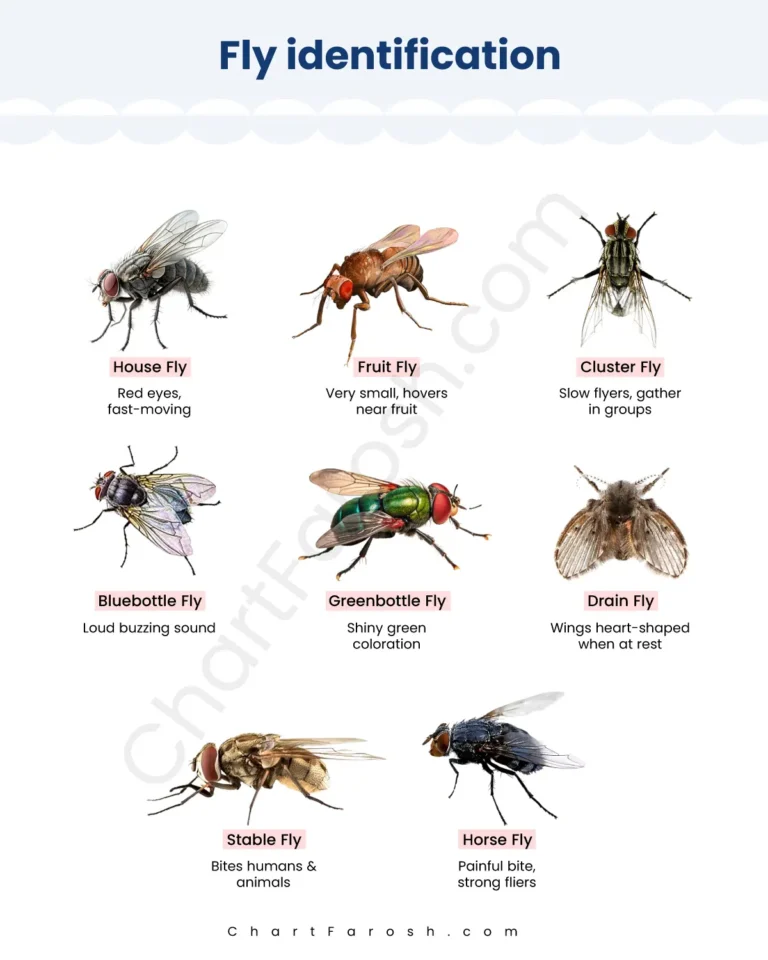
If you are trying to identify a winged insect indoors and rule out other pests, our bug identification chart and fly identification chart help you compare the usual suspects.
Names That Overlap or Get Used Loosely
Flying ants pick up a lot of names, and most of them describe the same thing. Here is what each one really means.
- Alate, swarmer, and reproductive: all three mean a winged ant produced for the mating flight, whether queen or male.
- Queen vs male: the large flying ant is a future queen; the smaller, slender one is a male that dies soon after mating.
- Flying ant as a species: there is no single flying-ant species. The name covers the winged stage of many ordinary ant species.
- White ants: this old name almost always means termites, not ants. True flying ants are dark, with a pinched waist.
- Budding species: Pharaoh and Argentine ants rarely do big flights; they spread when a queen walks off with workers to start a satellite nest.
FAQs
What are flying ants?
Flying ants are winged reproductive ants, called alates. They are the future queens and the males of ordinary ant species, grown wings only for the mating flight.
Are flying ants a separate species?
No. Any ant species can produce winged forms. The flying ant you see is just the reproductive stage of a normal colony nearby.
How do I tell a flying ant from a termite?
Look at three things. A flying ant has bent antennae, a pinched waist, and front wings larger than the back. A termite has straight antennae, a thick waist, and four equal wings.
Why do flying ants all appear at once?
Colonies of the same species sync their nuptial flight to a warm, humid day, often after rain. Flying together at the same time raises the odds of finding a mate and surviving.
Do flying ants bite or sting?
Most are harmless and only want to mate. Fire ant and harvester ant swarmers can sting, so it is best to keep your distance from those species.
What does it mean if I see flying ants indoors?
It usually means a colony is nesting in or near the building. Large carpenter ant or yellowish citronella ant swarmers indoors are worth investigating.
How long do flying ants live?
The males live only a day or two after mating. A mated queen can live for years, sometimes well over a decade, once she founds a colony.