Crane Fly Lifespan Chart
Every autumn my window fills with crane flies bouncing off the glass, and every autumn someone tells me they are giant mosquitoes that bite. They are not. A crane fly cannot bite you, does not hunt mosquitoes, and in most cases barely eats at all. It gets about a week or two to find a mate, and then it is done.
The leggy insect we swat at is the tail end of a much longer story. Crane flies spend most of their lives underground as plump larvae called leatherjackets, chewing on roots and rotting plants. The adult is the short final stage, built for breeding and little else.
This chart lists the adult lifespan and full life cycle of 15 crane fly types. It also covers why the adult stage is so brief and how to tell a crane fly from its look-alikes. Use it for garden planning, school work, or to win the next argument about giant mosquitoes.

Table of Contents
Crane Fly Lifespan Chart
Adult crane flies live only a few days to about two weeks. The full life cycle runs much longer, usually a year and sometimes two, because nearly all of that time is spent as a larva in soil or water. The table below gives both numbers for each type.
The gap between the two columns is the whole point. A crane fly may fly for ten days, yet its leatherjacket fed for the better part of a year first. Crane flies are true flies in the order Diptera, so they belong with the other types of flies, not with spiders or mosquitoes.
| Crane Fly Type | Scientific Name | Adult Lifespan | Total Life Cycle |
| European Crane Fly | Tipula paludosa | 10–15 days | About 1 year |
| Marsh Crane Fly | Tipula oleracea | 5–15 days | About 1 year |
| Giant Western Crane Fly | Holorusia hespera | 3–10 days | 1–2 years |
| Common Crane Fly | Tipula maxima | 5–12 days | About 1 year |
| Tiger Crane Fly | Nephrotoma appendiculata | 7–14 days | About 1 year |
| Yellow-Spotted Crane Fly | Nephrotoma ferruginea | 5–14 days | About 1 year |
| Giant Crane Fly | Holorusia rubiginosa | 3–10 days | 1–2 years |
| Winter Crane Fly | Trichocera annulata | 1–3 weeks | About 1 year |
| Hairy-Eyed Crane Fly | Pedicia rivosa | 5–10 days | 1–2 years |
| Brown Crane Fly | Tipula brunneinervis | 5–12 days | About 1 year |
| Meadow Crane Fly | Tipula vernalis | 5–10 days | About 1 year |
| Black Crane Fly | Tipula luna | 5–12 days | 1 year |
| Phantom Crane Fly | Bittacomorpha clavipes | 4–10 days | 1 year |
| Long-Palped Crane Fly | Dictenidia bimaculata | 5–15 days | 1–2 years |
| Large Marsh Crane Fly | Tipula abdominalis | 7–14 days | 1–2 years |
A quick note on the list. Most of these sit in the family Tipulidae. The phantom crane fly and the winter crane fly belong to related families, and the two giant species (Holorusia hespera and H. rubiginosa) are names that overlap for the large western crane flies. They are all crane flies in the everyday sense.
Which Crane Flies Live the Longest?
Among adults the differences are small, since none last long. The winter crane fly stretches to about three weeks, which is the high end here. On the total life cycle, the giant, hairy-eyed, long-palped, and large marsh crane flies run up to two years. Their larvae take longer to mature in cooler or wetter ground.
Which Crane Flies Have the Shortest Adult Life?
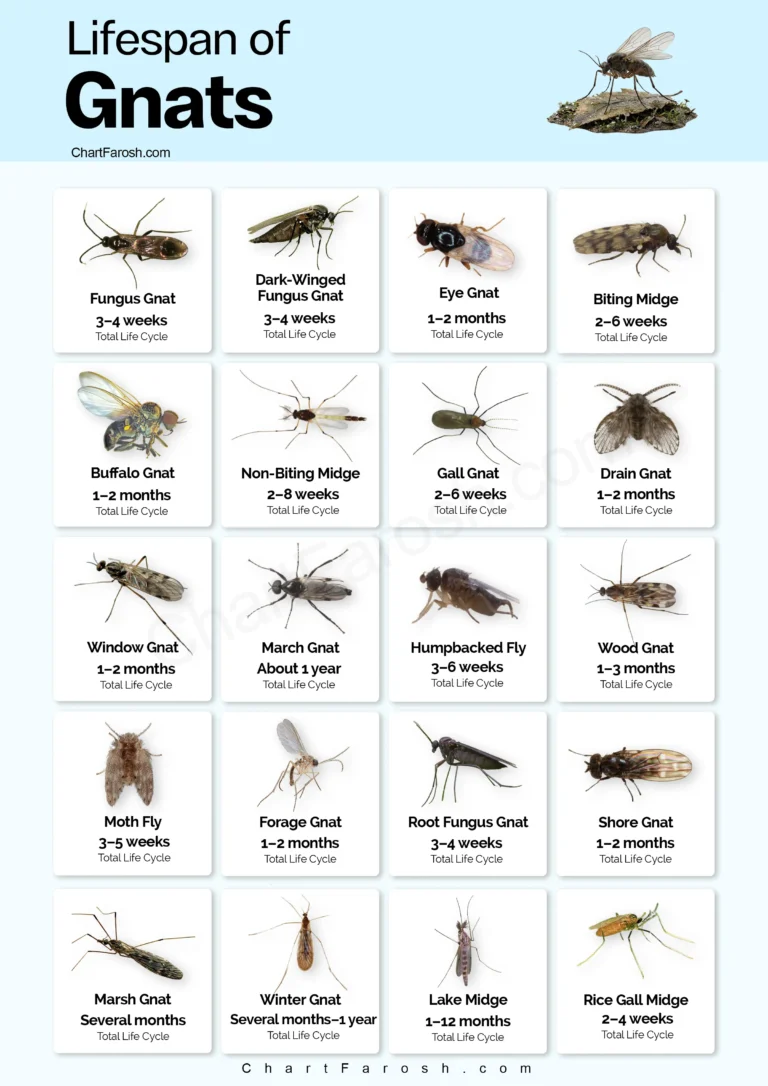
The giant crane flies get the shortest adult run at three to ten days. The pattern is the same one you see across short-lived insects in our bug lifespan chart: the bigger and showier the adult, the briefer its time. Most of the living already happened underground.
The Crane Fly Life Cycle: Egg, Larva, Pupa, Adult
Crane flies go through complete metamorphosis, the same four-stage path as all true flies: egg, larva, pupa, and adult. A female lays her eggs in moist soil or shallow water, often hundreds at a time, and she does it within days of becoming an adult.
The larva is the leatherjacket, named for its tough, leathery skin. It is legless and grey-brown, and it spends months feeding on roots, decaying plants, and organic matter. This is the stage that matters for gardeners, because heavy numbers can chew turf from below and leave brown patches. You can see the egg stage of many insects in our insect egg identification chart.
When the leatherjacket is fully grown, it pupates in the soil and then pushes partway out before the adult emerges. The adult has reduced mouthparts and often does not feed, though some sip nectar or plant fluids. Its job is to mate and, for females, to lay the next batch of eggs.
Factors That Affect Crane Fly Lifespan
Crane fly timing shifts with conditions, mostly at the larval stage. A few factors explain the spread.
- Temperature and season: warm soil speeds the larva along, while cool, damp ground stretches the cycle toward two years.
- Moisture: leatherjackets need damp soil and die out in drought, so wet years bring bigger emergences.
- Species: giant crane flies tend to take two years, while common lawn species finish in one.
- Predators: birds, frogs, ground beetles, and skunks eat both larvae and adults in large numbers.
- Adult feeding: because most adults barely eat, the adult lifespan is fixed and short no matter what.
How Crane Fly Lifespan Compares to Other Flies
Crane flies are not the shortest-lived flies, but they are close, and they are the most misunderstood. Here is how they stack up against the flies and look-alikes they get confused with.
| Fly or Look-Alike | Adult Lifespan | Total Life Cycle | Bites Humans? |
| Crane fly | 3–15 days | About 1–2 years | No |
| Housefly | 15–30 days | 1–2 months | No |
| Mosquito | 1–8 weeks | 1–2 months | Yes (females) |
| Fruit fly | 30–50 days | 1–2 months | No |
| Mayfly | Hours to 2 days | Up to 1 year | No |
The key column is the last one. A crane fly does not bite, unlike a female mosquito, which is the single most useful thing to remember when one lands on your arm. For the other end of the lifespan scale, our cat lifespan chart shows how household pets compare.
Crane Fly, Daddy Longlegs, or Mosquito?
Three different things share the name daddy longlegs, and only one is a crane fly. The crane fly is an insect with six legs and two wings. A harvestman has eight legs and is an arachnid, not a spider and not a crane fly. A cellar spider is a true spider that also gets the nickname.
None of them is dangerous to people, and the old story that daddy longlegs are deadly but cannot bite is a myth. If you want to sort the eight-legged ones apart, our spider identification chart covers the cellar spider and its relatives.
The biggest crane flies belong to the genus Holorusia. They are among the largest true flies, with leg spans that can reach about 10 centimetres, or four inches. The Japanese species Holorusia mikado is often named the largest of all, which is how a harmless fly ends up looking like something out of a horror film.
Need a custom crane fly or insect lifespan chart for your classroom, lab, or pest-control business? Our Animal Chart Designing Service builds clean, branded charts and printable PDFs to your exact spec.
FAQs
How long do crane flies live?
Adult crane flies live only about 3 to 15 days, depending on the species. The full life cycle takes a year or two, with most of that time spent as a larva in the soil.
Do crane flies bite?
No. Crane flies have no piercing mouthparts, so they cannot bite people or animals. They are harmless, even though they look like oversized mosquitoes.
Do crane flies eat mosquitoes?
Adult crane flies do not eat mosquitoes, despite the nickname mosquito hawk. Most adults barely eat at all, although the larvae of a few species may take mosquito larvae in water.
What is a leatherjacket?
A leatherjacket is the larva of a crane fly. It is a legless, grey-brown grub with tough skin that lives in soil and feeds on roots and rotting plants.
Why do crane flies die so quickly?
Adult crane flies have reduced mouthparts and mostly cannot feed, so they survive only long enough to mate and lay eggs. The feeding and growing all happened during the larval stage.
Are crane flies and daddy longlegs the same thing?
Not always. Daddy longlegs is a shared nickname used for crane flies, harvestmen, and cellar spiders. Only the crane fly is an insect; the other two are arachnids.
What is the biggest crane fly?
Giant crane flies in the genus Holorusia are the largest, with leg spans up to about four inches. The Japanese Holorusia mikado is often called the biggest of all.