Elephant Lifespan Chart in Captivity and Wild
I watched an old matriarch lead her herd across a dry riverbed in Kenya once. Her ears were torn and her back had sunk with age. The guide guessed she was close to sixty. He said she had probably led that family for thirty years, and that the herd knew every waterhole because she did. When she goes, he said, some of that map goes with her.
That reframed elephants for me. These are animals that can live as long as a person, and the old ones carry the memory the herd runs on. In the wild, a healthy elephant often reaches 60 or 70.
Here is the part that surprised me most. Elephants are one of the few animals that live longer in the wild than in a zoo. The captive numbers are not higher. They are lower, sometimes by decades.
So I built one elephant lifespan chart, every type side by side, wild against captive, with the real science attached. Below is that chart and the full story behind the numbers.
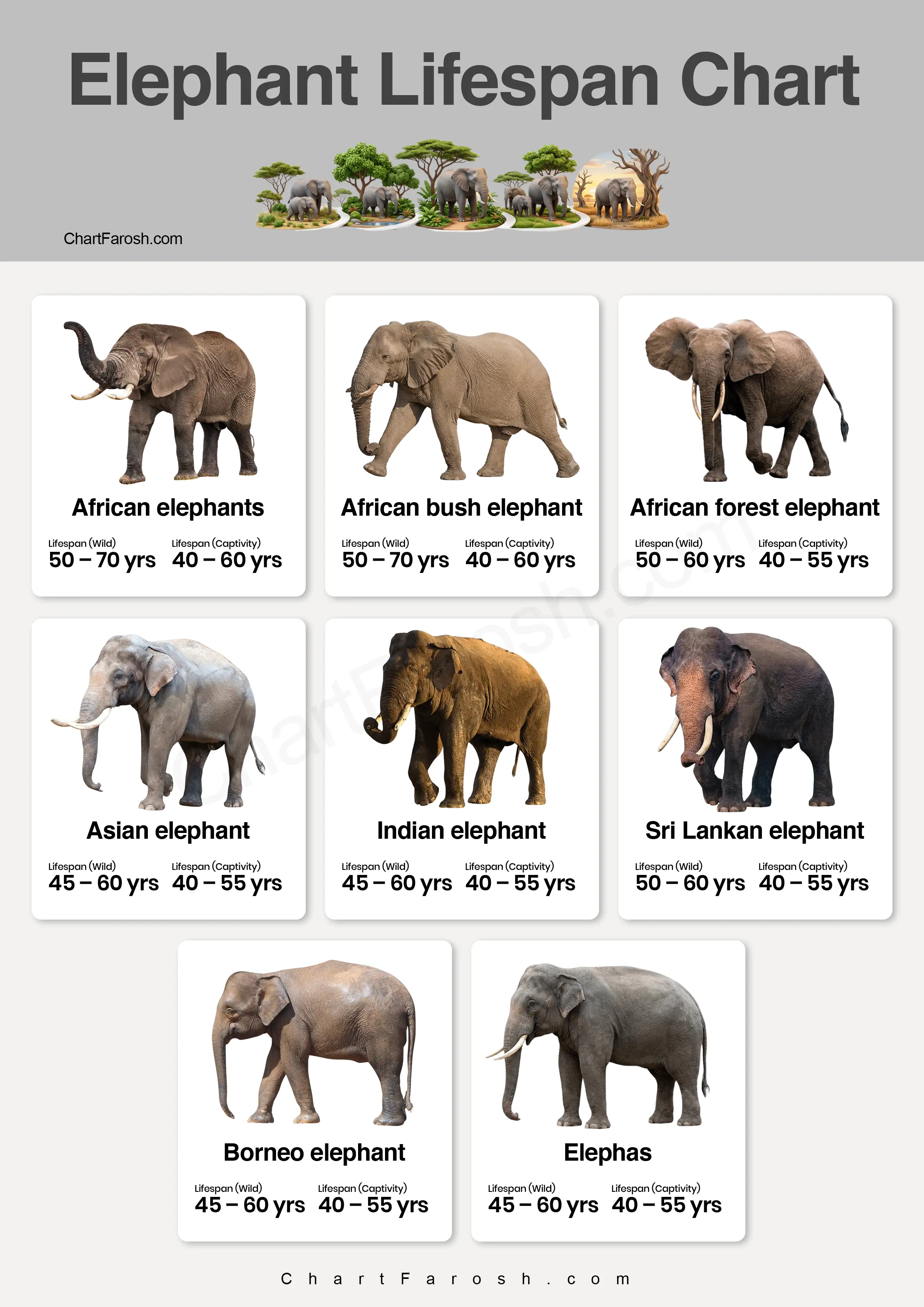
Table of Contents
Elephant Lifespan Chart
Two African species, one Asian species, and the Asian subspecies below it. The wild numbers are high for a land animal. The captive numbers, corrected against survivorship studies, are lower than most people expect.
| Elephant Type | Scientific Name | Status | Wild | Captivity |
| African bush elephant | Loxodonta africana | Endangered | 60-70 yrs | 17-40 yrs |
| African forest elephant | Loxodonta cyclotis | Critically Endangered | 60-65 yrs | 17-40 yrs |
| Asian elephant | Elephas maximus | Endangered | 55-70 yrs | 19-45 yrs |
| Indian elephant | E. m. indicus | Most numerous | 55-70 yrs | 19-45 yrs |
| Sri Lankan elephant | E. m. maximus | Largest Asian | 55-70 yrs | 19-45 yrs |
| Sumatran elephant | E. m. sumatranus | Critically Endangered | ~55-60 yrs | 19-45 yrs |
| Bornean elephant | E. m. borneensis | Endangered (2024) | ~55-60 yrs | 19-45 yrs |
Lifespan does not vary much from one type to the next. An elephant is built to last 60 to 70 years whether it is African or Asian. What the chart really shows is the gap between the wild and a cage, and the fact that three of these types are now endangered or worse.
The Surprise: Elephants Live Longer in the Wild
For almost every pet or zoo animal, captivity adds years. Elephants are the famous exception. A 2008 study in Science tracked more than 4,500 elephants and found the wild ones lived roughly three times longer.
| Aspect | Wild | Captivity | Why |
| African median lifespan | 56 yrs | 17 yrs | Zoo born vs Amboseli, Kenya |
| Asian median lifespan | ~42 yrs | 19 yrs | Myanmar camps vs zoo born |
| Main risks | Poaching, drought | Obesity, foot disease | Different killers entirely |
| Best case | Matriarchs into 60s-70s | Top facilities 33-45 | Care is improving slowly |
The numbers are stark. Wild female African elephants in Kenya’s Amboseli park reached a median of 56 years. Zoo-born African females reached a median of 17. For Asian elephants, working animals in Myanmar timber camps lived to about 42, while zoo-born females managed 19.
Why the gap? Elephants evolved to walk many miles a day, browse a wide diet, and live in tight family groups. A zoo struggles to give them any of that. Restricted movement leads to obesity and foot disease. Isolation brings stress. The animals look safe, but the body and mind both suffer over decades. Modern sanctuaries and the best zoos are closing the gap, yet the wild still wins.
African vs Asian Elephants
The two living elephant lines split millions of years ago, and they are easy to tell apart once you know the cues. Lifespan is the one place they barely differ.
| Feature | African | Asian |
| Size | Larger, up to 6,000+ kg | Smaller, up to 5,000 kg |
| Ears | Large, shaped like Africa | Smaller and rounded |
| Tusks | Both sexes usually have them | Mainly males have them |
| Wild lifespan | Up to 60-70 years | Up to 60-70 years |
| Status | Bush EN, forest CR | Endangered |
African elephants are bigger, with ears shaped a little like the African continent. Asian elephants are smaller, with rounded ears and a domed head.
Both can reach their late sixties in good wild conditions, which puts them among the longest-lived land animals, alongside large grazers like giraffes and rhinos. The African forest elephant is the quiet worry here. It breeds slowly, lives deep in Central African rainforest, and was listed as Critically Endangered in 2021 after heavy losses to poaching.
Why Elephants Live So Long
Big animals usually outlive small ones, and the elephant takes that rule to the land-animal limit. Its size is only part of the story, though.
| Factor | Effect on Lifespan |
| Body size | Large animals tend to live long, and elephants are the largest on land |
| Cancer defense | Elephants carry about 20 copies of the TP53 anti-cancer gene; people have one |
| Few predators | A healthy adult has almost no natural enemies |
| Slow life history | Late breeding and a 22-month pregnancy stretch the whole timeline |
| Captivity | Often shortens life through obesity, stress, and restricted movement |
The cancer fact is the strange one. By body size, an elephant should get cancer far more often than a person, because it has so many more cells. Instead it gets cancer less.
The reason appears to be its roughly 20 copies of the TP53 tumor-suppressor gene, where humans carry a single copy. Add a slow life history and almost no predators, and the elephant is built for the long haul. Only a handful of mammals, such as bowhead whales, clearly beat it.
That slow life history deserves its own note. An elephant carries a pregnancy for about 22 months, the longest of any land mammal. A calf nurses for years, and a female does not have her first calf until she is around 12 to 14.
Nature only invests that much time in animals it expects to live a long time, and the elephant pays it back with decades.
An Elephant’s Life, Stage by Stage
An elephant grows up slowly, much like a human. The early years lean on the mother, the middle years are the prime, and the old years still carry weight in the herd.
| Life Stage | Age | What Happens |
| Calf | 0-2 yrs | Nurses and stays glued to the mother and the herd |
| Juvenile | 2-12 yrs | Learns from the family; females stay, young males drift off |
| Adult | 12-45 yrs | Prime breeding years; females raise calves, bulls roam |
| Matriarch / old bull | 45-70+ yrs | The oldest female leads; worn teeth often mark the end |
A female often stays with her birth family for life, while young males leave around adolescence to roam alone or in loose bachelor groups.
The oldest female becomes the matriarch and holds the herd’s knowledge of routes and water. For most elephants, the true clock is the teeth. An elephant wears through six sets in a lifetime, and once the last set goes, it can no longer chew enough to survive.
The Oldest Elephant on Record
The oldest documented elephant was Lin Wang, an Asian bull who died at Taipei Zoo in 2003 at an estimated 86 years old. He had hauled supplies through Burma during World War II before retiring to the zoo, and Guinness World Records still lists him as the oldest elephant in captivity.
Other animals have been claimed at 88 or even past 100, but those ages were never verified, since elephants born long ago carry no birth records. The realistic ceiling for most elephants is the low 70s.
Reaching 86 is extraordinary, and it happened in human care, which makes Lin Wang the exception that proves the rule. Most elephants, wild or captive, never come close.
FAQs
How long do elephants live?
Wild elephants usually live 55 to 70 years, with some matriarchs reaching their late sixties. Captive elephants often live far less, with median lifespans near 17 to 19 years in older zoo data, though the best modern facilities now do better.
Do elephants live longer in the wild or in captivity?
In the wild, by a wide margin. A 2008 study found wild African elephants lived to a median of 56 years, against 17 for zoo-born ones. Elephants are one of the few animals that do worse in captivity.
Which elephant lives the longest?
Lifespan is similar across species. The oldest on record was Lin Wang, an Asian elephant who reached 86 in a Taiwan zoo. In the wild, both African and Asian elephants can reach their late sixties.
Why do elephants live so long?
Their large size, slow life history, and lack of predators all help. They also carry about 20 copies of the TP53 anti-cancer gene, which lowers their cancer risk despite their size.
How many types of elephants are there?
There are two African species, the bush and forest elephant, and one Asian species with four subspecies: Indian, Sri Lankan, Sumatran, and the Bornean elephant, confirmed as a distinct subspecies in 2024.
What usually ends an elephant’s life?
In old age, worn-down teeth. An elephant grows six sets of molars, and once the last set wears out it cannot chew enough food. For more on these giants, see the types of elephants guide and the full Animals Chart hub.