Crocodile Lifespan Chart in Captivity and Wild
Two years ago I stood at a wildlife park railing and stared at a saltwater crocodile the size of a rowboat. The keeper said he was over 70 years old. He had been alive longer than most of the people watching him, and that stuck with me.
Crocodiles are some of the longest-living animals on land. A wild saltwater crocodile can pass 65 years. The famous Cassius, a captive saltie in Australia, is estimated at 110 to 120. Few animals come close to that, and fewer still keep growing the whole time.
Their secret is patience. Crocodiles grow slowly, eat rarely, and age at a crawl. A big croc can go almost a year between meals if it must. That efficiency buys decades of life.
Lifespan still varies by species. The giant saltwater and Nile crocodiles lead the pack. Smaller species like the dwarf crocodile run shorter, though even they reach 50 years or more. Below is a clear crocodile lifespan chart covering the main species, wild and captive, followed by why these reptiles last so long.
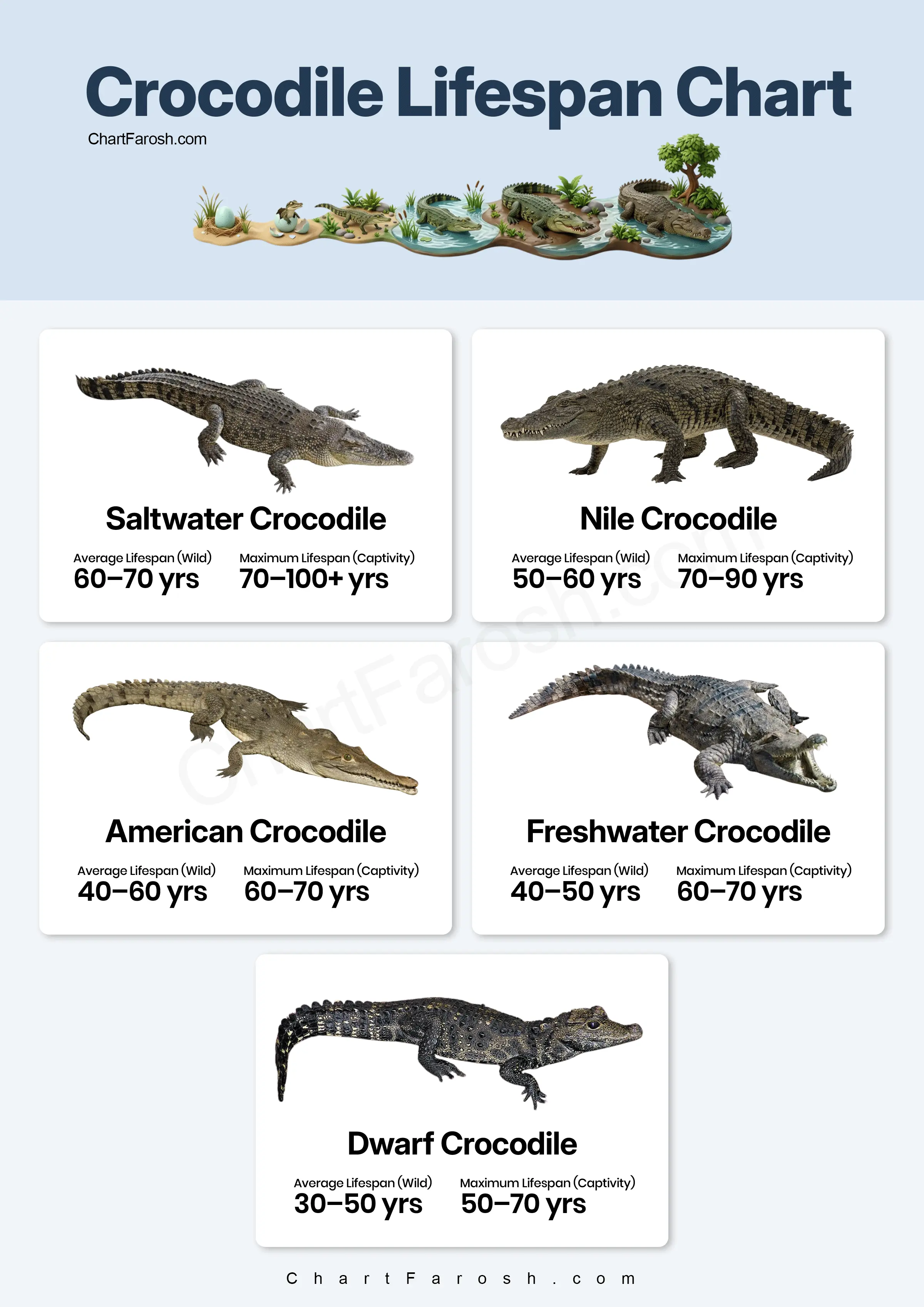
Table of Contents
Crocodile lifespan chart: how long crocodiles live
Here is the chart. It lists 8 crocodile species, with average wild lifespans next to maximum captive ages.
| Crocodile Species | Average Lifespan (Wild) | Maximum Lifespan (Captivity) |
| Saltwater Crocodile | 60-70 years | 70-100+ years |
| Nile Crocodile | 50-60 years | 70-90 years |
| American Crocodile | 40-60 years | 60-70 years |
| Freshwater Crocodile | 40-50 years | 60-70 years |
| Morelet’s Crocodile | 50-65 years | Up to 80 years |
| Mugger Crocodile | 30-44 years | Up to 80 years |
| Cuban Crocodile | 30-50 years (est.) | 50-75 years |
| Dwarf Crocodile | 30-50 years | 50-70 years |
Two patterns stand out. Bigger species live longer, and captive crocodiles outlast wild ones by a wide margin. The saltwater crocodile, the largest reptile alive, tops the chart in both columns.
Even the smaller dwarf and mugger crocodiles reach ages that shame most mammals. You can meet the full range of species in the types of crocodiles guide.
Why crocodiles live so long
Crocodiles are built for the long haul. Their bodies waste almost nothing. A crocodile digests slowly, stores fat for months, and can survive a long stretch without food. That slow metabolism means less cellular wear over time.
They also age slowly. Crocodiles keep growing for most of their lives, and their cells show fewer signs of breakdown than mammal cells of the same age. Scientists studying crocodile gut bacteria think the microbiome may play a part in this resistance to aging.
| Longevity factor | How it adds years |
| Slow metabolism | Months can pass between large meals, cutting cellular stress |
| Lifelong growth | Bigger bodies handle cold, hunger, and rivals better with age |
| Slow aging | Cells show fewer breakdown signs than mammals of the same age |
| Efficient immunity | Strong immune defenses help wounds heal in dirty water |
None of this makes a crocodile immortal. They do age, just slowly. Tooth wear, cataracts, and a weaker immune system still arrive late in life.
A crocodile can die of old age, but most never get the chance in the wild. The few that reach their natural limit are usually large males in quiet, food-rich territory where rivals and humans leave them alone.
Big crocodiles vs small crocodiles
Size shapes a crocodile’s lifespan more than almost anything else. The large species live longer because few predators can touch a full-grown adult. The smaller species face more risk and shorter lives, though they still reach impressive ages.
| Trait | Large species (saltwater, Nile) | Small species (dwarf, mugger) |
| Adult length | 4-7 m (13-23 ft) | 1.5-3 m (5-10 ft) |
| Wild lifespan | 50-70 years | 30-50 years |
| Captive record | 100+ years | 50-80 years |
| Main threat | Hunting and habitat loss | Small range and habitat loss |
Captivity narrows the gap. With steady food and no rivals, a smaller species can approach the lifespan of a large one. The same is true across reptiles, where body size and longevity tend to rise together, a pattern you can also trace in the types of lizards guide.
Why captive crocodiles live longer
Wild crocodiles rarely reach their natural limit. Drought, starvation, and fights with rivals end most lives early. A managed crocodile skips all of that. Steady meals, no territorial battles, and care for injuries let it live out its full span.
| Factor | In the wild | In captivity |
| Food supply | Feast and famine with the seasons | Steady and reliable |
| Territorial combat | Common and often fatal | Rare or prevented |
| Injuries and disease | Untreated | Treated by keepers |
| Hatchling survival | Roughly 1 in 100 reaches adulthood | Most hatchlings survive |
The numbers are blunt. Only about 1 percent of saltwater crocodile hatchlings survive to adulthood in the wild. The few that make it can then live for decades. Remove the early dangers, as a zoo or farm does, and far more reach old age.
The longest-living crocodiles on record
A few captive crocodiles have pushed the limits of reptile longevity. Their exact ages are estimates, since none were hatched under observation, but the records are striking.
| Crocodile | Species | Estimated age |
| Cassius | Saltwater Crocodile | 110-120 years (captive, Australia) |
| Mr Freshie | Freshwater Crocodile | Reportedly ~140 years (died 2010) |
| Typical large croc | Saltwater or Nile | Often 70-90 years in good care |
Cassius is still growing in his old age, which fits the rule that crocodiles never fully stop. These record holders also show why captivity matters. A protected crocodile with food and care can reach ages a wild animal almost never sees.
What shortens a crocodile’s life
Most crocodiles die long before old age. The danger is highest at the start and never fully goes away.
| Threat | Effect on lifespan |
| Hatchling predation | Birds, fish, and larger crocs eat most young in the first year |
| Drought and starvation | Dry seasons cut off prey and kill weaker animals |
| Territorial combat | Adult males injure or kill rivals over space and mates |
| Humans | Hunting, the skin trade, and habitat loss remain the biggest pressures |
Several species in the chart are endangered for these reasons. The Cuban crocodile has the smallest range of any croc and survives in just two swamps. You can check the status of any species on the IUCN Red List, and the Smithsonian National Zoo tracks recovery work for the rarest ones.
How do we know a crocodile’s age?
Most crocodile ages are educated guesses. A crocodile has no easy clock to read. Unlike a tree, it grows no neat yearly ring you can count at a glance, so researchers rely on a few indirect methods.
The most common approach is growth rate. Scientists measure how fast young crocodiles grow, then work backward from the size of the oldest animals. Bone and tooth layers help too.
Crocodile bones lay down faint bands over the years, and a thin slice under a microscope can hint at age. For captive animals, keepers simply track arrival dates and records, which is why famous crocodiles like Cassius have the firmest numbers.
Even then, a wild-caught adult arrives with an unknown head start, so the final figure is still an estimate. This is why every wild age in the chart above is a range rather than an exact number.
How crocodile lifespans compare to other animals
Crocodiles outlive almost every land animal their size. A lion rarely passes 15 years. A saltwater crocodile can triple that and keep going.
Only a handful of animals beat them. Some whales live past 100 years, as the types of whales breakdown shows, and certain tortoises pass 150.
Crocodiles sit just below those giants, near the top of the longevity list. What makes them stand out is consistency. A whale or tortoise needs the right conditions to reach old age, while a healthy crocodile seems almost designed to keep ticking for decades. For the deeper history of crocodiles and their cousins, Britannica has a useful overview of the order.
Frequently Asked Questions
How long do crocodiles live on average?
Most crocodiles live 40 to 70 years in the wild, depending on species. Larger crocodiles like the saltwater and Nile reach the higher end. In captivity, many pass 70 years, and a few approach 100.
What is the longest-living crocodile?
The saltwater crocodile holds the records. Cassius, a captive saltie in Australia, is estimated at 110 to 120 years. A freshwater crocodile named Mr Freshie was reported to reach about 140.
Do crocodiles live longer in captivity?
Yes, by a wide margin. Captive crocodiles skip drought, starvation, and territorial fights. With steady food and care, they often outlive wild crocodiles by 20 years or more.
Can a crocodile die of old age?
It can, but it rarely gets the chance. Crocodiles age slowly and keep growing, yet they still develop worn teeth and weaker immunity late in life. Most wild crocodiles die from hunger, injury, or humans first.
Why do crocodiles live so long?
Their slow metabolism, lifelong growth, and strong immune system all help. A crocodile can survive months without food, which reduces the wear that ages most animals. Their cells also break down slower than those of mammals.
Which crocodile has the shortest lifespan?
The dwarf and mugger crocodiles sit at the lower end, with wild averages around 30 to 50 years. Even so, that beats most mammals their size. Smaller body and smaller range both play a part.
How does a crocodile’s lifespan compare to other reptiles?
Crocodiles are among the longest-lived reptiles, beaten mainly by large tortoises. Sharks rival them in the sea, as the types of sharks overview shows, and long-lived sea turtles compete too, which you can see in the all turtle species list.