Sloth Lifespan Chart
Last year I spent an afternoon at a wildlife rescue in Costa Rica, watching a two-toed sloth cross a rope at the speed of cold honey. A volunteer told me he was past thirty. I assumed she meant thirty months. She meant thirty years.
That stuck with me. A creature that barely moves, that takes weeks to digest a single leaf, was outliving most dogs and cats by decades. I went home and started reading, and the numbers surprised me again. Wild sloths often reach 20 to 30 years. In zoos some pass 40, and one named Jan fathered his 22nd child at 54.
How long a sloth lives depends on the species, the predators around it, and whether it grows up wild or under human care. The six living species fall into two groups, the three-toed and the two-toed, and their numbers differ in small but real ways.
Below is a clear sloth lifespan chart with every species, wild and captive figures side by side, and the factors that push those years up or down.
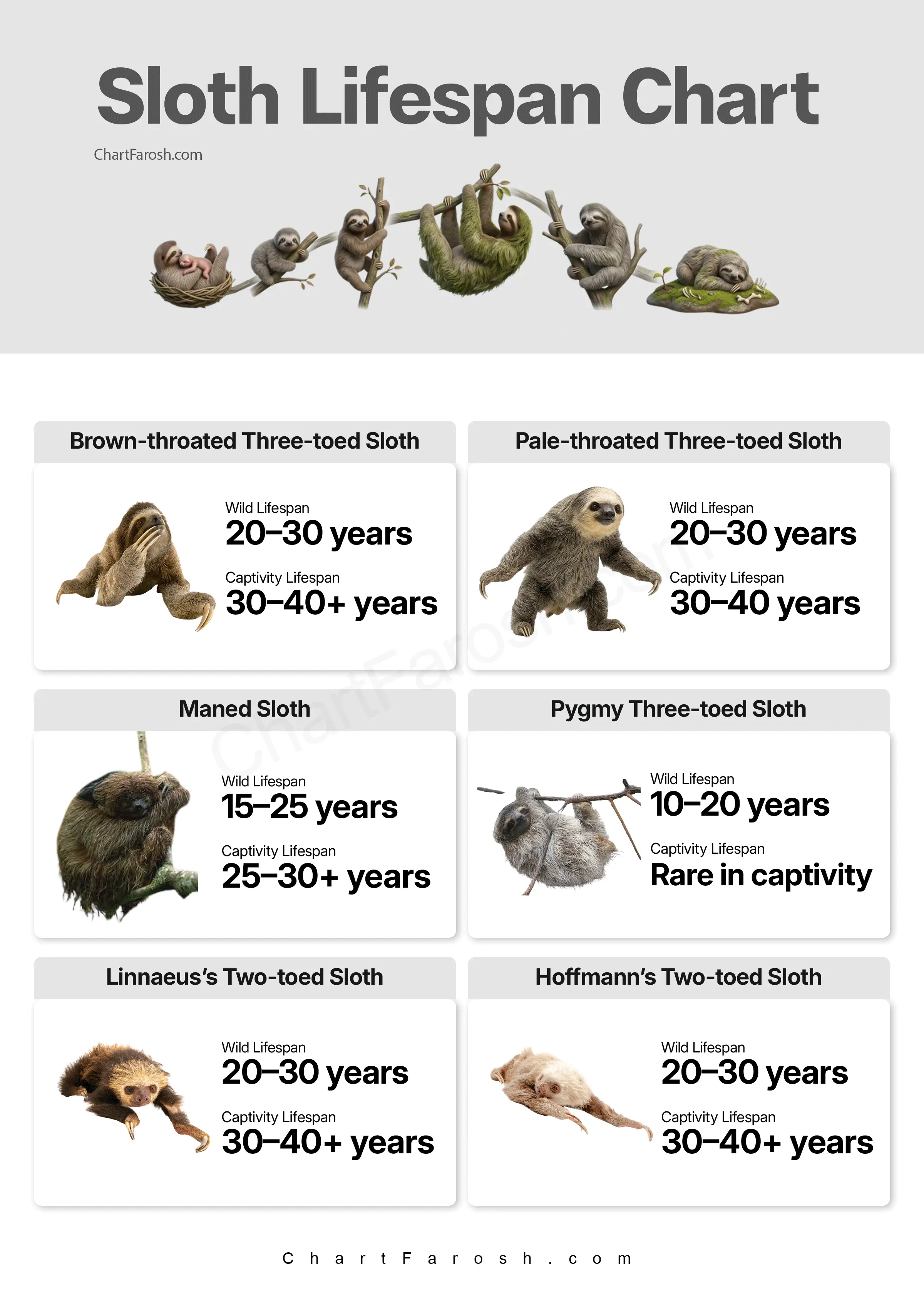
Table of Contents
Sloth Lifespan Chart: All Six Species
This table sets each species next to its wild and captive range. Captivity figures run higher across the board because food is steady and predators are gone.
| Sloth Species | Scientific Name | Type | Wild Lifespan | Captive Lifespan | Status | Notes |
| Brown-throated Three-toed Sloth | Bradypus variegatus | Three-toed | 20–30 yrs | 30–40+ yrs | Least Concern | Most common sloth species |
| Pale-throated Three-toed Sloth | Bradypus tridactylus | Three-toed | 20–30 yrs | 30–40 yrs | Least Concern | Rainforest canopy dweller |
| Maned Sloth | Bradypus torquatus | Three-toed | 15–25 yrs | 25–30+ yrs | Vulnerable | Brazil Atlantic Forest, limited range |
| Pygmy Three-toed Sloth | Bradypus pygmaeus | Three-toed | 10–20 yrs (est.) | Few records | Critically Endangered | Island species off Panama |
| Linnaeus’s Two-toed Sloth | Choloepus didactylus | Two-toed | 20–30 yrs | 30–40+ yrs | Least Concern | Nocturnal, more active |
| Hoffmann’s Two-toed Sloth | Choloepus hoffmanni | Two-toed | 20–30 yrs | 30–40+ yrs | Least Concern | Adapts well to captivity |
Status figures follow the IUCN Red List. Four species sit at Least Concern. The maned sloth is Vulnerable, and the pygmy three-toed sloth is Critically Endangered, with perhaps a few hundred left on one Panamanian island.
Wild vs Captivity: Why the Gap Is So Wide
A sloth in a good zoo can live a decade or two longer than a wild one. The reasons are simple once you list them.
| Factor | In the Wild | In Captivity |
| Food | Low-calorie leaves, seasonal gaps | Steady, balanced diet year round |
| Predators | Eagles, jaguars, snakes | None |
| Vet care | None | Routine checks and treatment |
| Typical lifespan | 20–30 years | 30–40+ years |
The record holders make the point. Jan, a Linnaeus’s two-toed sloth at Krefeld Zoo, reached at least 54. Paula at Halle Zoo hit 50. Wild sloths rarely get the chance, since a single trip to the ground to relieve themselves once a week is when many are caught.
Three-toed Sloth Lifespan
Three-toed sloths belong to the genus Bradypus. They are picky eaters tied to specific trees, which makes them hard to keep, so captive records are thinner than for two-toed sloths. In the wild they still reach 20 to 30 years in the common species.
| Species | Scientific Name | Wild Lifespan | Captive Lifespan |
| Brown-throated | Bradypus variegatus | 20–30 yrs | 30–40+ yrs |
| Pale-throated | Bradypus tridactylus | 20–30 yrs | 30–40 yrs |
| Maned | Bradypus torquatus | 15–25 yrs | 25–30+ yrs |
| Pygmy | Bradypus pygmaeus | 10–20 yrs (est.) | Few records |
One taxonomy note worth knowing. In 2022 researchers split the maned sloth in two and named the southern maned sloth (Bradypus crinitus) as a separate species.
Many guides, including this chart, still use the older six-species count, so you will see both six and seven quoted depending on the source. Lifespan estimates for the two maned forms are treated the same for now. For the full species rundown, see the types of sloths guide.
Two-toed Sloth Lifespan
Two-toed sloths (genus Choloepus) are larger, more active at night, and far easier to keep, which is why nearly every long-lived sloth on record is a two-toed one. They take a broader range of foods, so zoos can feed them well.
| Species | Scientific Name | Wild Lifespan | Captive Lifespan |
| Linnaeus’s Two-toed | Choloepus didactylus | 20–30 yrs | 30–40+ yrs (record 54) |
| Hoffmann’s Two-toed | Choloepus hoffmanni | 20–30 yrs | 30–43 yrs |
Ms. Chips, a Hoffmann’s two-toed sloth at the Smithsonian’s National Zoo, lived to 46. Numbers like that are why captive two-toed sloths often double the rough wild estimate.
What Affects How Long a Sloth Lives
Lifespan is not fixed. The same species can fall short or run long depending on a handful of pressures.
| Factor | Effect on Lifespan |
| Habitat loss | Deforestation shrinks range and forces ground crossings, the riskiest moment for a sloth |
| Predation | Harpy eagles, jaguars, and snakes take wild sloths, mostly on the ground or canopy edge |
| Diet quality | Low-energy leaves mean slow recovery from injury or cold; steady food extends life |
| Species type | Two-toed sloths handle captivity better and post the highest recorded ages |
| Human care | Vet treatment and no predators add 10 to 20 years over wild figures |
Groups like the Sloth Conservation Foundation point to road deaths and power-line shocks as fast-growing threats near towns. Those rarely show up in the old wild-lifespan numbers, which were set before sloth habitat met so many roads.
Sloth Lifespan vs Other Mammals
For a small mammal, a sloth lives a long time. Slow metabolism seems to buy them extra years. Here is how the two-toed sloth stacks up against a few others.
| Mammal | Wild Lifespan | Captive Lifespan | Note |
| Two-toed Sloth | 20–30 yrs | 30–54 yrs | Slow metabolism, low energy use |
| House Cat | 2–16 yrs | 12–18 yrs | Indoor life roughly doubles it |
| Little Brown Bat | 6–7 yrs avg | Up to 30+ yrs | Tiny mammal, surprisingly long-lived |
| African Elephant | 60–70 yrs | Up to 65 yrs | Large body, long lifespan |
The bat line surprises people. A 7-gram animal beating a 5-kilogram sloth on raw years shows that size alone does not set the limit. If you like these comparisons, the types of bats chart breaks down the long-lived species, and the types of elephants guide covers the giants at the other end.
FAQs
How long do sloths live on average?
Most sloths live 20 to 30 years in the wild. In zoos they often reach 30 to 40 years, and a few two-toed sloths have passed 50.
Which sloth species lives the longest?
Linnaeus’s two-toed sloth holds the records. Jan at Krefeld Zoo reached at least 54, and Paula at Halle Zoo lived to 50. Two-toed sloths adapt to captivity better than three-toed ones.
Do sloths live longer in the wild or in captivity?
Captivity, by a wide margin. Steady food, no predators, and vet care add 10 to 20 years over typical wild figures. Wild sloths face eagles, jaguars, and habitat loss.
Why do sloths live so long for their size?
Their slow metabolism burns little energy and seems to slow aging. Low activity also means fewer injuries day to day, which helps a low-energy animal recover and survive.
How long does a pygmy sloth live?
The pygmy three-toed sloth is estimated at 10 to 20 years in the wild, though hard data is scarce. It is Critically Endangered and lives on a single island off Panama, so few have been studied closely.
What kills most wild sloths?
Predators take many, usually during the weekly trip to the ground to defecate. Near towns, road traffic and power-line shocks now kill a growing share as forests give way to development.
How does a sloth’s lifespan compare to a cat’s?
A sloth outlasts most cats. A two-toed sloth can reach 40 or more, while a house cat usually lives 12 to 18 years indoors. For the full feline range by breed and age, see the cat lifespan chart. For another slow mammal with an unusual body clock, the types of pangolins guide makes a good next read.