Starfish Lifespan Chart
I found my first starfish at low tide on a beach in Maine when I was maybe seven. It was an ochre sea star, purple and stiff, clamped to a rock. My dad said it could be older than I was. I did not believe him.
He was right. Ochre sea stars can live past twenty years, and a few reach thirty-four. That stuck with me. Some of the most overlooked animals on the shore quietly outlive the family dog.
Starfish lifespans are hard to pin down. No one tags a wild sea star and checks back decade by decade, so most figures are estimates. What we do know is that they range from a couple of years in small burrowing species to several decades in the large cold-water ones.
The starfish lifespan chart below lists nine common species with wild, captive, and record years, then groups them by habitat and explains what pushes those numbers up or down.

Table of Contents
Starfish Lifespan Chart: 9 Sea Star Species
Each row shows a wild estimate, a captive estimate, and the longest age on record. Wild and captive figures often match because starfish are rarely tracked for their whole lives. The max column is where the surprises hide.
| Type | Scientific Name | Wild Lifespan | Captive Lifespan | Max Recorded | Notes |
| Common sea star | Asterias rubens | 5–10 yrs | 5–10 yrs | ~10 yrs | North Atlantic intertidal |
| Ochre sea star | Pisaster ochraceus | 10–20 yrs | 10–20 yrs | ~34 yrs | Keystone predator; some reach 34 |
| Crown-of-thorns starfish | Acanthaster planci | 5–10 yrs | 8–15 yrs | ~15–17 yrs | Coral predator; Pacific form A. cf. solaris |
| Blue sea star | Linckia laevigata | 10–15 yrs | 10–15 yrs | ~15 yrs | Popular in home aquariums |
| Sand sifting starfish | Astropecten spp. | 2–5 yrs | 2–5 yrs | ~5 yrs | Burrowing genus, short-lived |
| Chocolate chip starfish | Protoreaster nodosus | 5–10 yrs | 5–10 yrs | ~10 yrs | Indo-Pacific reef species |
| Sunflower sea star | Pycnopodia helianthoides | 5–10 yrs | 5–10 yrs | up to 65 yrs | Critically Endangered (IUCN 2020) |
| Red-knobbed sea star | Protoreaster lincki | 5–10 yrs | 5–10 yrs | ~10 yrs | Bright red knobs, Indo-Pacific |
| Cushion star | Culcita novaeguineae | 5–10 yrs | 5–10 yrs | ~10 yrs | Rounded, pillow shaped |
Two species stand out. The ochre sea star can reach 34 years, and the sunflower sea star has a record near 65, even though its average is far shorter. Status data for these species follows the IUCN Red List, which now lists the sunflower star as Critically Endangered.
Reef and Tropical Sea Star Lifespans
These are the warm-water species you see on coral reefs and in home tanks. They tend to live 5 to 15 years. Aquarium keepers often get the lower end, since water quality and feeding are harder to keep perfect than the ocean is.
| Species | Scientific Name | Typical Lifespan | Max Recorded |
| Blue sea star | Linckia laevigata | 10–15 yrs | ~15 yrs |
| Chocolate chip starfish | Protoreaster nodosus | 5–10 yrs | ~10 yrs |
| Red-knobbed sea star | Protoreaster lincki | 5–10 yrs | ~10 yrs |
| Cushion star | Culcita novaeguineae | 5–10 yrs | ~10 yrs |
| Crown-of-thorns starfish | Acanthaster planci | 5–10 yrs | ~15–17 yrs |
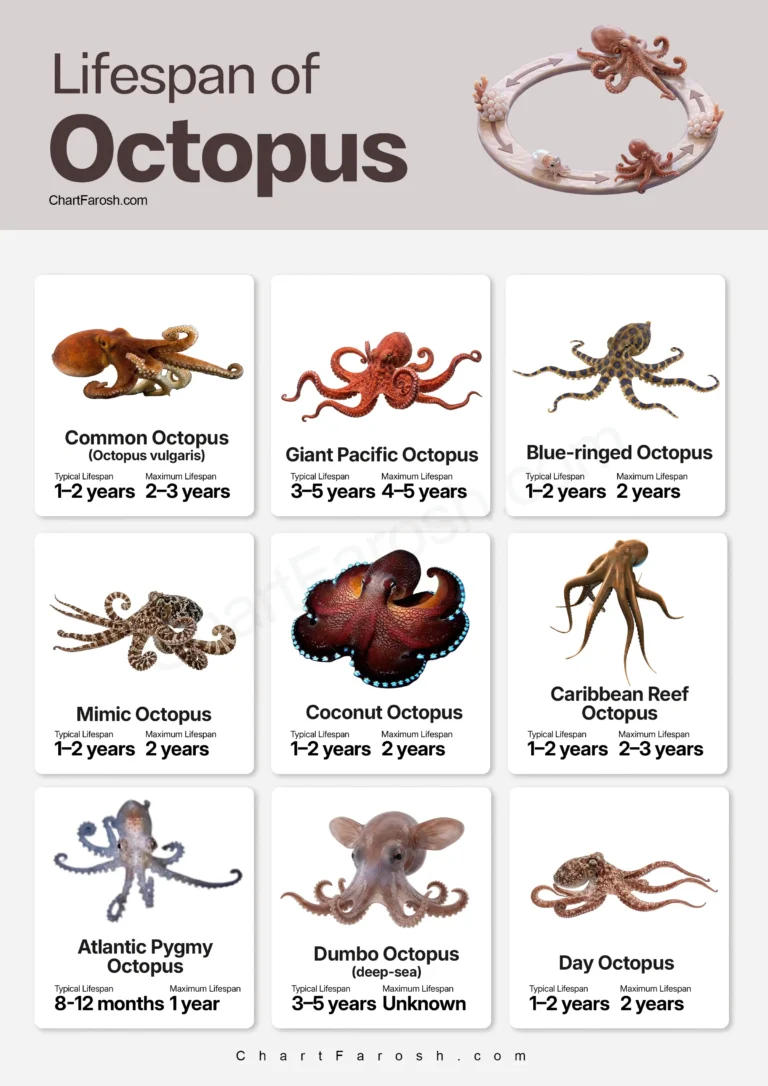
The crown-of-thorns is the odd one out. It eats coral and breeds in huge numbers, so reef managers track it closely. A single female can release tens of millions of eggs in a season. For other reef animals worth knowing, the types of octopus page covers a much shorter-lived invertebrate by comparison.
Cold-Water and Coastal Sea Star Lifespans
Temperate and cold-water sea stars live the longest of the group. Slow growth in cold water tends to come with a longer life. These are also the species hit hardest by sea star wasting disease since 2013.
| Species | Scientific Name | Typical Lifespan | Max Recorded |
| Common sea star | Asterias rubens | 5–10 yrs | ~10 yrs |
| Ochre sea star | Pisaster ochraceus | 10–20 yrs | ~34 yrs |
| Sunflower sea star | Pycnopodia helianthoides | 5–10 yrs (avg ~7) | up to 65 yrs |
| Sand sifting starfish | Astropecten spp. | 2–5 yrs | ~5 yrs |
The ochre sea star is the famous keystone species from Robert Paine’s tide-pool studies. Remove it and mussels take over the rock, which is how the keystone idea entered ecology. The sand sifting group, by contrast, is short-lived and spends its days buried, which keeps its numbers low.
The Sunflower Star Collapse
The sunflower sea star earns its own note. It is one of the largest sea stars on Earth, up to a meter across with as many as 24 arms, and it once kept sea urchin numbers in check along the Pacific coast.
Sea star wasting disease changed that. Starting in 2013, the disease killed billions of sea stars from Mexico to Alaska, and the sunflower star was hit worst. The Monterey Bay Aquarium and other groups are now breeding the species to try to bring it back. A starfish with a 65-year record is now Critically Endangered in much of its range, which says a lot about how fast an ocean can change.
Small vs Large Sea Stars
Size and water temperature predict starfish lifespan better than almost anything else. Set the two ends side by side and the pattern is clear.
| Trait | Small / Tropical | Large / Cold-Water |
| Example | Sand sifting, cushion star | Ochre, sunflower sea star |
| Typical lifespan | 2 to 10 years | 10 to 34+ years |
| Growth rate | Faster, matures young | Slower in cold water |
| Main threat | Predation, tank conditions | Wasting disease, warming seas |
This is why a buried Astropecten might see 5 years while a cold-water ochre star passes 30. The same body plan, very different clocks.
What Affects How Long a Starfish Lives
Lifespan is not fixed within a species either. A handful of pressures move the number up or down.
| Factor | Effect on Lifespan |
| Water temperature | Cold, stable water tends to mean slow growth and longer life |
| Water quality | Pollution, low oxygen, and wrong salinity shorten life fast, especially in tanks |
| Disease | Sea star wasting disease can kill whole populations in weeks |
| Food supply | Steady prey supports growth; scarcity stalls it and weakens the animal |
| Predation and damage | Lost arms regrow, but heavy injury and predators cut wild lives short |
Regeneration is the starfish trick everyone knows. Many can regrow a lost arm, and a few can rebuild a whole body from one arm and part of the central disc. The Smithsonian Ocean portal covers how that water-powered body works in more detail.
FAQs
How long do starfish live on average?
Most sea stars live 5 to 15 years. Small burrowing species may only reach 2 to 5 years, while large cold-water species like the ochre sea star can pass 30.
Which starfish lives the longest?
The ochre sea star and sunflower sea star top the list. Ochre stars reach 34 years, and a sunflower star has been recorded near 65, though its average is closer to 7.
Do starfish live longer in the wild or in captivity?
It is close, unlike most pets. Good tank conditions can match wild lifespans, but poor water quality often cuts captive lives short. Few starfish are tracked long enough to give firm numbers either way.
How long do sand sifting starfish live?
Sand sifting stars in the genus Astropecten are short-lived, usually 2 to 5 years. They spend most of their time buried in sand hunting small prey.
Why is the sunflower sea star endangered?
Sea star wasting disease killed most of the population after 2013. The IUCN listed it as Critically Endangered in 2020, and recovery efforts are underway.
Can a starfish die of old age?
In theory yes, but most wild starfish die from predators, disease, or habitat change long before old age. Regeneration helps them survive injuries that would kill many animals.
How does a starfish lifespan compare to other sea animals?
A large sea star can outlive many fish and most invertebrates. For comparison, the types of cuttlefish usually live only 1 to 2 years, the types of sea turtles can pass 50, and you can see more longevity tables in the snake lifespan chart and the sloth lifespan chart.