Rhino Lifespan Chart
I used to think of rhinos as one animal in five slightly different costumes. A horn, thick grey skin, a famous bad temper, and not much else to tell them apart. Then I read that a black rhino in Tanzania reached 57 years. Some wild rhinos barely make it to 30. That gap stuck with me.
It turns out lifespan is one of the clearest ways to separate the five species. I wanted one place to see how long each rhino lives, in the wild and in human care. No combing through a dozen conservation pages. The numbers shift by species, by habitat, and by how much pressure people put on each population. The chart below brings all five together so you can compare them and see what really moves the needle.

Table of Contents
Rhino lifespan chart by species
There are five living rhino species. Two are African, the white and the black. Three are Asian, the Indian, Javan, and Sumatran. Most rhinos live about 30 to 50 years. Where a species lands in that range depends on its size and its surroundings.
Wild numbers and zoo numbers tell different stories. In the wild, poaching and habitat loss pull the average down. In a good zoo, steady food and vet care can add years. The table sorts the five species by typical wild lifespan, by lifespan in human care, and by a short note on size and status.
| Species | Scientific Name | Wild Lifespan | In Human Care | Notes |
| White Rhinoceros | Ceratotherium simum | 35–40 years | 40–50 years | Largest rhino; near threatened |
| Black Rhinoceros | Diceros bicornis | 30–40 years | 35–50 years | Browsing diet; critically endangered |
| Indian Rhinoceros | Rhinoceros unicornis | 35–45 years | 40–50 years | Greater one-horned; largest Asian rhino |
| Javan Rhinoceros | Rhinoceros sondaicus | 30–40 years (est.) | None in captivity | About 50 left; critically endangered |
| Sumatran Rhinoceros | Dicerorhinus sumatrensis | 30–40 years | 35–45 years | Smallest and hairiest; critically endangered |
Which rhinos live the longest?
The Indian and white rhinos sit at the top of the range. Both can reach the mid-40s in the wild when poaching is low. Both often pass 45 years in human care. The Indian rhino is also called the greater one-horned rhino. It does well in protected parks like Kaziranga in Assam, where steady food and tight security let it grow old. You can see how it compares with the other four in our types of rhinos chart.
White rhinos graze on open grassland. Food is plentiful there, and they face few natural threats. The white rhino is also the only species not listed as endangered. So more wild animals get the chance to grow old. Zoo numbers look even better, with several rhinos living past 50.
Which rhinos have the shortest lifespans?
The black, Javan, and Sumatran rhinos sit lower on the chart. The reason is pressure, not biology. Black rhinos are built much like white rhinos. But heavy poaching pulls their wild average down to the low 30s. In safe settings, black rhinos have lived close to 50. The gap is about circumstances, not lifespan potential.
The Javan rhino is the hardest to pin down. None live in captivity, so every figure is a field estimate. About 50 survive, almost all in one Indonesian park. Researchers have little data to work with. The Sumatran rhino is the smallest and hairiest of the five. It has the same gaps in record-keeping, since most lifespan numbers come from a few managed animals.
Factors that affect rhino lifespan
Two rhinos of the same species can live very different lives. Some reach their late 40s. Others die young. The difference comes down to a handful of factors that stack up.
- Poaching: the biggest threat. Demand for horn has caused steep declines. It removes adults long before old age.
- Species and size: big grazers like the white and Indian rhino outlive the smaller Sumatran and Javan rhinos.
- Habitat quality: protected parks with water and grazing support longer lives. Broken or degraded land does the opposite.
- Diet: grass grazers face fewer food swings than browsers, which rely on shrubs and trees.
- Human care: steady food, dental care, and treatment for injury can add years in a zoo.
- Genetic diversity: tiny populations like the Javan and Sumatran rhino risk inbreeding. That can weaken health over time.
- Stress and human exposure: rhinos not used to people can suffer from sudden contact. Constant stress also shortens life.
How rhino lifespan compares to other large mammals
Rhinos are long-lived by mammal standards. But they are not the oldest giants on land or at sea. Placing them next to other large animals gives the numbers some context. The table below lines up a typical rhino against other heavyweights. Each one links to a related ChartFarosh page.
| Animal | Typical Wild Lifespan | In Human Care | Quick Note |
| Rhino (all species) | 30–45 years | 35–50 years | Varies by species |
| Elephant | 50–70 years | up to 60+ years | Longest-lived land herbivore |
| Tiger | 10–15 years | up to 20–26 years | Big cat, shorter life |
| Bear | 20–35 years | up to 30+ years | Eight living species |
| Deer | 10–20 years | up to 20+ years | Smaller, faster turnover |
| Whale | 30–90+ years | varies widely | Bowheads can pass 200 |
Next to an elephant, a rhino looks short-lived. Elephants often reach their 60s. Against a big cat, the picture flips.
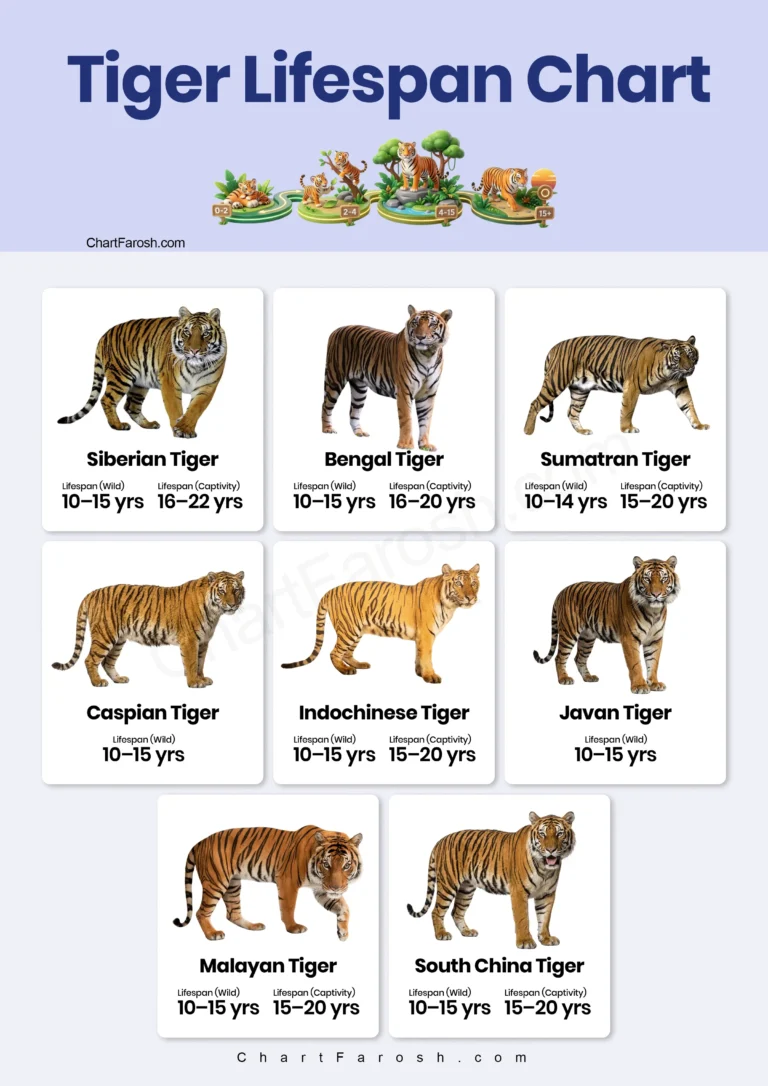
Most tiger species live only 10 to 15 years in the wild. Deer rarely pass 20. A rhino’s three to four decades stand out among land mammals.
A bear sits in the same band as a rhino. The real outliers live in the ocean. Some whale species, like the bowhead, may pass 200 years. That makes even the oldest rhino look young.
Oldest rhinos on record
The record-holders show what a rhino can reach when it survives the usual threats. The oldest documented rhino was Fausta, a black rhino in Tanzania. She lived to about 57. She spent most of her life free-ranging in the Ngorongoro Crater. She moved to a sanctuary only in her final years, well past the typical wild span.
A southern white female named Sana reached about 55 in a French zoo. She is the oldest captive white rhino on record. These cases are exceptional, not the norm. Take away poaching and habitat loss, and the ceiling rises well above the averages.
One edge case is worth flagging. The northern white rhino, a subspecies, is now functionally extinct. Only two females remain, under armed guard in Kenya. Their story is a reminder that lifespan means little when a population can no longer reproduce.
What helps rhinos live longer
Rhinos are wild animals. What extends their lives is conservation, not an owner’s care. The work is slow and unglamorous. But it is what keeps individuals alive long enough to grow old.
Anti-poaching patrols and protected reserves cut the biggest threat: the horn trade. Captive breeding adds a safety net for the rarest species. Groups like the International Rhino Foundation run sanctuaries. These have bred Sumatran rhino calves in recent years.
Habitat protection matters just as much. Broken land cuts off food, water, and mates. The IUCN Red List tracks numbers and status for every rhino species. You can also back field work through charities such as Save the Rhino International.
FAQs
How long do rhinos live on average?
Most rhinos live about 30 to 50 years. White and Indian rhinos sit at the top of that range. Black, Javan, and Sumatran rhinos fall lower, mostly from poaching and habitat loss.
Which rhino species lives the longest?
The white and Indian rhinos tend to live longest. Both reach the mid-40s in the wild. Some pass 45 years in human care.
Do rhinos live longer in captivity or in the wild?
For most species, rhinos live a few years longer in human care. Steady food and vet care remove some wild threats. White rhinos in zoos have lived past 50.
What is the oldest rhino ever recorded?
Fausta, a black rhino in Tanzania, reached about 57 years. She is the oldest rhino on record. A white rhino named Sana lived to about 55 in a French zoo.
Why do black rhinos have shorter lifespans than white rhinos?
The gap is about pressure, not biology. Black rhinos are critically endangered and heavily poached, so fewer reach old age in the wild. In safe settings they have lived close to 50.
Are there any Javan rhinos in zoos?
No. There are no Javan rhinos in captivity anywhere. So every lifespan figure for the species is a field estimate.
What is the biggest threat to a rhino’s lifespan?
Poaching for horn is the biggest threat, followed by habitat loss. Both remove adults long before their natural lifespan.