Wild Rabbit Lifespan in captivity and wild
The first wild rabbit I found dead in my garden was a young cottontail, barely a few months old. I learned later that this is the rule, not the exception. Most wild rabbits never reach their first birthday.
That short, fast life is the whole story of rabbit longevity. A wild cottontail averages one to two years, while a pet rabbit of the same family can pass twelve. The gap comes down to one thing, which is who is trying to eat them.
I gathered the numbers for eight wild species and put them in one chart. Below you will find wild and captive lifespans, the longest ages on record, and the reasons rabbits live so fast and die so young.
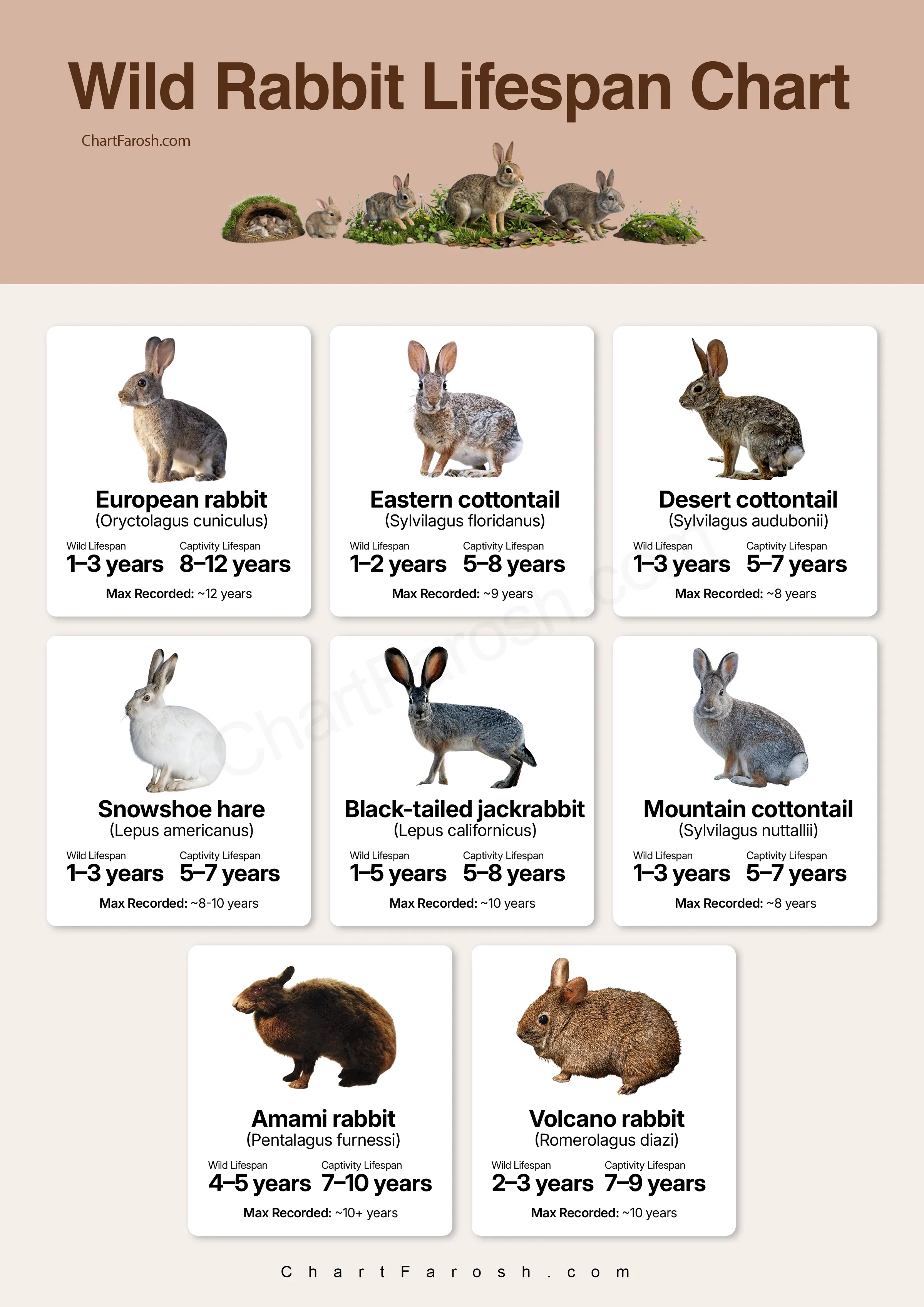
Table of Contents
Wild rabbit lifespan chart
Wild rabbit lifespan is short almost everywhere. Predators, disease, and weather keep wild averages low across nearly every species. The protected versions of the same animals live four to eight times longer.
The chart covers eight wild species, from the familiar European rabbit to the rare volcano rabbit. Wild figures reflect typical averages, not the lucky few that beat the odds. A couple of these animals are technically hares, which I explain below the chart.
| Species | Scientific Name | Wild Lifespan | Captive Lifespan | Max Recorded | Notes |
| European rabbit | Oryctolagus cuniculus | 1–3 yrs | 8–12 yrs | ~12 yrs | Ancestor of most domestic rabbits |
| Eastern cottontail | Sylvilagus floridanus | 1–2 yrs | 5–8 yrs | ~9 yrs | Very high predation rates |
| Desert cottontail | Sylvilagus audubonii | 1–3 yrs | 5–7 yrs | ~8 yrs | Adapted to dry environments |
| Snowshoe hare | Lepus americanus | 1–3 yrs | 5–7 yrs | ~8–10 yrs | A hare; changes fur color by season |
| Black-tailed jackrabbit | Lepus californicus | 1–5 yrs | 5–8 yrs | ~10 yrs | A hare, not a true rabbit |
| Mountain cottontail | Sylvilagus nuttallii | 1–3 yrs | 5–7 yrs | ~8 yrs | Found at higher elevations |
| Amami rabbit | Pentalagus furnessi | 4–5 yrs | 7–10 yrs | ~10+ yrs | Rare, ancient rabbit lineage |
| Volcano rabbit | Romerolagus diazi | 2–3 yrs | 7–9 yrs | ~10 yrs | One of the smallest rabbits |
Captive figures come from zoos, rescues, and breeders where food is steady and predators are gone. That single change is why a one-year wild lifespan can stretch to eight years or more in safe hands.
Which wild rabbits live the longest?
The rare, isolated species top the list. The Amami rabbit and volcano rabbit reach seven to ten years, helped by remote mountain homes with fewer predators. The European rabbit also does well in captivity, where eight to twelve years is normal.
Both of those long-lived species are endangered, which is part of why their captive figures look strong. They are studied and protected closely, so the wolves of their world, including feral cats and habitat loss, are kept at bay in managed settings. In the open, even these hardy rabbits face real pressure.
Which wild rabbits have the shortest lives?
Cottontails sit at the bottom in the wild. The eastern cottontail averages just one to two years, and most die in their first season. Foxes, hawks, and roaming cats take a heavy toll, and you can see the range of one classic rabbit predator in the all fox species guide.
Disease adds to the pressure. Myxomatosis and rabbit hemorrhagic disease can wipe out whole populations in weeks. Those outbreaks keep wild averages low even in good years.
Rabbits, hares, and cottontails: what’s the difference?
Not every animal on the chart is a true rabbit. The black-tailed jackrabbit and the snowshoe hare are hares, even though everyday speech lumps them in with rabbits.
The difference is real. True rabbits are born blind, hairless, and helpless in a burrow. Hares are born fully furred with open eyes and can run within hours. Cottontails sit in between as New World rabbits, related to but separate from the European rabbit that gave us pet breeds. I kept the hares in the chart because people search for them as rabbits, but the labels matter for accuracy.
How they shelter differs too. The European rabbit digs deep, connected burrows called warrens, while cottontails rest in shallow surface scrapes called forms and lean on speed and cover to stay alive. Those habits shape how exposed each animal is, which feeds straight back into how long it tends to live.
Factors that affect wild rabbit lifespan
A wild rabbit’s lifespan comes down to how long it can avoid being eaten. A few factors shape the odds.
- Predation: more than 80% of wild rabbits die from predators in their first year.
- Disease: myxomatosis and rabbit hemorrhagic disease move through populations fast.
- Habitat and weather: drought, floods, and lost cover cut food and shelter.
- Breeding pressure: rabbits mature in months and breed hard, trading long lives for many young.
- Captivity: protection and veterinary care stretch a rabbit’s years many times over.
That captive advantage is dramatic. The same wild-versus-protected gap shows up in common pets, including the breeds in the cat lifespan chart, where indoor animals far outlast outdoor ones.
The fast life is not an accident. Rabbits evolved to breed early and often, with females ready to reproduce by three to six months and able to raise several litters a year. The species survives by replacing losses quickly rather than by any one rabbit living long. A short average lifespan is the cost of that strategy.
How wild rabbit lifespan compares to other mammals
Wild rabbits live fast even among small mammals. The comparison below places a wild cottontail next to other animals people often ask about.
| Animal | Avg Wild Lifespan | Avg Captive Lifespan | Notes |
| Wild cottontail | 1–2 yrs | 8–9 yrs | True rabbit; born helpless |
| Domestic rabbit | — | 8–12 yrs | Protected from predators for life |
| Hare (jackrabbit) | 1–5 yrs | 5–8 yrs | Born furred and ready to run |
| Guinea pig | 1–4 yrs | 5–8 yrs | A rodent, not a lagomorph |
| Gray squirrel | 1–6 yrs | up to ~20 yrs | Tree cover lowers predation |
| House mouse | ~1 yr | 2–3 yrs | Short life, fast breeding |
Prey animals live fast. A wild cottontail rarely lasts more than a season or two, and other herbivores face the same pressure. The types of deer guide shows another grazer that breeds quickly and loses many young to predators.
The hunters tell the opposite story. Foxes, wolves, and big cats usually outlive the rabbits they catch, partly because they sit at the top of the food chain. You can compare the longer end of that scale in the all wolf species and types of tigers guides.
Record-holders: the oldest rabbit ever
The oldest rabbit ever recorded was a wild one. Flopsy was caught in Tasmania in 1964 and lived 18 years and almost 11 months as a pet. That figure still stands as a Guinness World Record. The next-oldest on record, a buck named Mick near Chicago, reached 16.
Her story is the whole point in a single animal. A rabbit that might have lasted two years in the wild lived nearly nineteen once the predators were gone. If you like to picture a pet’s years on a human scale, the cat human age chart shows how that kind of age conversion works.
FAQs
How long do wild rabbits live?
Most wild rabbits live 1 to 2 years, and cottontails often die in their first year, while protected rabbits reach 8 to 12 years.
Why do wild rabbits die so young?
Predation is the main cause, since more than 80% die from predators in their first year, with disease and harsh weather adding to the toll.
What is the oldest rabbit ever recorded?
Flopsy, a wild rabbit caught in Tasmania, lived 18 years and nearly 11 months in captivity, the longest on record.
Which wild rabbit lives the longest?
The Amami rabbit and volcano rabbit reach 7 to 10 years, helped by remote mountain homes with fewer predators.
Is a jackrabbit a rabbit or a hare?
It is a hare. Jackrabbits and snowshoe hares are hares, born furred and ready to run, not true rabbits.
Do wild rabbits live longer in captivity?
Yes. Protected from predators and disease, the same species can live four to eight times longer than in the wild.
How long do cottontail rabbits live?
Eastern cottontails average 1 to 2 years in the wild and up to 8 to 9 years in protected care.