Whale Lifespan Chart in captivity and wild
I always assumed the biggest animals lived the longest, and with whales that hunch turns out to be right. A bowhead whale alive today could have been born before the American Civil War. Some have survived more than two hundred years in the cold Arctic.
Whales sit at the far end of the animal lifespan scale. The shortest-lived species on this chart still outlasts almost every land mammal, and the longest-lived outlasts all of them. The reasons come down to size, cold water, and a slow, steady pace of life.
I gathered the numbers for ten whale species and put them in one chart. Below you will find wild lifespans, the rare captive figures, the oldest ages on record, and why these giants live so long.
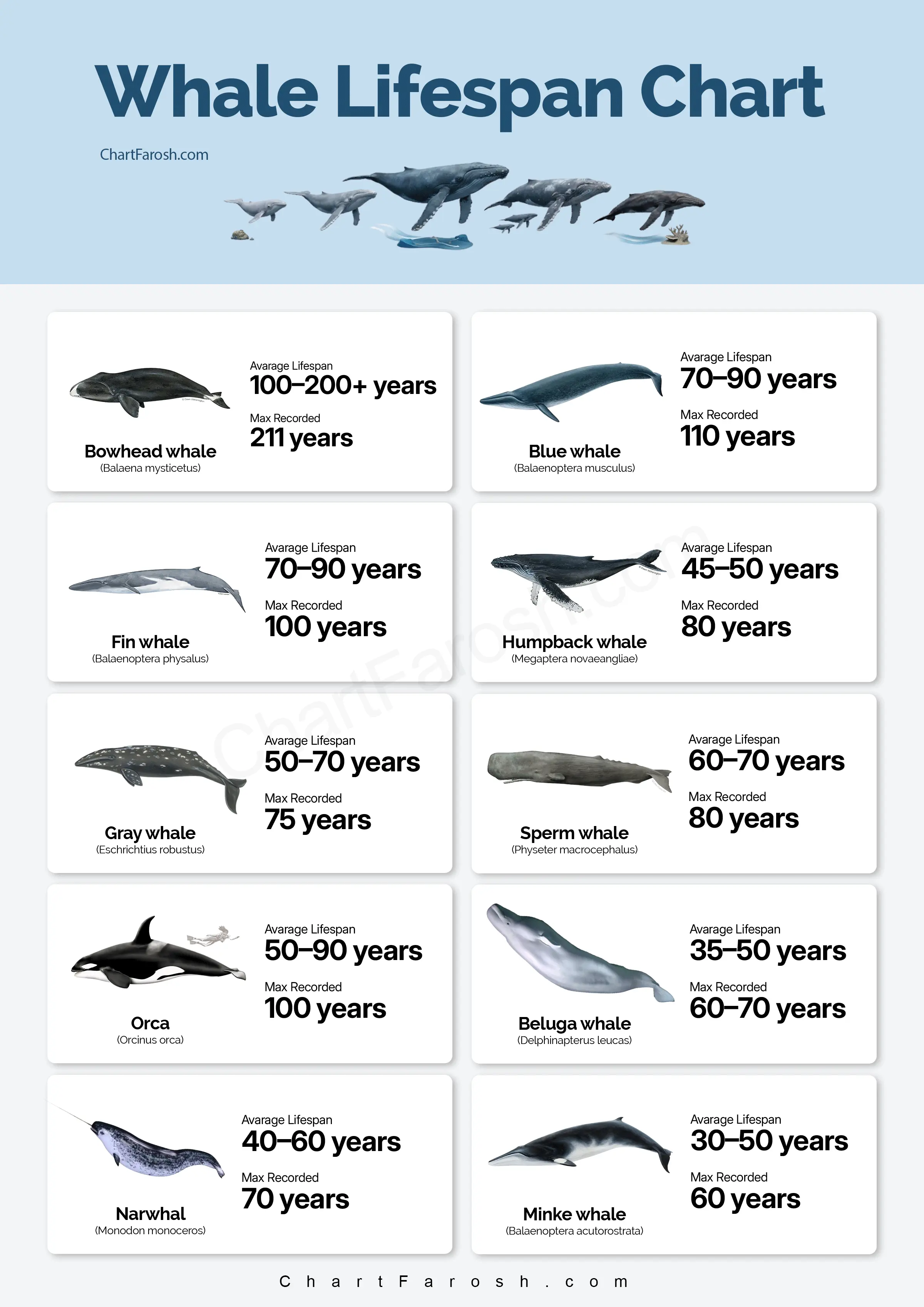
Table of Contents
Whale lifespan chart
Whale lifespan runs longer than almost any other group of mammals. Most species on this chart live longer than people, and the bowhead lives more than twice as long. Cold water and a slow metabolism seem to be the shared reason.
One thing stands out right away. Most whales are too large to keep, so the captive column reads “Not kept” for nearly every species. Only the orca and beluga appear in aquariums, and their captive numbers tell a different story than the rest of the chart. For the full species rundown by size and family, the types of whales guide lists them all.
| Species | Scientific Name | Wild Lifespan | Captive Lifespan | Max Recorded | Notes |
| Bowhead whale | Balaena mysticetus | 100–200+ yrs | Not kept | ~211 yrs | Longest-lived mammal |
| Blue whale | Balaenoptera musculus | 70–90 yrs | Not kept | ~110 yrs | Largest animal ever |
| Fin whale | Balaenoptera physalus | 70–90 yrs | Not kept | ~100 yrs | Second-largest whale |
| Humpback whale | Megaptera novaeangliae | 45–50 yrs | Not kept | ~80 yrs | Known for its songs |
| Gray whale | Eschrichtius robustus | 50–70 yrs | Not kept | ~75 yrs | Long migration routes |
| Sperm whale | Physeter macrocephalus | 60–70 yrs | Not kept | ~80 yrs | Largest toothed predator |
| Orca | Orcinus orca | 50–90 yrs | 20–40 yrs | ~100 yrs | Largest dolphin; females outlive males |
| Beluga whale | Delphinapterus leucas | 40–60+ yrs | 30–40 yrs | ~70–80 yrs | Arctic; lifespan revised upward |
| Narwhal | Monodon monoceros | 40–60 yrs | Rarely kept | ~70 yrs | “Unicorn of the sea” |
| Minke whale | Balaenoptera acutorostrata | 30–50 yrs | Not kept | ~60 yrs | Smallest baleen whale |
The figures reflect typical ranges, not single outliers. Ages above one hundred are estimates drawn from eye-lens dating and growth-layer analysis, since you cannot read a whale’s age from the outside.
Which whales live the longest?
The bowhead whale is the clear champion. It can pass two hundred years, which makes it the longest-lived mammal on Earth. Blue and fin whales follow at seventy to ninety years, helped by their enormous size and slow growth.
Size is the thread that ties the top of the chart together. The largest whales take decades to mature and age slowly once they do. Even the deep-diving sperm whale, the largest toothed predator, reaches sixty to seventy years on the same slow clock.
Which whales have the shortest lives?
The smaller species sit at the lower end. Minke whales average thirty to fifty years, and humpbacks land around forty-five to fifty. Even these shorter lifespans would be remarkable for a land mammal of similar size.
The gray whale fills the middle of the range at fifty to seventy years, despite one of the longest migrations of any mammal. A round trip from the Arctic to Mexico and back covers up to twelve thousand miles, year after year, which says a lot about how durable these animals are.
Baleen whales, toothed whales, and why an orca is a dolphin
The ten animals on this chart split into two groups. Baleen whales, including the bowhead, blue, fin, humpback, gray, and minke, filter tiny prey through plates of baleen. Toothed whales, including the sperm whale, beluga, and narwhal, hunt fish and squid with teeth.
The orca is the odd one out. Despite the name killer whale, it is the largest member of the dolphin family, not a true whale. Belugas and narwhals are toothed whales, but they sit in their own small family, the one with no dorsal fin. The labels do not change the lifespans, yet they explain why these animals behave so differently.
Factors that affect whale lifespan
A whale’s lifespan depends on biology first and human pressure second. A few factors stand out.
- Size: larger whales grow slowly and live longer, with the giant bowhead at the top.
- Cold water: Arctic species have slow metabolisms that appear to slow aging
- Predation: only orcas and large sharks threaten adult whales, so most die of old age.
- Human impact: ship strikes, net entanglement, and past whaling cut many lives short.
- Ocean change: warming seas and noise pollution add new pressure across marine life.
Those ocean threats reach far beyond whales. Many marine animals, including the species in the types of penguins guide, face the same warming and habitat shifts that now shape life at sea.
Why captivity shortens an orca’s life
For most animals I chart, captivity adds years. Whales break that rule. The orca is the clearest case, living fifty to ninety years in the wild but often only twenty to forty in a tank.
Confinement, stress, and limited space take a real toll on an animal built to swim a hundred miles a day. It is the opposite of what happens with a house pet, where safety usually means a longer life. You can see that more typical pattern in the cat lifespan chart, where protected animals far outlast wild ones.
How whale lifespan compares to other long-lived animals
Whales are longevity champions, but they are not the outright record-holders. The comparison below places the bowhead next to the oldest animals known to science.
| Animal | Typical Lifespan | Max Recorded | Notes |
| Bowhead whale | 100–200 yrs | ~211 yrs | Longest-lived mammal |
| Greenland shark | 270–390 yrs | ~400+ yrs | Longest-lived vertebrate |
| Giant tortoise | 100–150 yrs | ~190 yrs | Oldest known land animal |
| African elephant | 60–70 yrs | ~86 yrs | Longest-lived land mammal |
| Human | 70–80 yrs | 122 yrs | Listed for scale |
| Ocean quahog clam | 200–500 yrs | ~507 yrs | Longest-lived animal known |
The bowhead leads all mammals, yet the Greenland shark doubles it, living up to four hundred years in cold, deep water. Sea turtles and giant tortoises also pass the century mark, and you can explore the marine side of that in the types of sharks and types of sea turtles guides. Cold, slow, and steady seems to be the recipe for a long life in the ocean.
Record-holders: the oldest whale ever
The oldest whale ever measured was a bowhead estimated at 211 years, dated through proteins in its eye lens. The clue that first revealed bowhead longevity was even stranger. Hunters found old stone and ivory harpoon points lodged in living whales, weapons that had not been used in over a century.
A bowhead alive in the Arctic today may have been born around the year 1820. If you like to picture an animal’s age on a human scale, the cat human age chart shows how that kind of conversion works for a familiar pet.
Scientists keep studying bowheads to learn how they pull this off. A whale that size has trillions of cells, so by the usual logic it should develop cancer often, yet it rarely does. Genetic work points to extra copies of DNA-repair and cell-cycle genes that seem to guard the bowhead against the diseases that limit most long-lived animals.
FAQs
How long do whales live?
Most whales live 30 to 90 years, longer than people, while the bowhead whale can pass 200 years, the longest of any mammal.
What is the longest-living whale?
The bowhead whale, with one individual estimated at 211 years, the oldest mammal on record.
Do whales live longer in the wild or in captivity?
In the wild. Orcas live 50 to 90 years in the ocean but often only 20 to 40 years in captivity.
Is an orca a whale or a dolphin?
An orca is the largest member of the dolphin family, even though it is commonly called a killer whale.
Why do whales live so long?
Large size, cold water, and a slow metabolism all slow their aging, and few predators threaten adult whales.
How do scientists know a whale’s age?
They estimate it from eye-lens proteins, ear-wax layers, and growth rings, since a whale’s age is not visible from the outside.
Which whale has the shortest lifespan?
The minke whale is the shortest-lived here at about 30 to 50 years, still long for a mammal its size.