All Fox Species List with Pictures
I’ll never forget the first time I spotted a fox at dusk. I was hiking along a quiet trail, flashlight in hand, when a small reddish figure darted between the trees.
I froze, captivated by the way it moved, silent, alert, and impossibly graceful.
That encounter sparked a curiosity I hadn’t expected: how many fox species exist? What makes each one unique? Why do some live in the icy Arctic while others thrive in deserts or tropical forests?
My curiosity led me to spend hours reading field guides, watching wildlife documentaries, and even joining nocturnal observation hikes.
Over time, I discovered that foxes are more diverse and fascinating than I ever imagined.
From the Arctic fox with its fluffy white coat to the tiny desert-adapted fennec fox, each species has its own story.
Understanding foxes isn’t just about identification, it’s about appreciating how evolution shaped these clever, adaptable, and elusive animals.
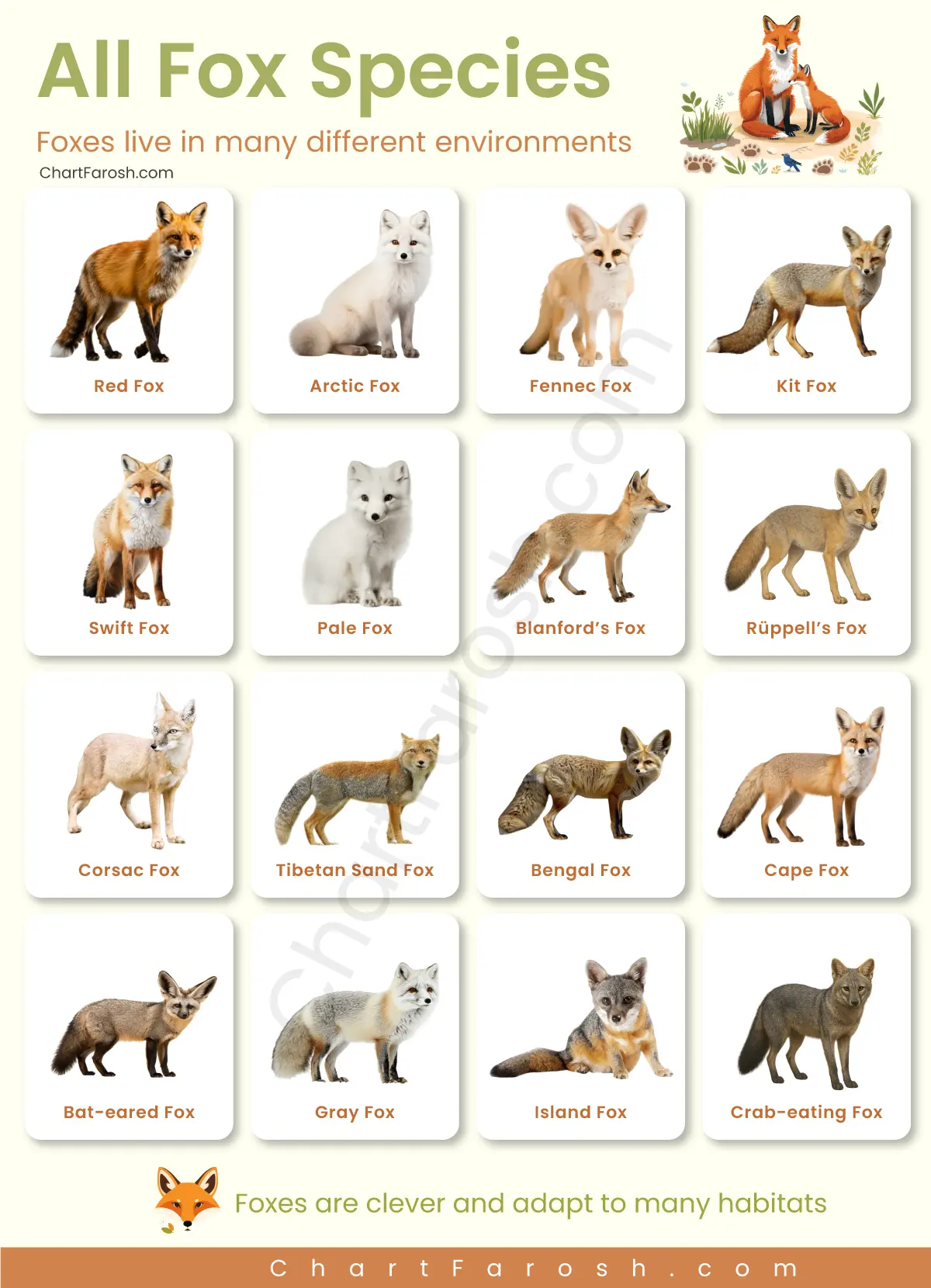
Table of Contents
All Fox Species: The Complete List of Foxes Worldwide
Foxes are members of the Canidae family, closely related to wolves, coyotes, and domestic dogs.
There are over 37 recognized species worldwide, distributed across every continent except Antarctica. Fox species occupy a wide range of habitats, including forests, grasslands, deserts, mountains, and even urban areas.
Despite this diversity, most foxes share similar characteristics: pointed ears, bushy tails, sharp eyes, and remarkable agility.
Their diet is omnivorous, ranging from small mammals and birds to fruits and insects, allowing them to adapt to almost any environment.
Foxes are mostly solitary, with some species forming small family groups, and they communicate using a variety of vocalizations and scent markings.
Studying all fox species helps scientists understand ecological balance, predator-prey dynamics, and evolutionary adaptations.
From the well-known red fox to obscure species like the bat-eared fox, the diversity of foxes worldwide is both intriguing and ecologically important.
| Common Name | Scientific Name | Region | Key Feature | Conservation Status |
| Red Fox | Vulpes vulpes | North America, Europe, Asia | Most widespread fox | Least Concern |
| Arctic Fox | Vulpes lagopus | Arctic regions | Thick white winter coat | Least Concern |
| Fennec Fox | Vulpes zerda | North Africa (Sahara) | Large ears, desert-adapted | Least Concern |
| Kit Fox | Vulpes macrotis | Western North America | Small size, large ears | Least Concern |
| Swift Fox | Vulpes velox | Central North America | Fast runner | Least Concern |
| Pale Fox | Vulpes pallida | Sahara Desert | Sand-colored coat | Least Concern |
| Blanford’s Fox | Vulpes cana | Middle East, Central Asia | Small, bushy tail | Least Concern |
| Rüppell’s Fox | Vulpes rueppellii | North Africa, Middle East | Desert specialist | Least Concern |
| Corsac Fox | Vulpes corsac | Central Asia | Steppe habitat | Least Concern |
| Tibetan Sand Fox | Vulpes ferrilata | Tibetan Plateau | Square-shaped face | Least Concern |
| Bengal Fox | Vulpes bengalensis | Indian Subcontinent | Slender build | Least Concern |
| Cape Fox | Vulpes chama | Southern Africa | Small African fox | Least Concern |
| Bat-eared Fox | Otocyon megalotis | Eastern & Southern Africa | Huge ears, termite eater | Least Concern |
| Gray Fox | Urocyon cinereoargenteus | North & Central America | Can climb trees | Least Concern |
| Island Fox | Urocyon littoralis | California Channel Islands | Small endemic species | Near Threatened |
| Crab-eating Fox | Cerdocyon thous | South America | Omnivorous diet | Least Concern |
| Pampas Fox | Lycalopex gymnocercus | South America | Grassland habitat | Least Concern |
| Culpeo (Andean Fox) | Lycalopex culpaeus | Andes Mountains | Largest South American fox | Least Concern |
| South American Gray Fox | Lycalopex griseus | South America | Silver-gray coat | Least Concern |
| Sechuran Fox | Lycalopex sechurae | Peru, Ecuador | Desert-adapted | Near Threatened |
| Darwin’s Fox | Lycalopex fulvipes | Chile | Rare forest species | Endangered |
How Many Fox Species Are There?
Determining exactly how many fox species exist can be tricky because taxonomy changes as scientists learn more.
Currently, there are about 37 recognized species, spread across multiple genera.
The majority of these species fall under the genus Vulpes, known as “true foxes,” while others belong to genera like Urocyon, Lycalopex, and Otocyon.
Fox species vary tremendously in size, appearance, habitat, and behavior, from the tiny fennec fox of the Sahara Desert to the massive red fox found across the Northern Hemisphere.
Some species are highly specialized, like the Arctic fox, adapted to survive freezing polar conditions, while others are generalists thriving in forests, deserts, and urban environments.
Understanding how many fox species exist helps researchers track biodiversity, plan conservation efforts, and study the evolutionary history of these clever and adaptable mammals.
Each species plays a unique role in its ecosystem, making the count more than just a number, it reflects ecological complexity and survival strategies.
Fox Family Classification: Genus Vulpes and Beyond
Foxes belong to the family Canidae, which also includes wolves, coyotes, jackals, and domestic dogs.
Within this family, foxes are grouped into several genera based on evolutionary relationships, habitat, and physical traits.
The genus Vulpes contains the true foxes, including well-known species like the red fox, Arctic fox, and fennec fox.
Other genera include Urocyon, which houses gray and island foxes, Lycalopex, covering South American foxes, and Otocyon, the bat-eared fox.
Each genus reflects adaptations to specific environments: Vulpes species are highly versatile, Lycalopex species are specialized for South American ecosystems, and the bat-eared fox has unique ear adaptations for desert insect hunting.
Classifying foxes accurately helps researchers understand their behavior, ecology, and evolutionary history, while also informing conservation strategies.
Studying these classifications reveals how different fox species adapted to survive in varied climates and terrains around the world.
True Foxes vs Fox-Like Canids Explained
Not all animals called “foxes” are actually true foxes, and that’s where things get interesting. In everyday language, we tend to label any small, pointy-faced, bushy-tailed canid as a fox.
But scientifically, true foxes are primarily grouped within the genus Vulpes.
These species share defining traits such as narrow muzzles, upright triangular ears, long bushy tails (often with a white tip), and flexible, omnivorous diets that allow them to thrive in deserts, forests, tundras, and even cities.
However, there are also fox-like canids that resemble true foxes in appearance but belong to entirely different genera.
These species may differ genetically, behaviorally, and ecologically, despite their similar looks. Some evolved in isolated regions and developed fox-like features through convergent evolution rather than close ancestry.
- True foxes have classic fox traits.
- Gray and island foxes are slightly larger, with unique social behaviors.
- South American foxes are adapted to grasslands and deserts.
- Bat-eared fox has oversized ears for insect hunting.
- Some fox-like species are misnamed, appearing similar but genetically distant.
Genus Vulpes: The True Fox Species
The genus Vulpes includes the classic “true foxes” that most people recognize, from the red fox to the Arctic fox and fennec fox.
These species are highly adaptable, found across multiple continents in habitats ranging from icy tundras to deserts and forests.
True foxes share certain physical traits: pointed ears, slender snouts, bushy tails, and long legs built for agility and speed.
Their omnivorous diets allow them to survive in diverse environments, feeding on small mammals, birds, insects, fruits, and even human leftovers in urban areas.
Social behavior varies; some species are solitary, while others form small family groups or mate for life.
Studying Vulpes species is crucial for understanding how foxes adapt to environmental pressures, from extreme climates to human-impacted landscapes.
Their intelligence, resourcefulness, and versatility make them one of the most successful canid genera in the world.
Genus Urocyon: Gray and Island Foxes
The genus Urocyon includes the gray fox and the island fox, both unique for their climbing abilities.
Gray foxes are one of the few canids capable of climbing trees, which helps them escape predators and search for food.
They inhabit forests and wooded areas throughout North and Central America, displaying remarkable adaptability to both wild and urban environments.
Island foxes, smaller and more endangered, are restricted to California’s Channel Islands and have evolved in isolation, resulting in unique behaviors and reduced size.
Both Urocyon species are opportunistic omnivores, feeding on small mammals, birds, insects, fruits, and berries.
These foxes are primarily solitary, using dens or hollow logs for shelter, and rely on stealth, agility, and keen senses to survive.
Conservation of island foxes is critical, as their small populations are vulnerable to habitat changes and introduced predators.
Genus Lycalopex: South American Fox Species
South America is home to several fox species classified under the genus Lycalopex, sometimes called “South American foxes” or “zorros.”
These foxes inhabit diverse habitats, including deserts, grasslands, shrublands, and forests, often at high elevations in the Andes.
Lycalopex species are generally small to medium-sized, with slender bodies and bushy tails.
They are opportunistic omnivores, feeding on rodents, insects, birds, fruits, and small reptiles.
Their social behavior varies, with some species living solitarily while others form small family groups.
Studying South American foxes provides insight into how foxes adapt to arid and temperate ecosystems far from the traditional fox habitats of the Northern Hemisphere.
- Pampas fox: Grassland specialist, widespread in Argentina.
- Culpeo : Largest South American fox, adapted to Andes.
- Sechuran fox : Desert specialist in Peru.
- Chilla: Shrubland and forest habitats in Chile.
- Darwin’s fox: Critically endangered, forest dweller in Chile.
Genus Otocyon: The Bat-Eared Fox
The bat-eared fox (Otocyon megalotis) is a fascinating species native to African savannahs, deserts, and open plains.
Its most striking feature is its oversized ears, which serve a dual purpose: enhancing hearing to detect insects and regulating body temperature in hot climates.
Bat-eared foxes primarily feed on insects, particularly termites, though they also eat small mammals, fruits, and birds.
Unlike most foxes, they often exhibit cooperative hunting, with pairs or small groups working together to locate and capture prey.
They are mostly nocturnal, using dens for shelter during the day. Observing the bat-eared fox reveals unique adaptations, such as highly specialized teeth for insect consumption and intricate social behaviors.
These foxes highlight the diversity of the fox family and how evolution shapes species to thrive in challenging environments.
Arctic Fox and Its Cold-Climate Adaptation
The Arctic fox (Vulpes lagopus) is perfectly adapted to the extreme cold of the Arctic tundra. Its dense, white winter coat provides insulation and camouflage against snow, while a thick tail can be wrapped around the body for extra warmth.
In summer, the coat changes to brown or gray, helping the fox blend into the tundra’s rocky and vegetative landscape. Arctic foxes are small, compact, and have short ears and limbs, reducing heat loss.
They primarily feed on small mammals like lemmings, birds, eggs, and carrion, and are known to follow polar bears to scavenge leftovers.
Arctic foxes are highly resourceful, storing food in caches to survive lean periods.
Studying them demonstrates how species can thrive in extreme climates through behavioral and physical adaptations, making them one of the most resilient and fascinating fox species.
Fennec Fox: The Smallest Fox Species
The fennec fox (Vulpes zerda) is the smallest fox species, native to the Sahara Desert and other North African deserts.
Despite its tiny size, it is perfectly adapted to desert life, with oversized ears that dissipate heat and enhance hearing to detect prey underground.
Fennec foxes are nocturnal, avoiding daytime heat and becoming active at night when temperatures drop.
Their diet is omnivorous, consisting of insects, small rodents, fruits, and plants.
Fennec foxes are highly social, living in small family groups and digging extensive burrows to shelter from extreme temperatures and predators. Observing them highlights remarkable adaptations for survival in harsh deserts.
- Tiny size: Only 2–3 pounds, highly agile.
- Large ears: Heat dissipation and hunting advantage.
- Nocturnal habits: Avoid daytime heat.
- Burrowing behavior: Shelter and temperature regulation.
- Omnivorous diet: Insects, small animals, fruits, and plants.
Largest Fox Species in the World
When people think of foxes, they often picture small, delicate animals slipping through the woods. But not all foxes are tiny.
Some species are surprisingly large and powerfully built, capable of taking down sizeable prey and surviving in harsh environments.
When looking at all fox species by size, a few stand out immediately for their impressive body mass, long limbs, and thick coats.
Size in foxes isn’t just about weight, it’s also about adaptability, territory range, and hunting capability.
The largest fox species in the world is the Red Fox. Adult males can weigh up to 14 kg (30 pounds) in some regions, especially in colder climates where larger bodies help retain heat.
Close behind is the Tibetan Fox, known for its stocky build and dense fur adapted to high-altitude plateaus.
Looking at the all bear species list, sorry, all fox species list, by comparison, foxes are much smaller than bears, but within their own group, size differences are significant.
Larger foxes tend to dominate territories more easily and may hunt slightly bigger prey than their smaller relatives.
Smallest Fox Species
On the opposite end of the spectrum, some foxes are incredibly tiny, almost cat-sized. When reviewing all fox species by size, these small desert specialists really stand out.
Smaller body size often helps with heat regulation, energy efficiency, and survival in food-scarce habitats.
Many of the smallest foxes live in hot, arid environments where being lightweight and agile is a major advantage.
The smallest fox species in the world is the Fennec Fox (Vulpes zerda). Weighing just 1–1.5 kg (2–3 pounds), this desert fox is famous for its oversized ears, which help release heat and detect prey underground.
Another small contender is the Swift Fox (Vulpes velox), native to North American grasslands. Its lightweight frame allows it to sprint quickly and escape predators.
Comparing all fox species by size really highlights how evolution shapes animals based on environment , from Arctic heaviness to desert minimalism.
Rare and Endangered Fox Species
Some foxes are widespread and adaptable, but others are fighting quietly for survival. Habitat destruction, climate change, hunting, and introduced predators have placed certain species at serious risk.
When examining the all fox species list carefully, you’ll notice that not every species is thriving equally. Some are limited to small geographic areas, making them especially vulnerable to environmental shifts.
One of the rarest foxes is the Darwin’s Fox (Lycalopex fulvipes), found only in parts of Chile.
Another highly vulnerable species is the Island Fox (Urocyon littoralis), native to California’s Channel Islands.
Because island species evolve in isolation, they often lack defenses against introduced predators and diseases.
Conservation programs have helped some populations recover, but their long-term survival still requires monitoring and habitat protection.
Extinct Fox Species
Extinction is part of natural history, but human activity has accelerated the process dramatically. Fossil records show that fox-like canids once occupied regions they no longer inhabit.
Climate shifts during the Ice Age also played a role in shaping which species survived and which disappeared.
Studying extinct fox species gives researchers insight into evolutionary trends and environmental pressures over time.
One example is Dusicyon avus, an extinct South American canid that shared similarities with modern foxes.
Although not all extinct fox-like species were true members of the genus Vulpes, they contribute to understanding how canids diversified.
Looking at both living and extinct members within the broader fox lineage helps scientists map evolutionary relationships and ecological adaptation patterns.
Red Fox: The Most Widespread Fox
If there’s one species that defines foxes globally, it’s the Red Fox (Vulpes vulpes). Found across North America, Europe, Asia, and even introduced to Australia, this species is incredibly adaptable.
Forests, tundras, deserts, mountains, and cities the red fox has learned to thrive almost everywhere. Its intelligence and flexible diet are key to its success.
Red foxes eat rodents, birds, insects, fruits, and even scraps from urban areas. Their coat color varies from bright red to silver and even cross patterns, depending on region and genetics.
When people search for the all fox species list, the red fox is often the first and most familiar name. Its wide distribution also makes it one of the most studied fox species in the world.
Fox Species Found in North America
North America hosts a surprisingly diverse range of fox species, each adapted to very different landscapes, from dry deserts and open grasslands to dense forests and the Arctic tundra.
When exploring all fox species by size within this continent, the variation becomes even more interesting
You’ll find tiny desert runners built for speed and heat tolerance, medium-sized grassland specialists that rely on agility, and cold-climate foxes with thick insulating coats designed to survive freezing temperatures.
This diversity isn’t just about appearance; it reflects how evolution has shaped each species to thrive in specific ecosystems.
Desert foxes tend to have larger ears for heat regulation, while northern species often have compact bodies and dense fur for warmth. Across the continent, foxes play an important ecological role.
- Red Fox – Widespread and highly adaptable.
- Gray Fox – Excellent climber, forest habitats.
- Swift Fox – Small grassland specialist.
- Kit Fox – Desert-adapted with large ears.
- Arctic Fox – Northern tundra survivor.
Fox Species Native to Europe
Europe’s fox diversity is smaller compared to other continents, but it remains ecologically significant and surprisingly dynamic.
The Red Fox dominates most regions, ranging from remote rural farmland and alpine meadows to suburban neighborhoods and inner-city parks.
Its adaptability is one of the main reasons it thrives across such a wide geographic range. In some southeastern parts of Europe, the Corsac Fox extends into Eastern Europe from Central Asia, favoring open steppes and semi-arid grasslands.
While not as widespread as the red fox, its presence adds to the continent’s overall canid diversity.
European foxes have adapted remarkably well to human presence. Urban fox populations are especially notable in cities like London and Berlin, where they navigate traffic, scavenge efficiently, and den in surprisingly small green spaces.
Studying fox populations in Europe helps researchers understand wildlife adaptation in developed landscapes, human-wildlife conflict management, and how predators adjust behavior in densely populated regions.
Fox Species in Asia
Asia is home to some of the most unique and specialized fox species on the planet.
From the windswept, high-altitude plateaus of the Himalayas to scorching deserts and vast open steppes, Asian foxes demonstrate impressive environmental adaptation.
When reviewing the all fox species list in Asia, you’ll come across species that are rarely seen or even discussed outside wildlife research circles.
Many of them are perfectly tuned to their habitats, with physical traits and behaviors shaped by extreme temperatures, rugged terrain, and seasonal food scarcity.
For example, some Asian foxes have dense, compact bodies built for cold mountain climates, while others have slender frames and large ears suited for heat dissipation in desert ecosystems.
Their diets also vary widely, ranging from small mammals and insects to fruits and carrion, depending on local availability. Asia’s vast geographic range has allowed foxes to diversify into highly distinct ecological roles.
- Tibetan Fox – High-altitude specialist.
- Corsac Fox – Steppe and desert habitats.
- Bengal Fox – Native to the Indian subcontinent.
- Blanford’s Fox – Rocky desert regions.
FAQs
How many true fox species are there?
There are around 12 true fox species in the genus Vulpes, though the broader fox-like canids increase the total number.
What is the largest fox species?
The Red Fox is generally considered the largest true fox species.
What is the smallest fox species?
The Fennec Fox holds the title as the smallest fox.
Are foxes related to wolves?
Yes, foxes and wolves both belong to the family Canidae, but they are in different genera.
Do all foxes live in cold climates?
No. Foxes inhabit deserts, grasslands, forests, mountains, tundra, and even urban areas worldwide.