Tiger Lifespan Chart in captivity and wild
I once watched a Bengal tiger at a reserve in central India stand still in tall grass for ten minutes. The guide whispered that she was about nine years old. In the wild, he said, nine already counts as middle-aged. A few more years and her teeth would wear down, her hunts would start to fail, and the forest would close in.
That surprised me. A tiger sits at the top of its food chain with no natural predator, yet a wild one rarely passes fifteen. Captive tigers do far better, and a few reach their mid-twenties.
How long a tiger lives depends on the subspecies, the prey around it, and whether it lives free or behind glass. A Siberian in a good zoo and a wild Sumatran can sit a decade apart. So I built one tiger lifespan chart that lines up all nine subspecies, living and extinct, with conservation status attached.
Below is that chart, plus the reasons so few tigers grow old and the subspecies we have already lost for good.
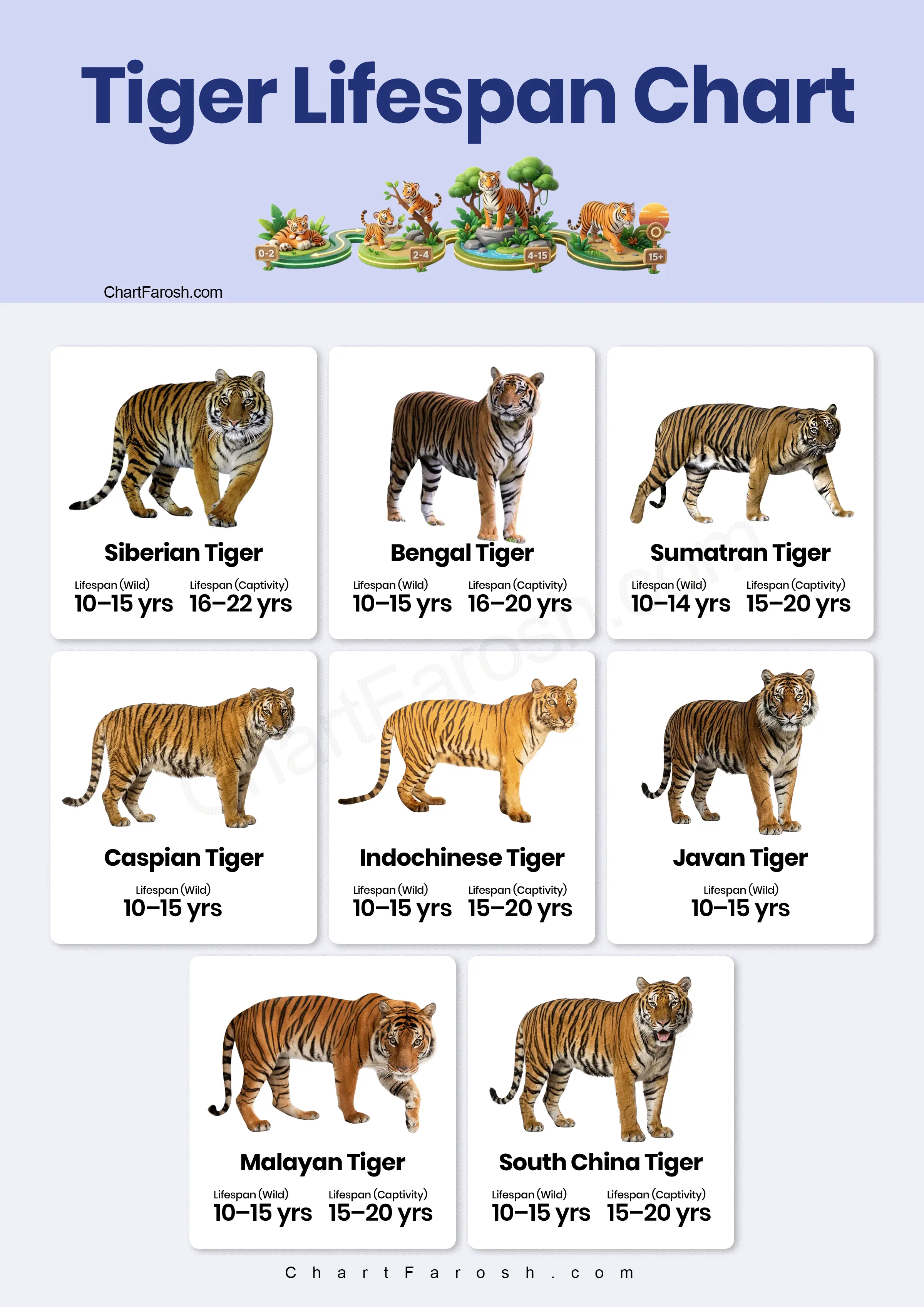
Table of Contents
Tiger Lifespan Chart
Nine subspecies, six still living and three already gone. The numbers are typical ranges, not hard limits, and they do not swing much from one subspecies to the next. Since 2017 only two subspecies are formally recognized, so the names below sit inside Panthera tigris tigris or sondaica.
| Tiger Subspecies | Group (2017) | Status | Wild | Captivity |
| Siberian (Amur) | P. t. tigris | Endangered | 10-15 yrs | 16-22 yrs |
| Bengal | P. t. tigris | Endangered | 10-15 yrs | 16-20 yrs |
| Indochinese | P. t. tigris | Endangered | 10-15 yrs | 15-20 yrs |
| Malayan | P. t. tigris | Critically Endangered | 10-15 yrs | 15-20 yrs |
| South China | P. t. tigris | Extinct in Wild | None confirmed | 15-20 yrs |
| Caspian | P. t. tigris | Extinct | Gone | None |
| Sumatran | P. t. sondaica | Critically Endangered | 10-14 yrs | 15-20 yrs |
| Javan | P. t. sondaica | Extinct | Gone | None |
| Bali | P. t. sondaica | Extinct | Gone | None |
The pattern is steady. Almost every tiger lives 10 to 15 years in the wild and 16 to 20 in captivity. What changes between rows is not the lifespan but the risk of reaching it. The Malayan and Sumatran tigers are critically endangered, and three subspecies no longer exist at all.
Why Tigers Live Longer in Captivity
The gap between a wild tiger and a zoo tiger is wide. A wild tiger faces poachers, prey shortages, and rival tigers every season. A captive tiger faces none of that. The Smithsonian National Zoo puts the wild lifespan at 10 to 15 years and the captive figure well above it.
| Aspect | Wild | Captivity | Why |
| Typical lifespan | 10-15 yrs | 16-25 yrs | No poaching or starvation in a zoo |
| Cub survival | ~50% past age 2 | Most survive | Vets and steady food protect cubs |
| Main threats | Poaching, prey loss | Old-age illness | Wild dangers vanish behind a fence |
| Oldest known | ~20 (rare) | 26 (Guddu) | Care lets a few reach the mid-20s |
The biggest difference shows up early. Roughly half of all wild cubs die before they turn two, from starvation, cold, or attacks. In a zoo, almost all of them live. That single fact lifts the captive average more than anything that happens in adulthood.
Captivity is not a perfect life. Space is limited and natural hunting is gone. But for raw years on the clock, a fence beats the forest every time.
The Two Tiger Subspecies
For a long time, scientists named nine tiger subspecies. In 2017 the IUCN Cat Specialist Group reviewed the genetics and cut the list to two. The mainland tiger became Panthera tigris tigris, and the island tiger became Panthera tigris sondaica.
The old names did not disappear. People still say Bengal, Siberian, and Sumatran, because those words point to real populations with real differences in size and coat. The table below shows how each traditional name now maps onto the modern pair.
| Traditional Name | Old Scientific Name | Now Grouped As |
| Bengal | P. t. tigris | P. t. tigris (continental) |
| Siberian / Amur | P. t. altaica | P. t. tigris (continental) |
| Indochinese | P. t. corbetti | P. t. tigris (continental) |
| Malayan | P. t. jacksoni | P. t. tigris (continental) |
| South China | P. t. amoyensis | P. t. tigris (continental) |
| Caspian | P. t. virgata | P. t. tigris (continental) |
| Sumatran | P. t. sumatrae | P. t. sondaica (Sunda) |
| Javan | P. t. sondaica | P. t. sondaica (Sunda) |
| Bali | P. t. balica | P. t. sondaica (Sunda) |
Mainland tigers run large and pale, like the heavy Siberian and Bengal tigers. Island tigers run small and dark, with the Sumatran the only one left. Whichever label you use, the lifespan stays close to the same range.
The Tigers We Have Already Lost
Three subspecies are extinct, and a fourth survives only in zoos. None of this happened in ancient history. The last Bali tiger died in the 1950s. The Caspian and Javan tigers were gone by the 1980s.
| Subspecies | Last Seen | What Happened |
| Bali tiger | 1950s | Hunted out on a small island, the first to vanish |
| Caspian tiger | 1970s | Lost across Central Asia as rivers and prey dried up |
| Javan tiger | 1970s-80s | Forests cleared for farming, prey gone |
| South China tiger | Wild: 1970s | None confirmed in the wild, only zoo animals remain |
The South China tiger is the hardest case. No one has confirmed a wild one in decades, so it is called functionally extinct in the wild. Around 150 live in Chinese breeding centers, and there is talk of someday returning them to protected forest. For now, the wild population is zero.
Each loss followed the same script. People cleared the land, the deer and wild pigs disappeared, and the tigers had nothing left to hunt. A predator cannot outlast its prey.
Why So Few Tigers Reach Old Age
A wild tiger’s life is short for one main reason: almost everything is trying to kill it before old age can. The threats start in the den and never fully stop.
| Factor | Effect on Lifespan |
| Cub survival | About half of all wild cubs die before age two |
| Prey supply | Few deer and wild pigs means hunger and shorter lives |
| Poaching | Poaching for skins and parts is the top adult killer |
| Territory fights | Solitary males clash, and the loser often dies of wounds |
| Captivity | Steady food and vet care can push a tiger past 20 |
Prey is the quiet driver behind all of it. A tiger needs a steady supply of deer and wild pigs, and it will tackle prey as large as water buffalo or young elephants when hungry. Strip the forest of those animals and the tiger starves long before its teeth wear out.
A Tiger’s Life, Stage by Stage
A tiger’s odds change a lot depending on its age. The dangerous years come early and late. The middle is the only stretch that feels secure, and even that depends on holding a territory.
| Life Stage | Age | What Happens |
| Cubs | 0-2 yrs | Born blind, fed by the mother, about half do not survive |
| Subadults | 2-3 yrs | Leave the mother and search for a territory of their own |
| Prime adults | 3-10 yrs | Hold a range, hunt well, and raise the next litters |
| Old tigers | 10-15 yrs | Teeth wear down, hunts fail, and rivals take the territory |
The subadult stage is the riskiest after cubhood. A young tiger leaving its mother has no territory and little hunting skill yet. It wanders into land held by older tigers and often pays for it.
Those that survive and claim a range enter their prime, the years when a tiger is at full strength. Once the teeth go, the decline is fast. An old tiger that cannot bring down prey starves, and a hungry tiger drifting toward villages rarely ends well.
Oldest Tigers on Record
The record holders all lived in captivity, where time runs slower. Guddu, a male Bengal tiger at Kanpur Zoo in India, reached 26. Two earlier tigers, Flavio and Ramu, each made it to 24.
Wild records are far lower and far harder to verify. A wild tiger that reaches 20 is rare and remarkable. Even in captivity, the smaller island tigers tend to fall short of the giants. Rokan, a Sumatran tiger at the Smithsonian National Zoo, was considered old at almost 20, well past the 15-year mark his wild cousins are lucky to reach.
Most tigers never see their fifteenth year, which is exactly why the captive numbers look so generous by comparison. Compared with other big cats, tigers are not unusual here. Power and a solitary life come with a short clock.
FAQs
How long do tigers live in the wild?
Wild tigers live about 10 to 15 years. Roughly half of all cubs die before age two, so the average across a whole population is lower than the figure for adults.
How long do tigers live in captivity?
Most captive tigers live 16 to 20 years. With steady food and veterinary care, a few have reached their mid-twenties, including a Bengal tiger named Guddu who lived to 26.
Which tiger subspecies lives the longest?
Lifespan is similar across subspecies. Siberian (Amur) tigers often reach the high end in captivity at 16 to 22 years, helped by their cold, low-stress climate and large enclosures.
How many tiger subspecies are there?
Two are formally recognized since 2017: the continental tiger and the Sunda island tiger. The older system named nine, six of which still exist as distinct populations.
Are any tiger subspecies extinct?
Yes. The Bali, Caspian, and Javan tigers are extinct, and the South China tiger is extinct in the wild. Only the South China tiger still survives, and only in zoos.
Why do tigers live longer in zoos than in the wild?
Zoos remove the main killers: poaching, starvation, and territorial fights. Cubs survive at much higher rates, and adults get medical care. For more on the living subspecies, see the types of tigers guide and the full Animals Chart hub.