Types of Crickets
For two weeks one September I could not sleep. A single cricket had moved into my bedroom wall and chirped all night, every night. I tore the room apart twice and never found it. Then one cold morning it went quiet, and I almost missed the sound.
That hunt taught me something. I had no idea what I was looking for. I pictured the black field cricket from cartoons. The bug in my wall could have been any of a dozen kinds, and some of the things people call crickets are not crickets at all.
There are more than nine hundred species of true crickets, and a whole crowd of look-alikes that borrow the name. Camel crickets. Bush crickets. Mole crickets. Even the giant weta of New Zealand, one of the heaviest insects on the planet.
Some chirp all night. Some make no sound at all. Some live in your basement, some in deep caves, some underground.
Below are the crickets and cricket relatives worth knowing, what each looks like, where it lives, and the trait that sets it apart.
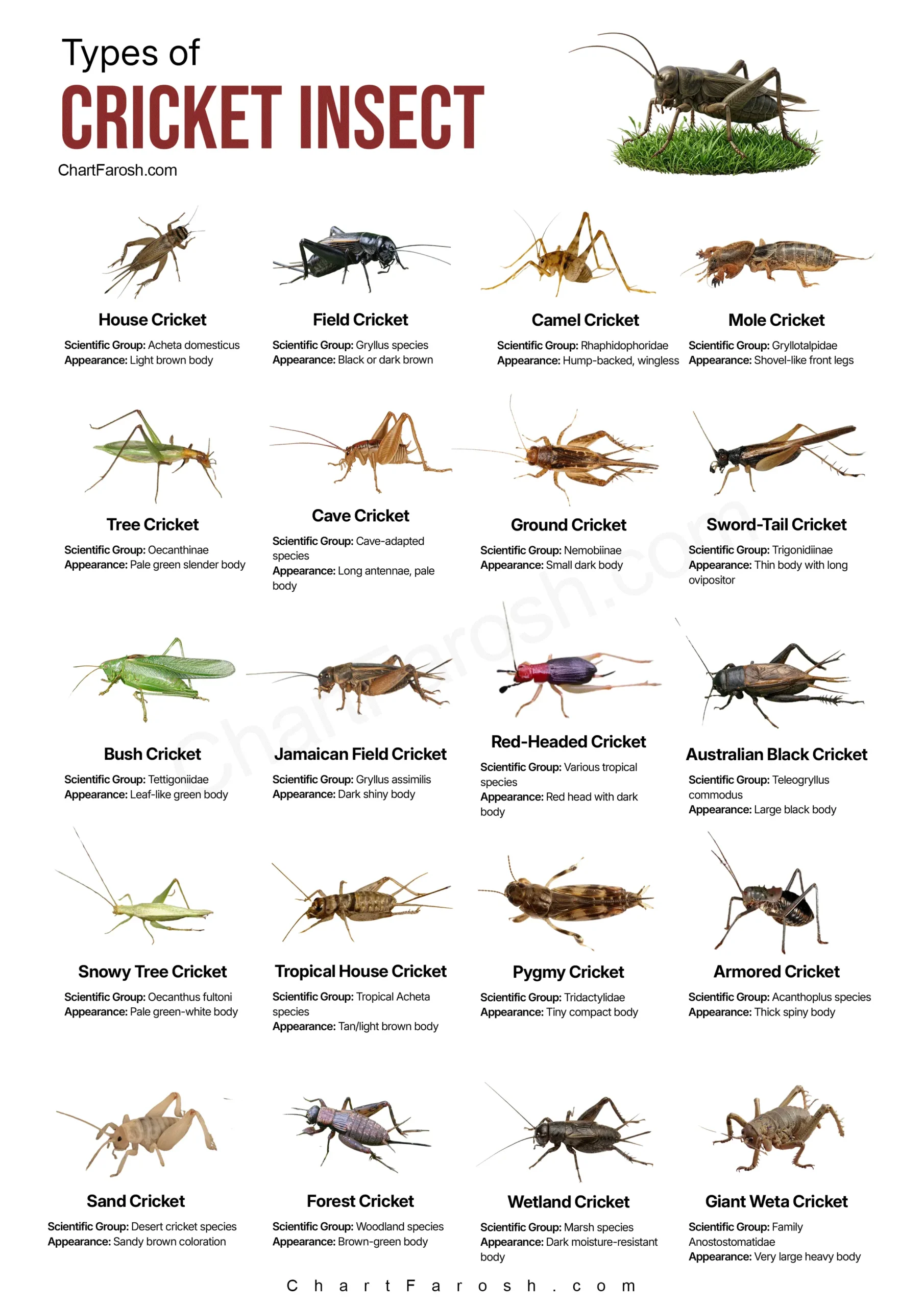
Table of Contents
Cricket identification chart
True crickets number more than nine hundred species. Dozens more insects get called crickets without earning the name. The twenty below are the ones people ask about most.
They run from the cricket chirping in your wall to the weta the size of a mouse. The chart sorts each by name, scientific group, look, home range, and the one feature that stands out.
| Type | Scientific Name / Group | Appearance | Habitat | Distinct Feature |
| House Cricket | Acheta domesticus | Light brown body | Homes, warm buildings | Common indoor cricket |
| Field Cricket | Gryllus spp. | Black or dark brown | Fields and gardens | Loud chirping |
| Camel Cricket | Rhaphidophoridae (Diestrammena) | Hump-backed, wingless | Basements, sheds | Cannot chirp, strong jumper |
| Mole Cricket | Gryllotalpidae | Shovel-like front legs | Underground soil | Expert digger |
| Tree Cricket | Oecanthinae | Pale green slender body | Trees and shrubs | Soft musical trill |
| Cave Cricket | Rhaphidophoridae (cave-dwelling) | Long antennae, pale body | Caves, damp areas | Lives deep in caves |
| Ground Cricket | Nemobiinae | Small dark body | Leaf litter and soil | High-pitched trill |
| Sword-Tail Cricket | Trigonidiinae | Thin body, long ovipositor | Grasslands, shrubs | Female has a sword-like tail |
| Bush Cricket (Katydid) | Tettigoniidae | Leaf-like green body | Bushes and forests | A katydid, not a true cricket |
| Jamaican Field Cricket | Gryllus assimilis | Dark shiny body | Tropical regions | Strong chirp, farmed as feed |
| Red-Headed Bush Cricket | Phyllopalpus pulchellus | Red head, dark body | Eastern North America | Bright red head (handsome trig) |
| Australian Black Cricket | Teleogryllus commodus | Large black body | Australia | Loud night calls |
| Snowy Tree Cricket | Oecanthus fultoni | Pale green-white body | Trees and shrubs | Chirp rate tracks temperature |
| Tropical House Cricket | Gryllodes sigillatus | Tan body, dark bands | Warm climates, homes | Fast breeding, farmed as feed |
| Pygmy Mole Cricket | Tridactylidae | Tiny compact body | Near water and mud | Grasshopper relative, not a cricket |
| Armored Cricket | Acanthoplus spp. | Thick spiny body | African grasslands | A katydid with defensive spikes |
| Sand Cricket | Sand-treaders, Schizodactylidae | Sandy brown body | Deserts and dunes | Burrows in loose sand |
| Wood Cricket | Nemobius sylvestris | Brown-green body | Forest floors | Leaf-litter dweller |
| Marsh Cricket | Pteronemobius spp. | Dark small body | Swamps and wetlands | Lives in damp ground |
| Giant Weta | Deinacrida spp. (Anostostomatidae) | Very large, heavy body | New Zealand forests | Among the heaviest insects |
One thing to notice before you read on. Not everything labeled a cricket is a true cricket. Camel crickets, bush crickets, armored crickets, and weta all sit in different families.
They earned the nickname by looking or jumping like crickets, not by being them. The next section sorts that out. To match a cricket to a photo, the bug identification chart places each one beside a clear image.
True crickets vs crickets in name only
A true cricket belongs to the family Gryllidae, part of the cricket branch of the order Orthoptera. True crickets have long thread-like antennae and flattened bodies.
The males chirp by rubbing their wings together. House crickets, field crickets, tree crickets, ground crickets, and mole crickets are all true crickets or close cricket-family relatives.
Plenty of other insects borrow the name. Camel crickets and cave crickets (family Rhaphidophoridae) are wingless and cannot chirp at all. Bush crickets are katydids (family Tettigoniidae).
They share the long antennae but sit in their own group. Armored crickets are katydids too. Weta (family Anostostomatidae) are heavy, flightless cricket cousins from New Zealand and Australia. Pygmy mole crickets are not on the cricket branch. They sit closer to grasshoppers.
As Britannica describes them, the true crickets are the chirping, wing-rubbing members of Gryllidae, and the rest are relatives that look the part.
The quickest way to place an unknown insect is to compare it against a katydid and a grasshopper.
| Feature | True Cricket | Katydid (Bush Cricket) | Grasshopper |
| Family | Gryllidae | Tettigoniidae | Acrididae (mostly) |
| Antennae | Long, thread-like | Long, thread-like | Short and stout |
| Body | Flattened, brown or black | Leaf-like, usually green | Robust, varied color |
| Makes sound by | Rubbing forewings | Rubbing forewings | Rubbing legs on wings |
| Active | Mostly at night | Mostly at night | Mostly by day |
| Female ovipositor | Needle or spear-like | Sword or blade-like | Short, often hidden |
Common true crickets
Most of the crickets you meet are true crickets in the family Gryllidae.
The house cricket (Acheta domesticus) is the pale brown cricket that gets indoors and chirps from warm corners. It is the cricket most often farmed for pet food.
The field cricket (Gryllus species) is the familiar black or dark brown cricket of lawns, fields, and doorsteps. Its loud chirp is the classic summer-night sound.
The tree cricket (subfamily Oecanthinae) is a slender, pale green cricket that sings a soft, steady trill from shrubs and trees. The snowy tree cricket (Oecanthus fultoni) takes that to a famous extreme. Its chirp rate rises and falls with the temperature. Count the chirps and you can estimate how warm it is, a rule known as Dolbear’s law.
The ground cricket (subfamily Nemobiinae) is small and dark and trills from leaf litter and soil. The wood cricket (Nemobius sylvestris) is its woodland cousin, and the marsh cricket (Pteronemobius species) is the version that lives in damp, swampy ground.
The sword-tail cricket (subfamily Trigonidiinae) is named for the long, blade-like ovipositor the female carries. The red-headed bush cricket (Phyllopalpus pulchellus), also called the handsome trig, is a striking eastern relative with a bright red head and a dark body.
The mole cricket (family Gryllotalpidae) is the oddest true cricket. It has wide, shovel-like front legs and spends its life tunneling through soil like a tiny mole.
A few field crickets are raised by the million as feeder insects. The Jamaican field cricket (Gryllus assimilis) is one. So is the tropical house cricket (Gryllodes sigillatus), the tan, dark-banded species also called the banded cricket. The Australian black cricket (Teleogryllus commodus) is the loud night-caller of southern Australia.
Cricket look-alikes: camel crickets, katydids, and weta
These insects carry the cricket name without being true crickets.
Camel crickets and cave crickets (family Rhaphidophoridae) are the hump-backed, wingless jumpers you find in basements, sheds, and caves. They have no wings and no song, so they cannot chirp.
The Missouri Department of Conservation notes that they feel their way through the dark with very long antennae. The greenhouse camel cricket (Diestrammena asynamora) comes from Asia.
It is now the most common camel cricket in eastern North American homes, a spread documented by a continental citizen-science survey. The cave cricket proper lives deeper, in true caves, pale and shaped by the dark.
Bush crickets are katydids (family Tettigoniidae). They are usually leaf-green and leaf-shaped, and while they share the cricket’s long antennae, they belong to their own family. The armored cricket (Acanthoplus species) of African grasslands is also a katydid. It is thick and spiny, and it defends itself by squirting its own blood and biting.
The sand cricket is a desert specialist. Sand-treader camel crickets and the unrelated dune crickets (family Schizodactylidae) both burrow through loose sand and match its color.
The giant weta (Deinacrida species, family Anostostomatidae) of New Zealand is the heavyweight of the group. A large female can weigh as much as a small bird. That makes the giant weta one of the heaviest insects on Earth. It is flightless, slow, and a cricket relative rather than a true cricket.
How crickets chirp
The cricket chorus comes from stridulation, not from the legs as many people think.
A male cricket has a hardened ridge on one forewing and a scraper on the other. He rubs them together, and the wings work like a tiny bow and file. The result is the chirp. Each species has its own pattern. It lets females find the right mate in the dark.
Males do the singing. Females stay quiet and home in on the call. Tree crickets and ground crickets trill steadily, while field crickets pulse in sharp chirps.
The snowy tree cricket turns its chirp into a thermometer. Count the chirps in fifteen seconds, add forty, and you land close to the temperature in degrees Fahrenheit. The cooler the night, the slower the song.
Not every cricket sings. Camel crickets and cave crickets have no sound organs at all and stay completely silent. So the next time a chirp keeps you awake, you can at least rule those out.
Crickets in the house: harm, benefits, and prevention
Crickets are harmless to people. They do not bite, carry no disease, and do no damage like termites or carpet beetles.
The two real annoyances are noise and the odd bit of fabric damage. A house cricket trapped indoors will chirp through the night. In large numbers, house crickets can chew on paper, fabric, and stored food. That is rare in a clean home.
To keep them out, seal gaps around doors, windows, and pipes. Cut the damp in basements. Reduce outdoor lighting that draws them to the walls at night.
Clearing leaf litter and clutter near the foundation removes the shelter they look for. Crickets also do good outdoors. They feed birds, lizards, and other wildlife, which is why they count among the useful beneficial insects in a garden. Most are strong jumpers and weak fliers. A flying insect identification guide helps rule them out when something buzzes past.
FAQs
How many types of crickets are there?
There are more than nine hundred species of true crickets in the family Gryllidae, plus many more insects that share the name, such as camel crickets, bush crickets, and weta. The most familiar are house crickets, field crickets, and tree crickets.
What is the difference between a cricket and a katydid?
Both have long antennae and rub their wings to sing, but they belong to different families. True crickets (Gryllidae) are usually brown or black with flattened bodies. Katydids, also called bush crickets (Tettigoniidae), are usually green and leaf-shaped.
Are camel crickets real crickets?
Not quite. Camel crickets and cave crickets belong to the family Rhaphidophoridae. They are hump-backed, wingless, and cannot chirp at all. They look like crickets and jump like them, but they sit in a separate family.
Why do crickets chirp at night?
Male crickets chirp to attract females. Most are active after dark, when it is cooler and predators are fewer. They make the sound by rubbing their wings together, not their legs.
Can you tell the temperature from a cricket’s chirp?
Yes, with the snowy tree cricket. Count its chirps over fifteen seconds and add forty for a rough temperature in degrees Fahrenheit. This pattern is known as Dolbear’s law.
Are crickets harmful?
No. Crickets do not bite people seriously, carry no disease, and do little damage. The worst they do is chirp through the night and, in large numbers, nibble on fabric or paper. For help telling insects apart, see the bug identification chart, and browse the wider Animals Chart collection for more guides.