Ladybug Lifespan Chart
People always ask me how old the ladybug on their finger is, and the answer surprises them. You cannot tell a ladybug’s age from its spots. The spots show which species it is, not how many birthdays it has had. Most ladybugs live for about a year, whatever their spot count.
It also surprises people that a ladybug is a beetle, not a true bug. The bright red dome we love is the wing case of a small predator that spent its youth hunting aphids. Lifespans run from a few months for the mildew-eaters to two or three years for the hardiest species.
This chart lists the typical and maximum lifespan of 20 ladybug species, why the spot-counting trick does not work, and how long each kind really lives. Use it for a garden project, a school report, or to settle the spot myth once and for all.

Table of Contents
Ladybug Lifespan Chart
Most ladybugs live around a year, and the hardiest reach two or three. The typical column shows the usual range from egg to adult death, and the maximum column shows the longest recorded for that species. A long, cool winter spent resting can stretch the adult stage well into a second year.
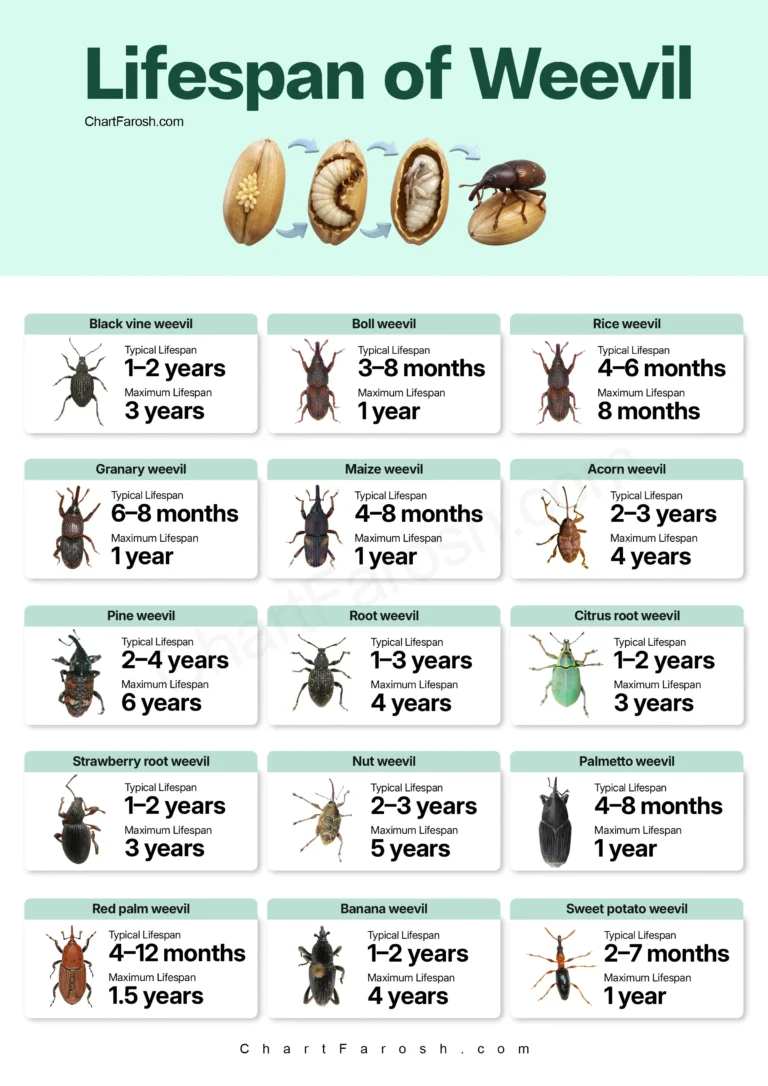
Ladybugs are beetles in the family Coccinellidae, so this chart sits alongside our wider beetle lifespan chart. The mildew-eating species at the bottom of the list, like the twenty-spotted and orange ladybirds, live the shortest lives.
| Ladybug Species | Scientific Name | Typical Lifespan | Maximum Lifespan |
| Eyed lady beetle | Anatis ocellata | 1–2 years | 3 years |
| Asian lady beetle | Harmonia axyridis | 1–2 years | 3 years |
| Seven-spot ladybird | Coccinella septempunctata | 1 year | 2 years |
| Two-spotted lady beetle | Adalia bipunctata | 1 year | 2 years |
| Convergent lady beetle | Hippodamia convergens | 1 year | 2 years |
| Pink spotted lady beetle | Coleomegilla maculata | 1 year | 2 years |
| Nine-spotted lady beetle | Coccinella novemnotata | 1 year | 2 years |
| Fourteen-spotted ladybird | Propylea quatuordecimpunctata | 1 year | 2 years |
| Thirteen-spotted lady beetle | Hippodamia tredecimpunctata | 1 year | 2 years |
| Cream-spotted lady beetle | Calvia quatuordecimguttata | 1–2 years | 2 years |
| Twice-stabbed lady beetle | Chilocorus stigma | 1–2 years | 2 years |
| Ashy gray lady beetle | Olla v-nigrum | 1–2 years | 2 years |
| Parenthesis lady beetle | Hippodamia parenthesis | 1 year | 2 years |
| Spotless lady beetle | Cycloneda sanguinea | 1–2 years | 2 years |
| Transverse lady beetle | Coccinella transversoguttata | 1 year | 2 years |
| Twenty-spotted ladybird | Psyllobora vigintimaculata | 6–12 months | 1.5 years |
| Twenty-two-spotted ladybird | Psyllobora vigintiduopunctata | 6–12 months | 1.5 years |
| Orange ladybird | Halyzia sedecimguttata | 6–12 months | 1.5 years |
| Kidney-spot ladybird | Chilocorus renipustulatus | 1 year | 1.5 years |
| Pine ladybird | Exochomus quadripustulatus | 1 year | 1.5 years |
Which Ladybugs Live the Longest?
The eyed lady beetle and the Asian lady beetle live longest, reaching up to three years. The eyed lady beetle is the largest species in this list and lives on conifers. The Asian lady beetle survives long winters by sheltering indoors. Both clear two years far more often than the smaller garden species.
Which Ladybugs Have the Shortest Lifespan?
The mildew eaters are the short-lived group, at six to twelve months. The twenty-spotted, twenty-two-spotted, and orange ladybirds feed on fungus rather than aphids, and they tend to run through their cycle faster. Even so, a year is a long life next to most of the insects in our bug lifespan chart.
Can You Tell a Ladybug’s Age by Its Spots?
No. This is one of the most common garden myths, and it is not true. The number of spots is set by the species and is fixed the moment the adult emerges from its pupa. As the US National Park Service puts it plainly, counting the spots does not tell you a ladybug’s age.
What the spots do tell you is the species. A seven-spot ladybird has seven, a two-spotted has two, and a twenty-two-spotted has twenty-two. The Forest Preserve District of Will County notes that some ladybugs have no spots at all, and others have stripes. The pattern is an identity card, not a clock.
The Ladybug Life Cycle: Egg, Larva, Pupa, Adult
Like all beetles, ladybugs go through complete metamorphosis with four stages: egg, larva, pupa, and adult. A female lays clusters of yellow eggs near a food supply, usually a colony of aphids. The larva that hatches looks nothing like the adult. It is long and spiky, a little like a tiny alligator, and it is a hungry predator from day one.
A single ladybug, larva or adult, can eat hundreds of aphids in its life. That is why gardeners welcome them, and why our beneficial insects chart features them. After feeding and molting through several stages, the larva forms a pupa and remakes itself into the spotted adult. You can compare egg clusters across species in our insect egg identification chart.
The bright color is a warning. When a ladybug is threatened, it can ooze a foul, bitter fluid from its leg joints, a trick called reflex bleeding. The red-and-black pattern tells birds to expect that bad taste and leave it alone.
Factors That Affect Ladybug Lifespan
Whether a ladybug lives a few months or a few years comes down to a handful of things.
- Species: large predators like the eyed lady beetle live longer than small mildew eaters.
- Overwintering: adults that survive winter in a resting state called diapause can push their lives into a second or third year.
- Food supply: a steady run of aphids or mildew lets a ladybug breed and live to its full potential.
- Temperature: cool conditions slow the body down and stretch the life cycle, while heat speeds it up.
- Predators and pesticides: birds, spiders, and garden sprays cut many ladybugs short despite their chemical defense.
Ladybug Lifespan and Diet by Group
Sorting the 20 species by what they eat lines up neatly with how long they live. The predators last longest, and the fungus eaters the shortest.
| Ladybug Group | Examples | What They Eat | Typical Lifespan |
| Aphid hunters | Seven-spot, two-spotted, convergent, nine-spotted | Aphids and soft pests | About 1 year |
| Large conifer species | Eyed lady beetle | Aphids on pines | 1–2 years |
| Scale specialists | Twice-stabbed, kidney-spot, pine | Scale insects | 1–2 years |
| Mildew eaters | Twenty-spotted, twenty-two-spotted, orange | Powdery mildew (fungus) | 6–12 months |
| Invasive generalist | Asian lady beetle | Aphids; enters homes | 1–2 years, up to 3 |
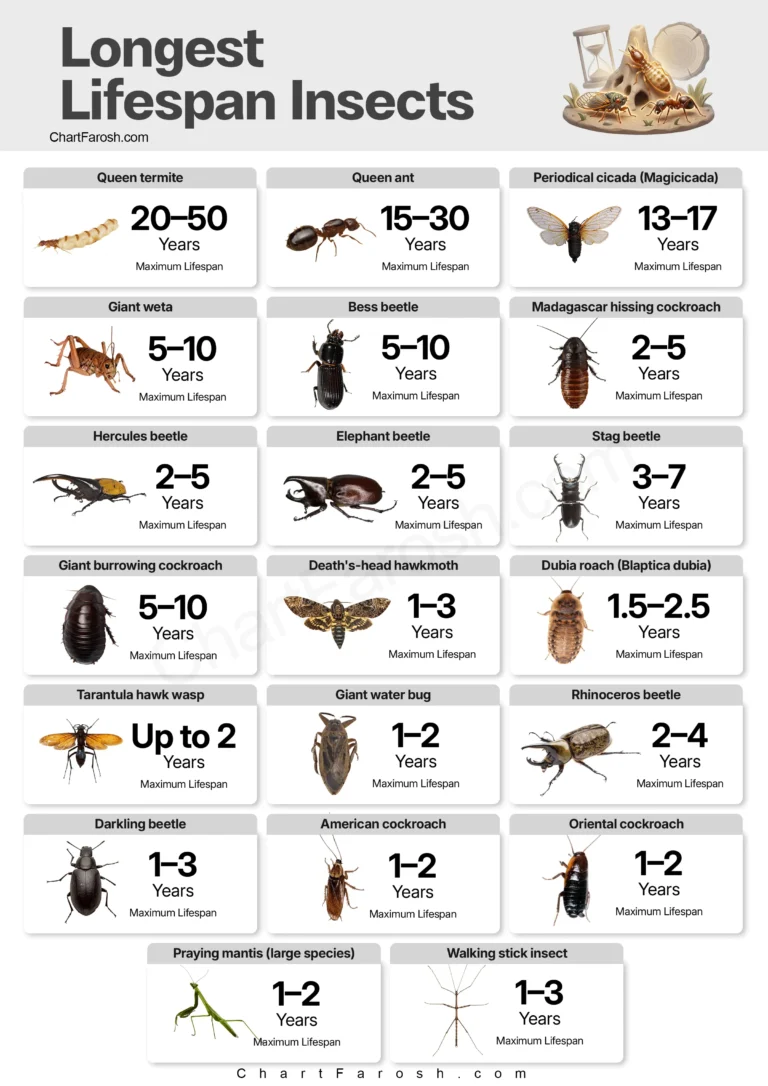
The pattern is steady across the family: a meat diet of aphids and scale tends to mean a longer life than a diet of mildew. For the other end of the lifespan scale, our cat lifespan chart shows how household pets compare.
Need a custom ladybug or insect lifespan chart for your classroom, garden centre, or science display? Our Animal Chart Designing Service builds clean, branded charts and printable PDFs to your exact spec.
FAQs
How long do ladybugs live?
Most ladybugs live about a year. The hardiest species, like the eyed and Asian lady beetles, can reach two or three years if they survive the winter.
Can you tell a ladybug’s age by its spots?
No. The number of spots is set by the species and fixed when the adult emerges. It identifies the species, not the age.
Are ladybugs insects or beetles?
Both. Ladybugs are insects, and more specifically they are beetles in the family Coccinellidae. Despite the name, a ladybug is not a true bug.
What do the spots on a ladybug mean?
The spots help identify the species. A seven-spot ladybird has seven spots, while some ladybugs have none at all or have stripes instead.
Which ladybug lives the longest?
The eyed lady beetle and the Asian lady beetle live longest, up to about three years. Most other species live one to two.
Do ladybugs hibernate?
Yes, in a way. Adults overwinter in a resting state called diapause, often clustering together in sheltered spots until spring.
Are ladybugs good for the garden?
Very. Most ladybugs are predators that eat aphids and other soft pests, so they help protect plants without any sprays.