Types of Orangutans List with Pictures
A few years ago, I was helping a friend fact-check a wildlife worksheet for kids, and one simple question stopped us both: “How many types of orangutans are there?” I answered confidently, two.
Bornean and Sumatran. That’s what I had always heard. But when we double-checked, the answer wasn’t that simple anymore. Research had changed.
A third species had been identified, and conservation numbers were shifting fast. It made me realize how easy it is to carry around outdated information, especially about animals that live far from our everyday lives.
Since then, I’ve paid closer attention to how science evolves, especially when it comes to species fighting for survival. Orangutans are one of those animals that look familiar to everyone, yet their story is more complex than most people realize.
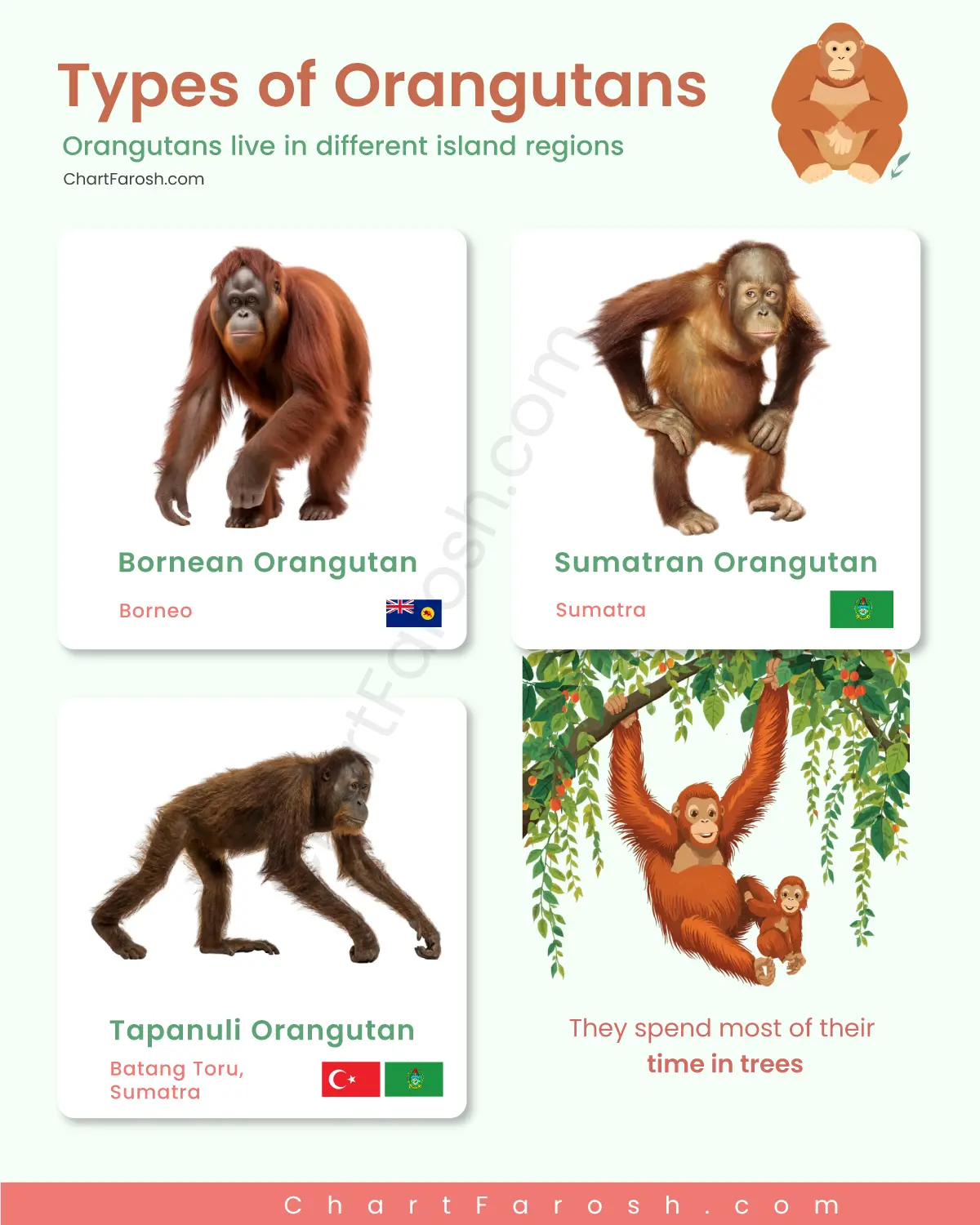
Table of Contents
Types of Orangutans
When discussing the types of orangutans, scientists now recognize three distinct species within the genus Pongo.
For many years, only two were acknowledged, but genetic research confirmed a third species in 2017. These species differ in location, physical characteristics, behavior, and population size.
All orangutans are native to Southeast Asia and are found only on the islands of Borneo and Sumatra.
Understanding the types of orangutans is essential not only for wildlife enthusiasts but also for conservation planning, as each species faces unique environmental pressures and threats.
| Orangutan Type | Scientific Name | Region | Key Feature | Conservation Status |
| Bornean Orangutan | Pongo pygmaeus | Borneo | Large body, dark reddish-brown hair | Critically Endangered ⚠️ |
| Sumatran Orangutan | Pongo abelii | Sumatra | Slimmer, longer hair | Critically Endangered ⚠️ |
| Tapanuli Orangutan | Pongo tapanuliensis | Batang Toru, Sumatra | Smallest population, unique skull | Critically Endangered ⚠️ |
Rarest Orangutan Species in the World
Among the three species, the Tapanuli orangutan is considered the rarest great ape on Earth.
Discovered as a separate species only recently, its population is critically small and restricted to a limited forest region in Sumatra.
Rarity in orangutans usually reflects habitat fragmentation and human encroachment rather than natural scarcity.
The smaller the habitat range, the more vulnerable the species becomes to environmental disruption.
Conservationists are particularly focused on these rare populations because their limited numbers make recovery extremely difficult.
| Species | Estimated Population | Location | Conservation Status |
| Tapanuli orangutan | ~800 | Batang Toru, Sumatra | Critically Endangered |
| Sumatran orangutan | ~14,000 | Northern Sumatra | Critically Endangered |
| Bornean orangutan | ~104,000 | Borneo | Critically Endangered |
| Hybrid individuals | Very rare | Captivity only | Not wild populations |
Most Endangered Orangutan Species
All types of orangutans are endangered, but the level of risk varies.
The Tapanuli orangutan faces the highest immediate threat due to its tiny population and ongoing infrastructure development within its habitat.
The Sumatran orangutan is also under intense pressure from deforestation linked to palm oil plantations.
Even the Bornean orangutan, despite having the largest population, has experienced dramatic declines in recent decades.
Endangered status is determined not just by numbers but by how quickly those numbers are falling.
| Species | Main Threats | Population Trend | Risk Level |
| Tapanuli orangutan | Hydropower projects, habitat loss | Rapid decline | Extremely High |
| Sumatran orangutan | Deforestation, agriculture | Declining | Very High |
| Bornean orangutan | Logging, fires | Declining | High |
| All species | Illegal wildlife trade | Ongoing | Severe |
Bornean vs Sumatran vs Tapanuli Orangutans
Although they share the same reddish fur and long arms, these species show noticeable differences. Bornean orangutans tend to be slightly larger and have broader faces.
Sumatran orangutans are generally more slender and spend more time in trees. Tapanuli orangutans have distinct skull shapes and unique vocalizations.
Geographic isolation played a major role in these differences. Over thousands of years, separated forest populations evolved independently, resulting in the three recognized types of orangutans we know today.
| Feature | Bornean | Sumatran | Tapanuli |
| Scientific Name | P. pygmaeus | P. abelii | P. tapanuliensis |
| Size | Largest | Slightly smaller | Smallest average |
| Habitat | Borneo | Northern Sumatra | Batang Toru |
| Population | Highest | Moderate | Lowest |
How to Identify Different Types of Orangutans
Identifying the types of orangutans requires paying attention to subtle physical and behavioral traits. Location is the biggest clue, if the orangutan is in Borneo, it’s Bornean.
If it’s in northern Sumatra, it’s either Sumatran or Tapanuli. Beyond geography, facial structure, hair texture, and social behavior offer hints.
Sumatran orangutans often appear more social and are more frequently observed in groups, while Bornean individuals are typically more solitary.
Tapanuli orangutans differ slightly in skull structure and call patterns, though these differences are harder to detect without scientific study.
| Identification Clue | Bornean | Sumatran | Tapanuli |
| Island | Borneo | Sumatra | Sumatra |
| Face Shape | Broad | Narrow | Distinct skull profile |
| Social Behavior | More solitary | Slightly more social | Limited data |
| Hair Texture | Coarser | Finer | Thick, frizzier |
Male vs Female Orangutans
Sexual dimorphism in orangutans is striking. Adult males are significantly larger and may develop large cheek pads called flanges.
These flanged males produce long calls that echo through the forest. Females are smaller, lack flanges, and are primarily responsible for raising young.
Interestingly, not all males develop flanges, some remain unflanged but can still reproduce. This dynamic creates a unique social structure compared to other great apes.
Size differences, facial structure, and vocal behavior are the clearest ways to distinguish males from females.
| Feature | Male | Female |
| Size | Larger | Smaller |
| Cheek Pads | Present (flanged males) | Absent |
| Long Calls | Yes | No |
| Role in Parenting | Limited | Primary caregiver |
Orangutans vs Other Great Apes
Orangutans differ significantly from other great apes such as chimpanzees and gorillas. Unlike African apes, orangutans are primarily arboreal, meaning they spend most of their lives in trees.
They are also more solitary, especially compared to highly social chimpanzees.
Orangutans possess remarkable problem-solving skills and tool use abilities. Their slower reproductive rate, females give birth only once every 7–9 years, makes population recovery extremely slow compared to other apes.
| Feature | Orangutans | Chimpanzees | Gorillas |
| Region | Southeast Asia | Africa | Africa |
| Social Structure | Mostly solitary | Highly social | Group-based |
| Habitat | Forest canopy | Forest/woodland | Forest |
| Reproduction Rate | Very slow | Moderate | Moderate |
FAQs
How many types of orangutans are there?
There are three recognized species: Bornean, Sumatran, and Tapanuli.
Which orangutan species is the rarest?
The Tapanuli orangutan is the rarest, with fewer than 1,000 individuals remaining.
Are all orangutans endangered?
Yes. All three species are classified as Critically Endangered.
What makes Tapanuli orangutans different?
They have unique genetic markers, distinct skull structure, and live in a very limited geographic area.
Where do orangutans live?
Orangutans are found only on the islands of Borneo and Sumatra in Southeast Asia.