Green Algae Species List Chart with Pictures
A few summers ago my garden pond turned green in a week. The water went from clear to pea soup. I had kept fish for years, but I never once thought about what turns water green. I scooped some out and held it to the light. Thin green threads hung from my fingers. That was my first real look at green algae, and it sent me reading for weeks.
I thought algae meant pond scum and nothing else. I was wrong. Green algae range from a film on a fish tank to a single cell the size of an eyeball. One kind builds white sand on tropical reefs. Another is dried into a protein powder. One ancient branch gave rise to every tree and flower on land.
Below you will find 20 green algae species, where each one lives, what it looks like, and what it is known for. Some you can only see under a microscope. Some you can hold in your hand. The chart comes first, then the detail by habitat.
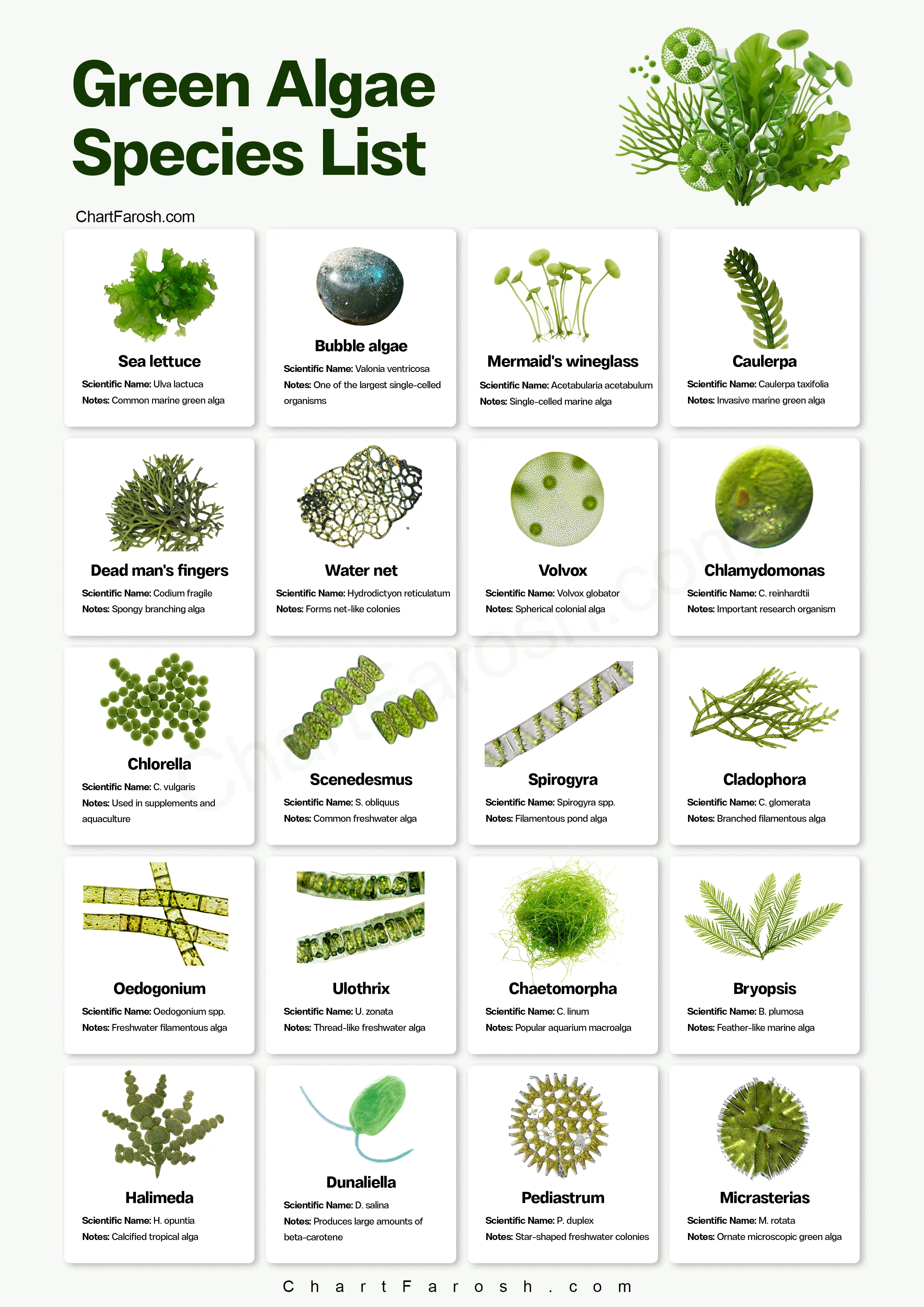
Table of Contents
Green algae identification chart
Here are the 20 green algae species side by side. Use it to match a name to a habitat and a form. The sections below sort them by habitat: marine first, then freshwater, then the microscopic kinds.
| Common name | Scientific name | Habitat | Form | Best known for |
| Sea lettuce | Ulva lactuca | Marine | Sheet seaweed | Edible bright-green sheets |
| Dead man’s fingers | Codium fragile | Marine | Spongy seaweed | Invasive oyster thief |
| Caulerpa | Caulerpa taxifolia | Marine | Siphonous | Killer alga; one giant cell |
| Bryopsis | Bryopsis plumosa | Marine | Feathery seaweed | Fine feather-like fronds |
| Chaetomorpha | Chaetomorpha linum | Marine | Coarse filament | Aquarium chaeto for tanks |
| Halimeda | Halimeda opuntia | Marine (tropical) | Calcified segments | Builds reef and beach sand |
| Bubble algae | Valonia ventricosa | Marine | Single cell | Sailor’s eyeball sphere |
| Mermaid’s wineglass | Acetabularia acetabulum | Marine | Single cell | Giant nucleus; lab classic |
| Spirogyra | Spirogyra spp. | Freshwater | Filament | Spiral chloroplasts; pond scum |
| Cladophora | Cladophora glomerata | Freshwater | Branched filament | Blanket weed mats |
| Oedogonium | Oedogonium spp. | Freshwater | Filament | Threads on water plants |
| Ulothrix | Ulothrix zonata | Freshwater | Filament | Ring-shaped chloroplast |
| Water net | Hydrodictyon reticulatum | Freshwater | Net colony | Visible net-like mesh |
| Pediastrum | Pediastrum duplex | Freshwater | Flat colony | Star or wheel-shaped plate |
| Volvox | Volvox globator | Freshwater | Hollow colony | Rolling green spheres |
| Scenedesmus | Scenedesmus obliquus | Freshwater | Small colony | Row of 4 to 8 cells |
| Chlamydomonas | C. reinhardtii | Freshwater | Single cell | Lab model organism |
| Chlorella | C. vulgaris | Freshwater | Single cell | Protein supplement powder |
| Dunaliella | D. salina | Saline lakes | Single cell | Beta-carotene; reddens water |
| Micrasterias | M. rotata | Freshwater | Single cell (desmid) | Ornate mirror-image halves |
What makes green algae green
Green algae get their color from the same pigments as a blade of grass. They carry chlorophyll a and chlorophyll b. They store their food as starch.
Their cell walls hold cellulose. In each of these traits they match land plants, and that is no accident. One branch of green algae gave rise to every plant on land. Mosses, ferns, oak trees, and meadow grass all trace back to a green alga in shallow water. You can read more on Britannica.
Scientists sort green algae into two main groups. The Chlorophyta hold more than 7,000 species and live in the sea, in fresh water, and even on snow. The Charophyta are fewer, but they are the closest relatives of land plants. The full naming list lives on AlgaeBase, the standard database for algae.
Marine green seaweeds
These are the green algae you meet at the beach. Sea lettuce (Ulva lactuca) grows in thin bright sheets two cells thick, and people eat it in salads and soups. Dead man’s fingers (Codium fragile) is a spongy, forking seaweed from Japan. It now smothers oyster beds far from home and is listed as invasive, which earned it the nickname oyster thief.
Caulerpa (Caulerpa taxifolia) looks like a small fern, yet the whole frond is one giant cell with many nuclei. An aquarium strain escaped into the Mediterranean and became the killer alga.
Bryopsis (Bryopsis plumosa) forms soft green feathers in rock pools. Chaetomorpha (Chaetomorpha linum) is the coarse green chaeto that reef keepers grow to pull waste from tank water. Halimeda (Halimeda opuntia) lays down chalk in its segments, and when it dies it crumbles into white sand on the reefs where cuttlefish hunt and sea turtles graze.
| Alga | Form | Size or scale | Habitat or use |
| Sea lettuce | Thin two-cell-thick sheets | Often 15 to 30 cm | Rocky shores; eaten in salads and soups |
| Dead man’s fingers | Spongy forking fingers | Fronds to 40 cm or more | Japan native; invasive in the Atlantic |
| Caulerpa | Feathery fronds on runners | Fronds 60 to 80 cm | Warm seas; the whole body is one cell |
| Bryopsis | Soft feather-like tufts | A few centimetres | Rock pools and reefs worldwide |
| Chaetomorpha | Tangled coarse green threads | Mats of any size | Reef tanks, soaks up excess nutrients |
| Halimeda | Chains of chalky segments | Segments under 1 cm | Tropical reefs; makes white sand |
Giant single-celled algae you can see
Most single cells are too small to see. A few green algae break that rule. Bubble algae (Valonia ventricosa) grows as a shiny green sphere up to 5 cm wide, all one cell.
Sailors called it the sailor’s eyeball. Mermaid’s wineglass (Acetabularia acetabulum) is a single cell shaped like a tiny umbrella on a stalk. Its one large nucleus made it famous in biology. Early researchers cut and grafted the cell to prove that the nucleus carries the instructions for shape. Caulerpa belongs in this club too, as the largest single cell of all.
| Alga | Form | Size or scale | Habitat or use |
| Bubble algae | One shiny green sphere | 1 to 5 cm across | Coral rubble in warm seas |
| Mermaid’s wineglass | Stalk with an umbrella cap | Up to about 10 cm tall | Shallow Mediterranean and Caribbean |
Freshwater filamentous algae
These green algae grow as threads, and they are the usual cause of pond scum and blanket weed. Spirogyra (Spirogyra spp.) is the slimy one, named for the spiral ribbon of chloroplast inside each cell. Cladophora (Cladophora glomerata) forms thick branched mats in moving water. Oedogonium (Oedogonium spp.) hangs in fine threads from water plants. Ulothrix (Ulothrix zonata) prefers cool flowing streams. You find them in the same green ponds where frogs lay their eggs.
| Alga | Form | Size or scale | Habitat or use |
| Spirogyra | Slimy unbranched threads | Long floating mats | Still ponds and ditches |
| Cladophora | Branched coarse filaments | Dense mats | Streams, lakes, and tanks |
| Oedogonium | Fine unbranched threads | Long strands | Clings to water plants |
| Ulothrix | Thread of short cells | Microscopic width | Cool running freshwater |
Freshwater colonial algae
A colony is a fixed group of cells living as one. The water net (Hydrodictyon reticulatum) builds an open mesh you can see with the naked eye. Pediastrum (Pediastrum duplex) forms flat plates shaped like stars or wheels.
Volvox (Volvox globator) rolls through the water as a hollow green ball of hundreds of cells, with baby colonies growing inside the parent. Scenedesmus (Scenedesmus obliquus) is smaller, a tidy row of four to eight cells, and one of the most common algae in any pond sample.
| Alga | Form | Size or scale | Habitat or use |
| Water net | Open mesh of linked cells | Nets up to several cm | Nutrient-rich ponds |
| Pediastrum | Flat star or wheel plate | Microscopic | Plankton of lakes and ponds |
| Volvox | Hollow rolling sphere | Up to 0.5 mm, seen as dots | Sunlit ponds and pools |
| Scenedesmus | Row of 4 to 8 cells | Microscopic | Common freshwater plankton |
Microalgae in labs and supplements
These single cells are tiny, but a few of them earn their keep. Chlamydomonas (C. reinhardtii) is a teardrop cell with two whip-like flagella, and it is one of the most studied algae in science. Chlorella (C. vulgaris) is a plain green ball packed with protein, sold as a green powder. Dunaliella (D. salina) lives in salt lakes and stores so much beta-carotene that it can turn whole ponds orange-red, which is why it is farmed for the pigment.
Micrasterias (M. rotata) is a desmid, a flat cell split into two matching halves with lacy edges. Many people think it is the prettiest cell under a microscope.
| Alga | Form | Size or scale | Habitat or use |
| Chlamydomonas | Single cell with two flagella | About 10 micrometres | Soil and fresh water; lab model |
| Chlorella | Tiny green ball | 2 to 10 micrometres | Tanks and ponds; sold as powder |
| Dunaliella | Single cell, no wall | About 10 micrometres | Salt lakes; farmed for beta-carotene |
| Micrasterias | Flat cell, two mirror halves | Microscopic | Acidic bogs and clean ponds |
Single-celled vs colonial vs filamentous vs seaweed
Green algae take only a few basic body forms. Sorting them this way makes the whole group easier to learn. A single cell lives alone. A colony is a set group of cells. A filament is a thread. A siphonous alga is one huge cell with many nuclei and no inner walls. A sheet seaweed is a flat blade you can pick up.
| Body form | What it looks like | Example genera | Where it lives |
| Single cell | One cell, often with flagella | Chlamydomonas, Chlorella, Dunaliella | Soil, fresh water, salt lakes |
| Colony | Cells grouped in a fixed shape | Volvox, Pediastrum, Scenedesmus | Ponds and lake plankton |
| Filament | Threads of cells end to end | Spirogyra, Cladophora, Oedogonium | Ponds, streams, tanks |
| Siphonous | Many nuclei, no cross-walls | Caulerpa, Bryopsis, Codium | Warm and temperate seas |
| Sheet seaweed | Flat blades you can hold | Ulva (sea lettuce) | Rocky marine shores |
FAQs
Is green algae a plant?
Not quite. Green algae sit right beside plants and share their pigments and starch storage, but most have no true roots, stems, or leaves. Land plants did evolve from one branch of green algae.
What is the largest green alga?
By single cell, Caulerpa taxifolia and bubble algae rank among the largest single-celled organisms alive. By length, seaweeds like dead man’s fingers can reach about a metre.
Is green algae harmful?
Most is harmless and useful. A few species turn invasive, such as Caulerpa and Codium, and thick pond blooms can rob the water of oxygen. The toxic blue-green blooms people fear are cyanobacteria, not true green algae.
Can you eat green algae?
Yes, several kinds. Sea lettuce goes into salads and soups across Asia and Europe. Chlorella and Dunaliella are dried and sold as supplements.
What is the difference between green algae and seaweed?
Seaweed just means a large marine alga. Green seaweeds like sea lettuce are green algae, but many seaweeds are red or brown algae instead, which are separate groups.
Where do green algae live?
Almost anywhere wet. Oceans, ponds, rivers, soil, tree bark, melting snow, and even the fur of some sloths.
Where can I learn about the animals that live among algae?
Green seaweeds shelter a lot of reef life. See the octopus guide for one clever resident, then browse the wider Animals Chart hub for more.