Types of Birds Chart with Pictures
At some point, I noticed how often birds showed up in everyday life without me really understanding them.
I could point one out on a wire, hear another outside early in the morning, or see a flock pass overhead, but naming them or explaining why they behaved a certain way felt harder than it should.
I didn’t want dramatic stories or textbook definitions. I just wanted a clear, grounded way to understand birds as living creatures shaped by size, environment, and survival needs.
Once I started grouping birds instead of memorizing names, things became easier. Patterns replaced confusion. Birds stopped feeling random and started feeling logical.
Whether it was how diet affects beak shape or why some birds migrate while others don’t, everything began to connect. That shift made birdwatching, learning, and even casual noticing far more meaningful.
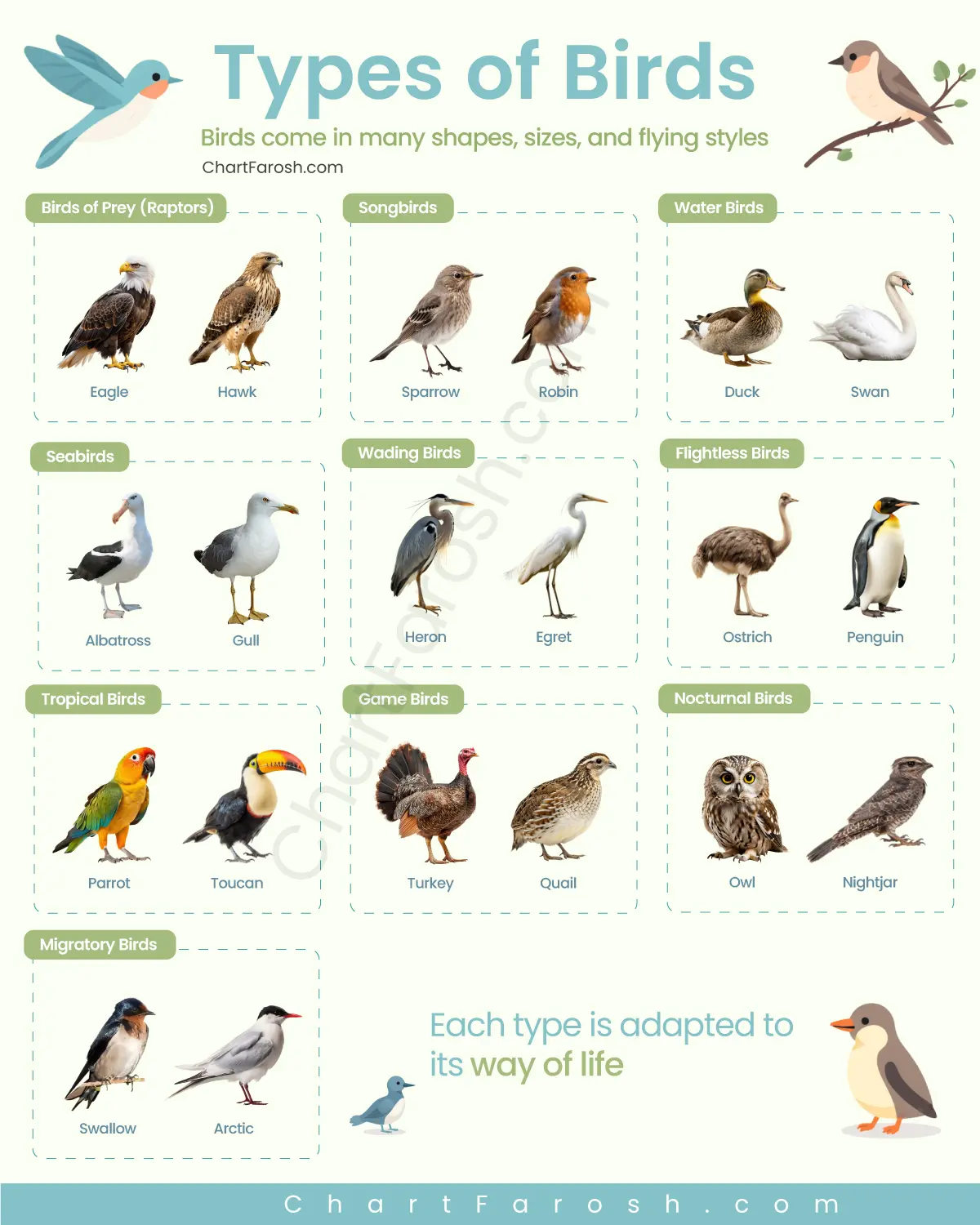
Table of Contents
Types of Birds
Birds are incredibly diverse, but they aren’t impossible to understand. Grouping them into types helps make sense of their differences without needing deep scientific knowledge.
These categories are based on shared traits like physical structure, behavior, or environment rather than complicated classifications.
When you start looking at birds this way, identification becomes more intuitive and less overwhelming.
Understanding types also helps explain why birds act the way they do. This foundation makes it easier to explore Types of Birds and their names, build a printable list of Birds, or visually compare species using a Types of Birds chart.
| Bird Type | Examples | Key Features | Habitat | Fun Fact |
| Birds of Prey (Raptors) | Eagle, Hawk, Owl | Sharp talons, hooked beaks | Mountains, forests | Exceptional eyesight |
| Songbirds | Sparrow, Robin, Finch | Vocal songs, small size | Gardens, forests | Make up most bird species |
| Water Birds | Duck, Swan, Goose | Webbed feet | Lakes, rivers | Excellent swimmers |
| Seabirds | Albatross, Gull, Puffin | Long wings, salt glands | Oceans & coasts | Can stay at sea for months |
| Wading Birds | Heron, Egret, Stork | Long legs, long necks | Wetlands | Hunt in shallow water |
| Flightless Birds | Ostrich, Penguin, Emu | Cannot fly, strong legs | Land & coastal regions | Ostrich runs faster than horses |
| Tropical Birds | Parrot, Toucan | Bright colors, curved beaks | Rainforests | Highly intelligent |
| Game Birds | Turkey, Quail, Pheasant | Heavy bodies | Grasslands | Strong ground runners |
| Nocturnal Birds | Owl, Nightjar | Active at night | Forests | Silent flight |
| Migratory Birds | Swallow, Arctic Tern | Long-distance travel | Global | Arctic tern travels pole to pole |
Types of Birds by Size
Size plays a major role in how birds live, move, and survive. Smaller birds often rely on speed, agility, and frequent feeding, while larger birds depend on strength, wingspan, or ground movement.
This difference affects everything from nesting habits to lifespan and predator avoidance. Recognizing size categories is one of the fastest ways to narrow down identification in real-life sightings.
Looking at birds by size also explains why certain species dominate open landscapes while others remain hidden in trees or shrubs. For people exploring types of Birds species, size-based grouping provides a practical starting point that works across regions and habitats.
| Size Category | Example Birds | Average Length | Notable Trait |
| Small | Hummingbird, Finch | 3–5 inches | High metabolism |
| Medium | Sparrow, Pigeon | 6–12 inches | Versatile flyers |
| Large | Eagle, Heron | 30+ inches | Powerful wings |
Types of Birds by Habitat
A bird’s habitat shapes nearly every aspect of its life. From beak design to leg length, physical traits often reflect where a bird spends most of its time.
Forest birds are adapted for climbing and camouflage, while wetland birds are built for wading or swimming. Habitat-based classification helps explain these differences clearly.
This approach is especially useful for people learning birds locally. Once you know the environment, you can predict the types of birds likely to appear there.
It’s a practical way to organize a list of Birds breeds or create region-based references without relying only on names.
| Habitat | Common Birds | Key Adaptation | Environment |
| Forest | Woodpecker, Owl | Strong claws | Dense trees |
| Wetlands | Flamingo, Stork | Long legs | Shallow water |
| Urban | Pigeon, Crow | Adaptability | Human areas |
Types of Birds by Diet
Diet is one of the clearest indicators of how a bird survives. What birds eat influences their beak shape, hunting methods, social behavior, and even intelligence.
Carnivorous birds often have sharp, hooked beaks, while seed-eaters rely on strong crushing bills. Omnivores fall somewhere in between.
Understanding diet-based groups helps connect behavior with appearance. It also makes visual identification easier when using types of Birds with pictures, since feeding posture and beak structure often stand out immediately.
| Diet Type | Example Birds | Food Source | Beak Style |
| Carnivore | Hawk, Owl | Meat | Sharp, hooked |
| Herbivore | Parrot, Goose | Seeds, plants | Strong, curved |
| Omnivore | Crow, Gull | Mixed | Flexible |
Flying Birds vs Flightless Birds
Flight defines most birds, but it isn’t universal. Some species evolved away from flying because other survival strategies worked better for their environments.
Strong legs, swimming ability, or sheer size replaced the need for flight. This contrast highlights how evolution favors efficiency over tradition.
Comparing flying and flightless birds also helps explain why birds that look similar may behave very differently. It adds depth to understanding types of Birds species beyond surface-level traits.
| Category | Example Birds | Can Fly | Main Strength |
| Flying | Falcon, Swallow | Yes | Speed |
| Flightless | Ostrich, Penguin | No | Strength/swimming |
| Limited Flight | Chicken, Turkey | Short distances | Endurance |
Largest Bird Species
Large birds stand out not just for their size but for their ecological role. Many are apex species or dominant herbivores that shape their environments.
Their physical scale affects how they move, feed, and reproduce, often limiting flight or eliminating it altogether.
Learning about the largest birds adds perspective when comparing global diversity.
These species frequently appear in educational visuals like a Types of Birds chart because size differences are easier to grasp visually than through descriptions alone.
| Bird | Height | Weight | Habitat |
| Ostrich | 9 ft | 300 lbs | Savanna |
| Emu | 6 ft | 100 lbs | Grasslands |
| Cassowary | 5 ft | 130 lbs | Rainforest |
Smallest Bird Species
Small birds survive in a completely different way. Their lives revolve around constant movement, fast feeding, and precise energy management.
Even slight environmental changes can affect them, which makes their survival strategies especially fascinating.
Despite their size, these birds play major roles in pollination and insect control. When browsing types of Birds with pictures, seeing scale comparisons often makes their adaptations more impressive than those of much larger species.
| Bird | Length | Weight | Unique Feature |
| Bee Hummingbird | 2 in | <2g | Smallest bird |
| Goldcrest | 3.5 in | 5g | High energy |
| Pardalote | 4 in | 9g | Tree dwelling |
Rarest Birds in the World
Rare birds often exist in fragile balance with their environment. Habitat loss, climate change, and human activity have pushed many species to the edge of extinction.
Learning about these birds highlights how interconnected ecosystems really are.
Many rare species don’t appear in common list of Birds breeds, which makes awareness even more important. Understanding rarity isn’t just about numbers, it’s about recognizing vulnerability.
| Bird | Location | Status | Main Threat |
| Kakapo | New Zealand | Critically Endangered | Predators |
| Philippine Eagle | Philippines | Endangered | Deforestation |
| Spoon-billed Sandpiper | Asia | Critically Endangered | Habitat loss |
Common & Popular Bird Species
Common birds are often overlooked because they’re familiar. Yet their success tells an important story about adaptability.
These species thrive alongside humans, adjusting their diets, nesting habits, and behavior to changing environments.
For beginners, these birds are usually the first step in learning Types of Birds and their names. Their visibility makes them ideal reference points for broader classification.
| Bird | Region | Known For | Habitat |
| Sparrow | Worldwide | Abundance | Urban |
| Pigeon | Cities | Navigation | Buildings |
| Parrot | Tropics | Intelligence | Forests |
Types of Birds of Prey
Birds of prey are built for efficiency and precision. Sharp vision, strong talons, and powerful flight allow them to hunt effectively. They play a critical role in maintaining population balance within ecosystems.
Studying this group helps explain predator-prey dynamics and why these birds are often protected. They’re central to many types of Birds species classifications.
| Bird | Prey | Vision | Habitat |
| Eagle | Fish, mammals | Exceptional | Mountains |
| Hawk | Rodents | Sharp | Open land |
| Owl | Small mammals | Night vision | Forests |
Types of Songbirds
Songbirds are defined less by appearance and more by sound. Their vocal abilities are used for communication, mating, and territory defense.
These songs often change by region, making them useful for local identification.
People often hear songbirds long before seeing them, which is why a printable list of Birds paired with audio references can be especially helpful.
| Bird | Song Purpose | Size | Habitat |
| Nightingale | Mating | Small | Woodlands |
| Robin | Territory | Medium | Gardens |
| Canary | Communication | Small | Forests |
Types of Water Birds
Water birds are adapted for life around lakes, rivers, and oceans. Webbed feet, waterproof feathers, and specialized bills allow them to feed and move efficiently in water environments.
Their physical differences make them easy to compare visually, which is why they’re often featured in Types of Birds chart layouts.
| Bird | Water Type | Feature | Diet |
| Duck | Freshwater | Webbed feet | Plants |
| Pelican | Coastal | Large bill | Fish |
| Swan | Lakes | Long neck | Vegetation |
Types of Tropical Birds
Tropical birds evolved in stable, resource-rich environments. This allowed for bold colors, elaborate courtship displays, and complex vocalizations.
Their appearance often reflects competition for mates rather than survival alone.
These birds dominate searches for types of Birds with pictures because visual traits are central to their identification.
| Bird | Color | Region | Trait |
| Macaw | Bright | Amazon | Strong beak |
| Toucan | Multicolor | Rainforest | Large bill |
| Bird of Paradise | Vivid | Papua | Courtship |
Types of Birds of Prey
Birds of prey are defined by their role as hunters rather than where they live. Strong talons, hooked beaks, and sharp vision allow them to locate and capture prey efficiently.
Some rely on speed and open airspace, while others depend on stealth and low-light conditions.
These differences influence when they hunt, what they eat, and how they interact with their environment.
Understanding the types of birds of prey helps explain predator-prey balance and why these species are often protected.
They are indicators of ecosystem health and play a crucial role in controlling animal populations.
| Hunting Style | Bird | Active Time | Strategy |
| Soaring | Eagle | Day | High-altitude |
| Ambush | Owl | Night | Silent attack |
| Pursuit | Falcon | Day | Speed dives |
Types of Birds in Georgia
Georgia sits at a crossroads of habitats, which makes it an important region for bird diversity.
Coastal areas, wetlands, forests, and farmland all support different species, and major migration routes pass directly through the state.
This means bird populations shift noticeably throughout the year, with some species appearing only seasonally.
Local birds adapt well to both natural and human-altered environments, making them relatively easy to observe.
Exploring the types of birds in Georgia helps connect broader bird classifications to real-world sightings, especially for people interested in regional identification and seasonal patterns.
| Bird Type | Examples | Habitat | Key Trait |
| Songbirds | Northern Cardinal, Mockingbird | Forests, suburbs | Loud, melodic calls |
| Birds of Prey | Red-tailed Hawk, Bald Eagle | Open land, lakes | Sharp eyesight |
| Woodpeckers | Pileated Woodpecker | Forests | Tree-drilling beaks |
| Water Birds | Great Blue Heron | Wetlands, rivers | Long legs for wading |
| Migratory Birds | Warblers, Swallows | Seasonal routes | Pass through in spring/fall |
Types of Birds in Canada
Birds in Canada are shaped by extremes. long winters, short breeding seasons, and vast open landscapes.
Many species rely on migration to survive, spending only part of the year in Canada before traveling thousands of miles south.
Others are specially adapted to cold climates, with thick plumage and efficient energy use.
Forests, wetlands, tundra, and coastal regions each support distinct bird communities.
Understanding the types of birds in Canada means recognizing how seasonality and geography influence behavior, timing, and survival strategies in ways that differ from more temperate regions.
| Bird Type | Examples | Habitat | Key Trait |
| Waterfowl | Canada Goose, Mallard | Lakes, ponds | Strong migrators |
| Birds of Prey | Snowy Owl, Peregrine Falcon | Tundra, cliffs | Arctic adaptation |
| Songbirds | Chickadee, Robin | Forests, towns | Seasonal singing |
| Seabirds | Puffin, Gannet | Coastal regions | Cliff nesting |
| Boreal Birds | Spruce Grouse | Northern forests | Cold-tolerant |
Types of Birds in India
India supports an extraordinary range of bird species because of its varied geography and climate.
Wetlands, forests, mountains, grasslands, and urban spaces all host different bird communities, often within short distances of each other.
Many birds in India are permanent residents, while others arrive through long migration routes that cross continents.
Cultural attitudes toward birds also play a role, as certain species are protected, celebrated, or closely observed.
Looking at the types of birds in India helps reveal how biodiversity, climate, and human presence intersect to support one of the richest bird populations on the planet.
| Bird Type | Examples | Habitat | Key Trait |
| Peafowl & Game Birds | Indian Peafowl | Forests, grasslands | National bird |
| Songbirds | Bulbul, Mynah | Urban & rural areas | Loud calls |
| Birds of Prey | Black Kite, Eagle | Open areas | Scavengers & hunters |
| Water Birds | Painted Stork, Ibis | Wetlands | Long bills |
| Tropical Birds | Parakeet, Hornbill | Forests | Bright colors |
Types of Birds in Australia
Australia’s birdlife feels different the moment you start paying attention to it.
Many species evolved in isolation, which is why so many Australian birds look, sound, and behave unlike birds found elsewhere.
From loud, highly social parrots to ground-dwelling species that barely fly, the diversity reflects the country’s extreme environments, deserts, rainforests, coastlines, and open bushland.
Seasonal changes, bushfires, and long distances between habitats also shape bird behavior here.
Understanding the types of birds in Australia isn’t just about listing species; it’s about seeing how adaptation and isolation created one of the most unique bird populations in the world.
| Bird Type | Examples | Habitat | Key Trait |
| Flightless Birds | Emu, Cassowary | Grasslands, forests | Powerful legs |
| Songbirds | Magpie, Lyrebird | Woodlands | Vocal mimicry |
| Parrots & Cockatoos | Rainbow Lorikeet | Urban & forests | Bright plumage |
| Birds of Prey | Wedge-tailed Eagle | Open land | Massive wingspan |
| Water Birds | Pelican, Black Swan | Lakes, coasts | Large bills |
Also read: Birds egg Identification Guide
FAQs
What is the easiest way to classify birds?
Grouping by size, habitat, or diet works best for beginners.
Why do some birds stop flying?
Flightlessness evolves when flying is no longer efficient for survival.
Are charts helpful for learning birds?
Yes, they simplify comparison and improve retention.
Do all birds migrate?
No, migration depends on food availability and climate.
Where can I find reliable bird information?
Field guides and region-specific resources are best.